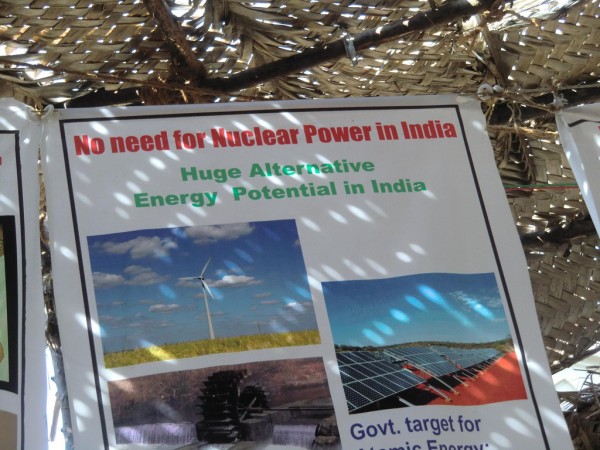
Koodankulam is an unsuitable site for setting up a nuclear plant

BY Prashant Bushan

I visited Koodankulam yesterday to meet the people fighting against the nuclear power plant to see for myself what is happening there.

It was very impressive and inspiring to see the discipline and determination of the thousands of people, particularly women and children who were sitting at the dharna site at Idinthakarai.
Continue reading ‘Koodankulam is an unsuitable site for setting up a nuclear plant’ »

Over 500 people on indefinite hunger strike since May 1st in protest against Koodankulam nuclear plant

Children protest against Koodankulam Nuclear Plant, Apr 26, 2012

By Sam Rajappa

THE manner in which the authorities have been trying to crush the agitation of the People’s Movement Against Nuclear Energy, which is no longer a mere protest against generating electricity by using nuclear energy to boil water, is shocking. It is a life-and-death struggle for the very survival of government of the people, by the people and for the people.

About 500 people, an overwhelming majority of them women, have been on an indefinite peaceful fast since 1 May at Idinthakarai, a fishing hamlet next to the Koodankulam Nuclear Power Project.
Continue reading ‘Over 500 people on indefinite hunger strike since May 1st in protest against Koodankulam nuclear plant’ »

‘Tamil Tigress’ by Niromi de Soyza: An unfolding saga describing the Best and Worst of the Tigers

By Prof. V.Suryanarayan

TAMIL TIGRESS: MY STORY AS A CHILD SOLDIER IN SRI LANKA’S BLOODY CIVIL WAR. | Niromi de Soyza (Allen and Unwin, Sydney, 2011), pp. 308, Price not mentioned.

Writing about his literary career, Robert Frost once wrote: “I have never started a poem yet whose end I know. Writing a poem is a discovery”. I was in the same predicament when I started reviewing Niromi de Soyza’s absorbing account as a Tamil Tigress.
Continue reading ‘‘Tamil Tigress’ by Niromi de Soyza: An unfolding saga describing the Best and Worst of the Tigers’ »

Curfew declared as prelude for massive police crackdown on peaceful protest against Koodankulam Nuclear plant

S.P. Udayakumar with an Associate

By Peoples Movement Against Nuclear Energy

Curfew orders have just been promulgated in our area once again right after our planning meetings with the youth, women, community elders and the Idinthakarai village committee on May 8, 2012. Thousands of police personnel are being posted in and around Koodankulam in haste.

We get reliable tips that the authorities are planning to clamp down our protest and arrest all of us, possibly tonight. Such a pre-dawn operation that the government usually does could be bloody as thousands of men, women and children from several villages are sleeping around the Church at Idinthakarai.
Continue reading ‘Curfew declared as prelude for massive police crackdown on peaceful protest against Koodankulam Nuclear plant’ »

Protesting people on hunger strike against Koodankulam Nuclear Plant: Appeal to Indian Civil Society and International Community

by S.P. Udayakumar

Let’s leave an Earth where our children and grandchildren can all play without worries.” – Yoko Kataoka, a retired baker from Japan.

The indefinite hunger strike has been going on for the past 7 days. Some 25 men have been on the fast since May 1 and 302 women and 10 more men have joined the strike on May 4, 2012.

More and more women are eager to join the indefinite hunger strike but because of logistical issues such as space, bedding and toilet facilities, we are not in a position to accommodate them all.
Continue reading ‘Protesting people on hunger strike against Koodankulam Nuclear Plant: Appeal to Indian Civil Society and International Community’ »

Kurunegala Anglican Bishop Emeritus Andrew Kumarage – An Appreciation

Cathedral Church of Christ the King, Kandy Road, Kurunegala

by Rt.Rev Kumara Illangasinghe

It was with much sadness that we learnt of the passing on of our beloved Bishop Andrew Kumarage, the Bishop Emeritus of the Diocese of Kurunagala, in the early hours of April 21, 2012. He was ailing for some time, but briefly and was a wonderful relief for some of us to know that he has ended his life on earth and being relieved from all pains, agony and suffering of this world.

Andrew Oliver Kumarage was born on January 16, 1934 as the eldest child of a family of five. The parents were devoted members of the Church of Ceylon and worked as lay ministers of the church.
Continue reading ‘Kurunegala Anglican Bishop Emeritus Andrew Kumarage – An Appreciation’ »

Tea Industry as a whole is said to be profitable while most estate operations report loss

By Dr. U. Pethiyagoda

As a sector of indisputable importance to the nation, the tea industry draws periodic comments and now seems such a time.

Court Lodge Estate, Kandapola-pic by: UKInSriLanka

The various assessments and comments are naturally, not wholly acceptable. In fact, my long held view is that the assumed profitability of the industry is spurious.
Continue reading ‘Tea Industry as a whole is said to be profitable while most estate operations report loss’ »

Immediate investigation needed for Dambulla Mosque incident

by Javid Yusuf

The incidents surrounding the Dambulla mosque and its aftermath have left the Muslim community shaken and uneasy. The Muslims have over centuries lived in harmony with their brother communities and enjoyed excellent relationships with both the Sinhala and Tamil communities.

Jummah Prayer in progress at Dambulla Masjid - pic courtesy of: twitter.com/NavamaniLK

This state of being was rudely shaken on April 20th when the Friday congregation prayers were disrupted by unruly mobs that took umbrage to the presence of the mosque which they described as being unauthorized, despite its existence without objection for over 50 years.
Continue reading ‘Immediate investigation needed for Dambulla Mosque incident’ »

Fighting Food Fascism: The Beef-eating festival at Osmania University

Meena Kandasamy

by Meena Kandasamy

“The university and all teaching systems that appear simply to disseminate knowledge are made to maintain a certain social class in power, and to exclude the instruments of power of another social class…. The real political task in a society such as ours is to criticise the workings of institutions, which appear to be both neutral and independent; to criticise and attack them in such a manner that the political violence which has always exercised itself obscurely through them will be unmasked, so that one can fight against them.” — Michel Foucault, debate with Noam Chomsky, 1971

It looks like Foucault’s “real political task” is what the organisers of the recent beef-eating festival at Osmania University set out to do: they fought the “food fascism” that kept beef out of the menu, reminded the secular state that a university hostel mess was not Sankara math, and criticised the imposition of caste-Hindu dietary diktats on Dalits from within the confines of a seemingly neutral educational institution.
Continue reading ‘Fighting Food Fascism: The Beef-eating festival at Osmania University’ »

The Koodankulam protest is to assert democracy

Dr. V. Suresh

by V. Suresh

By all accounts, the 230-day anti-Koodankulam nuclear power plant protest by villagers of Idinthakarai and Koodankulam in Tirunelveli district has been totally Gandhian.

Not a single stone has been thrown, although local people have been engaged in an intense struggle to safeguard their rights to a safe environment threatened by the nuclear power plant.
Continue reading ‘The Koodankulam protest is to assert democracy’ »

‘Disappeared’ Kumar Gunarathnam released and deported at 7:40 AM

Dimuthu Attygalle

by D.B.S. Jeyaraj

Disappeared”woman activist Dimuthu Attygalle has been “released” now at newly formed party office in Madiwela will have press conference soon

Aussie citizen Kumar Gunarathnam released due to Australian pressure. What about “Disappeared” woman activist & ex-JVP MP Dimuthu Attygalle?
Continue reading ‘‘Disappeared’ Kumar Gunarathnam released and deported at 7:40 AM’ »

Abduction of political activists Premakumar Gunaratnam and Dimuthu Attygalle

Dimuthu Attygalle

Political activists and leaders of the People’s Struggle Movement in Sri Lanka , Mr. Premakumar Gunaratnam[1] and Ms. Dimithu Attygalle[2] disappeared on 6th April 2012.

Prior to their disappearance both activists had been preparing for the first convention of the Frontline Socialist Party, a party formed by a dissident group from the opposition party, Janatha Vimukthi Peramuna (JVP – meaning People’s Liberation FRont).

FSP party members had received credible information that both activists were under intense Government surveillance, shortly before their disappearance. There is currently no information regarding their fate or whereabouts.

Premakumar Gunaratnam

Mr. Gunaratnam was a key leader of the People’s Struggle Movement (PSM) and Ms. Attygalle was the Secretary for Women’s and International affairs of the organization, which was a forerunner to the Frontline Socialist Party (FSP).
Continue reading ‘Abduction of political activists Premakumar Gunaratnam and Dimuthu Attygalle’ »

‘I Used Myanmar As An Example, Just As Others Have Used Israel And Cuba As Examples’– Amb. Dayan Jayatilleka

By Dianne Silva

Sri Lanka’s Ambassador to Paris Dr. Dayan Jayatilleka has come under scrutiny in recent days for his controversial remarks in the aftermath of the passing of the United States sponsored resolution against Sri Lanka at the United Nations Human Rights Council Sessions, last month. Certain remarks that were misconstrued as having compared Sri Lanka to Myanmar, a call for reform of Sri Lanka ’s foreign policy strategy and his unorthodox independent style of functioning have put him in the spotlight and opened his actions up for criticism.

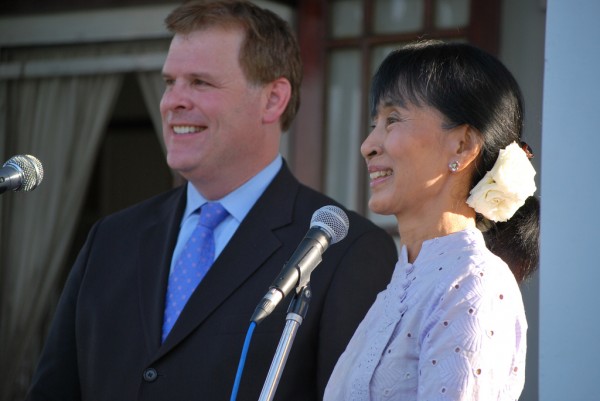
Mar 8, 2012: Minister Baird Delivers Certificate of Honorary Canadian Citizenship to Aung San Suu Kyi | Le ministre Baird remet à Aung San Suu Kyi un certificat de citoyenneté canadienne honoraire-pic: Foreign Affairs and International Trade Canada (DFAIT)

Media reports claimed that he was to be recalled on charges of mismanagement of the Embassy in Paris and that he was being targeted as a wider conspiracy to overhaul the power structure within the Ministry of External Affairs. However, later the Ministry denied the speculations of a recall.
Continue reading ‘‘I Used Myanmar As An Example, Just As Others Have Used Israel And Cuba As Examples’– Amb. Dayan Jayatilleka’ »

Text of Letter sent to Ambassador Dayan Jayatilleka by Ministry of External Affairs

Letter dated March 30th 2012 sent by Mr.W.A.S. Prasanna, Actg Director General (Overseas Administration) states thus:

“Instances of administrative and financial irregularities resulting from your administration of the Sri Lanka Embassy in Paris have come to the attention of this Ministry. In this context, while noting the following instances, explanations on the same are hereby requested:

1. Renovation of the Chancery Building
Continue reading ‘Text of Letter sent to Ambassador Dayan Jayatilleka by Ministry of External Affairs’ »

Tamil Nadu State Govt delays implementing pledge given to PNAME about releasing imprisoned protesters and withdrawing cases

Text of a press Release issued by PMANE on April 1, 2012

The People’s Movement Against Nuclear Energy (PMANE) entered into a negotiation with the Tamil Nadu State officials on March 27, 2012 with the assistance of some credible and respectable mediators.

Koodankulam: pic courtesy of: thehindubusinessline.com

As per that mediation, the Tamil Nadu State Government assured to release all the imprisoned people through due process and withdraw all the cases that have been registered against us.
Continue reading ‘Tamil Nadu State Govt delays implementing pledge given to PNAME about releasing imprisoned protesters and withdrawing cases’ »

Kolonnawa in firm grip of criminal mafia with political influence

By Chandana Kariyawasam and Wijitha Nakkawita

Kolonnawa, a suburb of Colombo, is bizarre. It came to the limelight a few months ago when one of its prominent citizens, former Member of Parliament, was killed.


View Larger Map

Though the news headlines flashed the slaying of the former MP and Presidential Advisor Bharatha Lakshman Premachandra, there were other facets of the incident that showed involvement of criminal gangs.
Continue reading ‘Kolonnawa in firm grip of criminal mafia with political influence’ »

Dismantling a dictatorship peacefully in Myanmar

By Marwaan Macan-Markar

(As Burma heads for an election on April 1st this analysis written in January is reproduced here due to its current relevance. The writer is a Sri Lankan journalist now working for IPS in Bangkok – DBSJ)

BANGKOK, Jan 23, 2012 (IPS) – As he dismantles a 50-year military dictatorship without a shot being fired, Burmese President Thein Sein is resorting to the political art of compromise.

Burma Democratic Concern ‘s Human rights day Demonstration in london 13 March 2012- pic By- Burma Democratic Concern (BDC)

The raft of reforms the former general has unveiled in less than a year has been reciprocated by Aung San Suu Kyi, the respected icon of the Southeast Asian nation’s pro–democracy movement, who has spent 15 of the past 22 years as a political prisoner.
Continue reading ‘Dismantling a dictatorship peacefully in Myanmar’ »

This is a struggle between powerful pro-mega development folks and powerless pro-sustainable development masses

by S.P. Udayakumar

Dear Friends:

Greetings! Pushparayan, the other 12 friends and I have become weaker and tired; but we are still able to sit up and talk to people. Today is the seventh day of the indefinite hunger strike.

pic by: Eunheui

Nobody from the State Government or the Central Government has bothered to come and see us or talk to us. A medical team came to check our health day before yesterday (March 23) but no public health officials came and offered any help even though some 10,000 people have been congregating here at Idinthakarai every day since March 19th.
Continue reading ‘This is a struggle between powerful pro-mega development folks and powerless pro-sustainable development masses’ »

Plight of journalists in Sri Lanka worsens after Geneva UNHRC Resolution-CPJ

By Bob Dietz

The sorry situation faced by Journalists in Sri Lanka has seemingly worsened after the US sponsored resolution was passed by 24 to 15 at the UN Human Rights Council in Geneva on March 22nd.

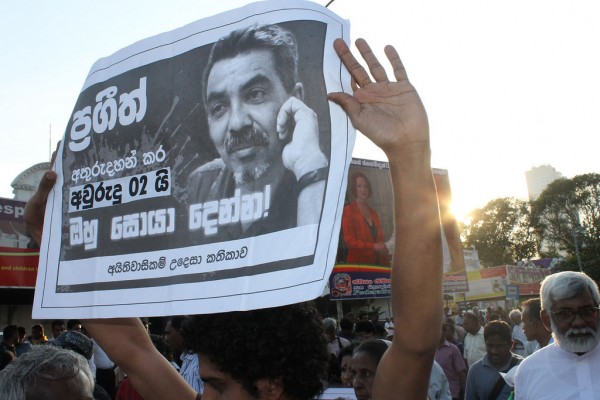
Vigil on 2nd anniversary of Prageeth Eknaligoda’s disappearance-24 Jan 2012, Pic by Sampath Samarakoon-courtesy: VikalpaSL

Bob Dietz, coordinator of Asia Program at media watchdog Committee for Protection of Journalists ( CPJ) has written three blogs on the Sri Lankan situation for the CPJ website.
Continue reading ‘Plight of journalists in Sri Lanka worsens after Geneva UNHRC Resolution-CPJ’ »

“In My Mothers House”by Sharika Thiranagama Tells Tales of Exodus and Eviction in Sri Lanka’s civil war

by Nirupama Subramanian

Key to understanding the Sri Lankan conflict, and the reasons that it remains unresolved even to this day, is an understanding of the impact of displacement

At a time the debate on Sri Lanka is focussed on the first five months of 2009 during which a yet undetermined number of Tamil civilians lost their lives in the final phases of the Army’s military push against the LTTE, an anthropological discussion of how the island’s two main minorities – Tamils and Muslims – view family, home, and homeland from the prism of their 30 year-experience of conflict might seem esoteric
Continue reading ‘“In My Mothers House”by Sharika Thiranagama Tells Tales of Exodus and Eviction in Sri Lanka’s civil war’ »

Paradise Gained and Lost: The Indo-Lanka Accord and Tamils

By D.B.S. Jeyaraj

“Nallathor Veenai Seithe – athai
Nalangkedap Puluthiyil Erivathundo?”

[ Is a good Veena (musical instrument) made and thrown into the dust to decay? ]-Subramaniya Bharathiyar

Twenty years have passed since the signing of the Indo – Lanka accord by Rajiv Gandhi and Junius Richard Jayewardena on July 29th 1987. It was hailed as a great breakthrough when it was signed. Much was expected of it then. Today it remains “valid” only on paper and seems destined for the dustbin of history unless New Delhi makes a determined effort to re-activate and enforce it vigorously.

When the accord was signed and Indian soldiers arrived in the Island as “peacekeepers” the predominantly Sinhala “South” protested vehemently. But the Tamils of the North – East welcomed the “jawans” whole- heartedly. Within months the situation reversed when the Liberation Tigers of Tamil Eelam (LTTE) took on the Indian army.
Continue reading ‘Paradise Gained and Lost: The Indo-Lanka Accord and Tamils’ »

Banda, Chelva and the Elusive Federal Idea

By D.B.S. Jeyaraj

The federal idea is not a new concept to Sri Lanka. It is however a controversial theme in the Country and is viewed on both sides of the ethnic divide with great hostility.Sri Lankan “patriots” think the introduction of federalism will ultimately lead to division of the Country.

[S.W.R.D. Bandaranaike, G.G. Ponnambalam and S.J.V. Chelvanayagam]

[S.W.R.D. Bandaranaike, G.G. Ponnambalam and
S.J.V. Chelvanayagam]

Tamil Eelam “patriots” think federalism is a ruse to weaken nationalist aspirations for a separate state. The Muslims particularly from the North – East are worried about their place in a federal situation. Against this backdrop of contending insecurities, federalism has become the “F- word” in Lankan politics.
Continue reading ‘Banda, Chelva and the Elusive Federal Idea’ »

Impact of the Federal Idea on a World Changing Fast

by D.B.S. Jeyaraj

“maybe the federal idea isn’t such a bad idea after all”– Bill Clinton (in 1999)

On September 4, 2013, President Bill Clinton gives remarks from the Clinton Presidential Center in Little Rock, Arkansas, on the critical role a high quality, affordable and accessible health care system plays in the United States-pic courtesy of:facebook.com/billclinton

On September 4, 2013, President Bill Clinton gives remarks from the Clinton Presidential Center in Little Rock, Arkansas, on the critical role a high quality, affordable and accessible health care system plays in the United States-pic courtesy of:facebook.com/billclinton

Ailing president of Cuba, Fidel Castro Ruiz, wrote recently an article responding to some observations made by US President George W Bush. In the last part of that article Fidel related an anecdote from his halcyon days of revolting against Batista. This is what it was –
Continue reading ‘Impact of the Federal Idea on a World Changing Fast’ »

Flying Tigers Elevate Conflict to New Heights

By D.B.S. Jeyaraj

They took off from unknown locations within tiger controlled territory in the northern mainland of the Wanni; they flew hundreds of kilometres over hostile territory in the darkness of night ; they flew at low altitude to avoid being spotted on radar; and swooped down suddenly from the skies above their target area; they ejected their bombs on specific targets scoring 70% strike success; they flew back, missions accomplished , as pandemonium reigned below; they returned home and landed to be swallowed up into invisibility; they wait patiently for the next chance to soar again , strike and return home safely.

These were the small aircraft belonging to the fledgling air wing of the Liberation Tigers of Tamil Eelam (LTTE) that has defied all odds by conducting three “known” sorties in five weeks. The air wing dubbed Tamil Eelam Air Force (TAF) by the LTTE has dropped bombs on specific targets in Katunayake , Palaly, Myliddy , Kolonnawa and Kerawalapitiya. The extent of damage inflicted by the TAF may be disputed but the awesome shock of it all has rocked the nation.The effect is greater than the cause!

The LTTE’s nascent air wing has actually flown four sorties so far to bomb targets. The first one was on August 11th last year when two planes flew over Palaly and dropped a few bombs. It was a flop as they were all completely off – target. The mission was part of an ambitious bid by the LTTE to paralyse Trincomalee and invade Jaffna peninsula simultaneously. That plan backfired and was aborted. The air attack also failed.

The LTTE was coy about it and did not claim it openly. The LTTE controlled media organs were made to carry a news story that Northern residents had seen two planes flying low. It was reported that rockets were fired at Palaly from the air. LTTE defence spokesman “Marshall” Ilanthiraiyan when asked about it answered indirectly saying the tigers would protect the Tamil people with all available resources on land, sea and air.

The Government of Sri Lanka (GOSL) was derisively dismissive. The GOSL said that no planes were sighted and that Palaly was targeted by LTTE artillery from Poonagary. It was as if the LTTE wanted cheap publicity about non – existent aircraft. Since the LTTE did not openly claim an air attack and did not contest the GOSL version most people believed the latter. The LTTE media had tried to pull a fast one it was felt. In retrospect the failed August air attack seems to have been an LTTE trial run.

The second air attack came this year on March 25th. Two planes flew over Katunayake and dropped three bombs each on the Air Force base. Five of them exploded. The Engineering and maintenance facility hangars were specifically targeted. Three air force personnel died and seventeen were injured. Some of the airmen were injured in the firing by colleagues who were blazing away at an enemy they thought was on surface.

The GOSL stated officially that three bombs were dropped and only two exploded. It was claimed that the damage was minimal. The elaborate air defence system was activated and the tiger planes had fled it was claimed. Inspired leaks appeared in Govt friendly media that the radars supplied by India were defective.

Interestingly enough no media persons were shown the damage or lack of damage at Katunayake. Even the SLMM was not allowed. Notwithstanding denials by Colombo informed reports in the Indian media stated that some K-firs and Mi 17 and Mi 24 helicopters were damaged. It was stated that 40 % of aircraft stationed at Katunayake were rendered dysfunctional.

These assertions were hotly denied. In order to prove such observations wrong and also as retaliatory action the tiger controlled areas were bombed ferociously for more than a week. Despite the intensity and frequency of aerial bombardment few K-firs were involved. The MIG ‘s and F – 9’s were the ones sighted by people on ground.

Sections of the media then reported that the LTTE had “night vision” but not the Sri Lankan air forc(SLAF). So the SLAF began night time bombing. Paralights were fired and in the glow bombs were dropped. Though the SLAF has been bombing the Wanni almost daily it was noted that very few K-firs were involved.

After almost a month of aerial bombardment it appeared to sections of the defence establishment that the LTTE had learnt its lesson. The tiger however crouches only to pounce. On April 24 th the TAF flew into action. This time two planes headed north dropping four bombs in the Palaly – Vasavilaan – Kadduvan areas and two in Myliddy.

Residents of Valigamam north and south living in areas around the Palaly – Kankesanthurai – Myliddy high security zone said they had heard a series of explosions. Columns of fire and smoke were visible in the night to people living in Atchuvely, Pathaimeni and Vallalaai areas.

The LTTE claimed that their planes had bombed ammunition dumps, fuel depots, food storage complexes and aircraft maintenance facilities. This was strongly denied by the Govt which said that the planes had fled when an air defence system was activated. Six soldiers were killed and around 30 were injured admitted the Govt.But this was due to a fleeing plane dropping a bomb on a bunker it was said.

Interestingly enough Colombo residents along Galle road observed an unusually high rate of ambulances plying from Ratmalana to the military and national hospitals. The GOSL which is yet to take journalists to Katunayake only seventen miles away from Colombo opted to take selected scribes two hundred and forty miles away to Jaffna by air. Three ministers were also in the contingent.

This team returned and soon the ministers and a few lap dogs were bellowing the GOSL line about the air attack. The watchdogs however remained non – committal. Jeyaraj (no relation) Fernandopulle was hilarious in a BBC interview. He said that the GOSL had conducted more than a hundred air raids while the LTTE had only done two. He also challenged the LTTE to drop bombs at daylight if they dared.

Marshall Ilanthiraiyan who had openly claimed LTTE responsibility for Katunayake attack did so in the case of Palaly – Myliddy too. He also remarked facetiously to media that the LTTE would not launch any air attack “tomorrow” because of the World cup cricket match. Sri Lanka was playing New Zealand in the semi – final on that day. Apparenly even the tigers root for our cricketers it was projected.

This was seized upon by sections of the media and soon people were waxing eloquent about how even Pirapakaran was watching the match and how Cricket was unifying the warring nation. Nothing happened during the semi – final and Sri Lanka entered the final after winning handsomely. Everything was hunky – dory and President Rajapakse went to West Indies to presumably bask in reflected cricketing glory.

But world cup cricket or not, some people had different plans. Even as Colombo and rest of the Country sat glued to their TV sets on April 28th – 29th night SLAF planes flew over the Wanni and dropped eight bombs in Viswamadhu. The bombardment ended at 1.00 am . On the same day at 1. 50 am two TAF planes dropped bombs over the Kolonnawa oil storage complex. They also bombed the LP gas facility in Kerawalapitiya at 2. 05 am.

The quantitative destruction caused by TAF was minimal but the qualitative damage was enormous. Sri Lankans were engrossed in front of their TV’s as Sanath Jayasuria and Kumar Sangakkara were batting when power went off as Colombo’s elaborate air defence system was activated.Power was restored at 3. am but a false alarm about tiger planes coming over the sea saw lights out again at 3. 15 am. This black- out lasted till 4. 00 am.The Country was wide awake and became fully aware of an “air raid” by the LTTE .

There was also panic bordering on hysteria among security personnel. Para lights were sent up and artillery fired in the air. Tracer fire lined up the sky brightly like a Guy Fawkes display. Foreign journalists who witnessed the scene have written humorously about how soldiers were firing away with their guns at non -existent planes in the sky. Several security personnel and civilians were injured in the fall – out.

Despite the boasting it became vividly clear that the security forces were totally unprepared and had no effective game plan. Many persons displayed cowardice. At Katunayake air port some security personnel locked themselves up in a pathetic display. The firing in the air for a long time after the tiger planes had flown away was nothing more than a loud joke.

The Govt as usual came out with its tale of activating defence systems and chasing the planes away. It was also said that most of the six bombs dropped had missed their targets. The ensuing fires were brought under control soon. The LTTE claimed the operation to be a great success.

The LTTE’s Ilanthiraiyan who had gone on record that they would not engage in an air attack on world cup nights had an “excuse”. He said the GOSL had bombed Viswamadhu . So the LTTE had retaliated he said. This claim by Ilanthiraiyan is not valid. The Viswamadhu bombing by SLAF was over at 1.00 am The TAF dropped bombs at Kolonnawa at 1. 50 am The tiger planes could not have scrambled that quickly and reached Colombo within 45 minutes.

This means that both the SLAF and LTTE had planned to bomb each other during the time people were watching World cup final. Even if Colombo had not bombed Viswamadhu on that night the LTTE would most probably have engaged in bombing. But the Vishwamadhu bombing provided Ilanthiraiyan with a convenient excuse as retaliatory bombing. The LTTE was only following the GOSL in this as the Govt often justifies its bombing as retaliatory or pre-emptory in nature.

The Govt resumed bombing the Wanni with fervour. Later in the week the LTTE claimed that it had shot down a Mig 27 in the skies over Iranaimadhu. There were reports in the media of seeing a smoking plane reeling in the air. The LTTE said the plane after being hit had flown out over the sea and fallen. The GOSL denied this flatly. But in what seemed a strange co-incidence the bombing of Wanni has ceased for the past four days.

The April 29th air attack by the TAF succeeded greatly in making people in the South particularly those in Colombo and suburbs realise its full implications . Though the damage was minimal the manner in which the security forces responded magnified the threat to massive proportions. It also demonstrated how ill – equipped and ill – prepared they were to tackle such a situation. The Govt’s proud boasts of activated defence systems compelling the enemy to flee rang hollow.

The Govt inspired media reports about installing radars and anti – aircraft guns in all vulnerable positions is a grandiose plan. In practical terms it is of little utility. It is a moot point as to how many places or points can be “protected” in this way. What Colombo fails to comprehend or simply tries to gloss over is the fact that the LTTE has an air capability of taking on any target in the Island. The TAF planes can fly north, south, east or west. They can drop bombs on virtually anything and need not confine themselves strictly to distinct military targets alone.

Against that backdrop the strategy to be adopted by the GOSL cannot be defensive alone. While some such preparations are necessary military analysts feel the LTTE air threat cannot be overcome that way. The logical option is to be on the offensive. Instead of being on the defensive the GOSL should go on the offensive and destroy the TAF aircraft thry say . For this the GOSL must conduct a massive ground – based drive into LTTE territory and destroy the planes is the idea suggested. Accurate bombing of planes on ground is also possible.

Theoretically the LTTE air threat can be eliminated only by going on the offensive and destroying the planes but in practical terms it is an almost impossible task. Chief among reasons for this situation is the fact that the GOSL lacks proper intelligence or information about the TAF. Whatever Colombo knows about the TAF seems to be woefully inadequate or totally erroneous.

One fact being trumpeted is that the LTTE has an air strip in Iranaimadhu. This is based on an Unmanned Aerial vehicle (UAV)spotting small planes on a makeshift air strip in Iranaimadhu. Thereafter Iranaimadhu was frequently bombed. It has been said on more than one occasion that Iranaimadhu air strip has been bombed out of sight and that LTTE air capability has been destroyed.

An interesting question that arises in this context is why the UAV’s or anyone else for that matter have failed to see any LTTE aircraft in any other place at any time. The planes have been there for nearly a decade but there is no such instance except Iranaimadhu. Was the LTTE that has been able to successfully conceal its air craft from sight slip up only in the solitary case of Iranaimadhu? Very unlikely!

The chances are that the UAV spotted planes in Iranaimadhu only because the LTTE wanted it that way. Mechanical UAV intelligence is no substitute for human intelligence. During “Operation Jayasikurui” the LTTE once set up in Mannakulam a cardboard cum hardboard structure of a camp as decoy. It was photographed aerially and the special forces launched a secret operation to surround and destroy it. It was a trap and the tigers lying in ambush made mincemeat out of the beleaguered soldiers.

Likewise there is every possibility that the LTTE cleverly set the stage for Iranaimadhu to be regarded as the LTTE air strip. The GOSL claims it has “de – commissioned” Iranaimadhu several times through intense bombardment. But still LTTE planes are taking off and landing in the Wanni without hitch. If so either Iranaimadhu must be functional or the tigers have another location or locations for aircraft take – offs and landings. In it’s the latter, Colombo has been suckered over Iranaimadhu.

Another point to be noted is about the TAF and aircraft in its possession. Had the LTTE simply bombed and kept silent there would have been no clear picture or definite proof of what actually happened or who was responsible. The LTTE however claimed credit after the March operation. Moreover in a media – friendly gesture the LTTE provided pix of the plane allegedly used and “masked” TAF personnel posing for camera with tiger supremo Velupillai Pirapakaran.

Much of the speculation and analysis about the LTTE air wing is due mainly to those tiger revelations. Various media have promptly used those pix as authentic.Again the question that arises is how does anyone know whether the pictures are true or real? Were the planes in those pix actually the ones that flew on TAF missions? Are the masked guys in the pix actually Tamil Eelam Air Force members? Would the LTTE actually fly in a “painted” plane like that? Would the LTTE expose its prized air wing cadres to the world wearing thinly veiled masks? Are plane pix of one air craft or of many intended to confuse?

Much is now being written by self – styled experts about the LTTE’s air wing. Many of these facts by learned analysts contradict each other. One says the planes were obtained from South Africa. Another says they were acquired via Australia. There is also a lot of speculation about the number and types of aircraft in LTTE possession. There is speculation about where and how the planes take off and land and which fly route they use. Despite this glut of information the stark truth is that no one really knows anything tangible.

How many aircraft does the LTTE have? what kinds are they? Where were they purchased? How were they brought into the Island? Were they assembled or simply flown in? What innovative features have been added on to the planes? Who is flying them? Who does the maintenance? Where did the pilots and technicians study and train ? Are there “kamikaze” type black air tigers? How does the LTTE conceal their air craft? Where are they kept? How do they take off and land and above all from where ?

Where did the pilots practice nocturnal , low – altitude flying? What is the LTTE’s game plan with TAF? Why did they not use aircraft earlier when hard pressed? Is the LTTE able to sustain its air capability? Can the LTTE procure aviation fuel? Can the TAF survive anti- aerial artillery and air attacks for long?

These are but some of the questions regarding the so called Tamil Eelam Air Force. Harsh reality is that in spite of a lot of information being provided by experts and analysts there is no real knowledge about anything concrete. Everything seems speculative and in some instances available information may be inaccurate. Analysis on the basis of inaccuracies can only be imperfect.

So far the LTTE has been using two small air craft for air attacks. This may lead to the impression that the tigers have only two such planes. This could be wrong. The TAF may be using different planes and possibly different personnel in each operation. There could also be a number of planes in different sizes in LTTE possession. They could be used en masse at some future stage. Suicide planes crashing on to targets also cannot be ruled out

In such a situation the GOSL does not have sufficient information to evolve a battle plan to invade the Wanni and take out TAF asircraft. Even if it does the spirited defence by the LTTE at Muhamaalai, Palamottai, Mullikulam etc suggest that penetrating the Wanni wont be a cake walk.

The other option is to bomb the planes on ground. Again for that precise information about aircraft whereabouts is needed. If they are in underground hangars powerful “bunker – buster” type bombs have to be dropped with exact precision. In the absence of such intelligence only random, haphazard bombing is possible without any idea of where intended targets are.. Much of the bombing that went on is of this type and heaps increased burdens on the helpless people.

There is also an ironic complexity in the situation. The GOSL downplays the LTTE air threat to the Sinhala people. It pooh poohs the whole thing and claims to be on top of the situation. While downsizing the threat to its domestic constituency the GOSL exaggerates it internationally. Attempts are made to depict the LTTE’s air capability as posing a serious threat to the world thereby requiring concerted action to eradicate it.

The LTTE on the other hand plays ardently to the Tamil “gallery”. The expatriate Tamil cash cows are a specific target. So too is Tamil Nadu. The tigers after suffering many reversals on ground are playing the rise of LTTE air power as their trump card in a desperate political poker game. While projecting a larger than life image of its air wing and arousing Tamil expectations the LTTE is playing it low key with the foreign countries. This downplaying is necessary to avoid unnecessary provocation of any type.

This is because the LTTE knows that arousing concern or opposition to its air wing internationally can be dangerous. In the final analysis only lack of international support stands between the LTTE and its cherished goal of Tamil Eelam. Even if support for that is not forthcoming at this juncture the tigers would at least like to prevent the global community from coming down hard on them. For this the LTTE would like to remove irritants. In the case of its air wing the LTTE cannot and will not remove that “irritant” but would like it to be as less “irritating” as possible.

The dice however is loaded against the LTTE on this. The international community (IC)will not like a “non – state actor” like the tigers to posses effective air capability. The tragedy of Sep 11th 2001 where terrorists crashed airplanes on to the twin towers has changed the western world. Any organization with terrorist credentials having air capability will not be tolerated . The LTTE having such capability is a worrisome factor.

Yet there has been no formal condemnation of the LTTE in this respect. This is due to the fact that the LTTE has succeeded so far in avoiding civilian targets and casualties. More importantly there is no valid basis to condemn one party when the other party has been brazenly violating the ceasefire and engaging in bombing sprees since April 25th 2006.

Also the GOSL bombings have resulted in a humanitarian tragedy comprising massive displacement. death and destruction. The TAF bombings are a mosquito bite in comparison. The IC is annoyed with the Rajapakse regime for its poor record in human rights and constitutional reform. It may adopt a tactical silence for now till the regime changes or changes its ways

This does not mean that the IC will veer around to the tiger camp or let the LTTE off the hook. The IC is extremely concerned about LTTE intransigence also. Its air capability is a fearsome factor particularly to India notwithstanding the LTTE’s assertions to the contrary. The more the LTTE increases its air capability the more the IC will become anxious. Already signs of an international crackdown on the LTTE are visible in France, USA and Australia. These developments are not entirely unrelated to the LTTE developing its air capability.

Therefore the euphoria amidst sections of the pro – tiger Diaspora may be pre – mature or misplaced. Talk of a shift in the power balance is both incorrect and foolish. There never can and never will be balance of power between an accredited state like Sri Lanka and an organization like the LTTE. Theories about LTTE being on par with the GOSL were figments of calculated imagination aiming to lull the tigers into a complacency and false sense of superiority. This bubble burst in the east recently. Now fresh “air” bubbles are being blown.

Until very recently the overwhelming Tamil mood was that of despondency as GOSL aircraft bombed and artillery shelled civilian areas indiscriminately. The Sinhala hawks were up beat with the expectation that the LTTE was about to be vanquished. The doves were silenced. Some sprouted hawkish feathers. With the LTTE air attacks the moods are reversing.

The Tamil diaspora is euphoric. The Sinhala diaspora is fuming. The Govt is trying to prove that TAF attacks were failures because of purported minimal damage. What Colombo misses is that the LTTE attacks cannot be measured in those terms. It goes far beyond the damage done. The attacks are symbolic and have a political dimension.

The tigers have shown that they cannot be simply written off as a military entity. They may be down but are not out. The nascent TAF shows the tigers can rise phoenix like from the ashes. What is more the tiger message to Colombo, the Tamils and the world at large is that they will continue fighting for their goal whatever the consequences. They are the defiant ones.

What cannot be denied is that the LTTE has proved once again that it is wily, resilient, innovative and capable of power projection with inadequate resources. The air tigers or TAF have demonstrated that they can accomplish missions successfully against overwhelming odds. Given the current situation of confusion and panic in the South and the security forces inability to confront a new challenge the LTTE image has transformed into gigantic “Vishwaroobha” proportions.

Unlike the SLAF the LTTE’s TAF has not targeted Sinhala civilians. No Sinhala civilian has suffered directly. Yet there is mass panic bordering on hysteria. This palpable sense of confusion and fear is contributing to loss of morale among people and security forces. This is due to GOSL propaganda building up an “invincibility” myth of armed forces due to superior air power, fire power and man power over the LTTE. This myth has been pricked at least in terms of air power.

Consequently LTTE sections of the Tamil diaspora is going ballistic. The vociferous minority hogging the megaphone is shouting about Sinhala civilians having to suffer like Tamil civilians. Two wrongs cannot make a right. No one who has seen the suffering wrought on innocent civilians by aerial attacks will want that to be inflicted on other civilians. The need of the hour is to avoid targeting civilians.

There is also an upbeat mood in the Tamil diaspora that the war is won. People wish each other about the “birth of Tamil Eelam” over air. It is as if the entire situation has transformed in the LTTE’s favour and Tamil Eelam is within sight. Memories are dangerously short. Such moods have been witnessed in 1995 when the LTTE acquired surface to air missiles and shot down planes too. Ultimately it was the LTTE that got ousted from Jaffna.

The current state of affairs cannot remain static for long. Time and again during this conflict the South has displayed panic , confusion and even cowardice when confronted with new threats and dangers. There is virtual paralysis. But after a while there is a rallying point. Thereafter the South renews itself and steels its resolve to confront and overcome challenges. Without this collective characteristic the Sinhala people would not have evolved as an independent nation. This is the lesson that history both ancient and modern teaches us.

In that context observers feel that it is but a matter of time before the South gets its act together and faces up to the LTTE air threat intelligently and courageously. If Colombo adheres to IC requests and re – formulates its military approach to that of a politico – military approach , mindful of human rights considerations and appropriate conflict resolution, norms then International support could be forthcoming in a big way.

If and when this happens the current situation could change drastically in favour of Colombo. Until then however the present situation is one where the high – flying tigers through their air capability have elevated the current conflict to new heights. (pun intended).

Yet the Tamil people must understand that TAF fireworks displays cannot by themselves restore their lost rights. The displacement of more than 160, 000 civilians in the east and the regimes project of fragmenting and Sinhalaising the East is far more dangerous. Can the TAF stop that?

What the Sinhala and Tamil people must understand is that there is no military solution.There can only be a political settlement. The Island cannot be a mono – state of the Sinhala Buddhists; there cannot be two states of Sri Lanka and Tamil Eelam either. What is required is a re- structuring of the Country on federal or quasi – federal lines. No other solution seems feasible.

T.K. Kalaa gets “Kalaimaamani” award

by D.B.S. Jeyaraj

Among those receiving the Tamil Nadu state governments “Kalaimaamani” award this year will be the singer TK Kalaa of “Thayit Sirandha Kovilum Illai” fame.Kalaa who displayed great promise when she burst on the Tamil film scene in the early seventies faded away gradually. It is to the credit of Chief minister Jayalalitha Jayaram’s administration that it has thought it fit to give due recognition to a talented singer of vast potential at this juncture.

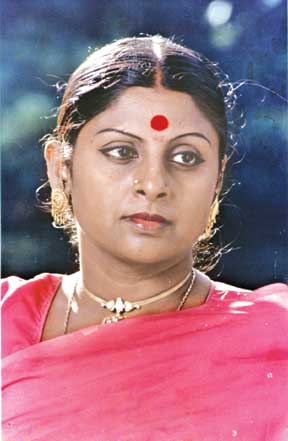
T.K. Kalaa

T.K. Kalaa

It is indeed a sign of our times that present day Tamil film song fans are fated to listen to a multiple of voices “murder” the sweet Tamil language in their renditions while many native warblers of high calibre continue to languish for want of opportunities to sing play back.Thiruthani Kabali Kalaa (TK. Kalaa) though honoured by an award is one songstress who despite her rich, uniquely harmonious voice and elegant style of singing never received the chances she fully deserved in the Tamil film song realm.
Continue reading ‘T.K. Kalaa gets “Kalaimaamani” award’ »

Why is the LTTE disappointed with Ranil Wickramasinghe?

by D.B.S. Jeyaraj

The attempt made by the Liberation Tigers of Tamil Eelam to enforce a Tamil boycott of the Presidential elections will affect Ranil Wickremasinghe as the bulk of Tamil votes was expected to be cast for him. The LTTE – TNA press conference in Kilinochchi has made it clear that the tigers are in favour of a boycott. Earlier there were confused signals to
that effect. Now it is in the open.

A striking feature in the LTTE attempt to push for a boycott is its undisguised contempt for Ranil Wickremasinghe. There is subterranean anger rippling. Indeed the whole boycott exercise in the name of the people seems to be aimed at teaching Ranil a lesson he would never ever forget. It is almost like a lover’s quarrel because in
popular perception there was a tacit alliance and understanding between Ranil and the tigers.
Continue reading ‘Why is the LTTE disappointed with Ranil Wickramasinghe?’ »

Fifteenth anniversary of the Muslim expulsion from Jaffna

by D.B.S. Jeyaraj

Fifteen years ago on this day (Oct 30th ) around 28, 000 men , women and children were expelled from Jaffna by the Liberation Tigers of Tamil Eelam organization. They were all Tamil – speaking Muslims living in the Muslim “vattaaram” or zone of Jaffna town. About 500 plus Muslims living in Chavakachcheri had been expelled about a week earlier. Around 150 other Muslims living in other parts of the peninsula were rounded up and sent away in the days that followed.Only the Muslims of Nainatheevu Island or Nagadeepa remained safe due to the Naval protection and benign presence
of the Buddhist prelate.

The expulsion of Muslims was not confined to the Jaffna peninsula alone. Muslims from the entire Northern province were expelled by the LTTE. The expulsion process on the Northern mainland began a few days before it commenced in the peninsula and concluded a few days after Jaffna was “cleansed” of Muslims. The bulk of Northern Muslims were living in Mannar comprising 26 % of the district population.

Apart from Jaffna and Mannar the Muslims of Mullaitheevu (4.9%) and Kilinochchi (1.6%) districts were sent out also.The Muslims in Vavuniya (6.9%) were luckier as most of their villages were in the Government controlled areas. Around 55 to 60,000 Muslims were expelled from the northern mainland by the LTTE. Together with those of the peninsula the Muslims driven out from the Northern Province numbered 80 to 85,000 in 1990.

The LTTE was particularly cruel in the case of Jaffna Muslims. The Jaffna Muslims were concentrated in two or three densely populated wards of the Jaffna Municipality.

Sonaka theru, Ottumadam and Bommaively etc were their areas. They were an integral part of Jaffna society. Though not on the same scale as Tamils they too had built up an educational tradition. Former civil servant and Zahira Principal AMA Azeez, Supreme Court Judge Andul Cader, Appeal Court Judge MM Jameel. Education Director Munsoor etc being some leading lights of the Jaffna Muslims. There were Municipal Councillors and one MMC Basheer was deputy – mayor and acting mayor of Jaffna.

The Jaffna Muslims like their Tamil counterparts had from time to time vacated their homes during intense shelling or bombing.They had always returned in a few days.

With the LTTE assault on the Jaffna Fort camp and stiff resistance being proffered in return, fighting escalated in September 1990. This led to many Muslims leaving Jaffna town for weeks. Many went to Mankumban islet where a Muslim sufi shrine existed.

The Jaffna Fort fell on Sep 26th and the LTTE led by Col. Bhanu took over the camp.

The heavy fighting ceased and the Jaffna people including Muslims began to return. People were picking up pieces and trying to resume normal life. Tamil – Muslim hostilities were increasing in the East. The desertion of some Muslim cadres in the LTTE and a few of them going over to the enemy incensed the Eastern LTTE under Karuna (military) and Karikalan (political). Many other Muslim cadres in the LTTE were executed by the leadership. An anti – Muslim spirit pervaded the LTTE.

On the other hand the state also exploited and aggravated these feelings. Many Muslim anti-social elements were inducted as homeguards. These sections collaborated with the security forces in promoting anti-Tamil violence. In some cases Muslim homeguards were responsible for Tamil civilian massacres. Some Tamil hamlets and villages were destroyed by Muslim homeguard led mobs. They were given covert support by sections of the security forces.

The LTTE in turn responded with equally gruesome massacres of Muslim civilians.

The Sammanthurai and Kattankudi attacks on Mosques and massacre of civilians at the Saddham Hussein model village of Eravur being notorious examples. Though Tamil-Muslim relations were at a low point in the East the situation was quite different in the North. Both communities continued to co – exist there peacefully. One reason being that Muslims were a small minority posing no threat to the Tamil majority.

This situation of Muslims living peacefully in the North while tensions prevailed in the East was unacceptable to the Eastern tigers. A delegation led by Karikalan came to the North to persuade Pirapakaran that “stern” action should be taken against Muslims. Karikalan apparently wanted a lesson to be taught to the Muslims. Even as this pressure was being exerted on the tiger hierarchy an incident occurred at Chavakachcheri.

Most of the Chavakachcheri Muslims lived on Dutch road. The LTTE while investigating an incident of intra-Muslim violence discovered some swords. According to tiger “explanations” this triggered off an alarm bell. The LTTE conducted a search of Muslim houses and businesses and found about 75 swords concealed in a Muslim shop. This was seen as part of a deadly conspiracy. Even if this explanation is true one cannot see 75 swords being of any use against the Kalashnikovs of the LTTE.

The swords were most probably kept as a precautionary measure against community oriented violence.

The shop where the swords were found belonged to a Muslim businessman whose lorries travelled to and from Colombo for trade.

The LTTE intelligence known for its excessive paranoia suspected a greater conspiracy. It was suspected that the security-intelligence apparatus could be using Muslim businessmen travelling frequently to Colombo as agents to engage in sabotage or act as spies. Preemptive action was required it was felt.

Once the Chavakachcheri Muslims were ordered to leave the chain reaction started.

The tragedy of this expulsion was that the Muslims began fleeing the areas they lived for generations on the orders of an armed movement. There was no protest, no opposition. Such was the terror and power of the LTTE. Besides the Muslims were few in numbers. Let us not forget that five years later Tamils too were forced into fleeing Jaffna in large numbers during the engineered exodus of 1995. That was perhaps the greater law of Karma or the principle of Dharma!

According to explanations provided by the LTTE later the presence of an Eastern contingent under Karikalan in the North in October was greatly responsible for the decision of mass expulsion. Essentially it was seen as some form of retaliatory warning to the eastern Muslims. This decision was further influenced by the exaggerated threat perception. In a blatantly racist mindset the Muslims were seen as potential fifth columnists. It was against this backdrop that the expelling exercise took place.

The proces began in Chavakachcheri and spread to the mainland. The Muslim people of Kilinochchi, Mullaitheevu and Mannar districts were now being driven out. Even as this terrible development was taking place the Jaffna Muslims were unperturbed. They could not see any danger befalling them. These were things happening to others for different reasons. Jaffna Muslims saw themselves as integral to Jaffna.

Nothing could happen to them from their Tamil brethren. Like some Jewish people during the Hitler era they continued with “normal” life unmindful of the brewing disaster.

It appears in retrospect that the LTTE was more harsh on Jaffna Muslims than the others. They were given an incredibly short deadline to leave Jaffna. This may have been due to the LTTE deciding that Jaffna be “cleansed” of Muslims by November. Comparatively the tigers came “last” to the Jaffna Muslims. The LTTE D-Day for them was October 30th

It was about 11.30 am in the morning that the LTTE vehicles with loudspeakers began plying the roads and lanes of the Jaffna Muslim residential areas. A terse announcement was repeated incessantly that representatives of each Muslim family should assemble at the Jinnah grounds of Osmania College by twelve noon. Armed tigers began patrolling the streets. Some began a house to house announcement in the thickly populated lanes and by – lanes.

The people abandoned whatever they were doing and hurried to the grounds. At 12. 30 pm a senior tiger leader Aanchaneyar addressed them. Aanchaneyar now goes by another name Ilamparithy. Yes! the man was none other than present Jaffna commissar Ilamparithy then in charge of Jaffna town sector politics. Aamnchaneyar or Ilamparithy had a brief message.The LTTE high command for reasons of security (Paathukaappu) had decided that all Muslims should leave Jaffna within two hours.

Failure to do so meant punishment. No further explanation was given.

When people started to question him Ilamparithy lost his cool. He barked loudly that the Muslims should simply follow orders or face consequences. He then fired his gun several times in the air. A few of his bodyguards followed suit. The message was clear.

The people thought initially that the army was going to invade Jaffna and that the LTTE was asking everyone to leave. Only belatedly did they realise that only the Muslims were ordered to leave.

With more and more armed tigers coming into the area the perturbed Muslims began packing. Initially they were not told of any restrictions on the things they could carry. So people packed clothes, valuables, jewels and money. Buses, vans and lorries were made available for transport by the tigers. Many Muslims made their private transport arrangements too.

The Muslims streaming out of their homes were now given a fresh order. They were asked to queue up at the “Ainthumuchanthi” junction. As the hapless people lined up they were in for a terrible shock. Male and female cadres of the LTTE began demanding that the Muslim people hand over all their money, belongings and jewellery to them. Each person would be allowed only 150 ruppes each. Each person would be allowed only one set of clothes.

Feeble protests were raised. The brandishing of sophisticated weapons and threats in aggressive tones quickly silenced them. The suitcases with clothes and other belongings were confiscated. They were opened first and selected clothes taken out.

If a person wore trousers an extra set of trouser and shirt was given.

If a person wore a sarong an extra sarong and shirt was given. All the money and documents including national identity cards were confiscated. Women and girls were stripped of jewels.

Some women cadres were brutal even pulling out ear studs with blood spurting in the ear lobes. The children were not spared. Not a watch was left. Jaffna Muslims reported later that Karikalan from Batticaloa was supervising the entire operation.

At least 35 wealthy Muslim businessmen were abducted. They were detained by the LTTE. Some Muslim jewellers were tortured for details of hidden gold. One jeweller was killed by the beatings in front of the others. Later huge sums of money were demanded for their release.

Some paid up to 3 million. The abducted persons were released in stages over the years. 13 people however never returned and are presumed dead.

After expelling the Jaffna Muslims the LTTE cordoned off the area with ropes. The “Virakesari” of Nov 2nd 1990 reported that this was done to protect the property till the Muslims returned. Some of the dazed Muslims too thought that their expulsion was only temporary. It took months for them to understand the true state of affairs. As time went on some of the once rich now pauperised Muslims found themselves unable to adjust to the new situation. They have declined greatly.

Some others who were financially unsound earlier coped with the changed situation better. Many have bettered their prospects amid changed circumstances. Quite a lot of Jaffna Muslims went abroad as refugees.

Most of the Muslims expelled from the North were temporarily re- settled in the Puttalam district. Many found their way to Vavuniya, Negombo and Colombo. Others relocated to the Anuradhapura, Kurunegala, Gampaha , Matale and Kandy districts.

The largest concentrations of displaced Muslims from the northern mainland are in Kalpitiya and Pulichakulam areas. The largest concentration of displaced Jaffna peninsula Muslims are in the Thillaiyaddy area of Puttalam.

The Premadasa regime in 1990 was unable to provide protection for these expelled Muslims. They were also not re-settled properly for years. It was only in 1994 when the Sri Lanka Muslim Congress joined the Chandrika Kumaratunga government and its leader MHM Ashraff became Rehabilitation Minister that the situation began to improve.

Though some Muslims continue to languish in refugee camps large numbers have moved out and settled down in new habitats. Ashraffs scheme of distributing lands in Puttalam district has enabled many to put down roots in the district.

Meanwhile the LTTE looted almost all possessions left in the Muslim houses. Many houses were stripped of tiles, wooden frames, doors, windows, etc. Much of the looted furniture was sold to Tamils through the LTTE Shops or “Makkal Kadai”. Some Muslims returning to the North after the ceasefire recognized their possessions in other houses and businesses. Many Muslim houses and vehicles were sold illegally to Tamils by the LTTE.

The LTTE received negative publicity through this terrible act of mass expulsion.

Ideologue Anton Balasingham was to admit later that a blunder had been made. Yet there has been no formal aplogy by the LTTE.

Balasingham also said that tiger supremo Pirapakaran regrets the expulsion. But Pirapakaran has been conspicuously silent on the subject so far.

The ceasefire of Feb 23rd 2002 gave the isplaced Muslims an opportunity to visit Jaffna again. They were aghast at what they saw.

In the case of many there was happy reunion with Tamil friends. As in the case of the silent majority of the Sinhalese who were helpless to stop the 1983 anti-Tamil violence most Tamils in Jaffna were powerless to stop the Muslim expulsion too.

There has been a stream of Muslims travelling to and from Jaffna after the ceasefire.

Some families have returned and the re-opened Osmaniya College now has 60 students on roll. Two Mosques are functioning again. According to a Jaffna Muslim source there is a floating population of about 2000 Muslims in Jaffna at any given time. Around 1500 are Jaffna Muslims while the rest are Muslim traders from other areas. About 10 Muslim shops are functioning.

There was a time when the Jaffna new market built by Mayor Alfred Duraiappah was virtually dominated by Muslims. Two of the three blocks were monopolised by Muslims.

The hardware, lorry transport, jewellery and meat trades were dominated by Muslims.

That era is now over. Ilamparithy addressed some Muslim businessmen after their return and instructed them to avoid certain businesses. The Muslims are being taxed along with the others. No tax concession is given them to help start a fresh life. Not one cent has been paid as compensation by the LTTE. Ilamparithy did not utter even one word of regret or explanation for the mass expulsion and misappropriation of
property.

Under these circumstances many Jaffna Muslims feel insecure. The prospect of another war is not ruled out. They know that they will be victims again at a time of war.

The LTTE has not shown any sign of a reformed attitude. The tiger taxation system inhibits all free enterprise. The paranoid security consciousness prevails still.

Besides many Jaffna Muslims have bettered their prospects elsewhere.

Despite the initial hardship many have improved their lot and are better off than their earlier position in Jaffna/ A new generation of children and young adults have no nostalgia for Jaffna and prefer to stay where they are now. Indeed many families have visited Jaffna during the past three years to make an appraisal. The majority have decided not to go back to Jaffna. Incidentally no Jaffna Muslim lives in refugee camp. This is not so in the case of Northern mainland Muslim refugees.

Under these circumstances many Jaffna Muslims are returning quietly to Jaffna and are selling off their property. The ceasefire is facilitating this process. In this they are like many Jaffna Tamils who have also sold their property. Tamil expatriates may shout for Eelam but have sold property in Jaffna. They and their children enjoy a short stay in the “motherland” but prefer to return “home” elsewhere than stay permanently in the tiger ruled Tamil land. Likewise Jaffna Muslims too prefer not to return to Jaffna.

As a Jaffna Muslim said “Earlier we were fishing in a puddle. Now we are fishing in an ocean. We dont want to go back”.

This Jaffna Muslim state of mind is not univrsally applicable. Also many Northern mainland Muslims are still languishing. They would like to go back. The situation however is not conducive yet. Displaced Muslims of the North have declared a “week of mourning” to denote the fifteenth anniversary of mass expulsion. A protest demonstration is scheduled in Puttalam on Oct 30th. A mass petition with 100,000 signatures urging speedy resettlement is to be sent to Kumaratunga and the UN.

One of the greatest attributes of some expelled Muslims that I have come across is their lack of visible bitterness with Tamils. They realise that it was the LTTE that was responsible for their predicament and the reasons for it. They do not blame the ordinary Tamil for it. They also retain sympathy for the Tamil plight at the hands of both the state and the LTTE. Above all their fondness for the Tamil language, its literature and media have not decreased. Furthermore they are wistfully nostalgic about Jaffna asserting proudly that the North is their homeland too.

This magnanimity in spite of the injustice meted out to them shames the Tamil community at large. Except for a few voices there has been no powerful outcry against the LTTE for perpetrating this atrocity against the Muslims. A greater and vigorous demand has to be made by the Tamils that all expelled Muslims be resettled in their former homes with full compensation and restoration of property. Above all a sincere and humble mass apology should be extended towards the Muslims for the mass expulsion fifteen years ago by the LTTE.

Muslims must be given rightful place at talks

“There is a misperception that this conflict merely involves two ethnic communities – the Tamil people and the Sinhala people. While it may be possible to look at the CFA in that light because the CFA involves a cessation of hostilities between an armed Tamil group and the government of Sri Lanka, the CFA does nothing to solve the problems of the Muslim people. These problems can only be resolved by adopting a political approach that goes beyond the CFA and in that process it is very necessary, indeed indispensable, that the voice of the Muslim people be heard…….It is imperative that the voice of the Muslim community should be heard on behalf of their displaced people at the negotiating table itself”. – Lakshman Kadirgamar in Parliament on October 21, 2003

By D. B. S. Jeyaraj

Chandrika Bandaranaike Kumaratunga deserves to be congratulated for initiating steps to revive the defunct peace process. Instead of being constrained by her earlier stance of displaying hostility towards the Liberation Tigers of Tamil Eelam (LTTE) she has extended the olive branch to the Tigers.

Whatever her hidden agenda may be the act of trying to talk to the LTTE again is by itself commendable because of the harsh reality that lasting peace would not be possible without Tiger consent.

Chandrika’s U turn

As stated in these columns earlier, Kumaratunga is performing a remarkable U turn now as earlier and she and her party along with the new ally had all been unequivocally critical of several aspects of the Oslo brokered peace process .

Despite facing the polls on a platform criticising the process she now seems to be following in the footsteps of Former Prime Minister Ranil Wickremesinghe thereby implying that the United National Front (UNF) had done nothing wrong in pursuing peace with the LTTE.

Unfortunately Kumaratunga in her burning desire to establish rapport with the LTTE and get the peace process going smoothly seems prepared to sideline or ignore other claims capable of affecting or retarding this objective.

However, just as these other claims may be, they are all of no consequence at present as far as Kumaratunga is concerned because her paramount goal is to curry favour with the Tigers and resume talks as soon as possible.

A major casualty in this respect is the just and legitimate claim of the Sri Lankan Muslim community that it should be represented at the talks along with representatives of the Sinhala and Tamil communities.

Due to practical necessity the government does not seem keen in accommodating the Muslims at the talks during this juncture because the LTTE is opposed to it. This is nothing but crass opportunism as this government during its opposition phase had been severely critical of the UNF for not making the talks tripartite.

The LTTE continues to remain rigid on the question of including a separate Muslim delegation at the talks as a third party. The statement issued by United People’s Freedom Alliance (UPFA) General Secretary Susil Premjayanth endorses this stand implicitly.

The LTTE does not deny that the Muslims have particular problems needing resolution but are reluctant to award third party status at the talks at this point of time.

There is a feeling shared by several Tamils that the Muslims need not be given representation at the talks because the community did not “fight for its rights against Sinhala might” like the Tamils.

The Muslims are perceived as the ‘third party’ that chose to throw in its lot with the Sinhala rulers of the day instead of joining hands with their Tamil speaking brethren and fight for their rights.

The Muslims are being depicted as ‘cats on the wall’ now jumping into the fray and demanding their fair share without sacrificing anything in the struggle.

The Muslim leaders have not made things easier by their disunity and unrealistic, ill expressed sentiments.

The Muslims are yet to forge a common front and articulate their aspirations in concrete form. Many engage in provocative utterances against the Tamil people in their anger towards the Tigers.

No Muslim leader in recent times has expressed support for any legitimate demand proposed by the Tamils. Instead some only parrot the cry that the Muslims should be given whatever that is given to the Tamils. Others make threats that the Muslims will sabotage Tamil aspirations.

All this increases Tamil trepidation that the Muslims will be used as an undermining factor by the Sinhala power structure. The fear that Muslims as a third party in the talks will side with the Sinhalese to the detriment of the Tamils is one reason for Tamil reluctance in accommodating Muslims.

Added to these general Tamil doubts is the particular Tiger trait of hogging all power for themselves. The LTTE does not want any other Tamil party at the talks. They do not want to share the limelight with even their parliamentary slaves the Tamil National Alliance (TNA). So the Muslims come further down in LTTE pecking (or chewing) order.

Compounding matters further is the systematic propaganda by interested parties among Tamils that only the Tamils suffered in the ethnic strife at the hands of the Sinhala state and that the Muslims were spared suffering. Furthermore, the action of some Muslim homeguards and criminal mobs in attacking Tamils in collaboration with the security forces is highlighted. So Muslims need not participate in talks as they are not affected goes this line of thought.

Muslims indeed suffered

The truth however is that Muslims of the north – east have indeed suffered. By a tragic irony they suffered more at the hands of their Tamil speaking brethren. The mass expulsion of Muslims from the north and all their possessions being seized is a human tragedy.

The gunning down of Muslims while praying at the mosques of Kattankudi and Sammanthurai are terribe crimes against humanity; the massacre of innocents in places like Eravur, Alinchipattanai and Muthukkal etc. are horrors indeed.

The continuous abduction and taxation of eastern Muslims, the protracted yet regular killings of Muslims, the seizure of lands and livestock, restrictions imposed on trade and fishing, the engineered ‘riots’ etc. are all proof of Muslim suffering at the hands of the LTTE and by extension the Tamils.

Moreover, there is a fundamental difference between the LTTE perspective of the ethnic problem and other parties notably the Sinhala and Muslim parties. The LTTE sees the crisis as one between two nations namely “Sinhala” Sri Lanka and “Tamil” Eelam. The problem can only be resolved on that basis. Many Tamils subscribe to this viewpoint and not everyone is a Tiger.

The other position is that Sri Lanka belongs to all its people and that the north-east is only the area of historic habitation of the Tamil people. If the Sinhala hegemonists claim Sri Lanka is the exclusive preserve of the Sinhala Buddhist people the Tamil ultranationalists want it to be divided in two. The third and appropriate option is to recognise this country for what it is exactly and treat it as such – a truly multi-ethnic, multi-religious country.

Since the LTTE subscribes to the two nation theory there is no space in its vision for tripartite talks. If Muslims want to be included they can attend as part of the government delegation as Rauf Hakeem did in the UNF-LTTE talks. Later a separate Muslim delegation can be included when the particular problems of north-eastern Muslims are discussed.

The LTTE in its proposal for an interim administrative council for the north-eastern Province says nothing explicitly about rights of the Muslims. There is an ambiguous clause about negotiations with Muslim representatives and the LTTE. Presumably both parties will be discussing matters of concern to the Muslims at some point of time.

A press conference was held in Kilinochchi on May 11 after Norwegian Foreign Minister, Jan Petersen met LTTE leader Velupillai Pirapaharan. Tiger political adviser and chief negotiator, Anton Balasingham conducted it. One question asked of him was about Muslim participation in talks.

Balasingham replied that there were several matters needing finalisation regarding direct talks between the government and the LTTE. Therefore, it was not practical for Muslims to be included as a separate entity at the talks now. Later when problems affecting Muslims are discussed they could be accommodated as a third party.

Thus the LTTE is following its earlier line. It does not deny the Muslims a place at the negotiating table but says the time is not ripe. The LTTE will keep the talks bilateral as long as possible as there is lurking suspicion that people like Ferial Ashraff and A.H.M. Athaullah will be pliable tools of their Sinhala bosses in thwarting Tamil aspirations.

The Kumaratunga government like that of its predecessor has taken the path of least resistance. Using the Tiger stance as a convenient excuse the UPFA too does not want to include the Muslims at the talks now. The statement issued by Premjayanth tries to cite precedent in justifying the position that only the LTTE and UPFA will be represented at the talks.

Kumaratunga’s chief focus at present is to ingratiate herself with the LTTE and get the talks started. So even Kadirgamar – Bala Annai’s bete noir – will be excluded from the talks for fear of irritating the Tigers. Fat chance then for the Muslims to be included right now.

So the very same People’s Alliance that criticised Wickremesinghe severely for omitting Muslim representation at the earlier talks is now going to emulate the UNF in its new avatar as UPFA. The very same Ferial Ashraff and Athaullah who were critical of Hakeem for not pushing Muslim claims for separate representation will now keep quiet as they are part of the government.

The Muslim Congress now in the opposition is better positioned to take on the government for excluding the Muslims. There was a time when Rauf Hakeem boasted that no government could be made or unmade without SLMC help. The present government lacking a viable majority is already in the saddle.

Two conditions

Efforts however are on to woo the Muslim Congress. Hakeem told the Navamani a Tamil journal specialising in Muslim affairs that 10 ‘posts’ had been offered to the SLMC if it joined the government. The SLMC politburo after prolonged discussions on May 10 decided that it would support the government on two conditions namely abandoning the constituent assembly proposal and ensuring separate Muslim participation at the peace talks.

The response of Kumaratunga towards the SLMC offer is yet to be seen. However attractive the offer is the government will be wary in accepting it if the separate Muslim delegation demand is non – negotiable. Her priority is to keep the Tigers happy and keep the talks going. Hakeem agreeing to defer the demand for a while may be welcome.

In any event Kumaratunga is very likely to get 10 Up Country Tamil seats (CWC -8;UCPF -2) directly in her fold very soon. Also if talks get going with the LTTE there is also the prospect of 22 TNA parliamentarians supporting her and at the very least not opposing her. So SLMC support, though welcome may not be that important if the arrangement upsets the LTTE.

While Kumaratunga’s practical difficulties in accommodating a Muslim delegation is understandable her attitude however cannot be condoned. Expediency at the cost of principle is not acceptable under any circumstance. As Executive President she has to hold the scales evenly among all communities. Moreover a large number of north – eastern Muslims voted for her party despite the JVP link because they expected a fair deal from her.

The simple truth

Whatever the LTTE may say the simple truth is that there is no valid reason whatsoever for excluding a separate Muslim delegation to the talks at any point of time. The Muslims are the third largest ethnicity in the island and the second largest community in the north – east. The north – east is the traditional homeland of the Muslims too. Besides recent demographic changes have made Muslims the single largest entity in the east.

The argument that the Muslims could be included at the appropriate time when issues affecting them are discussed is not valid. The Interim Self – Governing Authority (ISGA) proposal of the LTTE is not a simple idea to be disposed of quickly. It requires much discussion and would need intense negotiations that constitutional reform talks will take.

The Muslims cannot be relegated to a ‘second eleven’ role in this. Also one cannot see how the Muslims can be excluded from discussions on issues not affecting them as opposed to being included in discussions on matters affecting them. The Muslims are 37% of the east and 18% of the eorth-east. They are or were (before expulsion) living in every district of the N-E. They are the majority in two districts.

The Muslims have an inalienable right to participate in any meaningful discussions aimed at determining the future of Sri Lanka in general and the north-east in particular. So, be it the composition, structure, powers, functions etc. of the proposed ISGA, the Muslim representatives have to be involved in each aspect because every issue affects them.

Apart from direct military matters concerning the government and LTTE all other issues involve Muslims too. If negotiations without Tamil representatives is like staging the Ramayana without Rama then talks without Muslim representatives is like the same epic without Lakshmana. Neither the government nor the Tigers are granting any concession to the Muslims. They simply have to recognise Muslim rights and not seek to suppress them.

The LTTE is adopting double standards when it says on the one hand that talks should resume on the basis where it ended last year and say on the other that Muslims can be included only when matters progress and during finalisation.

If things are to begin from the point where it ended last year then the Muslims have to be included as the decision had already been made. If the Muslims are to be kept out on the premise that everything is beginning anew then even discussions on the ISGA cannot take place.

The demand for Muslim inclusion at the talks is not a fresh demand. It is an old one. More importantly it is one that had gained acceptance from all parties concerned. The LTTE, UNF, Norway, international community etc. have all agreed on the matter. Let us refresh our memory on this issue.

A debate

A debate was held in parliament on the initiative of the north – eastern Muslim Parliamentary forum on October 21, 2003. Rauf Hakeem tabling the motion outlined clearly the prevailing consensus on the issue. This is what Hakeem said then.

“Whereas the leaders of the Sri Lanka Muslim Congress (SLMC) and the LTTE in a joint statement dated April 13, 2001 agreed that Muslims should be represented at future negotiations for peace by a separate delegation.

Whereas on September 3, 2002 a press release issued by the Royal Norwegian Embassy in London following a meeting between Rauf Hakeem and Dr. Anton Balasingham, chief negotiator of the LTTE announced that it was agreed between them that Rauf Hakeem would participate at future rounds of peace talks as the head of a Muslim delegation representing the community.

“Whereas in the opening statement, head of the government delegation at the inaugural secession of the peace talks at Sattahip in Thailand, G. L. Peiris, emphasised that Rauf Hakeem will in due course participate in the talks in his capacity as leader of the SLMC and as the head of a Muslim delegation.

“Whereas it was agreed at the plenary session of the peace talks held in Oslo in November 2002 that ‘the parties agreed to explore a solution founded on the principles of internal self determination in areas of historical habitation of Tamil speaking people, based on a federal structure within a united Sri Lanka. The parties acknowledged that the solution has to be acceptable to all communities.

“Whereas the Prime Minister in his opening remarks at the conference in Tokyo stated that participation of a Muslim delegation at future peace talks is necessary to take the peace process forward.

“Whereas the Tokyo Declaration expressly mentioned the participation of a Muslim delegation as agreed in the declaration at the fourth session of peace talks held in Thailand.

“Whereas the Prime Minister agreed with the leader of the SLMC and included in the discussion paper sent to the LTTE that a separate Muslim delegation should participate at the future rounds of peace talks.”

Hakeem ended his presentation by saying “I hope this makes a convincing case to field a separate delegation and I request your support.” If this was the situation just two weeks before Kumaratunga staged her unilateral action of seizing three ministries let us also look at the PA’s opinion on the matter.

Ten considerations

Lakshman Kadirgamar addressing parliament on October 21, 2003 during the course of the same debate made an eloquent address advocating a separate delegation for the Muslims. Like the 10 commandments of Moses or Moosa Nabhi as the Muslims call him, Kadirgamar spoke of 10 ‘considerations’ concerning the issue. .Relevant excerpts are as follows.

“The first consideration is that a durable peace can come only if the just aspirations of all communities in the country are met. Unless the Muslim interests are taken into account and accommodated there is no prospect whatsoever of a durable peace.

“The second consideration is that at the signing of the MOU Muslim concerns were not looked into. The Muslim community in the East is very seriously affected by the consequences of the CFA particularly by the lawless behaviour that is going on, much of it directed against the Muslim community under cover of the ceasefire.

“Thirdly, one of the many fundamental flaws in the CFA, and there are many, was that at the outset the government of the day either did not consult the SLMC which is a part of the government or the SLMC did not press their case for consultation at that time.

“The fourth consideration is that it is inadequate to approach this matter from the point of view of the so-called rights of the ethnic Tamil community alone. The Muslim dimension is something else, it is different.

“The fifth consideration is that there are a number of events which are occurring in the east which directly affect the Muslim people. Muslim villages are being threatened, the Muslims have a very clear sense of insecurity.

“The sixth consideration is that if this state of affairs is allowed to continue unchecked we will have another looming problem of immense magnitude – that is, the possibility of Muslim youth taking to arms. I ask everybody to reflect for a moment seriously about the enormous and far-reaching ramifications of such a situation, both domestically and internationally.

“The seventh consideration is that it is common knowledge that when the Muslims who lived in the Northern Province for more than a century were summarily evicted from their traditional habitation by the LTTE, and were rendered displaced overnight, they lost their homes and their livelihoods.

“The eighth consideration is that on April 13, 2002 after a meeting between the SLMC leader and the LTTE leader there appears to have been an understanding that the SLMC would lead a Muslim delegation to the talks. As of today nothing has come of that understanding.

“The ninth consideration is that the Muslim community who are most directly affected by the ongoing situation must be able to choose the composition of their delegation and the line of representations that they wish to advance.

“The tenth consideration is this. It seems that the leader of the SLMC has found that it has not been possible for him to make his case within the government delegation. He has not been able to carry the government with him in presenting the case of the Muslim community and therefore it appears that he now seeks a wider mandate from the most appropriate forum of all – that is parliament.”

It can be seen therefore that all parties including the present government support the presence of an independent Muslim delegation at the talks. Kadirgamar thundered at the government benches while in the opposition. Now he is part of the government and the country looks up to him to do justice by the Muslims. This column concludes by quoting significant paragraphs from Kadirgamar’s Parliamentary address on October 21.

Reasonable request

“They (Muslims) wish to be represented clearly and solely on the basis of their own interests whether or not those interests converge with the interests of the government and the LTTE, and that is what they are asking for. They are asking for an independent place at the negotiations. That request is eminently reasonable and justified.

“At the moment the negotiations are scheduled between the government and the LTTE. This itself is a flawed situation because the process is exclusive; it is not an expansive process that takes into account the aspirations of all the communities of the country. It is a highly restricted process.

“Therefore, the Muslim community as one of the communities directly affected in the north and east by a final political outcome seeks to be represented independently as a third party to the negotiations which are supposed to lead to an overall political solution. There cannot be a viable final and durable political solution to the problem unless the Muslim community is heard and accommodated in its own right and not by proxy.

“There should not be dictation or manipulation by other parties with regard to the composition of the delegation and the position that they might wish to take. The intrinsic merits, at a political level, of the Muslim case for participation in the talks have been considerably reinforced by a large segment of global opinion.

“The government must now clearly indicate without any hesitation whatsoever that it is prepared to stand by the Tokyo Declaration, and it must indicate without any ambivalence that it has the political will to support that declaration.

“The Sri Lanka Freedom Party (SLFP) has no hesitation whatsoever in endorsing what we consider to be the just claim of the Muslims to be separately represented at the ongoing talks in order to place their case fully with a view to achieving a final political solution which is to their satisfaction. This is their right. They cannot be denied that right.”

The fall of Karuna

by D.B.S. JEYARAJ

The LTTE snuffs out the eastern rebellion but the political issues raised by the rebel leader Karuna are too serious to rule out any dissension in future.

THE eastern revolt within the Liberation Tigers of Tamil Eelam (LTTE) has come to an end after renegade ex-commander Vinayagamoorthy Muralitharan alias Karuna called it off on Easter Sunday (April 11) and escaped to Colombo with some of his trusted confidants.
Continue reading ‘The fall of Karuna’ »

Karuna ends eastern revolt after deal with LTTE

Said one among them – Surely not in vain ‘My substance of the common earth was ta’en ‘And to this figure moulded, to be broke, ‘or trampled back to shapeless earth again.’ Then said a Second – Ne’er a peevish boy would break the bowl from which he drank in joy, ‘And he that with his hand the vessel made’ Will surely not in after wrath destroy.” – Omar Khayyam ( by Edward Fitzgerald)

By D.B.S. Jeyaraj

The eastern revolt against the leadership of the Liberation Tigers of Tamil Eelam (LTTE) led by Vinayagamurthy Muralitharan alias Karuna ended on Easter Day (April 11) after the former Batticaloa – Amparai commander made a discreet deal with the estranged Tiger hierarchy based in the northern mainland of the Wanni. Karuna had already suspended fighting the previous day which was also Holy Saturday according to Christian tenets.

Hostilities had commenced in the early hours of Friday April 12 observed as Good Friday by Christians all over the world including the Eastern Province of Sri Lanka. According to knowledgeable sources, the settlement was worked out primarily by an important and well-known personality based in a Western country deeply involved with the Sri Lankan peace process. Other well-meaning individuals in Sri Lanka and abroad ranging from clergymen to journalists were involved too at different levels and in different degrees. The objective was not political but deeply humanistic.

The lives of LTTE cadres on both sides, the safe return of child conscripts to their homes, safety and peaceful life of civilians and the overall impact on the east were the issues at stake. It is therefore a matter of great satisfaction for those that strove hard to end this intra-Tiger conflict peacefully that Karuna as well as the LTTE hierarchy took into account all the ramifications and decided in the best interests of their cadres, people and themselves to end the armed hostilities.

The arrangements

According to the arrangement worked out, Karuna was required to provide and deliver on certain undertakings.

1) To cease fighting permanently.

2) To disband and disperse his forces and send them home.

3) To facilitate arrangements for the smooth handing over of military assets including arms, armaments and ammunition to the LTTE.

4) To release all Tigers and supporters in Karuna’s custody safely

5) To vacate “the soil of Tamil Eelam” (North – Eastern Province) immediately and never return to it again.

6) To refrain from any direct or indirect military or political activity in future.

7) To maintain silence about all matters concerning the LTTE and avoid all related media publicity.

8) To seek a new life outside Sri Lanka as early as possible.

In return the LTTE provided these assurances to Karuna. The LTTE –

1) Will not deter Karuna leaving the east or Sri Lanka.

2) Will not try to eliminate him while in Sri Lanka or abroad.

3) Will not demand return of any money or things of value taken away by Karuna.

4) Will not harm all cadres under Karuna’s control and allow them to return to a normal life.

5) To reabsorb only those cadres willing to rejoin the movement.

6) To refrain from punishing all senior cadres who stood by Karuna against the LTTE leadership.

7) To permit them wherever possible to leave the east and /Sri Lanka.

8) To refrain from taking revenge on eastern civilians who supported Karuna and engaged in acts like burning effigies, destroying Tiger offices etc.

Once this arrangement was agreed upon Karuna formally called off his revolt and ordered his cadres to hand over their weapons, uniforms, cyanide capsules, and identity tags etc and go home. The process began from Easter Sunday morning onwards and ended on Monday. Karuna himself left Batticaloa on Monday for Colombo. He is expected to travel to a South East Asian country shortly.

The chief reason for Karuna calling it quits after engaging in quite a lot of bravado was because of two over arching factors. One was that he had been outsmarted and checkmated by the LTTE leadership on a number of fronts. The second was a practical dilemma where he was confronted with difficult choices. Long simmering tensions between Karuna and the LTTE leadership reached a flashpoint on March 1 this year when Karuna arrested a number of intelligence wing operatives working in the east under the command of Pottu Amman. They had been summoned for a meeting at ‘Thenagam’ the LTTE political headquarters at Karadiyanaru. Among them was the Deputy Chief, Intelligence, Sinnathamby alias Neelan.

Emergency summit

Karuna and Paduman the Trincomalee District head were immediately summoned to the Wanni for an emergency summit. Karuna had been asked to come from last year to face several disciplinary charges but had refused to do so. Paduman went over on March 2 to Kilinochchi and was quickly relieved of his post as it was feared that he would align with Karuna. Sornam was appointed Trincomalee chief on special assignment. Karuna then revolted openly.

On March 3 he informed Norway officially of his stance and wanted Oslo to negotiate a separate agreement between him and the Colombo government. He claimed that he was for peace and development. Karuna hoped to be recognised as a distinct eastern entity on par with Velupillai Pirapaharan. Karuna was at a great disadvantage because of the timing. Had the war been on at the time Karuna rebelled against Pirapaharan the eastern leader would have been eagerly welcomed by Colombo. Unfortunately for Karuna it was a time of peace.

The LTTE was still firmly involved in the peace process and was adhering to the ceasefire vis a vis Colombo. There was no room for Karuna to manoeuvre in that situation. The big powers, global and regional as well as the facilitator Norway judged the Karuna revolt only in terms of its impact on the peace process. Despite the pro-Tiger elements shouting themselves hoarse about an external hand being involved, the revolt was essentially home grown. The danger was that some extraneous force could exploit the situation later.

But with the LTTE remaining in the process and threatening to revise its stance if Colombo or any other force was seen to back Karuna the options for the renegade leader became limited. In a bid to appease the Tigers and preserve the peace process everyone abandoned Karuna. The worst offender being the monitoring mission which in a betrayal of its mandate suspended activity in the eastern areas controlled by Karuna. The harsh home truth for Tamils and Muslims living in the north – east is that Colombo and the international community is only concerned about the LTTE not breaking the ceasefire and resuming fighting. As long as this is not done the Tigers can do many things with impunity. Some ‘token’ protests would be made and nothing more.

The assassinations of EPDP and EPRLF (Varathan wing) cadres, killing of civilians, conscription of minors, extortion and related abduction, the denial of democracy, the manipulation of the electoral process, etc are all clear examples. Now it was Karuna’s turn. As long as the armed forces were not drawn into the conflict even the wholesale massacre of young innocents on Karuna’s side by the LTTE would not have mattered.

No help for Karuna

Karuna realised belatedly that he would not be getting any help from any external source in attling Tiger onslaughts. Then came the long awaited Tiger attacks. Karuna could not hold them off at the district’s borders or adjacent areas as he had intended to do earlier. The Tigers militarily outmanoeuvred him. There was also no possibility of external assistance. Even the eastern coast was not under his control. Complicating matters further for Karuna was the composition of the Tiger invasionary force. It consisted mainly of eastern cadres (85% – 90 %). The clashes at Verugal demonstrated that the invaders could be ruthless notwithstanding regional affiliations. Several cadres belonging to Karuna were massacred in cold blood in the Verugal area. This is an ugly fact that the LTTE is suppressing from coming out. In addition there have been quite a lot of casualties on both sides. Certainly more than the four or five “martyrs” whose names were released officially by the LTTE.

The damage on Karuna’s side too is great. In keeping with typical Tiger conduct neither the LTTE mainstream nor the rebel faction acknowledge the loss of lives openly and may even deny it but the truth will not go away. Against this backdrop of being outsmarted by the LTTE, Karuna faced a difficult choice. After the initial debacle Karuna ordered all his cadres to fall back to certain areas. These were essentially areas in Paduvankarai to the west of the lagoon like Kokkatticholai, Karadiyanaaru, Aayithiyamalai and the hinterland areas of Tharavai, Vadamunai, Kudumbimalai (Thoppigala) etc.

With around 3500 to 4000 fighters in a fortified rectangular stretch of territory having jungles and hills there was a chance of prolonging the fighting. Karuna’s military headquarters base ‘Meenaham’ as well as his jungle base ‘Marutham’ were in this area.

The practical problem was that without external assistance serious logistical problems would have occurred. The Tigers would have steadily cut off all supplies. This would have created major difficulties like shortage of provisions, ammunition, fuel etc. Moreover, the fighting would have been fierce resulting in a lot of casualties. The ferocity displayed by the LTTE at the Verugal area showed that they would be equally harsh in the fighting here. It did not matter to those eastern cadres fighting on behalf of Pirapaharan that the opposite side consisted of eastern children of the soil too. What mattered was victory at any cost notwithstanding the massive publicity given in LTTE media about the Tiger national leader Velupillai Pirapaharan having instructed cadres to retrieve the east without bloodshed.

But in Karuna’s case he had taken the moral high ground by supposedly fighting for the eastern Tamil against Northern domination. He was therefore bound to the well- being and welfare of the Eastern Tamils. Ultimately it would not matter who won because the casualties on either side would be from the east. One of the reasons trotted out by Karuna in explaining the split was his refusal to send 1000 Eastern cadres to the Wanni. Karuna said that he would not allow Eastern cadres sacrificing their lives unnecessarily. The tone and tenor of his rebellion seemed to be a desire to end deaths on the battlefield.

Moral dilemma

Moreover Karuna had a moral dilemma. His justification for the revolt was that the east needed peace to prosper. He had gone on record publicly that he did not favour war. But now war had caught up with him. If the conflict continued much of Batticaloa’s youth would be decimated. The lives of the people and their way of life could be endangered. What a cruel irony for a man who wanted peace and prosperity for his people to cause just the opposite of that. Karuna was also besieged by several parents of the children in the LTTE. The parents were not only those fighting on Karuna’s side but also of those Batticaloa men fighting on Pirapaharan’s side too. As an irate father told Karuna ” aar sethalum nammadai pillaigal thane ?” (Whoever dies they are all our children no?) Karuna also knew that at Verugal those who surrendered without fighting had been spared but others who resisted were brutally murdered.

The propaganda barrage for and against Karuna ignores a salient aspect of Karuna’s personality and past. Until the split he was truly committed to the LTTE ideology and organisation. He had led the eastern Tigers for a record 17 years and had also fought almost every major battle in the north – east. Karuna built up the LTTE in the east. These young cadres were committed to him. Now was he going to destroy the movement by extending the intra-Tiger conflict? Was he going to sacrifice all those Batticaloa kids who stood by him?

Another problem was his own safety in the future. Even if he managed to escape or hold the Tigers off he would always be a marked man. After bitter fighting the LTTE would always target him and those close to him. The LTTE had offered him an amnesty earlier. He thought of availing himself of it even at this late juncture. If these were the reasons compelling Karuna to seek an end to the fighting the mainstream LTTE too needed peace. The LTTE propagandists may view all things militarily and boast that the great leader would solve all things.

The reality however is different. Removing Karuna from the arena of conflict peacefully was better than using military force. A protracted confrontation with Karuna would lead inevitably to great loss of lives and destruction. The scars of such a fraternal fight would be permanent. Even if the Tigers succeeded in eliminating Karuna after a savage fight, the LTTE would thereafter find it difficult to maintain control of the east in the way it had done so earlier. Moreover, there was every chance that Karuna would have reverted to guerrilla warfare after some positional warfare. This could have created a new set of problems.

Eastern martyr

Also if Karuna was killed then he would have become an eastern martyr. The LTTE may state for propaganda purposes that Karuna was a single individual without mass support. Now that the LTTE has gained ascendancy even those who stood with Karuna may now change their stance. The reality however is that Karuna did enjoy substantial support among sections of the people after the revolt. He continues to have dormant support even now. This is particularly so among eastern Tamil expatriates. Also the bulk of eastern cadres remained with him though a large number of ‘officer’ level cadres deserted him. Even after desertions Karuna would still have had about 3500 cadres with him. Of these about 1000 – 1500 could have remained loyal throughout. Around 500 would have died for him. So a long duel with Karuna was not to the LTTE’s liking too.

There was also the danger of protracted fighting spilling over to government controlled areas in a big way. If that happened the armed forces could have been drawn in gradually. If so the chances were that Karuna would be favoured at ground level. The LTTE could threaten to break off the ceasefire. If that did really happen then the Tigers would be blamed. It must not be forgotten that despite Norway washing its hands off in Pontius Pilate fashion the truth is that the LTTE is guilty of serious ceasefire violations in transporting cadres to the east and starting the conflict.

Given all these it was in the interest of both Karuna and the LTTE to call off the fighting and go in for a ‘silent’ truce. The LTTE had always hinted that it could allow Karuna to leave the east if he ended the revolt. Even the statement released on April 10 after the Good Friday fighting indicated this by saying that efforts are underway to expel Karuna from Tamil Eelam soil. So the Tigers adopted an undeclared suspension of hostilities on April 10 that was reciprocated by Karuna. After intense negotiations undertaken basically through telephone, an arrangement of sorts was arrived at. Verbal assurances were given. Karuna faxed a letter outlining assurances.

While both sides agreed to refrain from publicising the arrangement for respective reasons of their own, the actual implementation began in the early hours of Sunday morning. Karuna instructed his deputies to disband the cadres, decommission arms and send them to their homes in civilian clothing without their Tiger identity cards, uniforms and cyanide capsules. In certain camps the discarded uniforms were discarded and burnt in a bonfire. More than 3500 cadres were sent away from camps. LTTE mainstream cadres began moving into vacated areas.

A positive feature of the current situation is that the LTTE mainstream cadres moving into Batticaloa and Amparai have not punished anyone so far. Some senior cadres like women’s political wing chief Thenukha have been reinducted into the movement again. As for other cadres, those willing to join the LTTE again will be screened and reabsorbed if found suitable. Since eastern LTTE leaders familiar with the cadres are holding the reins the transition seems smooth.

Problems yet to begin

The problems could begin when Pottu Amman’s men move in to identify the involvement of people in the revolt. The Tigers have announced that ex-cadres of Karuna should register themselves at the nearest LTTE office within 48 hours. This may be a procedure to weed out the staunch pro-Karuna elements and re-induct others. If so the fate of those hard core Karuna loyalists becomes a question mark.

It is to be hoped that human rights activists would raise their voices in protest at least now and prevent a terrible internal purge. One aspect of the LTTE – Karuna agreement is that while Karuna is barred from speaking to the media the Tigers are not. We find therefore the Tiger media organs blacking out details of the agreement reached and projecting vicious accusations against Karuna. There could be many stories of intensive searches for him. After all history is written by the victors.

The LTTE is industriously accusing Karuna of many things including making deals with Sri Lankan intelligence and defence authorities. There may be some truth in that despite hollow denials by Defence Secretary, Cyril Herath who learnt intelligence methods in Israel. The Defence Ministry has issued a formal denial.

Army chief Balagalle at least has been candid in interviews to the Indian media accepting that he was in contact with Karuna. Also his hand has been fully exposed in the matter of trying to control the movements of Eastern Tamil National Alliance MPs who were allegedly in Karuna’s camp last week. Now all of them will swear that they were Pirapaharan loyalists all along. If the LTTE does find proof and establish that Karuna is hand in glove with Sri Lankan intelligence or military intelligence, then the agreement it has entered into will no longer be valid. Karuna will be a ‘legitimate’ victim from a Tiger perspective. Already the alleged killing of Lt. Col Neelan Sinnathamby by Karuna on April 12 is viewed as a violation of agreement principles by Karuna.

Blow to macho image

He was required to release all Tiger operatives in custody. The LTTE with its macho image will not like to publicise the fact that they entered into an agreement with Karuna and let him go away. The Tigers who claim that they like elephants never forget a fault will target Karuna at some point of time. Karuna’ s offences in LTTE eyes are unforgivable. Karuna knows it too. Sadly the militaristic LTTE does not realise that revealing details of an agreement with Karuna to avoid bloodshed and suffering will only enhance the LTTE reputation as being humanistic.

The Tigers fear that any act of compromise or mercy is infra-dig for them. So the LTTE is likely to deny all suggestions of an agreement and instead keep up the faade of a deadly manhunt for Karuna being on. Karuna too may have had an ulterior motive in suing for peace. He may have realised that there is no ‘opening’ for him in a peaceful situation. The idea may be to bide his time quietly and then surface if and when the ceasefire breaks and war erupts.

Whatever the possible crafty motives of Karuna or on the part of the LTTE there is no denying that this unpublicised agreement has benefited the people of Batticaloa. The reaction in the east to Karuna giving up so quickly is two-fold. On the one hand there is resentment that he abandoned his cadres and caved in to the LTTE after raising the banner of revolt so fiercely. And there is relief that he called it quits because the region and people have been spared bloodshed.

What is of singular satisfaction to the eastern Tamils is that a major fratricidal fight has been avoided. Thousands of cadres are going back home instead of being cannon fodder. Conscripted minors are being released. The LTTE too is being tolerant and accommodative at least for the present.

With the LTTE ruling the roost again the name ‘Karuna’ would become a dirty word not to be spoken in public with approval. Karuna’ s revolt however will not be forgotten. It will linger in eastern memories for a long time.

Pirapaharan falsely accused by Karuna

“Karuna knows in his deepest soul that Pirapaharan is beyond trivial regional sectarianism. Having lived and worked with Pirapaharan for more than 25 years I have never detected any shades of regionalism in his thoughts or action. Karuna’s accusation of regionalism in the LTTE leadership is unfounded and malicious. It is aimed to create confusion among his cadres.” – Anton Balasingham (Tamilnet of March 17, 2004)

By D. B. S. Jeyaraj

Liberation Tigers of Tamil Eelam (LTTE) leader, Velupillai Pirapaharan may be guilty of many things but certainly not that of practicing regional sectarianism. Renegade eastern Tiger Leader, Vinayagamoorthy Muralitharan alias Karuna is unfair in falsely accusing his former leader on that count.

This column has been critical of the LTTE chief on many issues but has never levelled charges against him as a sectarian leader. Pirapaharan, who was actually born in Batticaloa and not Velvettithurai has to the best of my knowledge never subscribed to a Jaffna supremacist mentality.

Pirapaharan’s political vision is a broadone encompassing the length and breadth of Tamil Eelam extending from Point Pedro in the north to Pottuvil in the east and is not compartmentalised. He is like former LTTE Jaffna commander, Sathasivampillai Krishnakumar alias Kittu in that respect.

Whatever his faults in the Karuna affair, Pirapaharan cannot be accused of sectarian hegemonism. This column agrees with the views of LTTE political adviser Anton Balasingham that Karuna himself knows deep down that Pirapaharan is not guilty of what he is accusing him of.

The Tamilnet of March 17, 2004 has published an interview of Balasingham on the Karuna crisis. Relevant excerpts are as follows:

” Karuna knows in his deepest soul that Pirapaharan is beyond trivial regional sectarianism. Pirapaharan enjoys great admiration from his people for having built a unified national liberation movement transcending the divisions of class, caste, creed and regions that permeated the traditional Tamil society for centuries. From the very inception the LTTE leadership embraced the concepts of Tamil homeland and nationality as cardinal principles of the freedom struggle. Eighteen thousand freedom fighters and 80,000 Tamil civilians have sacrificed their lives for the cause of a single, unified Tamil homeland. Having lived and worked with Mr. Pirapaharan for more than 25 years, I have never detected any shades of regionalism in his thoughts or action. Karuna’s accusation of regionalism in the LTTE leadership is unfounded and malicious. It is aimed to create confusion among his cadres.

“I can quote an incident to prove how deeply Pirapaharan is committed to the principle of a single, indivisible Tamil homeland. During the Premadasa talks the former President, at one point, urged me to convey a message to Mr. Pirapaharan saying that he was willing to grant even political independence to the north as a separate Tamil state but he will never allow the Eastern Province to be part of the Tamil homeland. When I conveyed this message to the LTTE Leader he said, ‘Please tell Premadasa that he is even prepared to give up the north, but he will not, under any circumstances, be prepared to abandon the Eastern Province and its people.”‘

Karuna may have some grounds to charge the LTTE of discriminating against the east. Due to acts of omission and commission the east has not received the entitlement it deserves. There is certainly a structural imbalance in the administrative machinery of the movement that needs to be addressed.

Pirapaharan’s fault has been in not recognising this earlier and taking steps to rectify it institutionally. For that he may be blamed but to charge the LTTE leader as being partisan towards the north in a deliberate sense is a grievous error or terrible falsehood.

Pirapaharan has had a soft corner for the east and its particular problems. There was a time when he offered Paramadeva arms and assistance to function independently in the east. Paramadeva declined it and opted to work within the LTTE.

De facto leader

In recent times Pirapaharan allowed Karuna to develop several autonomous structures for the east. These were more or less parallel to those in the north. The idea was to develop the LTTE in the east to be on par with their northern counterparts. Karuna who duplicates the great heroes day ceremony at Tharavai was virtually a de facto eastern national leader.

Initially, there was a lot of sympathy for Karuna after breaking away from the LTTE. Karuna, however, seems to have crossed the lakshman rekha in going against the grain of the basic tenets of Tamil nationalism in his fight against the LTTE hierarchy. Whatever the merits or otherwise of his independent stance Karuna cannot raise the regional cry to the point of breaking up broader Tamil unity and also truncating the homeland concept.

As Balasingham says in Tamilnet :

“It is a tragic irony that a person who played major roles in a liberation war to redeem the Tamil homeland from Sinhala military occupation is now denouncing and renouncing the homeland concept, the very foundation of the Tamil freedom struggle.”

Karuna has damaged his own cause by rushing to espouse a rupture with the north and strike a separate deal for the east. His seeming readiness to compromise with Colombo but not Kilinochchi will not go down well with the Tamil people. The fundamental cause for the current ethnic crisis and several related problems is Sinhala majoritarian domination.

Sinhala hegemonistic politics has not gone away. The election phenomenon indicates that clearly. Karuna’s seeming intention to align with the major contradiction as opposed to the lesser one will not be acceptable to Tamil opinion at this point of time.

He has aroused anger and hurt northern sentiment on the one hand. Eastern Tamil opinion too is worried and unhappy about Karuna’s moves to hitch his wagon to the Sinhala star. Reports of trying to join a future government can only trouble Tamil feelings further. Karuna can ignore this reality only to his cost.

Karuna, the eastern LTTE commander for 17 long years, cannot feign ignorance of recent history. State oppression has been brutal and bloody in the east. The violence unleashed on the eastern Tamils by the predominantly Sinhala armed forces aided at times by Muslim home guards made them rely more on the strength provided by the north. This was more of a state of mind at times .

Heightened tension

The Tamil – Muslim tensions exacerbated these feelings further. While decades of war impoverished and enfeebled the Tamils in general, the Muslim community identifying itself with governments in power and enjoying patronage politics were empowered more in comparison with Tamils.

Furthermore colonisation of the east as well as outward migration caused by war had reduced the Tamil presence in the province further. In 1921 the Tamils were 56%, Muslims 40% and Sinhalese four percent in the province; the 1981 census had 42% Tamils, 33% Muslims and 25% Sinhalese. According to the latest projections (minus counts in Tamil dominated uncleared areas), the Muslims are 40%, Tamils 34% and Sinhalese 26%.

Thus the average eastern Tamil who was at one time the dominant numerical entity in the east now feels that he or she is a minority in the region. There is also the underlying fear that the Sinhala and Muslim communities would gang up against the Tamil people of the province.

This sense of insecurity felt by the eastern Tamils was an important motivating factor behind the Tamil homeland demand. The east was seen as an integral part of the Tamil linguistic region or traditional homeland or area of historic habitation.

By linking up with northern Tamils in a greater north – eastern province the Batticaloa Tamils felt more secure. Given the very important role played by eastern Tamils in the politics of moderate as well as militant Tamil organisations the wishes of the east could not be ignored or overridden.

Moreover the brutal ferocity of the Sri Lankan state in trying to crush Tamil militancy in the province left in its wake a beaten and battered people and a virtual ‘scorched earth.’

Against that backdrop it would have been a gross betrayal for anyone to even suggest that the north and east should be linked and that the people of both provinces should be allowed to charter their own political course.

Emotive issue

The post – Thimhu phase of Tamil politics has in a practical sense been a search for greater autonomy. This search for the most part emphasised the unit rather than substance of devolution. Opposition to greater autonomy too has been based more on grounds of unit than powers.

The north – east merger has been a highly emotive issue. There could be no compromise on it. Opting for a de – merger was tantamount to betraying eastern Tamils it was felt.

Today, thesacred cow known as the north – east merger has been wounded if not slaughtered. From a northern perspective it is a deeply distressing feeling of hurt as the demand for de – merger comes not from elsewhere but from the heart of eastern Tiger land.

Karuna has now objected to northern hegemony in the form of north – east merger. The eastern Tamil voice has been added to those of Sinhala and Muslim voices arguing against a merger. This from a northern perspective is the unkindest cut of all.

It was Karuna and his band of eastern Tigers who fought the battles of Jayasikuru and Oyatha Alaigal on northern soil and earned the respect and gratitude of all Tamils at one point of time.

Unfortunately due to bizarre circumstances the very same Karuna has now raised the cry of regional revolt. Whatever the causes for his action there is no doubt that he has touched a raw nerve.

Karuna was perhaps the most inspiring example of the ‘new’ Tamils who is seemingly beyond considerations of caste, religion and region and worships only at the shrine of Tamil Eelam nationalism.

When he raises the regional cry it may strike a ‘limited’ responsive chord in the region. But the overall effect can only be to bewilder and sadden Tamils at large. There is no enthusiasm in the east for Karuna to go this far in his fight with the leadership.

Greater support

He could have enjoyed greater support if he had opted to fight for greater autonomy within the LTTE and accepting Pirapaharan’s leadership without threatening to split north – eastern unity.

The need of the hour is for saner and wiser counsel to prevail on all sides. The Karuna rebellion if allowed to run its course without any effort at reconciliation can only result in weakening the LTTE and by extension the Tamils. A statesmanlike approach is necessary.

Unfortunately the myriad voices raised in support of the LTTE and Velupillai Pirapaharan generate more heat than light. There is unequivocal condemnation of Karuna. He is depicted as a traitor. His act is perceived as treason.This is not conducive for rapprochement.

The London based Tamil Guardian in an editorial spoke about the crisis as one between ‘brothers’ and advocated rapprochement. This initial response was commendable. Subsequently the journal altered its position.

Amidst the cacophony of voices condemning Karuna, voices calling for a balanced and moderate approach are inaudible.

Cost of peace

What is of paramount importance is that the wishes of the eastern Tamil people should be respected. The people would like peace but not at the cost of fratricidal conflict or rupture of north – eastern unity.

If the people want peace, security and prosperity neither the LTTEnor Karuna should impose war on them again. Also if the eastern people do not want brother to fight brother then those wishes should be adhered to.

As TULF ex Amparai District Parliamentarian, Chandranehru Ariyana- yagam stated the eastern Tamil people think of ‘Praba and Karuna as their right and left eye.’None are so blind as those who have eyesight but will not see.

The internal squabbles of the LTTE should not be allowed to drive a deep wedge between the northern and eastern Tamils. Extraneous forces should not be allowed to exploit the situation and ultimately manipulate Karuna.

There is a saying in Tamil about the saree getting entangled in thorns needing to be retrieved carefully. It does not matter whether the saree fell on the thorns or the thorn pierced the saree. Unless it is retrieved carefully it is the saree that will get damaged.

Likewise broader Tamil nationalism is at a critical stage today. Karuna cannot fight both the LTTE and the government simultaneously. He has to make peace with one party.

If the LTTE continues to treat him as the ‘sole’ enemy then Karuna will have no choice other than to throw in his lot with Colombo.

If that happens the military equilibrium will be transformed. If Colombo can secure a peaceful eastern front and neutralise Karuna then Wanni will be at a distinct disadvantage. Colombo will be strengthened further.

If the LTTE continues to be hostile to Karuna and engages in armed action, then Karuna would be forced to align himself with the armed forces to protect himself.

Karuna has a large number of cadres with him. Hecontrols territory. He enjoys the sympathetic support of significant sections of eastern society. Given an external input and logistical assistance Karuna could prove to be an eastern thorn in Tiger flesh.

At best he could be a powerful warlord like Afghanistan’s Rasheed Dostom. At worst he could be the leader of another ex – Tamil militant group fighting alongside the army. There are enough of such outfits in the east already like the PLOTE Mohan Group, EPRLF Razeek Group and TELO Varathan Group.

Swift strike

At present the LTTE is trying to gradually diminish his support and wean away cadres. If and when he is weakened the LTTE will strike. The Tigers will always be on the lookout to launch a swift surgical strike to eliminate him – commando type raid or a covert assassination. If these methods do not succeed there could be an open conflagration at some time.

Whatever the outcome of this confrontation, the LTTE will be weakened. Even if killed Karuna will be a martyr to the east.

A fratricidal conflict where eastern Tiger fights Nothern Tiger will not be relished. Such a conflict will scar the eastern psyche forever.

Consequentially north – east feelings will be ruptured. The north – eastern merger will be lost.

Even if the LTTE installs a puppet Tiger regime manned by eastern quislings, it would not carry much weight with the Batticaloa people. Resentment will always be there.

The LTTE could never again be the fighting machine that it was in the east in particular and Sri Lanka in general.

One silver lining in this gloomy scenario is the current mediatory efforts of intellectuals and professionals from Batticaloa to resolve the situation.

Some of these people were initially supportive of Karuna but realise now the consequences of his action and want to help stabilise the situation.

Even at this late stage there is some chance for reunion if the LTTE hierarchy in Kilinochchi genuinely extends a hand of forgiving friendship.

Karuna too should refrain from escalating tensions further and seek a compromise. Conflict should be avoided and a settlement reached.

Such a compromise should radically reorganise the LTTE administrative machinery. The eastern region should be given extensive autonomy.

Karuna could be given a genuine guarantee of safety and allowed to retire with ‘dignity.’ He should not be labelled a traitor and treated as such.

This may be very hard for the LTTE hierarchy given its pride and sense of self – righteousness, but it is a bitter pill to swallow in the interests of the Tamil people and the movement.

If the Tigers and renegades remain inflexible and pursue a confrontational course it is the Tamil cause that would suffer irredeemable harm in the future.

Tiruchelvam vindicated by Balasingham

Dr. Neelan Tiruchelvam

Dr. Neelan Tiruchelvam

“The new constitution that is in the process of being drafted will contain an elaborate chapter on devolution. We are convinced that a substantial degree of devolution represents the key to the most vexed problem confronting the Sri Lankan nation at this time” — Prof. G.L. Peiris

“The package for the devolution of power submitted to the people by the government of Sri Lanka on August 3, 1995 may be considered more as a pre-constitutional document than as a statement of government policy………… It appears that this document represents the nation’s alternative to Eelam……………. The document contains in substance a balance between what any government in Sri Lanka could concede to the Tamil people while at the same time maintaining its political legitimacy in the eyes of the majority Sinhala people”

— Prof. Lakshman Marasinghe
“The proposals of August 3, 1995, represented the boldest attempt to redress the imbalance in the relationship between the different ethnic groups through devolution of power to the regions”

— Dr. Neelan Tiruchelvam

By D.B.S. Jeyaraj
Anton Stanislaus Balasingham described nowadays in chaste Tamil as “mathiyurainjar” (advisor) of the Liberation Tigers of Tamil Eelam (LTTE) made a startling disclosure about the devolution package formulated by the late Dr. Neelan Tiruchelvam at a press conference on March 12, in Kilinochchi.

The Jaffna based Tamil daily Uthayan of March 13 carried extensive details of what the Tiger Chief Negotiator had to say. Speaking within the context of the long search for a negotiated settlement, Balasingham made explicit reference to Tiruchelvam. This is what he purportedly stated:

Neelan Tiruchelvam presented in 1995 a draft amending the constitution. That was a correct draft. That was acceptable. But later in 2000 Chandrika submitted an amended version based on that draft. This one was only a half-baked version of the earlier draft by Neelan Tiruchelvam.
Continue reading ‘Tiruchelvam vindicated by Balasingham’ »

The Historical Quest to Restore Tamil Rights

by D.B.S.Jeyaraj

“In devising policy toward this region of ancient cultures, we know that a rounded historical perspective and due regard for South Asian attitudes are needed. And so is humility! As an American diplomat who has lived five years in India and about six months here in Sri Lanka, I appreciate the need for humility in approaching South Asia. Sometimes frankly, it seems to me that this region produces more history than it can consume. So complex are the various religious, ethnic and political relationships in South Asia that I often think one needs a degree in higher math to make sense of it all!
– From the address of U.S. Ambassador
Ashley Wills in Jaffna on March 7, 2001.

The enduring search for restoration of rights by the Tamils of Sri Lanka has undergone several phases over the past century. The evolution and growth of the Tamil struggle for equality is a heroic saga of a resilient people striving defiantly against overwhelming odds to regain their rightful place under the sun.

So complex are the issues that many persons sympathetic towards the Tamil plight are themselves not fully aware of the ramifications involved. This leads to situations where well-meaning individuals articulate viewpoints that are inaccurate as well as being insensitive to the feelings of a bitter and beleaguered people.

Erudite scholars, analysts and commentators are often guilty of a common fallacy in recent times. The crystallisation of Tamil political aspirations in the demand for a sovereign and secular state of Tamil Eelam has created an impression that the Tamil people are ethnic supremacists aiming to forge a separate state to pursue that objective.
Continue reading ‘The Historical Quest to Restore Tamil Rights’ »