By
Dilrukshi Handunnetti
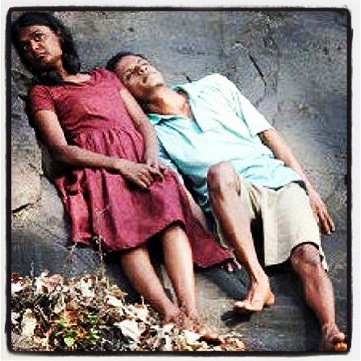
A still from the film ‘Flying Fish.’
When the guns fell silent in May 2009, the people of Sri Lanka collectively breathed a sigh of relief. It didn’t matter whether they were from the North or the South, because the end of the war offered a new lease of life, the strategies and the style of battle execution notwithstanding. To the ordinary people of Sri Lanka, it signified an end to the ritual of violence, though they are still waiting for that eagerly-awaited new lease in life.
The flames of violent conflict have been fanned and sustained for nearly three decades. Four years after the war, instead of dousing those flames, hatred and bigotry are fed, with the perverse of mind still continuing to demonstrate uncanny skills in identifying other targets and using with dexterity, innovative weapons of destruction.
It is easy to do, when there is absolute convergence of opinion and an invincible political leadership that basks in the glory of a successfully executed war. The generated sense of triumphalism in its wake continues to rub on others, and the result is, convergence snowballing. On the pockets of resistance – very small indeed – effective application of various methods of coercion can ensure a measure of silence, if not total submission. Such is the deafening silence of post- war Sri Lanka, it almost provides the perfect setting for a historical movie of a bloodied kind.
Banning of a movie
A few days ago, guns were literally turned on a Sinhala language, anthological movie titled Flying Fish (Igillena Maluwo) by a young film maker, largely unknown to the non-film industry persons, until he was made into a household name on 11 July, and his movie, the talk of the town. The cavalier manner in which it was banned from being screened at a film festival – delivering a double whammy by banning the entire film festival – illustrated only one fact: Our intolerance.
Until 11 July, the State-approved approver of movies in Sri Lanka – whether they have the necessary creativity, astuteness and the broadness of thinking to review a work of art to aesthetically evaluate and give it the final stamp of approval – was the Public Performance Board (PPB). But in this instance, the PPB was reduced to something it had never been: The silent observer, and complicit in a ‘criminal act.’
The crime was the film being permitted to be screened as part of Colombo’s French Film Festival, a ‘one-time screening to a select audience which will exclude children’ without simply banning it. Propagating the banning theory and making the decision were, the Media Centre for National Security (MCNS) and the Bandaranaike National Memorial Foundation (BNMF). So now we know who the actual approvers are!
There is now a special investigation, according to the MCNS, to find out why the film was not banned in the first instance for having scenes with actors in military fatigue and to identify the sources of funding. The BMICH, the venue provider, issued a public apology to the audiences and to the armed forces for allowing the screening in its premises. Both the MCNS and BMICH, in their patriotic zeal agree that, the film portrayed the Sri Lankan soldier as ‘sexually violent, despicable men on low morals’ as opposed to cadres of Liberation Tigers of Tamil Eelam (LTTE), as men with a higher purpose in life, though anti-social and aggressive in conduct.
The negative hype generated through the State-owned media institutions against the film was immense. The State television stations, once the broadcasters of the same movie’s international success, have now turned their collective guns on the film and its maker. Collectively, they are all making great attempt to redefine patriotism, and above all, the singularly approved portrayal of the fabled Sri Lankan soldier: The winner of wars – gallant, kind and simply heroic. If there are other interpretations, then in post-war Sri Lanka, there is absolutely no room for casting the virtuous soldier in any other such light, though like soldiers everywhere, there could be the gallant as well as the mercenary.
In a similar move, the Sri Lankan Government banned Kamal Hasan’s movie, Vishvaroopam, this January, citing portrayals that were distasteful and detrimental to the ‘national psyche.’ To begin with, when authorities decide for the ‘national psyche,’ it does pose a problem. Why? Esthetic appreciation can be collective as much as individual, the very reason why works of literature and art are presented to the public – to be validated or rejected by the audiences. As acclaimed cinematographer Dharmasiri Bandaranayake, said: “They (films) are to be approved by the authorized, not by the jackboots of cultural terrorism.”
Cabinet decision to ban
In India, Vishvaroopam, was banned through a Court order. Sri Lanka was smarter and swifter – and banned the movie through an expeditious Cabinet decision, clearly among the new tools at hand. The Public Performance Board (PPB), despite being the sole authority on such matters, was simply reduced to a silent, non-resistant observer.
At the time of banning, most critics including the Minister of Cultural Affairs and Art, T.B. Ekanayake, had not viewed the film. But each detractor was fully aware of the film’s inclusion of the scenes that were ‘seriously insensitivity to religion.’
To give him credit, Ekanayake called for an ‘independent scholarly interpretation’ through an expert committee, whereas Cabinet Spokesperson, Minister Keheliya Rambukwella, who gravely announced the ban at a media briefing, simply admitted that he was among those who have not viewed Vishvaroopam, but would love to do so (post ban).
The banning of movies and multiple authorities making ill-advised decisions appear to be the new order. Certainly, it is a trend that is likely to continue. It is already feared that Madras Café, directed by Shoojut Sircar and starring Bollywood super star, John Abraham, too would meet the same fate. A story that deals with terrorism in Sri Lanka, the movie is scheduled for an international release on 23 August.
The Flying Fish saga reached a new dramatic height yesterday, independent of the inquiry into the movie and its makers by the Criminal Investigations Department (CID). Concerned citizens, both men and women gathered before the French Embassy – held culpable now for the inclusion of this film in its film festival – which was intended to be an integral part of the French Spring Festival in Colombo – to denounce the movie and to label it as an act of treachery.
Some of the protesters admitted to being paid to be there, and proudly bore colourful national flags and posters that had both the Rajapaksa brothers’ smiling faces. They knew nothing about the content of the movie but when asked, had strong opinions about Flying Fish being ‘insulting to Sri Lanka; being part of an international conspiracy; was the reason for the attack on Bodh Gaya; a bad film; amongst other similar reasons.’ Their profound understanding of the film, its maker, its source of funding and the justification for banning were inspiring.
Herded from Kandy and Bandarawela
The demonstrators, to those who stepped aside to view the unravelling tragedy, represented that vocal majority with the herd instinct. There could not have been any convergence of opinion, for none had an option. To have one, they knew nothing of the movie except the reason why theory was herded from Kandy and Bandarawela to protest in Colombo 7.
They demonstrated two things: First, it reflected the lack of tolerance in post-war Sri Lanka. Second, it reflected a nation that had lost both its equilibrium and its once plural identity.
We have sacrificed, or been made to sacrifice, the once celebrated concept of Sri Lankan diversity, on the altar of pseudo patriotism.
For Sri Lanka, it is now defined by the rulers, and the polity is expected to remain in tacit complicity. Perhaps the next movie should be about that collective identity which is now sadly lost. The tragedy is not about the portrayal of the Sri Lankan soldier; it is about us and the lost Sri Lankan identity that had space for dissent COURTESY:CEYLON TODAY