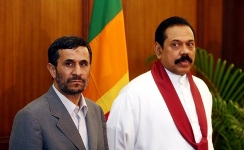
pic courtesy of: ISNA
By Ayesha Zuhair
Amidst the Western world’s psychological warfare against Iran, 42 heads of state including Sri Lankan President Mahinda Rajapaksa have confirmed plans to participate in the forthcoming summit of the Non-Aligned Movement (NAM) in Iran’s capital city, Tehran.
News that UN Secretary General Ban Ki-Moon and Egyptian President Mohamed Morsi will attend the 16th NAM summit to be held from August 26-31 has jolted Israel and its closest ally, the United States as it is certain to boost Iran’s international image.
Israeli Prime Minister Benjamin Netanyahu has said that it would be a “horrible mistake” for Ban Ki Moon to visit Tehran while the Obama administration has described Tehran as a “strange and inappropriate place for this meeting.”
However the message and the tone of the message coming from Tel Aviv and Washington reinforce the importance of NAM even in today’s unipolar world. As such it is apt that the meeting is being held in Tehran this year.
The founding objective of NAM was to create a forum for Third World solidarity resisting colonialism, imperialism and hegemony of powerful countries and in the popular political narrative these are at the root of the onslaught on Iran.
NAM is the second largest international organisation in the world after the United Nations. Its origins can be traced back to the Asia-Africa Conference held in Bandung, Indonesia in 1955 convened by the Prime Ministers of five Asian powers: Myanmar (then Burma), Sri Lanka (then Ceylon), India, Indonesia and Pakistan.
Sri Lanka has always played a vital role in the movement and in fact the idea to host an Afro-Asian conference in Bandung emerged at the ‘Colombo Powers’ Conference of 1954.
The idea of non-alignment, as articulated by Sirimavo Bandaranaike at the Cairo summit in 1964, arose out of a determination to be free of involvement with power blocs.
Mrs. Bandaranaike elaborated that non-alignment “merely means that each country that is non-aligned adopts independent judgements on foreign policy without being tied to ideas or ideologies of opposing military power blocs.”
She also pointed out that, “Non-aligned nations do not necessarily stand together on any given question.”
The organisation was eventually born during the height of the Cold War when the first summit of non-aligned nations was held in the former Yugoslavian capital, Belgrade in 1961. This was at a time when fears that the escalating nuclear arms race between the USA and USSR could result in a global war with devastating consequences, something that the world came very close to during the Cuban Missile Crisis in 1962.
The 2012 summit marks the beginning of Iran assuming the NAM’s rotating presidency for a three year term from Egypt and it will be a definite set-back for Western efforts to isolate Iran and portray it as a “rogue state” and “a threat to world peace”.
Abdolreza Mesri, Spokesman for Iran’s Majlis National Security and Foreign Policy Committee has described the upcoming summit as a promising “turning point” for the Islamic Republic and noted that, “The US and other hegemonic states had concerted all their efforts to prevent the conference from taking place in Tehran.”
As Tehran prepares to hold the 16th NAM Summit, participating member states comprising of 55 per cent of the world’s population are sending out a powerful message: that Iran continues to command global respect despite relentless Western efforts to weaken it, that it is impossible for bullying powers to subjugate it, that it is not as friendless as the West would wish.
The importance of NAM however goes beyond Tehran 2012. In view of the structure of the international system which is dominated by the powerful West, one could argue that NAM’s ideals have become even more relevant today than they were at the time it was founded.
NAM provides an ideal platform for third world voices to be heard, and a force to counter-balance the West’s domination of international affairs. It has the potential to restore the much-desired political, social and economic balance in the international system.
The NAM, if institutionalised, can positively address major trouble spots in the world such as Palestine and Kashmir. As posited by Executive Editor of Iran Review Mahmoud Reza Golshanpazhooh, if Iran provides rational and suitable leadership, NAM can evolve into an efficient organisation once more with much clout at the international level.
Respected American Professor Noam Chomsky, in an interview with AlterNet in October 2008, asserted that the “majority of the world supports Iran”.
When leaders of the non-aligned world converge in Tehran to discuss matters of mutual interest, they are – without doubt – endorsing this view. The majority of the world does support Iran. courtesy: Daily Mirror