INDIAN CONCERNS OVER ESSENTIALS OF POST-CONFLICT RECONCILIATION IN SRI LANKA
by Dr.Subramanian Swamy
(text of speech delivered by Dr.Swamy at Defence seminar 2012 in Colombo)
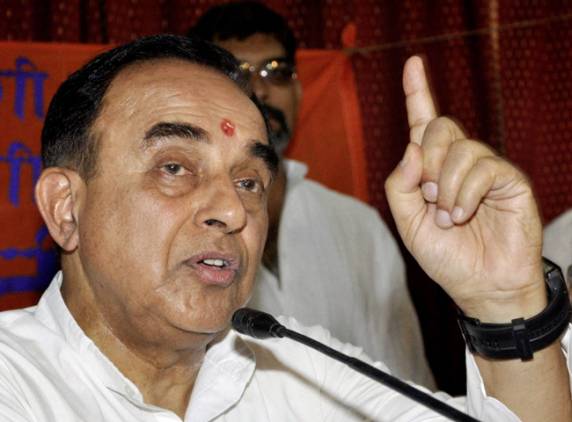
Janata Party President Subramanian Swamy addressing a press conference in Lucknow – PTI file photo
Introduction
The world witnessed a historic event in May 2009, when in a final assault of the Sri Lankan armed forces, a treacherous and murderous terrorist outfit called the Liberation Tigers of Tamil Eelam [LTTE] was decimated. Its Supremo V. Prabhakaran and his main associates were killed on May 19th.
Correctly disregarding the call from several countries for a ceasefire and negotiated settlement, the Sri Lankan President Mahinda Rajapakshe chose to bring a 29 years sordid chapter of terrorism to a decisive end by military means.
Much has improved in Sri Lanka since the formal end of violent strife on that historic date of May 19, 2009 in Sri Lanka, when coming to know of Prabhakaran’s death, the rump LTTE surrendered and laid down arms.
Thus, the spate of paralyzing suicide bombings causing killing and maiming of innocent civilians, both Tamils and Sinhalas, in southern parts of the island nation ended with the destruction of the LTTE.
But in the process, a large number of Tamil civilians were dislocated and many crossed the shores to become refugees in India. Many civilians and army personnel perished in the cross fire between the army and the LTTE amidst allegations of human rights violations and torture. The Sri Lankan Government set up a high powered committee called Lessons Learnt and Reconciliation Commission[LLRC] to go into all these allegations and identify the responsibility that devolves for the same.
Today Tamil families no more fear the so-called Tigers’ forced recruitment of their children and their various abuses. The extortion of funds from civilians to finance terrorist operations of the LTTE has also ended. Normalcy in daily life has returned after three decades.
The credit for this victory over terrorism naturally must belong to the political leadership of the President Mr. Rajapakshe and his ability to inspire the armed forces to fight on and die for the cause.
The Sri Lankan people gave the President a huge mandate in the subsequently held General Elections. With this halo and public mandate, it is clear that President Rajapakshe is now crucially positioned to effectively take necessary steps to solve another pending and pressing issue: a healthy Sinhala –Tamil reconciliation, by finding a mutually acceptable way to heal the festering Sinhala-Tamil divide, and bring about a meeting of minds of the two communities.
Decades of brutal insurgency have unfortunately polarized communities and undermined institutions that guarantee civilian rights. However this was not the only insurgency that the Sri Lankan state had waged. In 1970-71, the Government had battled the JVP, a terrorist Left wing Sinhala chauvinist outfit then, and wiped them out.
The JVP later re-tooled themselves as a parliamentary group, and became a part of the solution instead of remaining a problem. The LTTE failed to learn from that example, and chose to remain a brutal part of the problem, for which not only the LTTE but the Tamil populace paid a heavy price.
While the immediate problem to be tackled is the rehabilitation of the victims of the insurgency, of providing solace to the bereaved families of those killed in the cross fire, the displaced and the injured, the more fundamental long term problem before Sri Lanka today is of those across the length and breadth of Sri Lanka who are scarred mentally and emotionally by the brutalities that they had faced and the uncertainty today about their place in Sri Lanka’s future.
The situation facing the Tamils is particularly delicate. The war conducted by the Sri Lankan armed forces against a sinister terrorist organization had more or less polarized into a conflict between the Sinhala and the Tamil communities due to political miscalculations of some short sighted leaders over the last three decades.
The LTTE in fact had wanted that polarization, and Tamil leadership fell into the political quicksand created by it. They were egged on across the Palk Strait by selfish leaders in Tamil Nadu, many of whom were being financed by the LTTE.
As an Indian and a Tamil, let me say at this point that the overwhelming proportion of the people of Tamil Nadu had rejected the LTTE whenever they were made to make a call.
When the dismissal of the DMK state government took place in January 1991 for colluding with the LTTE, and which dismissal I had supervised as a senior Cabinet Minister holding the Law & Justice portfolio in the Union Government, there was overwhelming support from the people.
Not a single incident of violence took place when the dismissal was carried out. It became apparent then that the Tamils of the state think of themselves as Indians first and Tamils afterwards. This has been repeatedly affirmed by the Tamil Nadu people over the last two decades.
Therefore, let me assure you that for us Indians, national interests come first, and if state or regional interests clash with it, then it is the latter that will be sacrificed.
Hence, I can tell you with full conviction today that the Indian people wish Sri Lanka well. We in India in fact feel kinship with you Sri Lankans, emotionally, historically, religiously, linguistically and also for the benefit of our mutual national security.
Thus, we Indian people do not agree with our government on every decision it takes on political compulsions, as it often happens in a democracy. For example, an overwhelming majority of the Indian people disapproved of the Indian Government decision to support the US sponsored Resolution in the UN Commission on Human Rights on the alleged extrajudicial killings carried out in the final stages of the insurgency of the LTTE.
But I make it clear at the same time, even the most ardent well wisher of Sri Lanka wants to see that the present feeling of marginalization that seems to have gripped the Tamil community, including sections which were never with the LTTE such as the Plantation Tamils, is ended by a reconciliation process wherein the Tamils feel empowered to participate in nation building as if the LTTE era never happened.
This would require devolution within the basic structure of the unitary Constitution of Sri Lanka, for which the exact proposals must come from within, viz., the Parliament of Sri Lanka, and never imposed from abroad. This is not an Indian demand, but certainly it is our concern and expectation.
It must, we in India recognize, be within the comfort zone of Sinhala majority feelings and at the same time be considered adequate by the Tamil minority. Does such a Proposal exist? I think so, and that is what propose to expound here today.
The current Tamil-Sinhala emotional divide can end, by partly exorcising the false notions embedded in the minds of Indians and Sri Lankans through text books and false propaganda authored by the British Imperialists, and nurtured on both sides of the Palk Straits for political convenience. How this divide has manifested itself over time, may be seen from a brief review of this history.
Brief History of the Tamil-Sinhala Interaction
Sri Lanka situated at the southern extremity of the Indian peninsula, and separated by a 34 kms stretch of sea called Palk Strait/Gulf of Mannar. India’s Sanskrit texts have for long called the island as Lanka, and the nation’s Constitution in 1972 formally adopted the name ‘Sri Lanka’.
Because India’s unique relationship with Sri Lanka, viz., as geographical neighbour, cultural sibling, and as historical cohort since the people of Orissa, Andhra Pradesh and West Bengal have historic links with the Sinhala community, which is 75 percent of the total Sri Lanka’s population. Also, the people of Tamil Nadu and Kerala have long-standing and continuing links with Sri Lankan Tamils going back in ages.
But the origins of the current tension between the two communities, are however not ancient but born in the Sinhala’s perceived role of the Tamils during the British colonial period post 1850.
The British-Tamil friendly equation became possible because of the British familiarity with Tamils in India before coming to Sri Lanka. This familiarity led to collaboration between the Tamils and the British in ruling the occupied Lanka nation. Tamils cooperated with the British in India too.
In fact the so-called Self-Respect Movement which later became the Dravidian Movement in Tamil Nadu was inspired by the British Imperialists to subvert the Freedom Movement led by the some Brahmin leaders and other enlightened leaders such as Muthuramalinga Thevar and V.O. Chidambaranar.
The result of the British-Tamil collaboration in Sri Lanka was that the Tamils, despite being a minority, became disproportionately influential in the management of the Sri Lankan political and economic affairs right till the time of the country’s independence in 1948. The Tamils became better educated, and economically successful in the non-agricultural sectors of Sri Lankan society.
Thus the antagonisms were compounded by the Sinhalese feeling of being discriminated against, unfairly treated by the British and that too with the support of Tamils.
This antagonism according to my understanding is at the root of the Sinhala resistance to constitutional devolution of power to Tamil populated areas.
A deeper subconscious apprehension in the Sinhalese psyche about Sri Lanka Tamils demand for greater devolution is their ‘minority complex’ that manifests when the Tamils of India extend support to Tamils of Sri Lanka.
Though the Sinhala community constitutes over 75 per cent of the population of Sri Lanka, it often views the Tamils not as a minority but as part of the looming Tamil political and demographic presence to the north of the island in Indian peninsular area of Tamil Nadu, a population of 65+million, which is seen as the natural support base for Sri Lankan Tamils.
Thus the proximate linguistic political and cultural links that the Sri Lankan Tamils with Tamil Nadu, makes the Sinhalas feel threatened with dismemberment of their country – which the Sinhalas feel could be initiated by India under pressure from its own Tamil citizens.
Hence, the Sinhala aversion to respond spontaneously to any just Tamil demand for devolution of power or autonomy. India needs to be constantly cognizant of, and concerned with this Sinhala apprehension, without sacrificing the right to voice support in a friendly way for the human rights of the Tamil minority. The Indian Government however needs to rein in the sub-national jingoism that erupts from time to time in Tamil Nadu triggered by slanted English media reports.
Of course in a modern democracy, decision on governance issues are determined by counting heads – as representing “the will of the people”, the opinion of the majority of the people. The problem with such a dictum in real life is that if the minority and the majority are distinct mutually antagonistic communities, human rights violations result.
If democracy be the rule of the majority, the protection of minorities against injustice and hegemony is not a matter of compassion of the majority. It is definitely not! The reason is that modern constitutional democracy itself lays the legal basis for minority rights.
Human rights in a democracy are held to be inalienable – no human being could be deprived of those rights in a democracy by the will of the majority of the sovereign people.
This is the basic governance norm of democracy that was forgotten, especially since 1979 in Sri Lanka by the majority.
There however is no ethnicity involved in Sinhala majorityism. It is instead fanned by antagonism of the past and fears about being swamped by the perceived patronage of Tamil Nadu by the Union government.
On the question of ethnicity, Tamils and Sinhalas are two linguistic communities but not ethnically different. They are of the same DNA genetic structure, and as are all Indians.
Nor can it be said that Hindu and Buddhist religions are since the last 12 centuries anymore antagonistic theologies. Buddha was a Hindu by birth, and never repudiated the core concepts of Hinduism. He was a reformer and opposed to orthodoxy. Today Hindus own Buddha as one of their own– revere and worship Buddha.
In Sri Lanka about three-fourths of the population is Sinhala that profess Buddhism; Hindu, Christian, Muslims Tamils form twenty four per cent of the population, of which more than twelve per cent are Sri Lankan Tamils whose forefathers have been in the island for over hundreds of years; the rest of them are plantation workers brought over by the British as industrial labour in the last century, plus those Muslims whose mother tongue is Tamil.
The core cause of the Sri Lanka strife is thus not ethnicity or religion as the West is prone to project, but an erroneously perceived distinction in the minds of the Sinhalas and Tamils on language. Another cause is the recent past history of broken agreements between the leaders of the two communities.
Even the linguistic distinction is artificial and which distinction is an infection injected by British colonialists and their comprador historians. Sinhala and Tamil languages have deep connection with Sanskrit and with Brahmi script.
But after independence the Sinhala majority adopted two policies that have been the source of much discontent amongst Tamils (and later cause of much violence): a “Sinhala only” language policy and “standardization” of marks for entrance to universities.
At the time of independence the Tamils had 32% of the voting power in the Legislature. Upon the disenfranchisement of the ‘Estate’ Tamils (who worked on the plantations) the percentage dropped to 20%. At the General Elections, the Sinhala majority secured more than a two-thirds majority in Parliament. Then came the new Constitution of 1972, adopted by the predominantly Sinhalese Parliament in which Section 29 of the Soulbury Constitution was deleted; constitutional protection being denied, the minority became restive, and one event cascaded into another, inevitably to violence by the end of the 1970s.
In 1975, in a study prepared for the Minority Rights Group, Walter Schwarz prophetically wrote:
“If Sri Lanka is not to experience communal violence or terrorism… there will have to be more readiness for compromise and moderation than has yet been shown – It would be a pity if Sri Lanka’s leadership waited for bombs to explode and for the prisons to fill up again before conceding that the Tamils need re-assurance that they have a place in the future of the Island.”
Lack of appreciation of the perils of a conflict led to the riots of July-August 1981 and then to the more shocking near genocidal events of July 1983 led by Sinhala mobs. India’s direct intervention followed what was perceived in India as a genocide of Tamils.
That year, 1983, may be taken as a turning point and defining moment for the Sri Lankan current crisis. The basic problem is however embedded in the island’s history.
The failure to compromise, to resile from erroneous positions, and to learn from history is at the root of the Sri Lanka divide. I can do no better at this stage than repeat Walter Schwartz’s 1975 prophetic warning.
The present stalemate in Sri Lanka is not acceptable to the Tamils, even to those of us in India who oppose Tamil chauvinism and terrorism, and to the democratic world in general.
The moment of truth has arrived. Sri Lanka should respond to the regional aspirations of the Sri Lanka Tamils and chart the mutually acceptable path to reconciliation within a fixed target date. It is India’s concern, but the choice on how to do it is for the sovereign government of Sri Lanka.
A future Indian government which hopefully is not so precariously placed as today’s, will ensure love and support for a united cultural sibling nation of Sri Lanka so that hot heads in Sri Lanka and in Tamil Nadu do not rear their ugly and violent heads again. Sri Lanka must build a reconciled society on the historic victory achieved in 2009 against the LTTE.
The solution lies in the simple device of devolution– federalism or quasi-federalism. The US is the model for the former and India for the latter. However any proposal for devolution runs into the fear psychosis of both Tamils and Sinhalas.
The latter fear devolution as bring the fore runner of succession of the fertile lands of the north east and the outlet for take-over by India. The Tamils fear the devolution proposals are feeble and just time-buying tactics of the Sinhala community, and therefore short of a federal state there is no long-term security. They cite past broken agreements.
The Bandarnaike-Chelvanayakam Pact (July 1957) the first such attempt of the two linguistic communities to solve by devolution. The pact was between the then Prime Minister, Mr S W R D Bandaranaike and the then leader of the Tamil Federal Party, Mr S J V Chelvanayakam, inter alia provided for a wide measure of autonomy through Regional Councils to be set up in the Tamil areas of the north and east. The Councils were to have powers over a wide range of subjects including agriculture, cooperatives, land and land development, colonisation, education, health, fisheries, housing, social services, electricity, water supplies and roads.
It also provided for Tamil to be recognised as a language of the national Tamil minority of Sri Lanka and as the language of administration in the northern and eastern provinces. It further recognised that “early consideration” should be given to the question of Sri Lanka citizenship for plantation Tamils. Had this Pact been implemented, the country would have been spared much subsequent strife and violence.
However no sooner it was signed, an island-wide campaign was, mounted by the then opposition United National Party (UNP) and the Buddhist clergy denouncing the pact as a ‘betrayal of the Sinhalese/Buddhist people.’ On April 9, 1958, a large number of leading Buddhist monks stormed the Prime Minister’s residence and demanded that the Pact be abrogated forthwith. A besieged PM capitulated, but the monks insisted on getting this promise in writing. The Prime Minister obliged and gave the written pledge to the monks [Emergency 1958 by Tarzie Vittachi].
In 1965 effort was made by the then leader of the UNP, Mr Dudley Senanayake, and Mr S J V Chelvanayakam both as coalition partners in a new Government. The provisions of this agreement were similar to but not as detailed as the earlier 1957 Pact. In part fulfilment of the agreement, the government introduced regulations for the “reasonable use of the Tamil language”.
The SLFP, in Opposition, now led by Bandaranaike’s wife Sirimavo, formed the same alliance with the Buddhist clergy, replicated the earlier UNP/Buddhist operation in 1958, mounted a campaign characterising the regulations as a “sell-out to the Tamils”.
Although the regulations received parliamentary approval, these were never implemented since the government failed to honour the provision of the Agreement by enacting appropriate legislation, the Federal Party of Chelvanayakam resigned from the government and went into opposition. The seeds were planted for polarisation and confrontation.
The United Front Government under the SLFP led by Sirimavo Bandaranaike gained an absolute majority in the 1970 general elections. This government introduced of “standardisation” for university admissions, the marks equalization scheme, whereby a Tamil to get 25% more marks to be imposition of further restrictions on the employment prospects of Tamils.
The promulgation of the 1972 Republican Constitution contributed to a further widening of the differences between Tamil and Sinhalese, since it removed the vestiges of the theoretical protection accorded to the minorities in the Independence (Soulboury’s) Constitution of 1948, such as Article 29 of the 1948 Constitution.
Not only was this Article dropped without any similar provision being substituted, the 1972 Constitution, inter alia, granted constitutional status to Sinhala language as the sole Official Language. It also allocated to Buddhism the status of a state religion by giving it a “foremost place” and enjoining the state to afford protection to Buddhism.
Although the Tamil Federal Party (TFP) had, since its formation in 1949, adopted the position that Sri Lanka was comprised of two distinct communities Sinhala and Tamil and advocated a federal system of government as the most suitable constitutional structure for a country with two peoples speaking two different equal languages, it had, nevertheless, remained unreservedly opposed to a division or separation of the country.
The 1970 General Elections the Federal party had made a categorical appeal to the Tamil people “not to lend their support to any political movement that advocates a bifurcation of the country”. And the Tamil people supported the appeal in a very large measure by voting for the TFP.
The situation radically changed following the 1972 Constitution represented of the promise made to the Tamil electorate. In May 1972, a renewed sense of radical unity among the Tamils dawned with the formation of the Tamil United Front (later the Tamil United Liberation Front), an umbrella organisation of the main Tamil political parties.
The TULF organised protest demonstrations and campaigns in the Tamil areas against the new Constitution. Tamil youth campaigned strongly against the new Constitution. “Standardisation” for admissions to universities was the trigger since it produced predictable resentment among the Tamil youth.
The government responded with strong counter measures with draconian measures. Hundreds of Tamil youth were arrested and sent to prison without being charged.
Allegations of torture were widespread. There soon emerged sections of the Tamil youth who reacted violently. For the first time in Sri Lankan Tamil politics, the use of violence in pursuit of political purposes began to emerge as a viable option, phenomenon giving a new and alarming twist to the heightening conflict.
In May 1976, the TULF adopted a resolution which stated for the first time explicitly that the Tamils constituted a nation and that they had a right to self-determination. It committed itself to the “restoration and reconstitution of the Free, Sovereign, Secular, Socialist State of Tamil Eelam based on the right of self-determination inherent to every nation” and declared that such a state “has become inevitable in order to safeguard the very existence of the Tamil nation in this country”.[Vaddukoddai Convention, May 14, 1976].
The TULF resolution also called upon the “Tamil youth in particular to come forward to throw themselves fully in the sacred fight for freedom and flinch not till the goal of a sovereign socialist state of Tamil Eelam is reached”.
Although the Secretary General of the TULF Mr.M.Sivasithambaram in a letter to the PM declared “Ours is a non-violent, civil disobedience movement. According to the tenets of Gandhiji’s teachings, we shall suffer whatever stern action you (Sinhalas) propose to take. History has also shown such sacrifices triumph in the end”.
In 1977 the United National Party (UNP) led by J R Jayawardene won an unprecedented electoral victory in the General Elections to Parliament held in July 1977 winning 141 of the 168 seats in Parliament. The TULF became the largest opposition party, and Amrithalingam the leader of the Opposition in Parliament. The polarization spread to the Sri Lanka electorate and competitive radicalism began to pollute Sri Lanka’s democratic politics.
A reorganised UNP under the leadership of Mr. Jayawardene, as President, had recognised before the elections that “the lack of a solution to their problems has made the Tamil speaking people support even a movement for the creation of a separate state”. The UNP manifesto upon which it secured its massive victory, inter alia, stated:
“The United National Party accepts the position that there are numerous problems confronting the Tamil speaking people. The lack of a solution to their problems has made the Tamil speaking people support even a movement for the creation of a separate state. In the interest of a national integration and unity so necessary for the economic development of the whole country, the Party feels such problems should be solved without loss of time.
The party, when it comes to power will take all possible steps to remedy their grievances in such fields as
(1) Education
(2) Colonization
(3) Use of Tamil Language
(4) Employment in the Public and Semi-Public Corporations.
We shall summon an All-Party conference as stated earlier and implement its decisions. The decisions of an All-Party Conference, which will be summoned to consider the problems of non-Sinhala speaking people will be included in the Constitution.”
It is generally accepted that, except where the TULF candidates contested, the UNP received the largest number of Tamil votes. The Ceylon Workers Congress representing the bulk of the plantation Tamils also supported the UNP, and its leader, Mr S Thondaman, became a cabinet minister in the Jayewardene led government. The TULF, although having a mandate on its separatist platform, was also amenable to a solution.
A unique opportunity had thus been created in which a fair and permanent solution to the Tamil problem could have been achieved through the means of a round table conference as promised by the UNP. The Parliamentary vote had established that Tamils as a community has a grievance. Time was ticking away.
The Jayewardene government, however, did not summon its round table conference as promised. It pushed through instead the 1978 Republican Constitution within a matter of weeks when the country was still under a State of Emergency.
The TULF urged that provision be made in the proposed Constitution for a measure of autonomy for the Tamil regions of the north and east. When this was rejected, the TULF MPs took no further part in the making of the Constitution.
Thus, as in the case of the 1972 Constitution, the 1978 Constitution was also promulgated without the participation of the elected representatives of the Tamil people.
The pre-eminent and dominant Constitutional position given to the Sinhala language and Buddhism was ensured in the by making provision for Sinhala to be the sole official language and to “be the language of administration throughout Sri Lanka”. It also enjoined that the State “shall give Buddhism the foremost place and accordingly it shall be the duty of the State to protect and foster the Buddha Sasana (Administration)”.
It also declared Sri Lanka to be a “Unitary State”, thereby apparently diminishing any chance for a solution of the conflict along federal lines.
Militant groups, including the newly formed LTTE, began depicting TULF leaders as capitulationists, as people who could be taken for a ride by the Sinhala leadership. They argued only an armed rebellion can get Tamils justice, and Eelam was the only answer.
Rioting broke out frequently, and the Sinhalas responded aggressively. Riots took place in 1977, 1979 and 1981. But the worst was July 1983.
When asked by the rampage against the Tamils, President Jayewardene unabashedly told lan Ward, a British journalist, in these words:
“I am not worried about the opinion of the Jaffna people…. Now we can’t think of them. Not about their lives or of their opinion about us”. (Daily Telegraph, London, 11 July 1983.)
The government imposed strict censorship on all news relating to the Tamil people and operations of the army. With censorship in place, wild rumours and unreported news made the rounds unfettered.
As a further retaliation, the government announced its plan in 1984 to settle Sinhalese people in the predominantly Tamil north and east to make reflected demographic changes that the nationwide population ratio of 75% Sinhalese to 25% other minorities.
The Minister of National Security, Mr Lalith Athulathmudali, explained that this operation is linked to the overall ethnic problem. “I believe this is the successful method of combating terrorism in a non-violent way… This could mean that somewhere in the future there could be more Sinhalese in the north than the Tamils”. [“Democracy in Peril – Sri Lanka: A Country in Crisis”, by Patricia Hyndman, Report of the Lawasia Human Rights Standing Committee, p. 19.]
President Jayawardene’s view on the matter was contained in a PTI report of 22 January 1985:”… that his government would carry forward the programme of settling Sinhalese in the north and east in accordance with the principle of distributing state land on the basis of ethnic proportion.”
The government also commenced training and arming the Sinhalese settlers in these areas. Weapons were distributed among the settlers for “self-protection”. Advanced training was to be given to new settlers: “All able bodied persons going to the north to settle down will be trained in the use of arms and on defence tactics. Each family would have a three and a half acre piece of land to cultivate. The government would construct houses for them [The SUN (Colombo) 19 January 1985].
The effect of arming the Sinhalese in Tamil areas was to transform what was hitherto a conflict between the Tamil guerrillas and the security forces into an armed conflict between the civilian people of the two communities. What was up to some time ago action by the security forces against the groups which had chosen to take up arms against the state can now become generalised fighting between two armed separate groups.
The tragic consequences of this move were seen during the latter half of 1985 particularly in the eastern province when armed Sinhalese settlers joined with the security forces in “anti-guerrilla” operations. A new dimension to the Sri Lanka crisis was added by the ‘settlement policy’.
The violent events of July 1983 and the resulting flight of nearly 80,000 Tamils to the neighbouring South Indian State of Tamil Nadu left India no alternative but to take an active role in the island. The then Indian Prime Minister Mrs.Indira Gandhi’s special envoy, visited Sri Lanka a number of times to discuss with the government, major political parties and the Buddhist clergy a possible solution.
But Mrs.Gandhi was also not above playing politics. She despised Jayewardene personally, and saw the Sri Lankan crisis more as she had seen the East Pakistan crisis of 1971.
After several rounds of discussion between her emissary Sri Lankan government leaders and the TULF, a document which came to be known as ‘Annexure C’ was drawn up and finally agreed with President Jayawardene when he visited New Delhi for the Commonwealth Leaders’ Conference in November 1983.
The contents of Annexure C were to be the basis for negotiations at an All Party Conference (APC) to be convened by President Jaywardene.
Annexure C, inter alia, provided for the following:
(a) District Councils were to be the basic unit of devolution. However, District Councils within a province may combine into one or more Regional Councils if the districts so desired and approved at a Referendum;
(b) in the case of the northern and eastern pr
ovinces, the union of the District Councils within each province be accepted;
(c) each Regional Council was to have a Committee of Ministers drawn from among the elected members and headed by a Chief Minister;
(d) the Regional Councils were to have legislative and executive powers over specified areas including internal law and order, justice, social and economic development, cultural matters and land policy. They would also have power to levy taxes and mobilise resources through loans in addition to receiving block grants from central government;
(e) membership of the armed forces should reflect the ethnic r^tio and the police … force in the north and east should reflect the ethnic ratio in those provinces;
(f) Subject to a national policy on land settlement to be worked out later, all settlement schemes should be based on ethnic proportion so as not to alter the demographic balance; agreement to be reached upon settlement schemes for major projects.
(g) The Constitution and other laws dealing with the official language Sinhala and the national language Tamil, the National Anthem and the National Flag to be accepted.
Nine political parties were originally invited to participate in the APC which commenced on 10 January 1984. Later participation was widened to include the Buddhist, Christian, Muslim and Hindu clergies together with other interest groups. A Conference of political parties summoned to arrive at a political solution to the ethnic conflict was soon transformed into one of groups representing a multitude of conflicting vested interest groups.
Annexure C, which was agreed to by the President as the basis for negotiation, was later abandoned after objection to it was raised by Buddhist organisations. The APC lasted throughout 1984 with postponements and long delays between meetings. The absence of the second largest Sinhalese political party, the Sri Lanka Freedom Party (SLFP) which boycotted the APC due to the fact that its leader, Mrs.Bandaranaike, remained deprived of her political rights, due to certain criminal cases foisted on her by the Government, seriously undermined any chances of solution based on consensus. The APC become a non-starter, a dead letter.
In the absence of an agreement between the participants, President Jayawardene chose to submit proposals in the form of two draft Bills, describing them as the considered views emerging from the earlier Conference.
The proposals included provision for 3,000 village level local authorities, a further two tiers of District and Provincial Councils and also for the setting up of a second chamber of parliament to be called the Council of State, with 75 members, 50 of whom were to be nominated by the 25 District Councils and the balance by the President.
But his hard line Cabinet Minsiter, Mr Cyril Mathew, publicly opposed the proposals and exhorted the Buddhist clergy to do likewise. The SLFP also rejected the proposals, characterising them as a “legislative give away” to the Tamils with nothing in return. The TULF considered too at the other end of the political spectrum the proposals inadequate and stated that they “did not embody any scheme of autonomy which could be accepted by the Tamil people”; but it did not rule out any further negotiations on the proposals.
On 26 December 1984, President Jayawardene flatly announced that his government had decided not to go ahead with the proposals. He offered no other proposal or promises for the future. Another opportunity for a peaceful negotiated resolution of the conflict was thus lost. From then on, Sri Lanka had been on a roller-coaster of terrorist violence and counter state measures, all causing loss of civilian lives.
A PROPOSAL FOR RECONCILIATION
There are many a proposal on the desk of the Sri Lankan President Mr. Rajapakshe, so I see little point in giving another fully structured proposal. Rather I shall concentrate here on certain fundamentals of any viable and mutually acceptable reconciliation between the Sinhala majority and the Tamil minority.
First, no proposal for reconciliation can be pushed for acceptance in Sri Lanka from abroad, whether from India, or United Nations or any from any European busy bodies. The proposal must emerge indigenously in Sri Lanka after full democratic consultations with the stakeholders, none of whom shall have a veto, and adopted by the Sri Lanka Parliament by way of a resolution or if necessary by constitutional amendment.
Second, since there appears already a wide acceptability in Sri Lanka of the “13+ “ Amendment, which is a package that has been, in principle, substantially accepted by Parliament, hence the final reconciliation proposal should based on this Proposal, after adopting further amendments, to enhance or curtail the provisions of the 13+ Amendment.
Third, Sri Lanka by a Constitutional Amendment will become a Union of States, with exclusive and concurrent power delegated under the Constitution for the Union and the States to exercise and accordingly, a Union, Concurrent, and State Lists will be incorporated in the Constitution enumerating the subjects under the three categories.
Fourth, the Sri Lanka Constitution will remain Unitary in character, in the sense that the Parliament will have power under the Constitution to dismiss and take over the administration of a state for specified contingencies such as a state being unable to enforce the relevant provisions of the Constitution.
Fifth, the Head of the state government will have primary responsibility to maintain public order through a state police constituted for this purpose, but the Union shall have a Central Reserve Police and a contingent of the Armed Forces stationed in a special conclave in the state to intervene for the maintenance of public order whenever the President determines with ex-post approval of Parliament that a situation has arisen that requires such an intervention.
Sixth, Parliament will enact an amendment to the Constitution to empower the Union to appoint Special District Magistrates whenever necessary and whose power will supersede the orders issued in exercise of State Magistrates power to maintain public order.
Seventh, the Sri Lankan State will be secular in the conduct of its administration but will be entrusted to promote those religions which accept that religions if faithfully practiced will lead to God.
COURTESY:rkradhakrishnan.com