By Amanda Hodge in Colombo with Additional Reporting by Joe Kelly
EXHAUSTED and showing the strain of a horror week of deportation and interrogation, Dayan Anthony presented just the sobering warning he was intended to be as he fronted a Sri Lankan government media conference to warn of the repercussions of asylum-seeking.
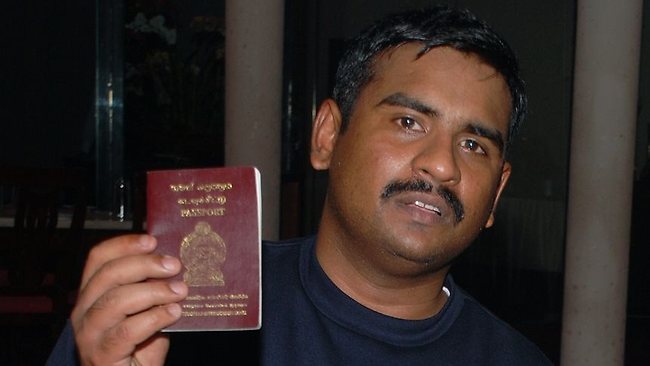
Tamil deportee Dayan Anthony after his release by Sri Lankan authorities yesterday. Picture: Saliya Rupasinghe
In sweat top and pants, his eyes red and hooded with fatigue after 16 hours of questioning, he told a sparse gathering of journalists: “Don’t believe what agents say. You get tempted when people tell stories in Australia about how you can get rich but the boys who go over there will return in handcuffs.
“I want to tell Tamils registered as asylum-seekers in Australia they can safely return because I also returned.”
It could not have been scripted better had it been written by the best propagandists of the Australian or Sri Lankan governments.
In the federal government’s war on people-smuggling, Mr Anthony is a serious shot across the bows of the king pins, whose message that hope and opportunity is a mere boat ride away has gained traction in the trouble zones of South Asia.
Mr Anthony became the first Tamil asylum-seeker to be deported from Australia since the end of the island nation’s 27-year civil conflict when he arrived at Colombo airport at 12.45am on Thursday and was handed to Sri Lankan immigration officials.
Less than 24 hours later he had been released from police custody to face the media, where he publicly recanted all claims of torture and mistreatment by Sri Lankan authorities and confessed he had lied to Australian officials, UN representatives and refugee advocates in order to obtain a refugee visa.
He also insisted he had been treated well by Sri Lankan police since his arrival, despite the fears of his Melbourne-based sister and brother-in-law and refugee advocates that his life would be in danger if he was returned to Sri Lanka.
In an interview with The Weekend Australian, conducted afterwards in an empty Colombo restaurant in the presence of a senior Defence Ministry official who, we were told, was helping him find accommodation, Mr Anthony insisted he was “OK” and “a free man”.
“I had an Australian dream. I came here in fear but now I feel OK,” he said. “I feel Sri Lanka is safe now. War is over. I don’t think anything will happen to me.”
A spokeswoman for Immigration Minister Chris Bowen said Mr Anthony was not being held by Sri Lankan authorities and his situation continued to be monitored.
The government returned Mr Anthony last Wednesday — ignoring an 11th-hour attempt by the UN Human Rights Commissioner to stop his deportation in Bangkok — saying he had exhausted all legal and ministerial avenues in a 27-month campaign for refugee status.
He denied he had been pressured to recant, but the Australian Tamil community has warned there is something strange about his decision to renounce his past claims of torture at the hands of the Sri Lankan government.
Australia Tamil Congress spokesman Bala Vigneswaran said he was concerned Mr Anthony may have been coached by Sri Lankan authorities during his marathon interrogation.
“They coach people before they put people to public media,” he said. “It should look obvious to normal thinking people, that this sounds fishy.
“When you read through the lines, you can see there are issues. And why would you need 16 hours for interrogation, if the person is making up stories?”
Refugee Action Coalition spokesman Ian Rintoul also expressed scepticism: “I think it’s fairly clear that any recantation is a result of duress.”
Mr Anthony, 30, had claimed to have been kidnapped and tortured in 2009 after he was seized and thrown into the back of one of Sri Lanka’s notorious white vans used in disappearances.
He also complained of severe back pain from beatings sustained in Sri Lankan custody — a diagnosis supported by a Melbourne specialist — and gave evidence to the UN special rapporteur on torture late last year. Before his deportation he was receiving treatment for mental health issues.
Asked about his conditions, he told The Weekend Australian: “I don’t have a back problem. I don’t have psychological problems. I’m OK. I feel OK.
“When I was flying here I felt I would be tortured and beaten up but I am OK.
“There’s a fear psychosis that’s created that when you come to Sri Lanka you will be hung up and beaten. But I was taken to the (Colombo CID’s notorious) fourth floor and given a cup of tea.”
Mr Anthony said he had been advised by a Malaysian Tamil people-smuggling agent, who arranged the forged passport for his April 2010 flight to Melbourne, to tell Australian officials he had been kidnapped in a white van and that he had links with the vanquished Liberation Tigers of Tamil Eelam.
“The agent told me if I said that they would give me a visa. Everybody was fleeing to go to Australia. A lot of people lied to get the visa. People come with hope because people-smugglers say they will get visas but nothing happens.”
He said Australia’s swelling ranks of Sri Lankan asylum-seekers should return voluntarily, rather than be forced back in handcuffs as he had been, and offered a swollen wrist as evidence he had been roughed up by Australian immigration officials.
“The Australian authorities behaved very badly. Even though they’re signed to international human rights (agreements) they did this to me. They put me in handcuffs. They did not allow me any fax or phone because otherwise I would contact people. They wanted to send me as an example,” he said.
“There’s no justice in Australia. This is just a political problem for them. This will happen to every person. They will interview and reject you.
“In future they will deport a lot more asylum-seekers in handcuffs. I feel Australia are (sic) racists and still it is for white Australians only.”
When asked what the future held for him, the former textiles trader admitted he had no concrete plans beyond “sleeping for 5000 hours” and finding a job — perhaps abroad.
“The future for everybody is suspicious,” he said. “Tomorrow we don’t know what will happen.” Courtesy: The Australian