by Thulasi Muttulingam
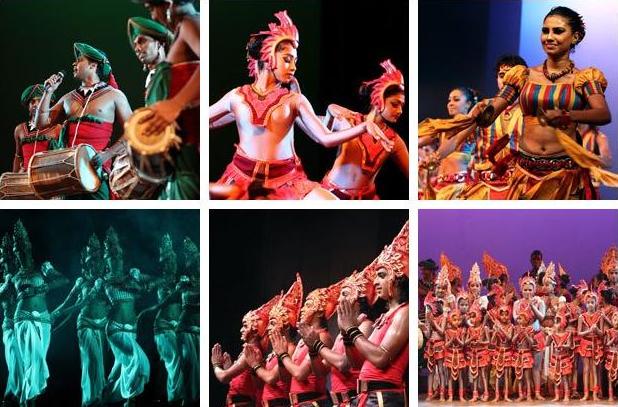
A name to look out for when it comes to recreating and renewing the traditional dance forms of Sri Lanka is Rangika Jeewantha. Or else the institute that is synonymous with his name – The Rivega Dance Studio.
pic by: Tharaka Basnayake
They are an up and coming troupe who have been on the scene for a few years now; people who have seen them all praise the vibrancy and creative ingenuity of these relatively new faces of traditional dance.
The troupe leader and founder Rangika was hooked on dancing, especially traditional dancing from the age of six. A graduate of the University of the Visual and Performing Arts, he also spent several years learning modern dance forms at the Royal Nelung Arts Center. As such he is one of the very few artistes of Sri Lanka who can claim to be a proficient dancer of both kandyan dance as well as western classical ballet.
He puts his knowledge to good use in combining the old and the new. He calls this marriage of tradition with modernity that has become his specialty, ‘fusion’ dance. This along with his intrinsic creativity in fashion designing and choreography usually means that any show he puts on is a feast to the senses in multiple ways. Natmo 2012, his latest production is no different.
Natmo 2012
A collaboration between the Royal Nelung Center of Rangika’s guru Niloufer Pieris and his Rivega Dance Studio, Natmo 2012 is a celebration of Sri Lanka’s traditional dances, music and songs –except that they reflect the modern rather than the ancient face of Sri Lanka.
In the midst of a traditional folk song came a solo violin recital – of Michael Jackson’s ‘Smooth Criminal.’ It was so smoothly worked in that it seemed in no way out of the ordinary.
T
his reviewer had to force herself to stop tapping her feet and clapping her hands in time to the beat to identify what was happening – unlike the rest of the audience who were swept along, uncaring of how or why. I had to write this review though, so I didn’t have that luxury. It was a struggle to get my brain to function every so often to make mental as well as physical notes of the technical details; it wanted to just enjoy the performance. Thus, Natmo 2012 also caused a war between the right and left sides of my brain. Michael Jackson in the middle of a soulful folk ballad accompanied by a traditional drums set? It worked though.
For the contemporary Si Lankans sitting in the audience, the music and dance offered did not showcase only the fossilized remains of their ancestor’s art; it was the living, breathing evolution of what they themselves are now – an amalgamation of traditional as well as western influences. For all the modernity and contemporaneity though, still uniquely Sri Lankan.
Evolving Tradition to Suit Modern Tastes
“Modern audiences don’t always react well to completely traditional dances” says Rangika. “Many of them might not understand what is happening on stage as it was evolved by their ancestors to portray something they can no longer relate to.
“That is why I believe in evolving traditional dances to suit modern tastes. It is essential that the audiences be able to relate to what they are seeing.”
The first piece in the production is titled Nil Manel; lithe female dancers, as delicate as the flower they portrayed, brought Sri Lanka’s National Flower to life on stage.
The second item, by an all male ensemble is apparently a celebration of the four classical dances of Kandy. New innovations in costumes saw them wearing skin coloured body suits under their minimal but colourful and highly decorated garbs of outer wear.
That along with the elaborate headdresses lent them an aura of mystique and grandeur, which their energetic dance enhanced. To a fanciful imagination, they evoked at times images of Red Indian Chiefs, and at other times, the Hindu God Skanda.
The programme consists of 12 items in total, each one unique, colourful and graceful. Interspersed with the dances were performances of folk songs and band performances of percussion as well as violin, guitar and flute.
Rivega had teamed up with other artistes such as Shamila Dadhiwala, a singer who rendered rare and almost lost folk Sinhala folk songs as well as the percussion troupe of Sachinta de Silva. As was to be expected, most of the drumming was on traditional drums, but in keeping with the tone of the evening, there were many innovative beats and sounds. They even had a beatboxer, Thimira Varnaka, whose energetic rendition of percussion music with his lips was a big hit with the audience.
Practice for Perfection
Music for the evening was composed by Nadika Weligodapola. In keeping with the performances, the music too was a symphony of the old and the new. After trying to identify for a while what was ancient, what was old and what was modern among the various background musical compositions, the reviewer gave up trying and just went with the flow. That was what the music ultimately was about anyway. The deeply familiar of both the old and the new. Whether it set one’s foot tapping, blood thrumming or eyes glazing in mellow tranquility, it felt just right – like an old and comfortable friend, who also has the ability to surprise and delight.
“Nadika and I worked on the music for over a year, working and reworking it again and again,” says Rangika. That kind of attention to detail and insistence on perfection brings its own results and it showed.
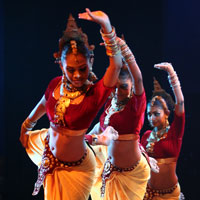
Rangika who was primarily involved with the choreography and the training of his troupe and students, has reserved only one dance item for himself. Titled Tala and Rupa, it showcases the complicity between rhythm and form (image). Portrayed innovatively by a pair of male and female dancers (Rangika and his wife Manohari), the dance showcases rhythm and form as two lovers who complement each other effortlessly.
“Nattumo means ‘Let’s dance,’ and that was the inspiration for the event title, Natmo” says Rangika.
“I staged Natmo 2010 two years ago, where I explored a completely different set of ideas and almost immediately started working on Natmo 2012. “
Help the Artistes
Adds Rangika, “It has been a long journey filled with many disappointments. Sponsorship for young artistes is almost impossible to find. I am grateful to Niloufer Pieris and her Royal Nelung Center for all their support.
If I had a message, it would be that art and culture lovers out there should seek to help and support dedicated but struggling artistes. We can’t survive without such help and appreciation.”
Despite the financial constraints, he and his troupe also hope to tour the country soon with Natmo 2012, which premiered at the Lionel Wendt last Friday.
“We hope to cover at least certain key areas such as Kandy, Galle and Jaffna. People of those areas don’t often get to see performances like ours live so we want to take it to them. I want to motivate and influence the younger generations to value our traditional arts in order to keep them alive.” courtesy: Ceylon Today