By
Aparna M Sridhar
( Carnatic Music Maestro Dr.Balamuralikrishna Passed away in Chennai on November 22nd 2016 at the age of 86. This article appeared under the heading “When Kalyani came calling “in the September 2014 Inaugural issue of “Saamagaana-The first Melody” published in Bengaluru. It was written by the magazine Editor Aparna M. Sridhar who interviewed the musical legend at his Chennai residence. He was 84 at that time. The article is being reproduced here with permission in honour of the memory of Mangalampalli Balamuralikrishna…………….DBSJ)
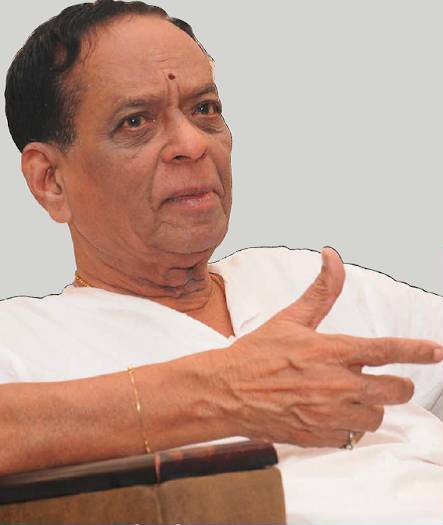
Dr M Balamuralikrishna
Dr M. Balamuralikrishna was once rendering an alapanam in Kalyani, that most enchanting of ragas, at once enjoyable and elusive, commonplace, well-known, accessible to early learners, but yielding her full secrets only to the maestro, as a reward for years of diligence – saadhana – and a musical intuition not gifted to many.
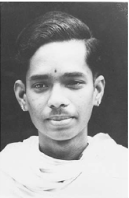
The Younger Dr M Balamuralikrishna
As he tells the story, immersed as he was in the full flow of his manodharma, he opened his eyes to spy a beautiful girl walking down the centre aisle of the auditorium, in a glittering saree. To his astonishment, she climbed the stage, and sat down next to him, with a demure smile.
He abandoned the kriti he was planning to sing, and instead launched into a spontaneous composition about Kalyani’s beauty. When he finished, he turned to look, and she was not there.
“I asked my pakka vadyam players excitedly, ‘did you see her, where did she go?'”
But they did not know. She had been visible only to him. “I felt extremely bad she had gone away.”
It is an entirely believable story. After all, an artist’s muse comes to him or her in many forms. And is it not a fact that they never stay?
But then, Balamurali Krishna has a very special relationship to music.
“I don’t know music, music knows me. I am nothing without music. I am an instrument. As long as music wants me I will sing. Music is in everything…..sound and rhythms are life. When the earth stops rotating the sound will stop.” Only then will he.
Early life
My first glimpse of the Master was of him coming down the steps of his two-storeyed house in Chennai, dressed in a simple white veshti and peering at us through the grill.
One enters the house of a typical south-Indian family — white-washed walls, red-tile flooring….nowhere to be seen are the faux trappings of carefully curated expensive paintings or Indian artifacts so typical of his “arty and classy” peers.
Mangalampalli Balamuralikrishna now in his 84th year, remembers his first home in Sankaraguptam, East Godavari District, in Andhra Pradesh, a small house one among only six Brahmin dwellings in that village.
His mother died 15 days after his birth, “giving me her music.” Suryakantam was a veena player and the daughter of the eminent composer Pryaga Rangadasa.
Balamurali is perhaps Karnatic music’s most recounted child prodigy. Like most geniuses he bloomed early, seemingly effortlessly, and was blessed with the brush of the divine. Music needs a medium, and many believe that these gifted children feel a messianic passion. And so frequently do not feel the burden of expectation.
“I became a big boy very early. I did not play with other children.” It was music which led the way.
He gave his first performance by the age of seven and by the age of nine gained recognition, and since then has only known music.
Such an intense childhood did not put pressure on him, because he simply did not know anything else.
“It’s not that they had put me into a thing which I did not like.”
Is there anything to explain the phenomenon of a prodigy? How does one script the rise of an original whose voice has held billions in its spell? How does one explain a child playing not one instrument but twelve instruments without any training?
“I have so many top ranks… composer-conductor, playback singer, nothing I do comes with effort. I don’t try to sing, don’t try and play an instrument, don’t try and do something. Even if it doesn’t come, I am not sorry.”
Picasso, the painter, a child prodigy himself, had a similar talent which he described in a newspaper interview, “The several manners I have used in my art must not be considered as an evolution or as steps toward an unknown ideal of painting……. I have never made trials or experiments.”
That favourite train journey
Like many other great musicians who left the small Indian towns of their past to move to the newly minted music capital of Chennai, in search of fame, Balamurali made the long journey between Vijaywada and Chennai often and with great enthusiasm.
He has always loved travelling by train and his father Pattabhiramiah, who was the main influence in his life, often took him on train journeys even when there were no concerts. He has made the Vijayawada to Chennai journey so many times that he knows every single station between Vijayawada and Chennai Central.
“Vijaywada…..Guntur……Chirala….Ongole……..Chennai Central” without skipping a beat he recounts about 20 stops. The consummate entertainer hasn’t aged.
His childlike eagerness to please, to hold audiences captive with his charm and wit is unabated even at 84. But what about his music? In a magazine interview given at the age of 35 he had said that if he were vested with supreme powers over the world of music for a day, “I would take firm steps to retire those musicians who, because of their enfeebled faculties can no longer give expression to music with their original powers and brilliance. This step is necessary as much to safeguard the standards of the art as in the interests of the affected musicians.”
Does he still hold this view? Fifty years later he says he will never lay down his music. “If I continue like this it’s okay. Continuing itself is more. More people listen to me nowadays. Some people listen for my name and fame. Some people listen to learn, some people listen to understand.”
In his view he is not reneging on his earlier stance. The quality he most admires in a person is ability. Be it musical ability or personal ability. So he will sing on till he is able.
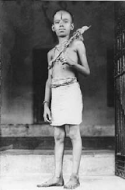
The Younger Dr M Balamuralikrishna
It is difficult to realise how difficult it is for a musician to hang up his boots, to bow out gracefully, to realise even adulation has an unpleasant habit of disappearing overnight. “Opportunities are more now. Suppose the music is not good, people know why that is so immediately. That is the problem. You have to be very careful now. Music knowledge has improved and so also listening capacity. People now know what is good and what is not.”
His greatest contributions to Karnatic music he says is having made it popular. He has innovated and experimented while keeping its rich tradition untouched. He has invented ragas which challenge conventions. In his words, “tradition is nothing without ‘edition’ “.
Ragas like Lavangi are set to three or four notes in ascending and descending scale, others like Mahathi, Lavangi, Sidhdhi, Sumukham have only four notes; while Sarvasri, Omkaari, Ganapathy have only three notes . He has also created a tala system. He may have challenged the status-quo frequently and often brazenly, but his music does pry open doors and lets in the light, the smell, the energy of pure sound.
One of the reasons of his popularity is his ability to sing in many tongues. He can sing songs in almost any language, with the perfect diction and articulation required. He has received two doctorates from the West Bengal Government and was asked to sing 30 Rabindra sangeet songs for preservation. “Because I sang in Bengali, people would come and talk to me thinking I knew Bengali. I just learnt to pronounce each word. I pay attention to the music of each word. I pick up languages easily for singing, not for speaking.” His rendering of compositions in his mother tongue Telugu, both his own and of other greats, is unsurpassed.
Karnatic music is intimately associated with the great Thyagaraja, and the January Aaradhana in the saint-composer’s birth place of Thiruvaiyaru is famous, regularly drawing the best vocalists. But Balamurali has not been seen there in a long time.
“I have sung there, but I am not comfortable that the Aaradhana date is on Thyagaraja’s death anniversary. One does not sing on those days. For me, music is a celebration. I have told them so many times to shift it to his birth date.”
Due to his truncated schooling experience, he had always wanted to learn English. Once a ‘handsome’ lady came to him and offered a handshake. “I did not know what to do with her hand. She looked at me as if I was a country boy. That hurt me a lot.” He went on to learn English and returned one day to thank her and shake her hand for having inspired him to learn English. He would get a laugh talking to his family members in English “because they did not know English and so couldn’t find fault with me”.
The journey from All India Radio to television, from small town performances to big venue dazzlement has won him many national and international accolades and awards.
What is his state of mind these days, one wonders. He admits he is growing old, and is tired of waiting for the Bharat Ratna. He hopes it will come quickly so that he is able to enjoy it.
There is no doubt that it is richly deserved, and millions of fans will rejoice.
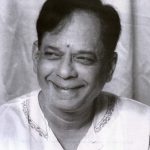
Dr M Balamuralikrishna
Courtesy: Saamagaana-The First Melody