(Following is the text of the 93rd Birth Anniversary memorial oration of Late Leader of Tamil United Liberation Front (TULF) M Sivasithamparam at the Karaveddy, Thachchai Araneri School, Jaffna made by Leader, Sri Lanka Muslim Congress and Minister of City Planning and Water Supply, Rauff Hakeem. ‘We need new remedies to old problems.)
Ladies& Gentlemen,
It is with heartfelt pleasure that I address you this evening in a lecture in memory of Murugesu Sivasithmapram. Indeed, I find it an exhilaratingly rewarding experience because this is the second time that I have been asked to be the principal speaker commemorating and celebrating his life and contribution to the public life in our country. Although he held strong political convictions, he was a moderate with friends on both sides of the political divide. He possessed a charming eloquence in both Tamil and English. Despite an imposing physical appearance, he was a gentle giant with brilliant communication skills that endeared him to both proponent and opponent.
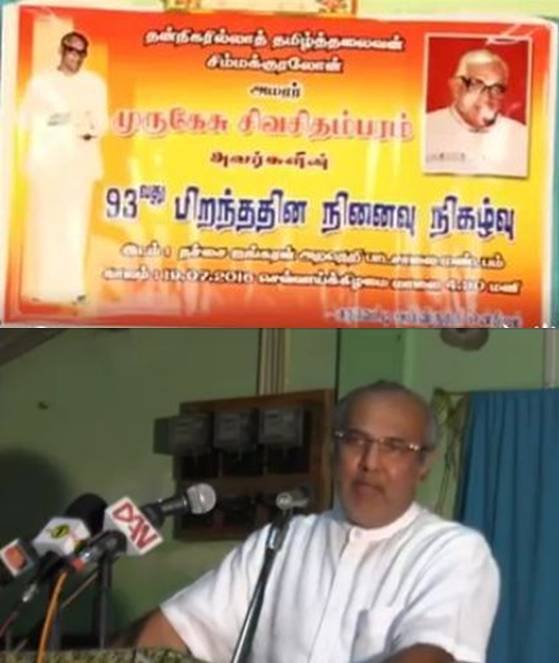
93rd Birth Anniversary memorial oration of Late Leader of Tamil United Liberation Front (TULF) M Sivasithamparam at the Karaveddy, Thachchai Araneri School, Jaffna made by Leader, Sri Lanka Muslim Congress and Minister Rauff Hakeem
He passed away on 5th June 2002, the year he returned to Parliament after an absence of three years. On 23rd January of that year he spoke in parliament on the overarching issues of the Tamil people and by a curious coincidence I followed him immediately after. His concluding line was I quote from the Hansard “While you go ahead with committees, please get together and find a way to live so that the people of this country the Tamils, the Sinhalese and Muslims – can live in peace, in freedom and as equals.”
Since those words in 2002 we have seen the end of a civil war and the dawn of peace. We have freedom and all citizens of this land stand equal. Yet we live in a time when these agreed parameters of the social contract need repetition and reiteration. That brings me to the title of my lecture today. ‘We need new remedies to old problems.’
The immediate inspiration for my title is the profound advice of Sir Francis Bacon who warned “he that will not apply new remedies must expect new evils…” Indeed, we do have two old problems. Our first problem is that we don’t know what our problem is. In order to find a solution we must first acknowledge that the problem exists. Once acknowledged we must define it. Then we must finally commit ourselves to solving the problem.
His Excellency the President, Maithripala Sirisena redefined the problem when he addressed the nation on the 67th Independence anniversary celebration, the first under his presidency at the parliament ground, Sri Jayewardenepura Kotte. He said “to end the war against terror, our heroic troops were able with their guns to silence the guns of terrorism. However, the biggest challenges we face today, is that of bringing together the minds of the people of the North and South, and through a process of reconciliation bring about coexistence and national understanding, and thus take our great Motherland forward as a land rich in human affection and understanding”.
The President has identified and defined our existential dilemma as a nation. We are yet to make Sri Lanka a land rich in human affection and understanding. It is not a Sinhala, Tamil or Muslim problem. It is a problem, dilemma, predicament, plight call it what you may, and there exists a chasm that needs to be bridged with human understanding and affection.
Now, we must ask ourselves why have failed to build an all embracing and central national consensus on what needs to be done to reach a Sri Lankan accord on reconciliation, co-existence and national understanding. I have used the three significant terms used by his Excellency the President in his call for national reconciliation.
Here, I must tell you a story. There were two young fish swimming along, enjoying themselves, content with their world. A much older fish meets them. With old world charm, the elderly Fish nods, and says “Good morning lads, how’s the water? Unimpressed and ignoring the old fish, the two young fish proceeded swimming in the other direction. Suddenly, one looks at the other in penetrative puzzlement and asks “What the hell is water?” Therein lies a tale. A vast segment of our population – the generations born in the last two decade of the past millennium and generations born in the new millennium do not know what water is. Then how will they know what the drenching was in 1983 and or the deluge of the decades after?
Without the personal commitment of each one of us, irrespective of our parochial identities, we cannot hope to reach the goal of meaningful reconciliation. We must avoid the fundamental issue of reconciliation turning in to a political dispute. We must encourage an open transparent debate on the historical interpretations that contending groups cling to.
The problem with nations such as ours, is that, after independence, we have developed different historical narratives for political convenience. Do not forget that some representatives from the north were collusive in the disenfranchisement of plantation Tamils. We are all witnesses to unprecedented repetitions of historical errors. We must avoid reconstructing the past to fit new circumstances and adopt contemporary solutions.
Modernity imposes rigorous and wide ranging changes. It is then natural for people to seek cultural comfort by searching for real or imaginary situations that they find reassuring. That is why you hear people complain ‘things are different. It was so good in bygone days.” Instead of reassuring them, we politicians reinterpret history and confuse them further.
Parties to conflict, develop their own lenses to view the world. Their respective social, cultural and political institutions sustain the particularisms that precipitated conflict. Their educational systems help perpetuate conflict by passing it to successive generations. Societal beliefs entrenched will guide mass media with some exceptional deviants.
I would like to say this couched in the most sensitive and subtle manner that springs to my mind. So, I shall commend to all my Tamil friends who are truly committed to national reconciliation the words of the eminent naturalist Charles Darwin. “It is not the strongest of the species that survives, nor the most intelligent, but the one most responsive to change.”
Reconciliation is coming together. It is the antithesis of falling apart. Reconciliation has a moral aspect. It is coming together of parts that were once united and later torn asunder. But, as I pointed earlier the task is not easy. Contemporary generations born in the nineties and later do not know the origins of the conflict as we do.
It would be more practical and accurate to suggest the converse. We miss reconciliation when we feel and develop a sense of its absence. We should also be focusing on a reconciled society in addition to the reconciled nation. We need to make reconciliation a social attitude and a collective emotion. This is something we should think about more deeply.
Our leaders know the direction. Why do we stand still? Why not move along the path they have outlined in recent times.
President Maithripala Sirisena has said I quote: “Let us bury the bitterness of war completely. War is detestable. It destroys all human values such as love, compassion and kindness. So war is not the solution for this country and our people. .. The country will be able to take forward as a peaceful country only by giving equal opportunities to every citizen of the country and building peace and reconciliation among the communities.”
The Opposition Leader, R.Sampanthan has responded. I quote: “We would like to achieve just fair, practical, permanent and every lasting solution. We should not disturb the current effort to achieve the political solution. … Therefore we all need to try our best to achieve the political solution not only for our own benefit but also for the benefit of the whole country. This is our duty. We should not walk away from it.”
Here is a Sri Lankan Tamil legal luminary who has withdrawn to a diasporic refuge, the Former Attorney General of Sri Lanka, Shiva Pasupati (Deshamanya) – “I think it is better to avoid using words Genocide, Federal constitution and Amalgamation. … In the current situation, it will become very difficult to find a solution if we talk about genocide. …. We need to forget about the past because there is no point in talking about genocide, unfairness and discrimination and blaming the government. It would be very useful if we can think how we can negotiate with government and bring a solution for the betterment of the whole country. We do not know whether we will get the similar opportunity again or not and hence we should not miss this opportunity.”
In approaching the subject of reconciliation it would be futile for me to pretend that I am dispassionate pundit. I am not. I am a politician and the leader of the Sri Lanka Muslim Congress. Therefore my view of pluralism of our society should necessary draw on my own experience of shepherding my people and my party.
In our nominally plural society, there exists a visible hierarchical arrangement of competing ethno-cultural groups with the numerically stronger and therefore ‘democratically’ dominant cultural group at its apex. Tolerance and peaceful coexistence is not only possible but will in all probability thrive, bloom and flourish as long as the predominance of the preeminent group is unambiguously accepted by other groups.
Any challenge to this plural structure which implicitly recognizes the primacy of one group among equals either direct or indirect would be calamitous. Tolerance and coexistence will evaporate. There will emerge forces that will insist on asserting supremacy.
As many scholars of the subject of reconciliation have repeatedly stressed, the promise of a shared future is empty rhetoric if a parallel process is not implemented to manifestly improve the socio political and economic conditions of all communities. Our dilemma will be to redefine equality in a framework which has also the principle of first among equals embedded in it.
On the other hand, reconciliation can focus on the less ambitious short-term objective of developing a relatively amicable relationship between past rivals. Its success will depend on a general recognition of ‘extreme injury’ inflicted upon each other avoiding specifics.
Both sides will acknowledge the reality of terrible acts that were perpetrated. They will admit each other’s suffering and reassure each other that the injustices suffered will be redressed.
Now I have arrived at a very sensitive phase of reconciliation- the claim that truth telling promotes peace and reconciliation by an official account of past crimes and misdeeds. It underlines the premise that there can be no peace or reconciliation without justice.
Now, there is a near universal acceptance of the path-breaking contribution made by the Truth and Reconciliation commission of South Africa. What did the TRC do? What did the TRC achieve?
It is extremely educative to follow its aftermath. There is an excellent analysis of the work of the South African TRC by Paul Van Zyl who served as the Executive Secretary of the TRC published in the Journal of International Affairs, spring 1999.
When the TRC was ready to deliver its report to President Mandela, there arose a controversy. Both former President F.W.de Klerk and the ANC which was the new ruling party launched legal proceedings to block the publication of the report. The African National Congress in its application to the Supreme Court said that the TRC had failed to properly consider its objections to the findings of the TRC regarding its responsibility for human rights abuse. The court rejected the ANC application only a few hours before the release of the report.
Van Zyl argues that the fact that both the ANC and the National Party that institutionalized apartheid were disappointed with the report was the strongest affirmation that the TRC fulfilled its mandate. That claim however is tangential to the point I wish to make. Paul Van Zyl then proceeds to make an observation that we in Sri Lanka should take note of. He says I quote “It also demonstrated that any attempt to deal with past human rights abuse is likely to be both complex and contested.”
In effect what he asserts is that the process did not deliver closure per se. He rightly points out that the work of the South African TRC in dealing with human rights abuse was a middle path that steered between an uncompromising insistence on prosecution and a defeatist acceptance of amnesty and impunity on the other.
In this context what I wish to say is that the process of reconciliation even in the case of South Africa involved a process of a realistic assessment of the extent of compromises the two sides were ready to concede. Reconciliation is not a one way street. It is a wide thoroughfare where both sides can meet at an acceptable median.
Can TRC be replicated elsewhere? I must agree with the Executive Secretary of the Truth and Reconciliation Commission of South Africa. The answer to the question is ‘no’. His explanation is illuminating. The experiment and the experience of the South African TRC is that democracies emerging from periods of conflict and violations of human rights are unable to prosecute more than a tiny percentage of those responsible for human rights abuse. He says I quote “For this reason, strategies for dealing with the past must not become narrowly focused on attempts to prosecute. Rather, more expansive and creative strategies should be considered and employed in order to address the rights of victims and the needs of society as a whole.”
He offers another remarkably prescient piece of wisdom. “The manner in which a successor government chooses to deal with those who have committed gross violations of human rights, during the tenure of a previous repressive regime is profoundly influenced by the balance of power between the old and new orders at the time of transition.” A peace that reaches beyond the absence of war requires healthy social relations between former adversarial communities (I have repeated this line again at the bottom).
There is now a discussion on setting up a constitutional court under envisaged reforms to our constitution. Representing a minority community, I would strongly advocate such a court. In democracy, the majority prevails. If the majority dominance diminishes the natural rights of minority citizens it moves from functional to a dysfunctional democracy. A constitutional court will therefore meet the excellent purpose of balancing the majority view with the intrinsic and inherent rights of all citizens no matter which cultural, ethnic, religious or economic group they belong to.
We should recall how we have arrived at this point. My mind now goes back to 8th January 2015. The Northern and the Eastern province voted overwhelmingly for change. The rest of the country did vote for change, but grudgingly. As pragmatic politicians we must now accept that protest on the street is also a part of the socio-political transformation we made with the election of President Sirisena. In reading the balance of power, we must also recognize that former dispensation is also entitled to the privileges of street protest. Our sense of realpolitik must supersede idealistic yearning for perfect absolute justice.
A peace that reaches beyond the absence of war requires healthy social relations between former adversarial communities. Profoundly expressive harmony and cooperation is possible not by punitive justice but by socio economic justice. Even in the post 8th January 2015 yaha palanaya, the marginalized and the deprived of all communities have not seen the light at the end of the tunnel not so much because the length of the tunnel, but because they have a long trek to the tunnel itself.
An agenda for social transformation can be effective only when it is designed to remove structural and systemic obstacles to social and national integration. The process needs to move beyond dialogue. In the absence of this understanding, we will continue to grope aimless mouthing platitudes – exclusion, marginalization, discrimination while wallowing in fragmentation.
In the absence of a determined effort by the majority community and also the aggrieved minority community the mere continuance of a dialogue amounts to a deception of the people and an attempt to persuade them to live in harmony and amity while perpetuating imbalances of power and abuse of power. The elected representatives of both sides of the divide are exposed to that risk.
In conclusion, I would like to commend to you a marvelously simple and honest definition and an amplification of national reconciliation made by Professor Elisabeth Porter of the University of Ulster and Flinders University. “People want peace, but reconciliation is a demanding ethic. It requires estranged, traumatized people to reach out to those who have been their opponents, antagonists or enemies, those who have harmed them in deep ways. This is not easy. Trust takes a long time to build and is easily broken. The places of meeting where reconciliation occurs are diverse. They include institutionalized tribunals and truth commissions, but at a wider level, they occur in everyday spaces where people meet in markets, under trees, around kitchen tables, drawing water from a shared well, in pubs and culturally diverse face-to-face encounters.
Thank you for your patience. In the final analysis as Judge Porter puts it so poignantly what matters is the face-to-face encounter.
To carry home I offer you something lighter from the Persian poet Saadi Shirazi. “However much you study, you cannot know without action. A donkey laden with books is neither an intellectual nor a wise man.
Empty of essence, what learning has he whether upon him is firewood or books?”