By
Radhika Coomaraswamy
(Text of Keynote Address “THE ART OF NUANCE:LAKSHMAN KADIRGAMAR THE STATESMAN” delivered at BCIS in a ceremony to commemorate the tenth death anniversary of Lakshman Kadirgamar PC. MP on August 12th 2015)
Every generation has its ideal man or woman, the icon who defines the values and aspirations of that generation. Lakshman Kadirgamar was born into an elite Colombo Tamil family in 1932. For members of that elite, in the era before international schools, going to Royal College, St. Thomas’ College or Trinity was absolutely essential. Being first in class was another important attribute. A University education in England was absolutely necessary and being a coloursman in sports was a must. The chosen vocation of such an individual would have been the professions or public service- not for them the world of business which many of them scorned in the era before globalization.
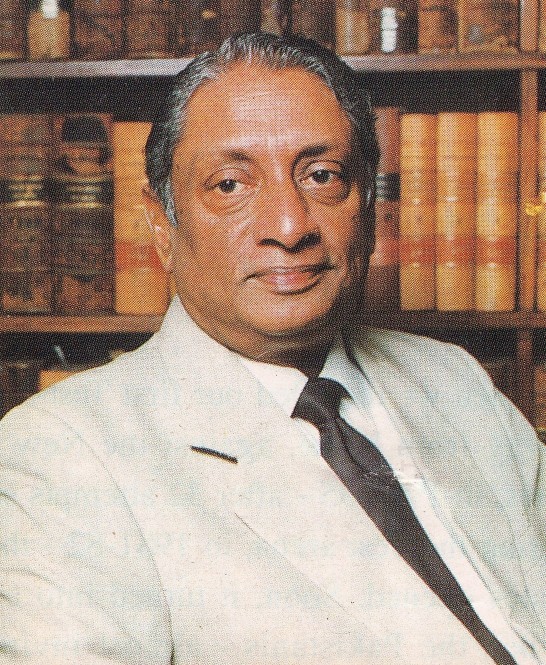
Lakshman Kadirgamar
While all his brothers went to Royal, Lakshman Kadirgamar went to Trinity because of the war and he was very proud of his old school. There he captained the cricket team and played rugby, a common face during the Bradby shield encounter with Royal. He won the prestigious Ryde Gold Medal at Trinity for being the best all round student and he was also a senior prefect. He then went onto Law School and Law College being placed first in the advocates’ final examination. Thereafter he went to Balliol College at Oxford, where he was the second Sri Lankan after Lalith Athulathmudali to be the President of the Oxford Union. He also played cricket for Balliol. My father would have looked at his CV and said “what a perfect life”. – Except of course for the fact that he did not go to Royal.
1956 brought a sea change in the political aspirations of this country and challenged the trajectory of the lives of elite Colombo Tamils. Placing an emphasis on Sinhala only, the rural schoolteacher, the public servant, the national entrepreneur and the Ayurveda doctor became the role models.

Dr.Radhika Coomaraswamy delivering Prestigious Grotius lecture, April 9. 2014
Overnight this Tamil elite became reviled as one of the great conspirators against the aspirations of the rural Sinhalese. The 56 movement had its positive points in that it gave voice to the vast majority of Sri Lankan but its exclusivist tendencies reached its pinnacle under the Presidency of Mahinda Rajapakse, where no minority felt that they belonged to this island.
The 56 revolution drove many of the Colombo Tamil elite out of the country either as immigrants or to join international organizations so that they could at least spend retirement in their beloved country and not give up their citizenship. Lakshman Kadirgamar was also one of them. He went abroad, lived in Geneva and worked for the World Intellectual Property Organization. When he retired he came back to Sri Lanka. But instead of sipping cocktail drinks every evening at the 80 club or retreating to enjoy the gorgeous flora and fauna in our country, he first went back to practice and then accepted President Chandrika Kumaratunga’s offer to become foreign minister.
To do that, he had to make his peace with the 56 generation and their children. One day he invited me over to discuss the possibility of bringing to Sri Lanka Indian leftists who were familiar with issues such as devolution and federalism and who could explain them from a Marxist framework. He had struck up a friendship with the leaders of the JVP and was determined to continue a dialogue with them about politics and the national question. Over time he seemed to have won their trust and they mourned his death with public expressions of grief. When you see the JVP today, renouncing violence, looking like a vibrant, modern party, always defending their position with facts and figures, one wonders how much of Lakshman Kadirgamar’s influence lingers on in their new approach to politics and society.
As part of his effort to reconcile with the 56 generation, he also reached out to the larger Sinhala community; some say with Prime Ministerial ambitions, others argue because he felt that this was the only way to move forward. He, for example, brought the proposal at the General Assembly to make Vesak an international celebration day and as a result it is celebrated every year in May at the General Assembly in New York.
Lakshman Kadirgamar will always be remembered for generations as one of the most successful foreign ministers of Sri Lanka. During the Rajapakse regime he was celebrated as a hero and his many caustic remarks about the United Nations and the West were often repeated with glee. For e.g. He once said that the United Nations should stick to eradicating mosquitos. But Lakshman Kadirgamar was far more than that and his strength lay in his ability to factor in nuance into our foreign policy.
It is true he drew boundaries that he felt that the UN and the West should not cross. But he always kept the door of dialogue and negotiation open and he never displayed bad faith. Despite all his caustic remarks he retained their trust. So much so it was during his time that the funding for the LTTE in western countries was stopped through effective legislation and quick implementation. That was the beginning of the end for the LTTE. For that we have to be grateful to Lakshman Kadirgamar and also to the western countries whose confidence he had won. It was his ability to be nuanced that gave him the strength to deal with his counterparts and made him an effective foreign minister
Mr. Kadirgamar did have a very complicated relationship with the United Nations. Unlike in the 1970”s with Gamini Corea in UNCTAD, my father Raju Coomaraswamy at UNDP, Shirley Amerasinghe at the Law of the Sea where they were working with a tide of third world solidarity resulting in the proposal for a New International Economic Order- (that collapsed with the rise of Milton Friedman and the tiger economies of South East Asia) – Lakshman Kadirgamar worked for WIPO which was completely dominated by the West and protected western copyright interests often at the expense of the third world poor. As a result he remained deeply suspicious of western agendas within the UN system though he worked effectively with some UN agencies. UN Resident Co-coordinators constantly claimed that he was Janus faced, one day positive, the next day distant. That duality was due to his general ambivalence. He knew Sri Lanka needed the UN but his own experience made him weary.
Lakshman Kadirgamar also had an uneasy relationship with members of the Tamil community- and to be honest- even at times with me. Asis Nandy in a tribute to Neelan Tiruchelvam had mentioned that before independence, especially for elite Tamils there was no distinction between being Tamil and being Ceylonese or Sri Lankan. They were in the forefront of the independence movement. The Jaffna Youth Congress, of which Lakshman Kadirgamar’s father was a member, was after all the first group in the country to ask for independence. Sir Muttu Coomaraswamy was the one who defended Buddhism in the State Council in the nineteenth century and Ramanathan and Arunachalam were leaders of the independence struggle- though Arunachalam in his later years seemed to have second thoughts. And of course Ananda Coomaraswamy was the first person to write about and revive Sinhalese arts and crafts in the twentieth century.
For people like my father born in that era that identity continued even after independence. – There was no tension or distinction between being Tamil or Ceylonese- Sri Lankan. The same could be said for Lakshman Kadirgamar. They were Colombo based and as I said members of the elite. They dealt with their Sinhala counterparts as equals. So when Tamil federalist politics began leading to a movement for separation they were aghast. They were deeply suspicious of Chelvanayakam and this type of politics. The Vaddukodai Convention left them cold. They just could not stomach it. Whether it was just a matter of class prejudice or their belief in a united and centralized Sri Lanka, where equality was the goal and not power-sharing, as being the best solution for Sri Lankan problems is something we will never know.
What was happening in the Tamil community was in some sense the parallel of the 56 revolution. The centre of power moved away from Colombo and leaders had to fulfill the aspirations of the provinces and the rural poor. The expression of this sentiment in separatist terms is a long discussion that we cannot have here but suffice to say that Lakshman Kadirgamar and people like him in the Tamil community had no sympathy for this politics and always felt it was a route to disaster.
His coldness to issues relating to Tamil politics had its consequences. Many Tamils do ask- why Lakshman Kadirgamar did not even try to understand the aspirations and needs of the young people in Jaffna? They were aghast when he said that there was no discrimination against minorities in Sri Lanka. They argue that if he was willing to talk to the JVP, why not to militant Tamils? Why did he seem so hardened to the suffering of Tamil people? For such reasons many Jaffna Tamils, even today, still do not forgive him.
The answer to all those questions was of course the LTTE. If Lakshman Kadirgamar had an implacable foe it was the LTTE. They were anathema to everything he believed in and stood for. He wanted them eliminated and he was a strong believer in a military solution while other leaders wanted to combine both a military and a political effort. He is well known for his opposition to negotiations with the LTTE, making stirring speeches from the opposition benches during the ceasefire period.
Again whether his approach was correct is a long discussion, but it is important to understand that Kadirgamar in this position was not being opportunistic- these were deeply held beliefs- as he said in his BBC interview: – “People who live in Sri Lanka are first and foremost Sri Lankans, then we have our race and religion, which is something given to us at birth”.
It is also fair to say that he remained troubled about his image in the Tamil community. Once I made a very anti LTTE speech in Canada and the web was as usual full of venom and nastiness- one gets used to that after awhile- and the fax machine at the Canadian embassy here also collapsed with angry faxes. Lakshman Kadirgamar called me over and expressed concern. He then spoke at length about how the Tamil community misunderstood him and how it was in their best interest to get rid of the LTTE. He was aware of their suffering and recounted to me the many quiet humanitarian negotiations he had conducted on their behalf.
But the mere mention of the LTTE would make every muscle in his body tense. He would not compromise where they were concerned. However, whether he would have sanctioned the humanitarian crisis and the bloody end that we saw in May 2009 is another question. He may have preferred a more humane option. It is not well known that Lakshman Kadirgamar was an active member of Amnesty International in his youth. In 1963 he was commissioned by Amnesty International to investigate the issues in South Vietnam. This was the first ever report for Amnesty International of a situation within an individual country and thus was a pioneering effort in the growth of the international human rights movement. As I said earlier he was a man of nuance.
Lakshman Kadirgamar had many winning personal qualities. He was loyal to friends- when Lalith Athulathmudali was assassinated he stood firmly by his widow, interrogating and questioning Scotland Yard as they had been put in charge of the investigations, insisting that it was not the LTTE but another force that had killed his friend. Because of being involved in a plane crash in his forties, he lived every day with terrible pain in his lower back that he bore with fortitude. He was a great raconteur and when we were young and spent evenings at the family home in Queens Road he would keep us spellbound with his many tales. While his brother Sam Kadirgamar QC terrified us, sitting on the verandah with his torn banyan and keen intellect, pulling our legs and giving us disapproving looks for not being perfect, Uncle Lakshman, as we called him, was more charitable and only smiled when we said stupid things in our eagerness to impress.
Lakshman Kadirgamar’s charm and grace could be interrupted by a caustic wit. When Shane Warne refused to come to Sri Lanka in 1996 saying that he could be targeted by a terrorist while shopping, Mr. Kadirgamar replied, “shopping is for sissies”. (We will ignore the sexist nature of this comment). The Australians were furious, as was the Australian foreign minister. Mr. Kadirgamar eased the tension by sending flowers to his counterpart as an apology with a note that said “Sending flowers is also for sissies”. That in a capsule then captures the art of nuance- the art he excelled in with a quiet dispassionate charm.