Introduction
The Sri Lankan Tamil refugees have lived in the camps of Tamil Nadu since 1983. Depending on the situation in Sri Lanka they have moved back and forth. Since 1991 refugees have lived in the camps of Tamil Nadu with the assistance of the Government of India (GoI) and the Government of Tamil Nadu (GoTN).
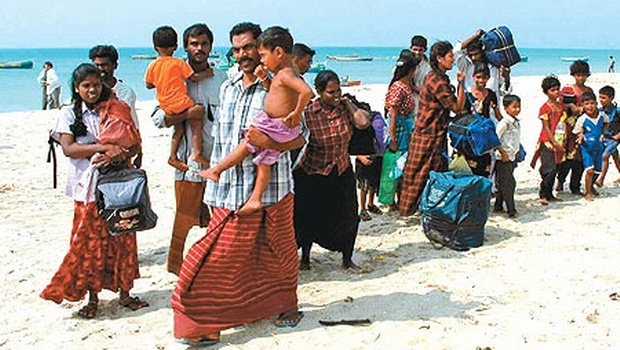
File pic via: PTI
Over the years with the patronage of GoTN, they have been able to survive the hardships of refugee life. During their stay in India, they have been able to access the benefits of health and education. As a result of this, currently there are 3,812 graduates, diploma holders and skilled personnel. With the war in Sri Lanka coming to an end in 2009, refugees have been contemplating on durable solutions. Over 8,000 refugees have returned to their motherland and have been able to restart their lives, whereas the vast majority of the refugees still remain in camps thinking about their future.
In this context, OfERR, an organization of the refugees, conducted seventeen rounds of discussions with the refugees from all the 110 camps located in 25 districts in Tamil Nadu over a period of nine months. It brought together a cross-section of the population in order to ensure a collective representation of the future thinking. The consultation process facilitated refugees diving deep into their current experiences, aspirations and hopes along with the fears and concerns. Refugees discussed a range of options, starting from staying in Tamil Nadu, emigrating to a third country and returning to Sri Lanka.
During the consultations process across the camps, it soon became clear that refugees recognized their right to return home as one of the solutions, but had a range of concerns. Refugees firmly resolved that the only durable solution to end the refugee status was to rebuild their homeland. Additionally, it would extend itself to rebuilding their lives.
This document reflects challenges likely to be faced by the refugees before return in India and on their return in Sri Lanka. The following are the list of the requests refugees have placed in front of various stakeholders in order to ensure a safe, dignified and sustainable return.
Preamble
We, the representatives of the refugees living in the camps in Tamil Nadu, firmly resolve to seek a durable solution to the refugee status that we have tagged for over three decades.
We believe that our stay in Tamil Nadu has equipped us with the necessary capacity to determine our future and that of our children.
We understand that the war in Sri Lanka is over, but disagreements endure affecting effective resolutions. However, we believe that we have a role to play in restoring participatory democratic process contributing to long lasting peach, harmony and prosperity.
We hereby acknowledge our responsibility to reconcile our war torn communities and rebuild our fractured motherland.
Not-withstanding the protracted nature of displacement, we reaffirm our right to return to our country and our obligation to protect, promote and preserve our culture, our property and our homeland.
In keeping, we urge all stakeholders to respect our rights, give due consideration to our needs and aspirations, and ensure a consensual solution for the problem. Our requests, which have been categorized below, are as follows:
Political resolution
1. An agreement/accord that guarantees the equivalent or stronger provisions as agreed under the Indo-Lanka Accord signed between Hon.Rajiv Gandhi and Hon.J.R.Jayawardena should be agreed to facilitate a permanent political solution for the ethnic conflict. This agreement should regularize the powers of Provincial governments.
2. Demilitarization of the northern and eastern provinces should be completed, along with closing of newly created Sinhalese settlements in Tamil areas
Protection
3. The Government of Sri Lanka (GoSL) should guarantee the security of young men and women in the country
4. In tandem with the provision of security Tamils should be recruited into the armed forces and police to reduce tensions, rebuild confidence, and to improve the security situation.
5. GoSL should release political detainees and ex-militants, who are in the custody of Army and Police. Efforts should be ensured to communicate the information about the arrested persons to the concerned family members.
6. Step-up efforts to demine areas of return and the GoSL, as an interim measure, should provide local communities with accurate and reliable maps clearly indicating mined and demined lands
Resettlement and Return of Refugees
7. The GoI and GoSL, taking into account various concerns of refugees, should develop a Memorandum of Understanding (MOU) on refugee returns. This MOU should ensure voluntary return of refugees in a safe, dignified and sustainable manner. This MoU should spell out the details of protection and humanitarian assistance assured to the returnees.
8. UNHCR to form a committee to specifically supervise the return and resettlement of Sri Lankan refugees from India. This committee to continue until the repatriation and reintegration process is complete.
9. Refugee returnees should be issued Sri Lankan National Identity Cards immediately on arrival to ensure returned refugees have recognized identity documents and are treated in accordance with their rights as Sri Lankan citizens. Documentation requirements should be kept to a minimum and refugee identity cards issued in India should be considered documentary evidence.
10. Refugee returnees should be granted access to essential welfare services, including land and housing, to ensure proper rehabilitation. The welfare services should be extended to the returnees for minimal period of three years from the time of return.
11. Refugee returnees should be assured with establishment of systems/schemes to reclaim their housing, land and properties; and if landless, a piece of land should be granted or equal compensation should be offered as per their wish.
12. Those, who don’t have documents proving their housing, land and property ownership should be assured of access to timely and fair processes through which to reclaim their lands with the evidence of substantial alternative documents or process of verifying the claims
13. Housing, land and property that has been possessed or occupied by the Sri Lankan Army or the public should be vacated and ownership restored to the rightful owners.
14. Extremely vulnerable individuals and families should be accorded priority access to goods and services appropriate to their needs and with a view to reducing their vulnerability and exposure to protection risks.
15. The ‘upcountry Tamils’ of Indian origin, who were displaced from the central highlands/tea plantations/hill country to Northern Sri Lanka and then to India, should be prioritized among the returnees and resettled in the areas of their choice.
16. Return of Sri Lankan refugees from India should be facilitated after ensuring the resettlement and rehabilitation of internally displaced persons (IDPs).
17. Given the short distance between Sri-Lanka and India, and the fact that refugees have acquired household goods and assets during their protracted stay in India that will be essential to their future livelihoods on return, the ferry service between Rameswaram and Talaimannar should be re-started to enable refugees to transport their household goods and properties including machinery and vehicles, etc. The GoI and GoSL should exempt all charges/taxes on the export and import of these goods.
18. The GoI and GoSL should come to an agreement regarding the safe transfer of their assets and savings from India to Sri Lanka through the official banking system.
19. Systems should be established to avail refugees of the benefits of life insurance, fixed deposits, bank savings, etc. in Sri Lanka on return.
20. All documents issued by the GoI, such as driving licenses and refugee identity cards, should be recognized and accepted in Sri Lanka on an interim basis or until replacement documents issued by the GoSL.
General Amnesty and compensation
21. Sri Lankan refugees, who were earlier part of militant groups, should be granted a general amnesty and guaranteed to live without any difficulties in Sri Lanka
22. Death certificates, insurance and compensation in cash or kind should be provided for those who died in the war.
Essential documents
23. Essential documents such as birth, marriage, death and academic certificates for every refugee family should be ensured before return. These essential documents must be accurate and recognized.
24. Sri Lankan refugee children, who were born in India, should be issued consular birth certificates and citizenship certificates by accepting the available documents of the parents. In the event of unavailability of parents’ documents, consular birth and citizenship certificates should be issued for the children by obtaining affidavits from the parents. Those who have already turned 18 years of age should be exempted from penalties applying to the late registration for Sri Lankan citizenship.
25. Sri Lankan refugee children without parents should be issued consular birth certificates on humanitarian grounds with a minimum of documentary evidence required.
26. Children, who were born during displacement caused by war, should be issued consular birth certificates and citizenship while in India itself with the support of minimum documents.
27. The Sri Lankan Deputy High Commission should issue Sri Lankan refugees, who are living outside the camps with or without Police or Superintendent of Police or Immigration Department registrations, travel documents or a one-way passport, to enable their return to Sri Lanka.
28. Regardless of whether registered or not, the GoI/Ministry of Home Affairs should recognize all Sri Lankans living outside the camps as refugees and waive their overstay penalty and visa fees in order to enable refugee return.
29. Mobile teams should be dispatched to remote areas to enable refugees’ access to documentation services and speed-up the issuance of documents.
Education
30. The Indian High Commission in Sri Lanka should facilitate the process of correcting and authenticating academic transcripts and certificates of returning refugee children.
31. Those who wish to continue their schooling and/or higher education in Tamil Nadu, should be provided hostel or other accommodation facilities and special schemes to continue their education in India.
32. The GoSL should recognize Indian educational attainments and ensure returnee children are able to continue their education in Sri Lanka without difficulties. Special arrangements should be created for the education of returnee children in Sri Lanka
33. All the technical, diploma, degree, professional and other academic courses followed in India should be recognized and equivalent certificates should be issued for all these academic certificates without delay.
34. Affidavits should be prepared in India to rectify the mistakes in academic transcripts and certificates and the GoSL should recognize the affidavits.
Health
35. Special immigration and emigration permissions should be issued to returnees to travel back to India for medical treatment and other purposes. Facilities for returnee visitors should be made to enable their temporary stay during such visits.
36. Chronic patients should be encouraged to take their medical records and documents upon return.
37. Special facilities should be made available for needy patients to undergo surgery in India prior to return.
38. Medical facilities in Sri Lanka should be improved to meet the needs of returning refugees.
39. Differently abled persons should be supported with the medical appliances such as wheel chairs, prosthetics before or at the time of return.
Livelihood: Employment opportunities
40. To ensure incomes and livelihoods for returnees families on arrival, and give refugees greater confidence in their ability to cope on arrival, employment linkage services should be enhanced, particularly the development of online employment services (for employment listings and the submission of applications).
41. Qualified returnees should be considered for government employment on a priority basis.
42. Those who were trained on livelihood and vocational fields should be extended loan provisions through government and private banking systems.
43. The Ministry of Industrial Development, GoSL and NGOs in Sri Lanka should offer returnees livelihood trainings and self-employment should be encouraged.
44. Livelihood schemes should be generated in the Northern and Eastern provinces of Sri Lanka with the support of World Bank.
45. People societies, especially women self help/community based organizations that are ready to engage in micro enterprising activities as groups should be encouraged with special loan provisions with nominal interest.
Documentation in India
46. Refugees intending on returning should be granted Overseas Citizen of India (OCI) status to enable them to come back to India for their medical, academic and other needs. A multiple entry visa facility should be established to enable Indo-Lankan multi journey.
47. The GoI and GoSL should agree to offer the children of Indo-Lankan couples their choice of citizenship in either country.
48. The GoI and GoTN should consider continuing same educational welfare measures that are available for the refugees now, to the returnees as well, to enable them to pursue professional and skilled academic education in India upon return.
Conclusion
Refugees, for the first time post ending of war, have spoken through this document. It is an expectation to find durable solutions, one of which is settling down in the island. This document reflects challenges likely to be faced by refugees in India before return and on their return in Sri Lanka. Refugees are confident that their requests arising out of a consultative process will be valued, respected and appropriately acted upon. Refugees expect that this forms a substantial part of a MoU and action plan supported by appropriate administrative mechanism and resources paving way for a constructive durable package for settling down in Sri Lanka. Refugees in India would expect this to emerge as a role model for similar situations around the world. Towards this they seek the support of all the stakeholders.
Voice of Sri Lankan Tamil Refugees in India