By K. Thirukumaran
Ammah: Since god cannot be everywhere,
Everyone here has this most selfless person in her or his own lives.

Neeampikai Ammal Kanapathypillai (April 15, 1934-August 10, 2014) & Sangarapillai Kanapathypillai (August 20, 1929-December 13, 2013)
Her passing is irreplaceable and all the more difficult to bear when she had not thought of seeing this day so soon a mere few weeks ago.
She borne the 4 of us for 10 months times 4, for 40 months, but didn’t even spare 4 weeks for us to care for her during this illness.
Ammah’s time on earth would still be a fairy tale, although the destiny of ending the journey here with this illness is amongst the toughest.
Ammah is confident about the journey’s end, and she inculcates the teachings of Gita in this regard.
Faith
While being ill, it gave her time to say good bye and even tell my sisters a few days ago what color to wear today (for cremation), and her faith emerged only stronger, as she wished for a quick close while being alert and dignified. That has been realized and she is one sweetly graced.
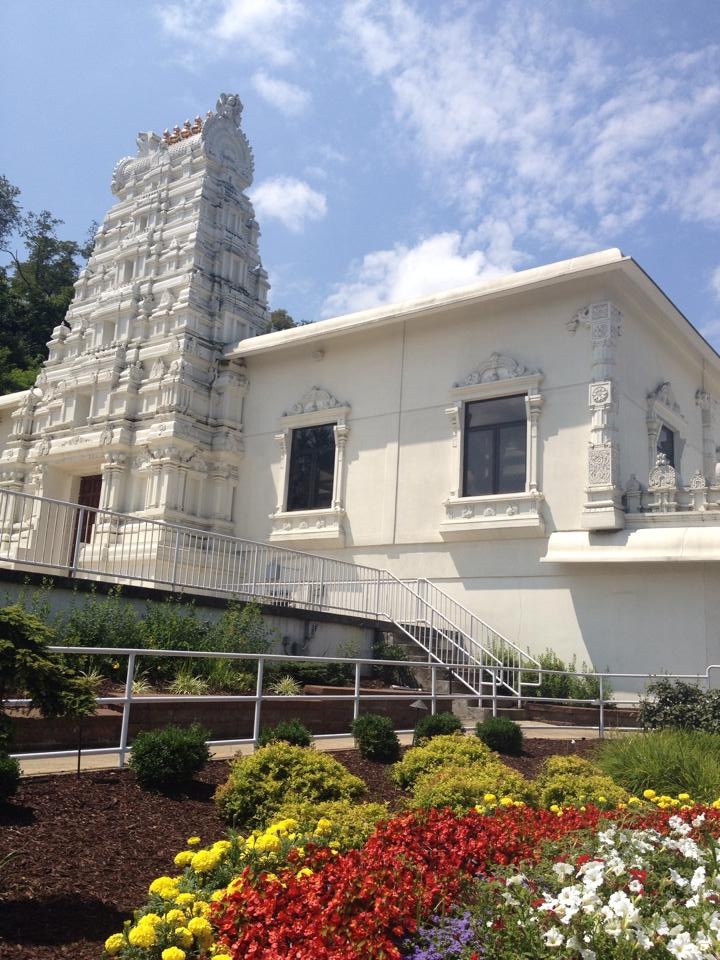
“Faith only emerges stronger”-Sri Venkateswara Temple, Pittsburgh, PA-Picture taken on Aug 2, 2014
Ammah’s colour choice for this final day is perhaps due to her father, Arumugam Murugesu – whom she called Aiyah. Our grandfather instilled the Lord of Benevolence, Murugan as her cherished deity, who is dressed in green on the thear (chariot) festival day at Nallur Kanthaswmay Temple in Jaffna. Though our grandfather, whom we called Appa, was a Lord Siva devotee and rarely went to any other temples, he made an exception in arranging for an Abhishekam ritual at the Nallur Kanthaswamy Temple annually on Sithirai – Parani, the birth star of Ammah.
So when I say of my Ammah is like this and all, everyone can relate to their own moms as well. Our heritage and adages tell that since god cannot be everywhere, therefore Ammah is created. It’s also a tradition that places the entire womanhood in the realm of motherhood.
Pristine
Ammah’s life has been a journey of joy. To benefit my sons, nieces, nephews and for those blossoms of future, friends and all others, I want to recall Ammah’s pristine beginnings.
She is the only child of my grandparents in Kalvayal, Chavakachcheri in Northern Sri Lanka.
The village Ammah grew up in is situated in the Southern part of the Jaffna peninsula, and can be said as being more remote and less in terms of famous schools than its northernmost counterpart, Vadamaradchi and Valikamam regions. There was no electricity in the village, even during the early years I visited.
Yet, the region known as Thenmaradchi is very prosperous due to the abundance of paddy fields that yield bountiful harvests even at times of seasonal rain faltering. The sowing paddy (vithai nellu) from there was sought after all across Sri Lanka those days in anticipation of a bumper crop everywhere. Ammah, Pappa and both their families are lifelong vegetarians, like many others in Thenmaradchi. Scholars say this is possibly due to influence of Jainism and related migration to the region.
Ammah’s home in Kalvayal, hallmarking Jaffna peninsula homes – is situated in a grove of mango, jak fruit trees, lemon, pomegranate, coconut, palmyrah, margosa trees amongst others and a water well surrounded by areca nut trees.
The town centre is filled with rice mills, goldsmiths and a grand farmers market (Santhai) that met only on Tuesdays, Thursdays and Saturdays. In the days preceding and after the Tamil Thanksgiving Day, Thai Pongal, Pongal Santhai would grandiosely burst in prosperous sentiments.
The temples held regular festivals with fanfare. My grandfather was retired after being a teacher in nearby Meesalai, when I was old enough to know him. I remember his evenings and nights of listening to All India Radio, Carnatic, light music programs or religious topics, and his deliberations about them with his friends on the verandah.
My Ammammah – Visaladchy, my first perception of how kind and generous a person can be was with my grandmother, also retired after teaching in a school nearby.
Ammah, though an only child, has numerous cousins. Many of them we knew also lived in nearby Sangaththanai, popularly known for being the location of Chavakachcheri Hindu College. From Kalvayal, Ammah’s Aiyah sent her to this school and later to Jaffna – to Hindu Ladies College in Vannarpannai.
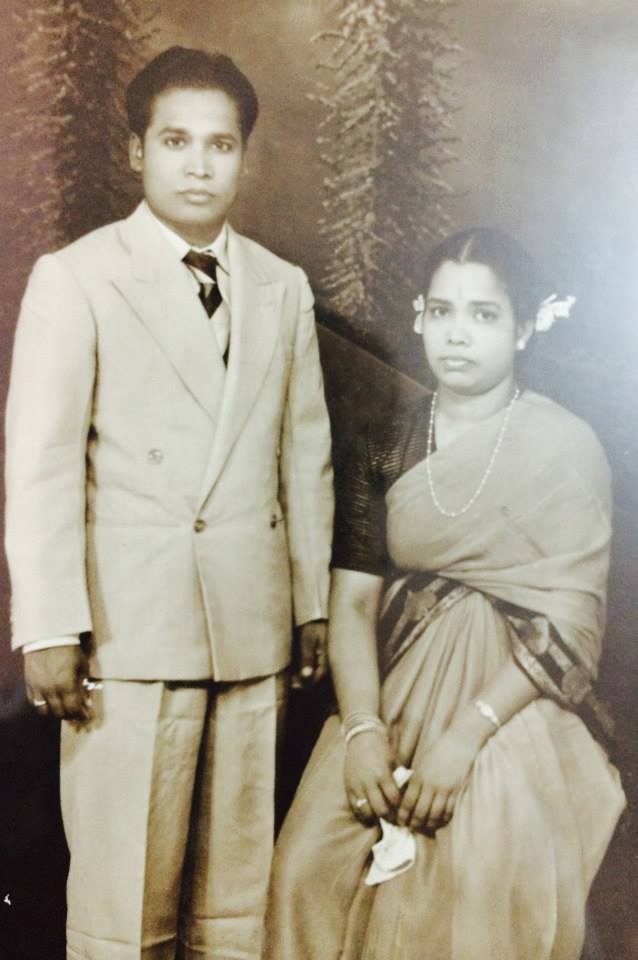
Pappa & Ammah
Boundless
When Ammah got married at the age of 21 to Pappa, she moved to Colombo.
Ammah’s mission, like only a mother can do, is to spread her selfless love to the family. Our Ammah is extremely caring, and in the meantime, open minded about our good-natured pursuits.
Ammah loves all arts, especially Tamil music, literature and dance. Ammah is an avid reader and follower of prolific writers such as Rajaji, Bharathiyaar, Kalki Krishnamoorthy, Ki. Va. Jagannathan, Akilan and Kannadasan. She likes the music in the trinity of M.S. Subbulakshmi, D.K. Pattammal and M.L. Vasanthakumari. One of her favorite singers is the rustic voiced rarity named A.L. Raghavan.
Nowadays, when I translate Tamil poems and works, I would often call Ammah for help. If something needs further research, she would tell me “paatthu solluran” (I have to look it up), and get back to me with more than I needed to know, resembling her boundless affection.
During my school years at D. S. Senanayake College, I remember Ammah waking up very early in the mornings, and through the night she would make at least 4 meals for us.
Around mid-morning, almost during the entire week, she would go to the Bambalapitty Pillaiyar Temple and/or shopping at Wellawatte market for fresh produce. Ammah’s meals are loved by all. When she shared them with her dear friends and neighbors like Mrs. Edith Pereira whom we called Nana, she would bring to us her own goody such as homemade strawberry and wood apple jam. Nana would hold both of Ammah’s hands while exchanging pleasantries. Ammah will now have such good company in her place of peace.
Ammah would always make me snacks to take to school even at the point where I insisted it was not so cool to bring food from home. She would take me to this tailoring shop that was the hardest ever to get to because she knew I favored the way they stitched the trendiest garments. This was also the case when there was an M.G. Ramachandran (MGR) starring matinée, and when no one else in the household would want to see the movie.
Separation
And when the time came that I had to separate from her to come to the USA, I remember to this day, Ammah’s eagerness for my betterment on that eve of parting for a long time to come. That was exactly 30 years ago in August 1984.
There was no way to send an SMS or pay phone near the US Embassy in Colpetty that I could use to inform her of the news about securing the US student visa. Upon returning home, however, I remember Ammah sitting with her hands clasped near the wide opened front door and looking towards the gate, awaiting my arrival. She got up as soon as she saw me with her wet eyes once I told her the news. This would mark the real beginning of my departure from Ammah up until today.
This separation is symbolic of their generation. Although, I understand several of us are accustomed to our relatives, friends and others undergoing even more severe and darker forms of detachment from our homes and parents missing their children.
Sacrifice
Pappa on December 13, 2013 and Ammah during the early hours of August 10 left us. They departed from this world from the very same bed in the very same room at home in Markham, Ontario. I still don’t exert the feeling that it’s permanent. Is it that having been not living near them for many years giving me this false comfort, I think so.
They belong to a generation of parents who have made huge sacrifices, especially a sacrificial separation from their loved ones for the enhancement of their children’s future. The generation I refer to are those noble souls, born anytime a decade after the turn of the last century through the 1940s.
In going back to say 100 to 700 years, which of our previous generations would have made a similar sacrifice? There could have been many, as human history is a history of migration and separation. Although migration from the Indian sub-continent has been prevalent during the last 200 years, my parents’ generation endured a sacrificial journey in the later part of their lives.
For those of us who are from the isle of serendipity, our parents’ generation migrating in vast numbers, than the previous two, is truly phenomenal.
Without whom they are and what they were ready to put up with such as limited mobility – in starting a new life with their loved ones or being at distance at home or another diaspora country, their sacrifices are immense.
Light
Their sacrifice is in silence to re-establish in a new land or circumstances in their golden years. Nevertheless, they resourcefully adapted to the new environment.
I can’t forget your sense of “duty” and how caring and kind you are Pappa and Ammah, and I am only hoping I can be like you two and do justice for all the time I am not able to be near you.
Now slowly but surely, we carry the flame. It is in the light of your blessings, Ammah and Pappa that the wellbeing of us all is assured.
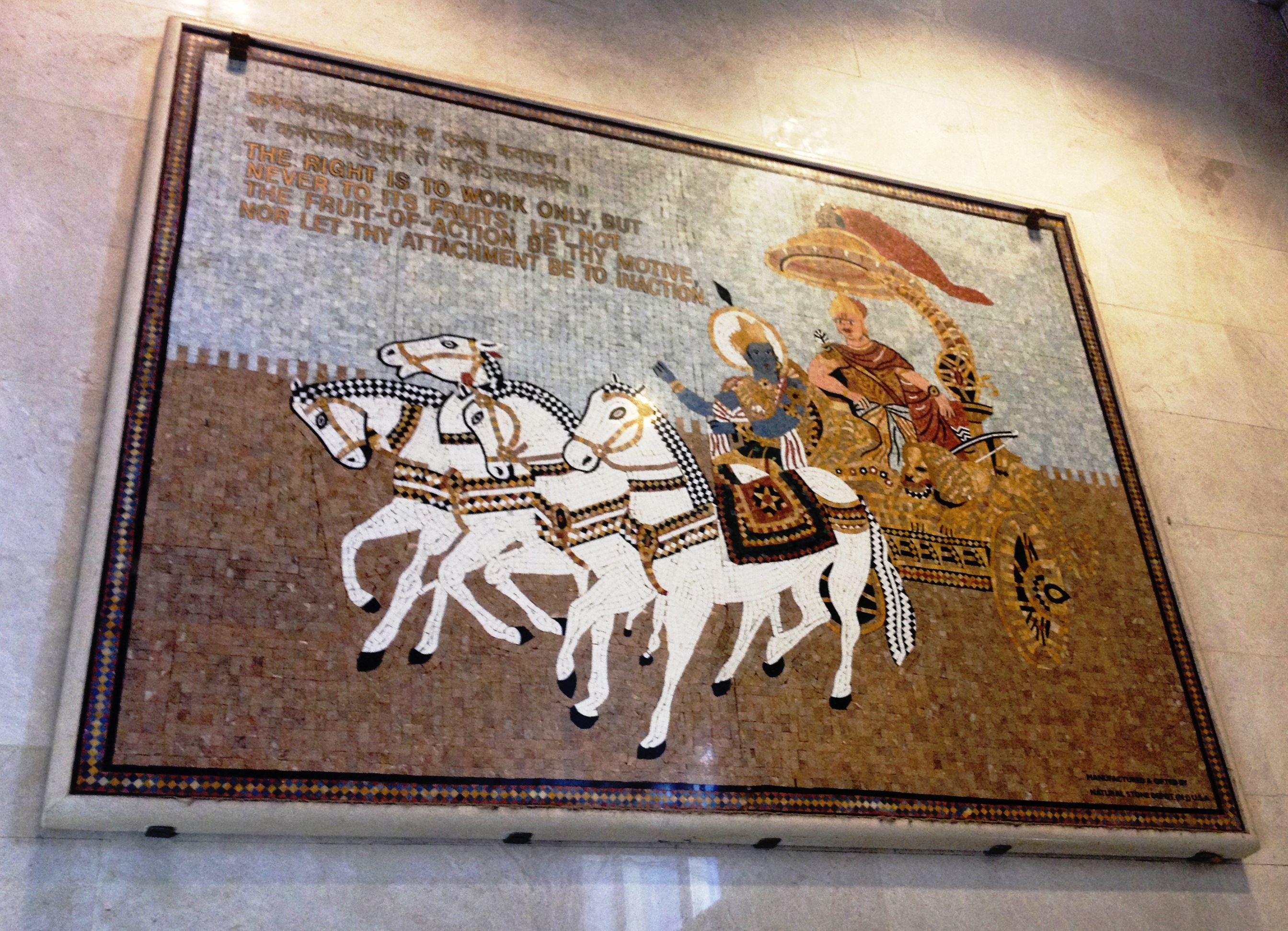
Gita Mural at Sri Venkateswara Temple, Bridgewater, NJ: “Thy right is to work only, but never with its fruits; let not the fruits of actions be thy motive, nor let thy attachment be to inaction”-picture taken on April 13, 2014
|
“Duty is the secret that gives life to the soul” (Translation of Excerpt) Ammah wrote this in தமிழ் Tamil early this year, in the small booklet we published in remembrance of my Father – K. Thirukumaran In the body awash with pity and affection, therein lies tear drops, amidst the eyes. Tears are not a form of water. It is a miraculous compound. It is the birthplace of light. It tightly bonds affection and relationships. We can express our joyous sentiments surrounded by many. But must weep alone. The more the tears, the more are its benefits. This is why those who weep are fortunate and the triumph of the tear attains divine status. An important duty of humanity is paying the ritualistic tributes. It is the ancestors’ blessings that live long past through and towards well-being of future generations. While it is important to worship our ancestors, it is the divine faith that needs to be adhered to on a daily basis. The elders guide us with divine power. They must be remembered with ritualistic duties annually. In accordance with today’s circumstances from the roots, to branches and fruits of all ages and blooms must join together as a family to rejoice in their memory. This will enable to foster boundless love and affection. When the duties are accomplished, the mind feels an emptiness, like a shrine without the presence of divinity in the Altar. This is the destiny life reaches when duties are fulfilled. Duty is the secret that gives life to the soul. As said in Gita, Whatever happened, happened for the good; whatever is happening, is happening for the good; whatever will happen, will also happen for the good only. As said in Gita, Do your duty to the best of your ability, with your mind attached, abandoning worry and selfish attachment to the results, and remaining calm in both success and failure. |