By
Zahrah Imtiaz
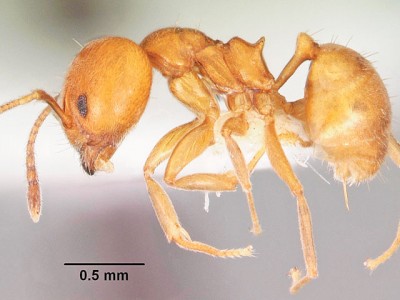
The Sri Lankan relic ant (Aneuretus simoni),which is the only living species of its kind in the world, having survived since the time of dinosaurs, is fighting to survive as its habitat at the Pompakele Reserve which is being cleared for a new water purification plant for the town of Ratnapura.
At a time where many species are becoming extinct due to changing climates or land use, one small ant has managed to stick it through, and it has done so for so long, that many of its cousins are to be only found as fossils. This ant is a species of evolutionary ancient ants only found in a few places in the Central Province of Sri Lanka. It is also one of the few ant species considered endangered in the world. The relic ant is so unique that it is classified in its own tribe known as Aneuretini. The other members of this tribe are extinct, and hence this Sri Lankan ant is the only living species of its kind.
Surprise
It is a surprise that they have survived for so long, as they only exist in small colonies of about 100-200 and are very specific in where they are found in leaf litter and within rotting and crumbly wood.
The National Water Supply and Drainage Board (NWSDB) in Sabaragamuwa, in a bid to build a new water purification plant next to its reservoir at the Pompakale Reserve, has cleared an acre of land of the Reserve with little concern for the endangered ants living in the vicinity. The ant was scientifically discovered by E.O Wilson, an American in 1956, as he studied ant species in Sri Lanka. He noted that it is only found in the forest reserves of Gilimale and Pompakele. The latter became a unique place for the ant which was subsequently declared critically endangered under Section 31B of the Flora and Fauna Ordinance of 1993. The area is also prone to high rates of erosion, thus in 1968, it was protected under the Soil Conservation Act.
Protected
According to Senior Environmental Lawyer, Jagath Gunawardene, a Gazette Notification released on 22 May 2008 further declared the Reserve protected, given its importance as a habitat for the relic ant. Given these considerations, no projects can be initiated on the Reserve without a proper Environmental Impact Assessment (EIA) being carried out on it prior to commencement.
The Reserve, which comes under the Department of Forests, is leased to the Ratnapura Municipal Council as the reservoir is located there.
When it came to building a new water purification plant, the NWSDB in Ratnapura decided to build it next to the reservoir as it was thought that purified water on top of the hill can easily be delivered to those at the bottom.
An acre of the Reserve was cleared for this purpose. The extent of the Pompakale Reserve is a mere 35 acres at present, having been cleared extensively over the years.
Ceylon Today learns the water board undertook this clearing of the sensitive area without an EIA. In addition to this, it is the trees right at the top of the hill that have been cleared, hence greatly increasing the erosion rate in the area, putting the lives of those who live below at risk.
When the Municipal Commissioner of Ratnapura, S.N.B.K.S. Senaratne was contacted with regard to the clearing of the Reserve he said, “Only a few trees have been removed, not a lot of damage has been done.”
He went on to add that the area in which work had commenced was not part of the sensitive area of the Reserve and that the new project was only an extension of the reservoir, which already exists there.
“You must understand that certain sacrifices need to be made if there is to be development,” Senarathne said.
Assistant General Manager (AGM), NWSDB Sabaragamuwa G.G.N. Gunawardene who is in charge of the new project said his project will supply clean drinking water to 80,000 families in the new town of Ratnapura. “Our reservoir is up there but the water treatment plant is at another location at present. In addition to the reservoir, with our new project coming up, we own about 10 acres there. We have received a foreign loan of Rs 4,200 million for the project and we have to start soon or we would lose the loan”, G.G.N. Gunawardene pointed out.
He explained that the EIA on the site is ongoing and claimed they had started the project with an Initial Environmental Assessment (IEA) done on a previous project. He said he has informed the Central Environmental Authority (CEA) of this.
Cannot be avoided
“We will do our best to mitigate the impacts as there are always environmental impacts, we cannot avoid that. What we have taken is less than 1% of the Reserve, the ants are right there, nothing has happened to them,” emphasized Gunawardene.
With regard to issue of increased soil erosion, as they had cleared the top of the hill of trees, Gunawardene said they would be building a boundary wall to stop soil erosion.
“Whether it is an acre or 10, the law is the law. In such a critically endangered area, no clearance can be done without an EIA. Even if you have an IEA, it has to be sent to the Department of Forests and the CEA and if they do give their approval, it would be a conditional approval. Several mitigatory measures need to be put in place before the project can begin” said senior lawyer Jagath Gunawardene explaining the legal aspect of it.
Gunawardene explaining the project as proposed by the Water Board said the current reservoir at Pompakale was 82m above sea level and that the storage tank at the new town is on another hill, 92m above sea level. “The plan is to take water from the Kalu Ganga, which is about 2km from the Reserve and pump it to the reservoir there. Once the water is purified by the water purification plant, the Board believes the gravitational pull will easily take the water downhill. However as the storage tank is 92m above sea level, you have to pump the water back up again.
“Then the distance between the reservoir and the storage tank is also about 2km, so all these pumping up and down will also have to be taken into account the building of several kilometers of expensive piping being laid out.”
He also pointed out that the project was not only the least cost effective but also the most socially and environmentally harmful option.
Associate Professor in Zoology, University of Kelaniya, R. K. Sriyani Dias, is the leading specialist on relic ants in Sri Lanka. She has spent the last 10 years of her life researching the ant.
According to her, Pompakale was the first place the ant was discovered by O.E. Wilson in 1956.
Since then, although she has found several other places for the ant, she pointed out that Pompakele is special because it is the only site in Sri Lanka where the ant thrives in a disturbed habitat,
“Pompakele is more urban now than it was in Wilson’s time. It was mostly forest then. It is close to the Ratnapura town and students visit the forest often for studies. In Forest Reserves like Singharaja, Gilimale and Udawatte, the ants are only found in strictly undisturbed areas. I have researched in former tea and rubber estates around Ratnapura, but it is only in Pompakele that I found the ants thriving in areas which were slightly disturbed. I do not completely understand the specialty of this reserve,” Professor Dias explained.
Professor Dias had conducted her research in Pompakale in 2001, 2003 and 2004 and though in 1971 another research team concluded that the ant was not found there, Dias and her team rediscovered them in 2001.
“I think the main issue was that in 1971, the forest undergrowth was quite thick and it was not very accessible, so they might not have reached all the areas. In 2001, when we went there, there was a road which ran through most of the forest, with living quarters built in certain places and there was also a visitors’ park. We found the ants in all of these areas, hidden within the leaf litter, which is quite thick at the Reserve. We also discovered them in decaying wood and in crevices of rocks” Professor Dias added.
In 1956, Wilson had found the ant near the water reservoir but the ant had disappeared soon after as the reservoir was built up over the years with concrete.
Dias emphasized that the ants are sensitive to air temperature, soil humidity, leaf litter, and covered areas, when it comes to its survival. “Once you start clearing areas, the ant fails to cope and soon disappears.”
The Conservator General of Forests at the Department of Forests was not available for comment and when the Director General of the CEA, Dr Saranga Alahapperuma was contacted by Ceylon Today, he said he was not aware of such activities taking place at Pompakale.
In the face of a major development project to help the residents of Ratnapura, the relic ant may seem insignificant, but as the only living species of its kind in the world, the relic ant too would like an equal opportunity to co-exist with the people of Ratnapura.
COURTESY:CEYLON TODAY