By Harrish Thirukumaran
Part V
“Save the Best for Last” – An Authentic African Safari
Etosha National Park had been our next and final recreational activity in Namibia. Arguably, it was also considered the most hyped event during our time in Namibia. It was held on the 2nd Friday and Saturday of our 3- week stay.
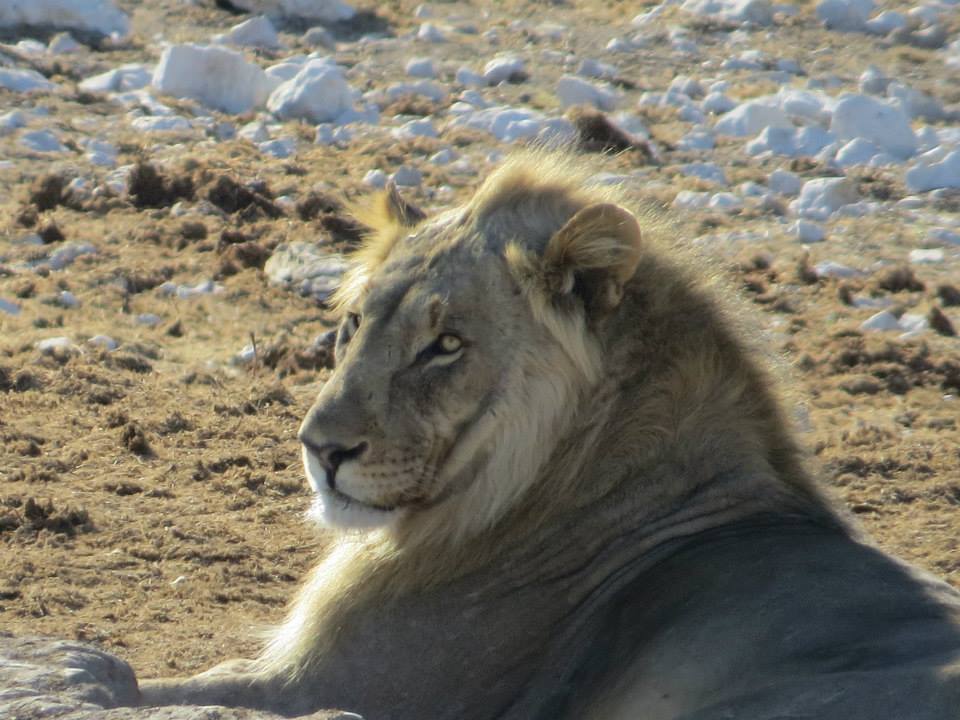
In Etosha National Park-photo credit: Rachel
Etosha is one of the largest game parks that is home to a substantial variety of mammal species in the entirety of Africa. On this trip, we were given the generous opportunity to experience a sensibly authentic African wild safari tour throughout the monumental park.
In the park, two fundamental rules that had to be abided were to keep quiet in the vehicles along with restrictions on stepping out of vehicles. These are so when entering Etosha, because tourists are inadvertently invading the animals’ own habitats.
During our first game drive, Shawn had specified that people are to be patient on the drives as it is extremely rare to spot certain distinguished animals such as the elephant or giraffe. He had also explained the rarity of people witnessing the big 5 in the park, which were elephants, giraffes, rhinos, buffalos, and leopards. However, the first walkthrough was immensely uncanny as we were able to spot 3 of those 5, which was unbelievably excellent.
On this occasion, we could even be guided by Tickey’s expertise on the African wildlife. The first animal seen was a large gray rhino in the distance and later we were able to see a live African elephant walking towards a watering hole. Now being able to see the elephant in its natural state and reacting to its surroundings was astounding. The elephant was amazingly massive judging by its physicality.
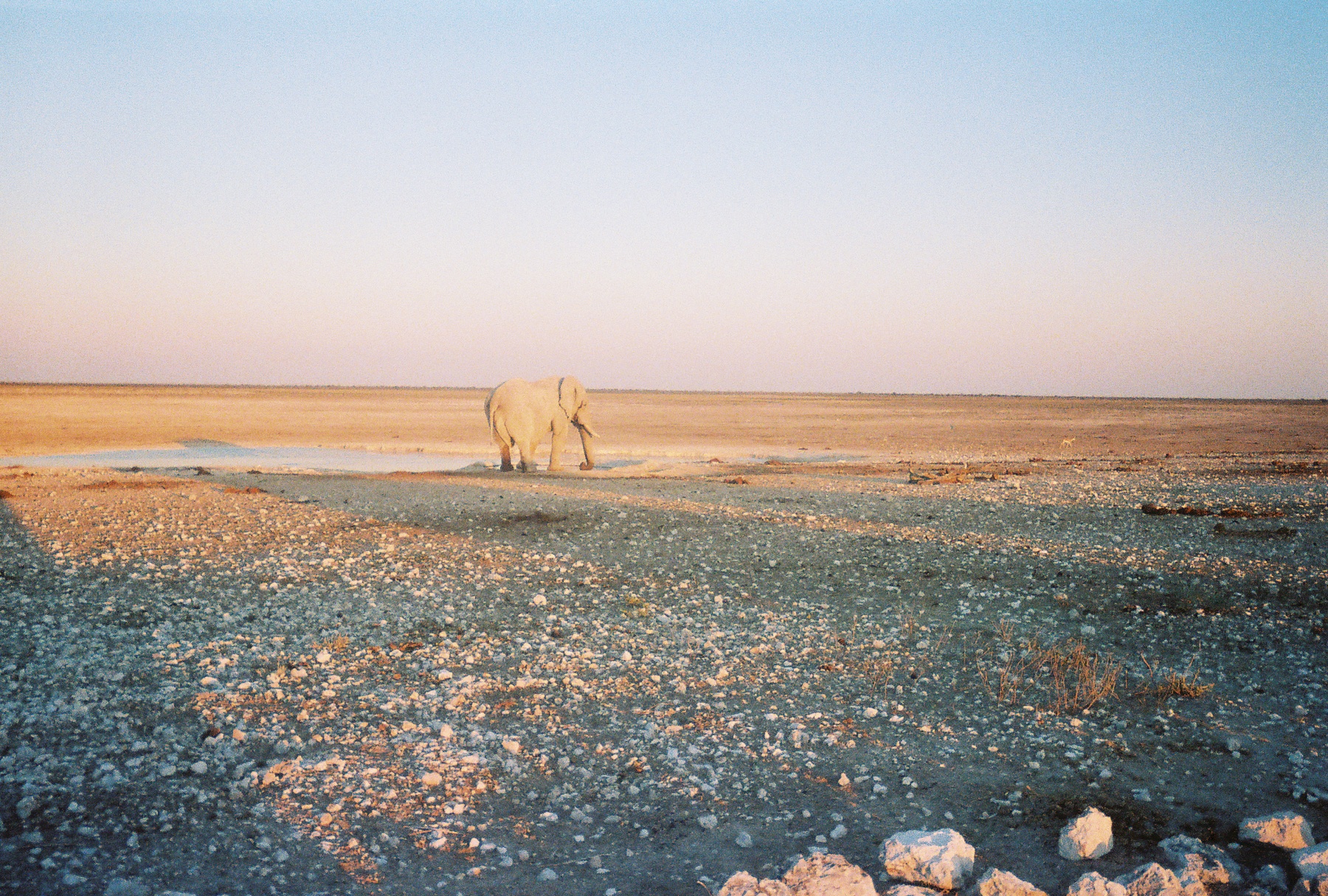
Elephant in Etosha National Park
The largeness of the African elephant had also indicated a physical trait that differentiates itself from Asian elephants. Such that African elephants are genetically bigger than Asian elephants like in some features such as their ears. Soon after, we saw a giraffe that had visibly stood out from the ground as designated by its majestic height attributed by its neck. The reserve had also been home to a thriving tourist business setup by camping sites in the park where we soon put up our camp. While driving through, we had been able to see a clear sunset as well. Slowly, we actually saw the sun lower and lower into the skyline. It felt somewhat magical even though it was realistically happening.
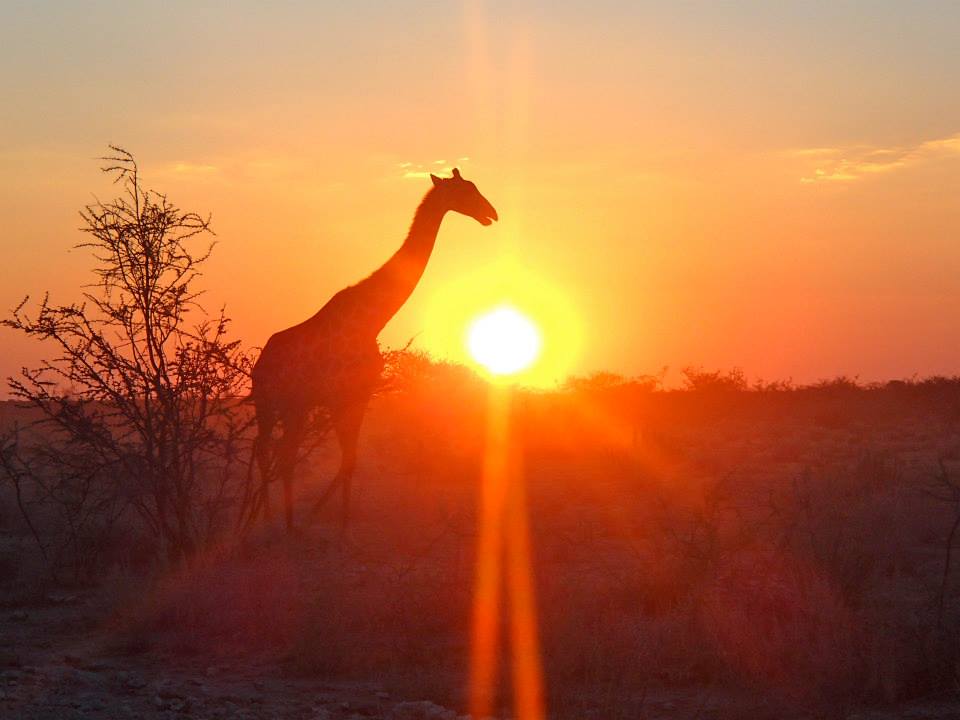
Sunset in Etosha-photo credit: Caroline
At the campsite, a large watering hole had been placed near the premise where many people were able to search for numerous animals drinking from the water. The very first animal I saw to approach the hole was a bush elephant dramatically appearing in the night where the elephant soon came across the pond. It was pleasurable to learn that all elephants literally pick up the water inside their trunks holding it until their mouth consumes it. Thus, contradicting notions that trunks inherently suck quantities of water until quenched.
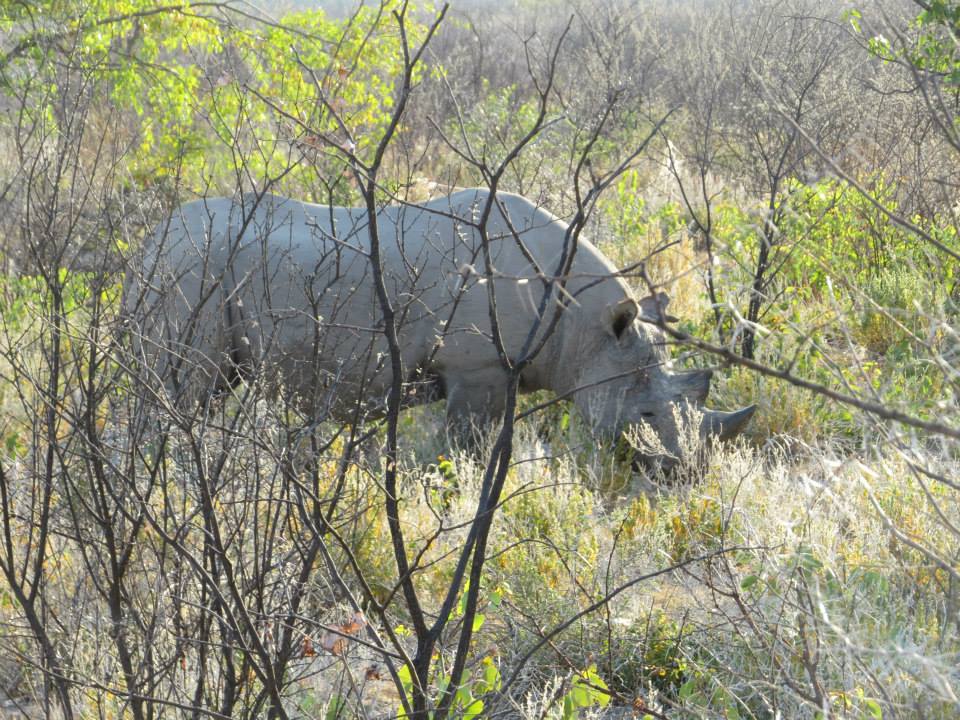
photo credit – Rachel
Other animals seen on the first night were more rhinos and giraffes. The giraffes had always extended their necks out towards the water for a drink, which was pretty neat seeing as how effortless it must be for them. It was amusing to see the rhinos interact in the water as some had already used it to bathe themselves. I think there had been one particular rhino that had roamed nonchalantly throughout cleaning itself and decided to do it again.
Apartheid as force for good
Later on, we had been socializing as a group circle where Shaun had delivered a speech about Namibia’s influence in the African continent. He delved upon the topic relating to bias and how it will often create ignorance and clout someone’s mind about defining a place or people. On Historical perspectives, he lectured how apartheid wasn’t as detrimental a phenomenon based on media’s interpretation.
Apartheid was apparently good on helping to sustain positive human development stemmed from creation of accurate public services for the various segregated peoples. It somewhat proved to prop up an exemplary service economy that had guaranteed a well off workforce through certain skills development. I feel his speech was his way of saying that all issues must be tackled from all academic perspectives or sides affecting the topic’s current state. After apartheid was eliminated, it was noted that the economy was terribly mismanaged and disorganized to assist citizens.
I believe his explanation of apartheid particularly was that economically it was beneficial but it was socially cruel. In addition, he had described that it should be known that Namibia is considered one of the most developed nations within the African continent with one crucial feature being the country’s government has provided access to clean water through its funded infrastructure.
This being true as for the entirety of the trip we have been able to use tap water for drinking which is highly seen risky by Canadian or American standards. The stability rate is so high that Shaun had mentioned when crossing into neighboring countries such as Angola there is a huge disparity in development socially and economically.
Coherent symbol of the entire African continent
Although, the old-fashioned camping was a socially reliving activity, it was clearly outweighed by being able to observe the watering hole. There, Tickey had fully demonstrated his knowledge on the animals such as the lion like how the creature actually makes a heavy grunting noise instead of a clichéd loud screaming roar as depicted by entertainment media. His sightseeing prowess for the animals was extremely efficient as well considering my fellow members and I used binoculars to better spot animals at night. At times, it was funny how he even assisted other tourists observing the hole.
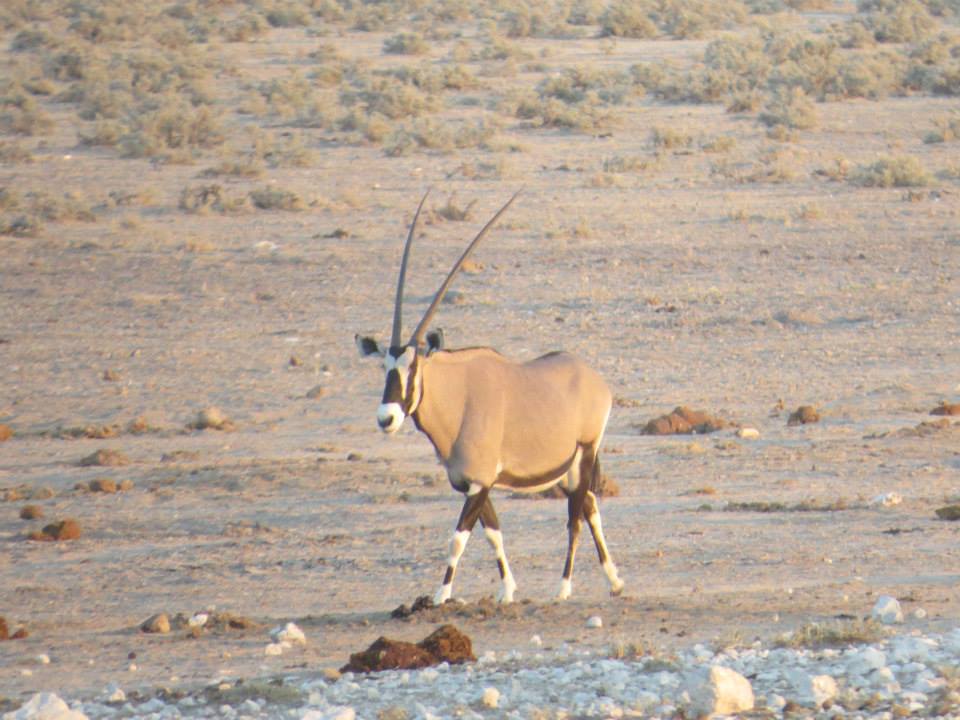
photo credit – Rachel
On Saturday, we headed off for another walk-through within the game reserve to spot for recurring animals and some potential new ones. During the 2nd round, we had a slim chance to witness a real lion but were granted a lucky moment when noticing the discrete lion within its rock-like environment. It was unreal seeing the lion acting as a natural predator based on its survival position. Tickey had mentioned that the lion does not simply go after prey it sees right away but patiently waits for the right opportunity to utilize its strength and take advantage. Soon after, the lion had sprinted towards a seemingly unlucky oryx around the nearby woods. Though it was somewhat cruel and saddening to see the oryx being hunted by the lion it also superbly exemplified a crucial aspect of the food chain. The eventful action had symbolically represented the predator-prey relationship.
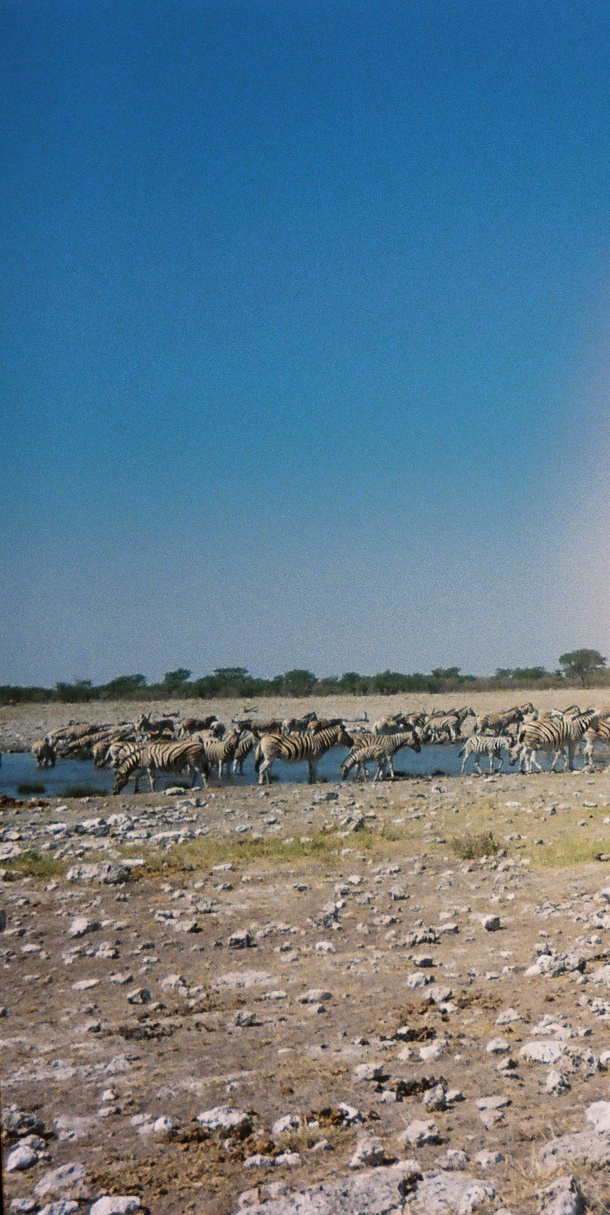
As usual it was great to easily be able to see the many unlikely animals such as elephants, giraffes, rhinos, and oryx. In this drive, it was also very common to see herds of zebras and springboks near lakes or walking together as a pack along with instances of seeing warthogs. The numerous warthogs were affectionately referred to as pumbas stemmed from the Disney film, The Lion King and a real word coming from Swahili, an African language. Tickey was also known to be an avid speaker of the language. Soon, another lion sighting had been partially confirmed when arriving near a hilly area.
It was actually a lioness blending within the yellow straw grass where a large herd of springbok were drinking from a small pond. As analyzed, it was obvious that the lioness was either trying to catch some springbok meat or get a drink. The moment was absolutely reserved for the lioness but due to an accidental sound all springbok quickly dispersed from the area all at once in the same reactionary motion. I think from that action it had emphasized their sense of social attachment to one another that springbok will all hesitate or react in the same manner.
Aside from the many animals it was nice to view the prolific natural environment comprised within Etosha. It was beautiful to see this particularly unique tree that stood freely within the flat grassy lands seen in various parts of the park. It was commonly referred to as the tree of life because of its characteristic shape and structure compared to other trees. This tree in my view was majestically a coherent symbol of not just Namibia but the entire African continent highlighting its rich wildlife prosperity and calming peace. As our game drive had begun to rundown it had generally been accepted that we had seen most of the popular wild species inhabiting Etosha except for the Leopard.
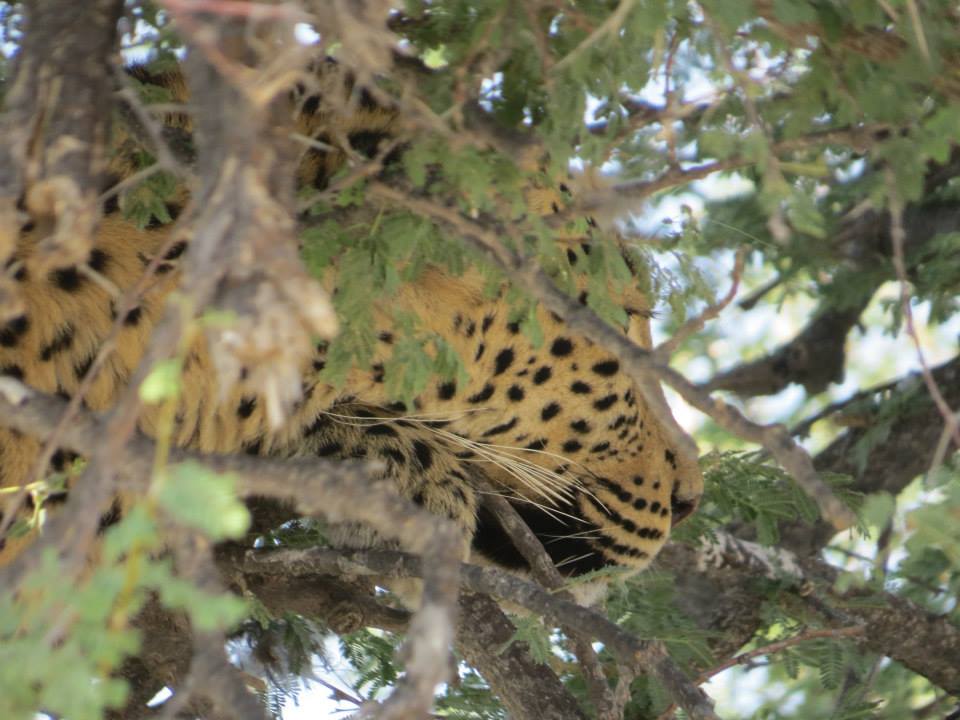
photo credit – Rachel
However, this soon changed for the best when our brilliant friend, Tickey had enthusiastically spotted a leopard inside a tree resting. It was considered exceedingly rare to see such a mammal more so than a lion. The weekend trip truly gifted us with an African adventure. It was manageable to tell that a leopard had been in the tree based upon seeing its normal black spots. It was riveting to hear how most leopards will normally stay inside trees for days or weeks unless requiring food.
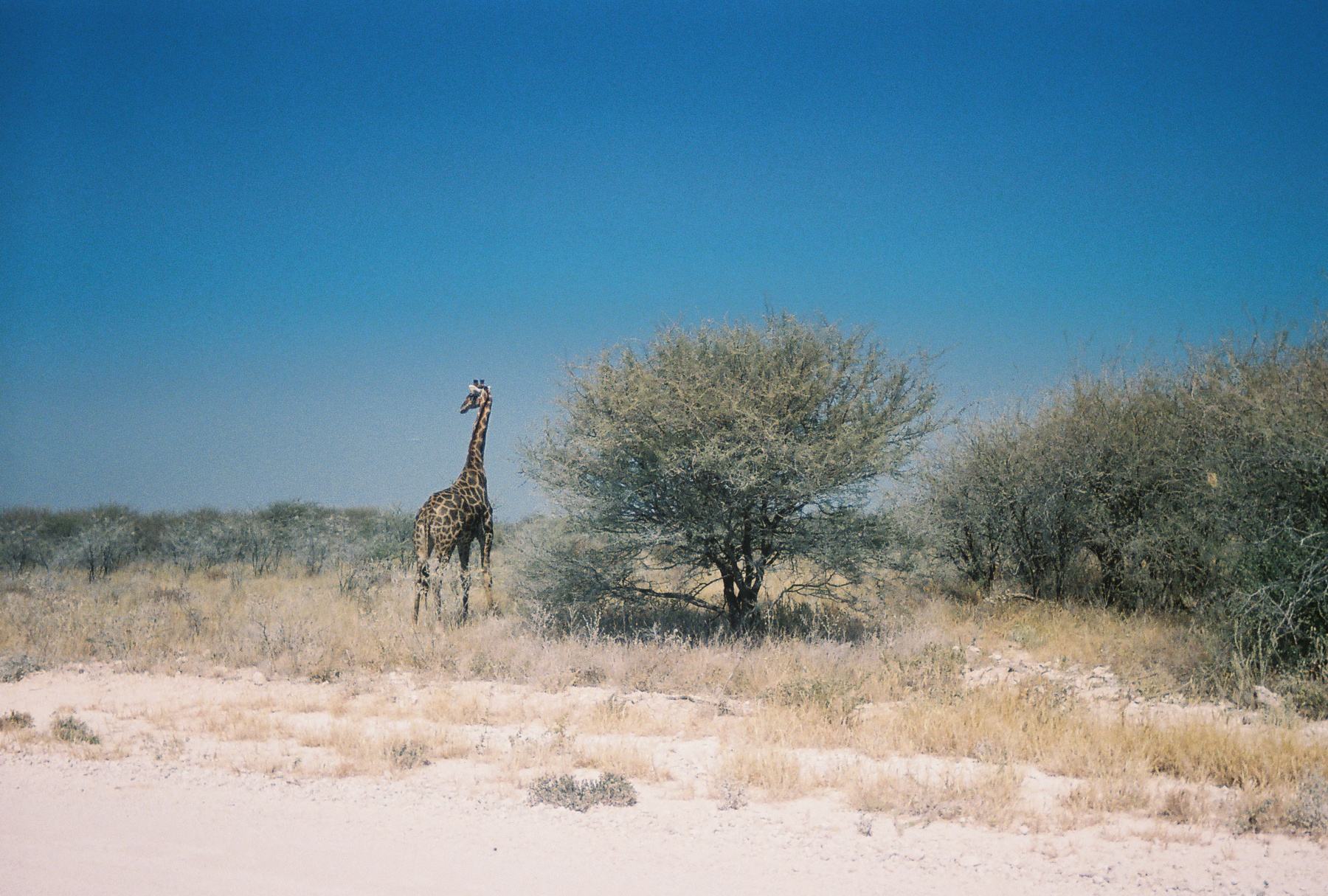
Giraffe in Etosha National Park-pic by: Harrish
Etosha National Park had definitely met most of our high expectations regarding an African safari experience; it undoubtedly was an amazing trip that had embraced the essence of Africa. [To be concluded with next installment-6/6]
(Harrish Thirukumaran attends second year at Brock University, Ontario, during 2013-14)
Part I: A Notebook from Namibia: Window on Windhoek
Part II: Children Achieving Prosperity by Prioritizing Education
Part III: Instilling Patience and Social Skills via Sportsmanship
Part IV: Discovering Social Divide and Desert Transitioning to Oceans and Beaches
pic by Harrish