by
Vishnuguptha
“The most glorious moments in your life are not the so-called days of success, but rather those days when out of dejection and despair, you feel rise in you a challenge to life, and the promise of future accomplishments.” – ~Gustave Flaubert
She has all the credentials that an international diplomat should possess; her academic background is impeccable, her posture is imposing and her communications skills are excellent. Yet she is portrayed by most dictators and ‘democratic-pretenders’, be it Syria or Egypt, Myanmar or Pakistan, as a trouble-maker, for what she finds out and her declarations could be harsh to those who wield power.
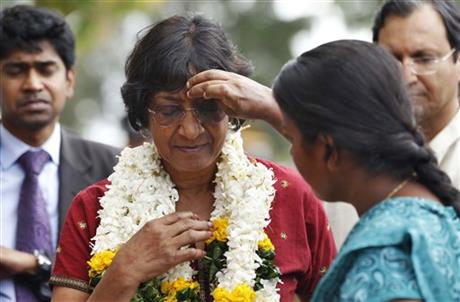
U.N. High Commissioner for Human Rights Navi Pillay being welcomed in Kilinochchi, Tuesday, Aug. 27, 2013-AP Photo-by-Eranga Jayawardena-courtesy: bigstory.ap.org
They could be utterly unpalatable to the abusers of power. To those rulers who are perpetually engaged in covering up their sinful acts against their own subjects, to those practitioners of inhuman treatment to those who don’t agree and conform, to those who dare to hold a view contrary to that of the rulers, Navi Pillay might indeed be a pest. But that is her job. One cannot find fault with her for doing her job with exceptional skill and aptitude and daring. If she does not do that, she does not belong there, period.
Wikipedia describes her thus: “Pillay was born in a poor neighborhood of Durban, Natal Province, Union of South Africa. She is of Tamil descent and her father was a bus driver. Supported by her local Indian community with donations, she graduated from the University of Natal with a Bachelor of Arts degree in 1963 and an LLB in 1965. She later attended Harvard Law School, obtaining an LLM in 1982 and a Doctor of Juridical Science degree in 1988. Pillay is the first South African to obtain a doctorate in law from Harvard Law School. In 1967, Pillay became the first non-white woman to open her own law practice in Natal Province. She says she had no other alternative: “No law firm would employ me because they said they could not have white employees taking instructions from a colored person”. As a non-white lawyer under the Apartheid regime, she was not allowed to enter a judge’s chambers. In 1995, the year after the African National Congress came to power, Mandela nominated Pillay as the first non-white woman to serve on the High Court of South Africa. She noted that “the first time I entered a judge’s chambers was when I entered my own.” Trying to belittle her personal achievements and subject her to unreserved ridicule is foolhardy, unprofessional and outrageous. Such ridicule and belittling belongs in the arena of the mediocre and certainly not in the wise man’s chambers.
In February 2003, she was elected to the first ever panel of judges of the International Criminal Court and assigned to the Appeals Division. She was elected to a six-year term but resigned in August 2008 in order to take up her position with the UN. From this background one could surmise that having Navi Pillay as your ally rather than as an adversary is not only prudent, it is indeed inspiring.
Her being Tamil is the one feature that the fringe elements in the political spectrum in Sri Lanka are trying to exploit; such narrow-minded politicking and hate-mongering would not augur well for those who are identified with the cause of ‘nationalism’ in Sri Lanka and nor would they be treated as reasonable men and women by those who really matter in the greater political discourse. Any attempt at an inference of a non-existent alliance, either psychological or real, between Pillay and the Northern terrorists led by the Liberation Tigers of Tamil Ealam, is laughable and should be condemned unequivocally.
Yet the majority of Sri Lankan Sinhalese population is very much prone to cheap propagandizing and any chauvinistic political slogan would go down with this majority effortlessly and those who initiate and execute such crazy slogan-mongering would be treated with highest possible honor and praise as national heroes and unequal patriots. The brittleness of mind and gullibility of heart have contributed to this mindset which has been fed over the last few centuries with myths of the Sinhalese war-heroes. While the writer fully acknowledges the enormity of sacrifices made and cruelties endured during war times by the Sinhalese in the service of territorial integrity and the people’s sovereignty, it must be emphasized that these tales of exaggerated heroism and embellished legends have paved the way for a susceptible and trusting mindset that is ever so ready and willing to disregard facts and believe only in fictitious fairy-tales. They would spend no time trying to separate fact from fiction; history from myth and truth from falsehood.
It is to this segment of population that the Balakayas and Senas are giving leadership to and trying to lead from the front-end of falsehood and exaggeration. Navi Pillay and her pronouncements in recent times fall right into this potpourris of warped thought processes.
If any violations of any type, shape or form were committed by our armed forces during the war, whether towards the closure of war or at any other time, it must be investigated by a qualified and seemingly impartial body of experts and adjudicated with emphasis on fact-finding and implementation of corrective measures. Dismissing such allegations and accusations as benign and of no consequence is completely injurious to the health of our country as it is struggling to raise its head from the painful vagaries of war and it is exceptionally troubling to the image and impression of our people due to the stain that this sort of accusation would leave behind. Everyone, barring none, would be tarred by the same brush and the painting would not be all that pretty to behold.
If on the other hand, as per Sri Lanka’s ex-UN Ambassador to Geneva, Dr. Dayan Jayatilleke’s call, an Office of the High Commissioner of Human Rights (OHCHR) is set up in the island, many an allegation of partiality and unaccountability would be answered with a very credible and believable standing, leaving the vulnerability of the regime with an acceptable armor and defense. However, in the absence of such honest, candid and sincere commitment to the cause of justice and fair-play, the international hounds would be let loose and however much our political leaders attempt to preach from their temporary political platforms, the eventual mark this insincere effort would leave behind is not going to be a good one. Sacrificing truth for short-term political gains might satisfy the inflated egos of politicians, but when the bubble so artificially created reaches the bursting point, the explosions that ensue would claim not only the lives and livelihoods of these very politicians but the national character of a people would be so damaged, any attempt at repair on a later date would be far too expensive and energy-sapping.
In such a tricky context of self-defeating contradictions, Navi Pillay’s visit to Sri Lanka should be treated as a blessing in disguise. Wise men would do so but the unwise would be left to stagger in their own rot and rubbish. Self-criticism and introspection is one essential component of leadership and statesmanship. When one mistakes stubborn foolishness for leadership and cut-rate ‘politricks’ for statesmanship, the monumental mess that one is left with is what we are having today as a ruling cabal and humiliating one-upmanship.