Part III:
A Tennis Rejuvenation in Namibia
by Harrish Thirukumaran
‘Sports don’t always come as a cakewalk as it does take patience as well’
At the BNC, the daily schedule would be as follows: in the morning to mid-afternoon the students were able to participate in expanded non-academic programs such as yoga, basketball, and tennis. From 2 to 5 pm, the volunteers including my Brock group were required to somewhat educate some of the students through work such as reading, hands-on activities, and math.
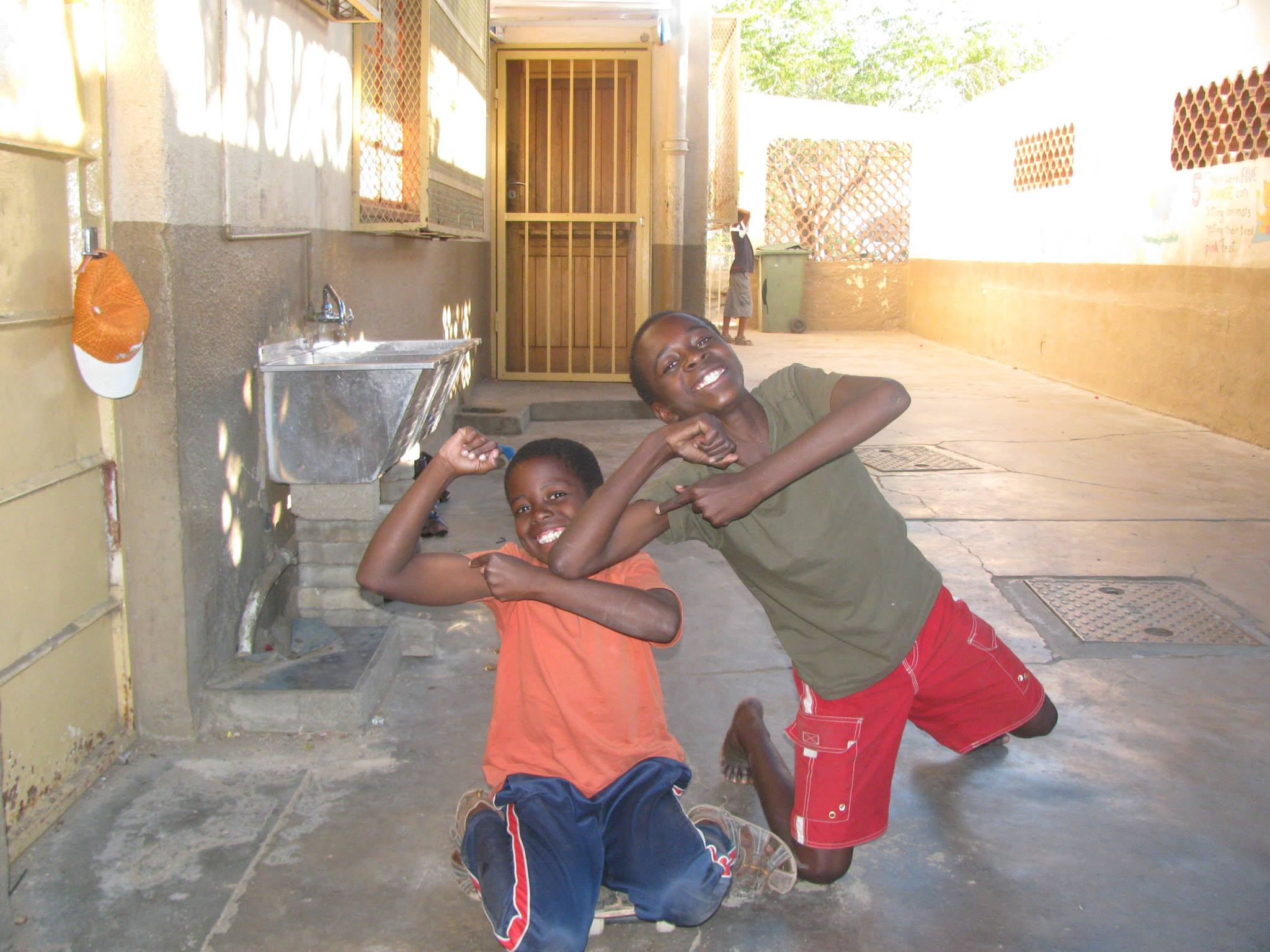
In pic-Johaness and Risto:
A project that enlisted my past athletic skills and allowed me to feel closer to the BNC kids was the tennis program. It was one of the many activities that attracted students to learn the sport and have as pastime during the holiday breaks. It was a joyous opportunity to contribute, along with another one of my volunteer mates for the students.
I had devoted my time to it spanning from the 2nd and 3rd days of our stay and a day during our last week. Although I had not played tennis since 11th grade, it was a good way for me to assist some of the students. It also helped me re-live my abilities at the game. It had been offered to Dan and I as a possibility due to our tennis history, which we eagerly took up from MaryBeth. It was a great volunteering affair where I got to know Brumelda (9th grade), Lorenzo (5th grade), Giovanni (5th grade), Wendemi (9th grade), Quentin (4th grade), Donovan (8th grade) and Emily (8th grade). It was even better considering that I met some students who didn’t attend the BNC. I spent more time with other students I knew such as Kali, Dino, Johanness, and Risto as well.
The car rides to and from the tennis camp were hysterical and had also fully established the admirable singing talents of the many children. In addition, they were comical and annoying when one of the kids farted in the tightly packed van which they codified as ‘puffing’. It was also hilarious to see and hear about how Tickey interacted with the many children along with the children’s reciprocal gratitude for him. The camp was held annually at the Central Tennis Club in Windhoek East. It was there we met the stern but friendly coaches Mickey, Kali, and Espien who instructed the kids in the fundamentals of tennis. The First teachings conducted would be through an array of videos explaining the precise movements that goes along with a certain tennis technique. The first day I was there they were working on the backhand, which is crucially considered weaker than the forehand.
I felt that the televised examples were a precursor educational component that taught the children how to perform a tennis characteristic before learning hands on as emphasized through my lesson-learning experience. It even displayed the children answering vital questions correctly on these moves. After a brief rundown of the focused objective for the day the students were ready to go out to the courts and play. The tennis program was also a healthy way to start off some of these Namibian days. In the program, we began with warm up stations to get our blood flowing. The coaches arranged these numerous stations that had different body exercises that would allow the students to properly play the game. They had even encouraged us to partake in the jogging exercises to ensure the participants were acting in the best of their physicality. The leg exercises had ranged from basic jogging to sidestepping. The stations also included ball exercises that were essential to tennis rule playing.
Afterwards, the students had dispersed into all available courts where they rallied to practice their backhands. I had worked specifically with Risto who was pretty good at the backhand. I believed he had a sensible understanding of the backhand along with Dino who rallied with Dan. At times however it was hard for him as I noticed he hit it with a forehand or hit it out or cross court unintentionally. This moment was where I had entrenched myself in a coaching capacity. I had taught him how to position himself in tennis before the ball came across along with the physical form tied to the backhand. I had reminded him and others repeatedly that the racquet should go behind the person’s side and be swung fully over the shoulder like a hit in baseball. In my opinion, I felt he eventually got the hang of it.
As a part of the coaches’ tennis teaching routine, they regularly used a video camera to film the student’s tennis skills to analyze for flaws comparable to the proper technique. After those rallies the students had returned inside where the coaches showcased the clips to see if the students were able to point out to the flaws in the backhand or comment on strengths of their abilities.
Though I had noticed, it seemed embarrassing for the children seeing themselves perform techniques wrongly yet it was fitting as all students had distinctive troubles in an area which came along with the program. The tennis camp’s purpose anyway was to teach the students and for them to learn from those mistakes on the court that can help them improve their game to the level of amateurs or pros. That was my view to assure the students even extending to players that didn’t attend the BNC like students Patricia, Carla, and Denise. As part of tennis schedule we then proceeded to teach the students how to position themselves for the backhand especially how it is to be swung.
I had taught specifically about the contact point in tennis where the ball actually met the racquet. With that, they were then learning to follow through with an exaggerated swing across the shoulder after completing the contact point. Dan and I would first instruct the students to get into rows where they were to imitate the frozen position of the contact point which required the students to extend their arms out with racquet so in reality they were able to meet and return a ball over the court. Seeing most of students getting it correctly by successfully hitting the ball over inside the tennis square made myself relieved that it was able to sink in. Setting them up into two separate lines where they were able to return ball feeds with a great amount of swing power did this.
My volunteer coaching seemed to be efficient in my view after also hearing Donovan thanking me for helping him understand the contact point when hitting the ball in tennis. Overall, the first day of the camp was spectacular, as it was a unique performance as a coach which contrasted with my tennis career as a pupil. It gave me a chance to understand the perspective of a tennis instructor and their ideal ways in coaching youngsters. It was also good because I was able to relate to the students while understanding their struggles in the game.
A BNC Tennis Philosophy
As we spoke with MaryBeth, It was absolutely motivating for us to return to the camp as it was a good pastime for exercise and a way to give our sports knowledge to the ambitious kids. In her view, tennis was a good active sport for the kids to engage in because of the integral running and shuffling. Her opinion is also rationalized along the lines that it is a relatively safe sport that requires almost little physical contact. In which, it could guarantee less chances for the youth to hurt or injure themselves in any way. It had also come to light, that only a certain number of BNC students were eligible to participate in the program leaving many unable to go.
This seemed as a good value instilled into the children as it hoped that the attending students were responsible enough to take advantage of the program so they were able to adequately acquire the skills to play the game. Therefore, with that knowledge they were able to teach the remaining students how to play the game themselves. Although it was only a holiday program I feel that the tennis camp is a way to prevent the youth especially the boys from becoming troubled on the streets like most I have seen during the trip. The camp was even integral in learning of the children’s own social skills during the lunch breaks as well.
For the next tennis lesson, the students were practicing the serve, which is considered one of the most difficult shots in tennis. It is difficult in the sense of getting it over and into the service box. Yet, it is one of the most powerful shots in the game and if mastered effectively it can be used as a weapon to gain momentum over an opponent. As with the normal routine inside we headed outside, got through the warm up which I had done with Risto who did scramble somewhat in the exercises.
As usual, I then rallied with Risto and Dinno for them to practice their serving. At times I felt they were able to get it and at other times it was lacking. In the station learning exercise, I had assumed the duty of showing the contact point in the serve where it is reached when the arm is up high in the air where the wrist snaps after touching the ball. It was neat seeing myself in front of the capable students who were able to perform the move to the best of their adherence to my teaching skills. Though as emphasized the serve was a tough shot to conquer. They were able to get it over and into the box but it didn’t have that same speed or velocity you desire in the serve, which can be learned if one gets the form of the serve.
The Difficult but Essential Serve
I had spoke to the group about the contact point, preceding the essential trophy position which is utilized for proper body balance before the serve. It wasn’t however a complete let down teaching the serve as the students were able to get the ball across the court and understood the idea behind the serve as a significant aspect of the game. Though the BNC children in particular retained an interest in tennis it was a bit frustrating when they did not listen to me when I described how to serve. Examples of this were when they grabbed too many balls to use or multiple kids trying to serve all at once on the base line.
In addition, when the cart was empty, some would still gather balls just to keep relentlessly hitting balls all over the place. In my defense, this probably was not surprising as it can be quite a task to teach students a specific talent or just to get them to listen carefully overall whereas they just want to play. I had observed that during other times of my volunteering at the tennis camp.
Although, I felt that my disgruntlement had disappeared when we collected the balls scattered all over the court. It was humorous when getting the balls as I suggested to use the tennis racquets to gather the balls in which many followed the example. It was even funnier seeing Johanness or Lorenzo collecting a bunch of balls and stuffing them into their shirt to hold and to put back in the basket.
Later on, it was time for them to go back inside for a briefing on the serving seen today so I had told most of the students to proceed while I collected the balls. Dino however continuously insisted on staying behind and helping me pick up the balls and yet I assured him that I could handle it and did not want him to be late. But, after a clumsy accident, all the balls spilled where Dino rushed back and decided to help even though I had told him it was okay. From that moment, I was able to see Dino’s personality was that of a helpful and caring person who wanted to lend a hand regardless of the issue. It was interesting to see a 12 year old who ensured everyone felt comfortable in a situation.

Serena Williams wins 2013 Rogers Cup-Aug 2013-pic courtesy: facebook.com/USTA
“I gratefully thank the tennis students for actually inspiring myself to reaffirm my interest in tennis since returning that had been lacking for some time.”
In regards to my own tennis skills, I was definitely rusty with aspects of the game pointing mostly to the serve. Playing with Coach Mickey however helped me realize my previous ability at the game when rallying, where I was able to get perfect forehands and backhands from a returning scope. I had even noticed some students watching our rallying who looked pretty impressed by my standard.
From my perspective, it also shaped their views in looking up to me for an extensive intelligence surrounding the sport. Utilizing the tennis shots from my own classes back in North America was also useful in demonstrating to the coaches and me that my ‘inept’ tennis skills were still intact. In my view, it was ironic that I had played the sport for a substantial amount of years when it felt annoying to learn. But now it feels right that I was able to learn it and contribute my understanding of the game into the minds of the athletic BNC followers.
A Youthfully Diverse Population
The breaks at the camp were also excellent times to get better acquainted with the students that I was working with as well. It was great to have conversations with the students who didn’t attend the BNC, as I was able to understand how other adolescents lived in Namibia and Africa as a whole. It was interesting to listen how diverse the students were from the BNC children. For instance, Denise a 7th grader was Zimbabwean who was living in Namibia through her mother.
She had also told me that she lived with her stepfather and biological mother. In addition, she had said that she was going to move back to Zimbabwe as her mother acquired a better job in the country. I also heard that science was one of her favorite school subjects. I had noticed from her that she was strongly shy during the meetings and seemed a little low confident when playing tennis. To help out, I had introduced myself to her and sincerely wanted to get to know Denise to make her feel comfortable at the camp. From my observance of her skills, I’d say she was playing at a good satisfactory level.
Two other girls I met were Carla and Patricia, who were also in 7th grade and 8th grade. They both hailed from Ecuador and Spain respectively. They had told they knew each other for awhile and have been regularly moving from country to country through different year spans because of their families. I think they had even said Namibia was a good African country to live in. Carla had said she had been taking tennis classes to re-familiarize herself with her skills as she had played briefly when she was smaller but stopped ever since. Her favorite subject was art which was compelling as I had used to uphold art as a favorite school activity and pastime in my own youth. Furthermore, I believe Patricia had said that her favorite subject was English.
There were even some students who attended the University of Namibia who were enrolled in classes who were able to quickly grasp the backhand in particular when I had demonstrated the correct way of returning it. The short intermissions had also made me realize the good nature of the BNC students in regards to sharing. For instance, I had forgot my lunch for one of the classes where Dino and Lorenzo had tried to generously offer some fruit provided by the camp or asking if Dan was able to share his lunch with me. They would also ask me repeatedly where my lunch was or if I got enough for my consumption which I believed were very thoughtful concerns. From their perspective, they had hoped that everyone was unconditionally provided equal sharing of food so we could play some sufficient tennis. I even somewhat grew closer to Dino learning that we both have younger brothers and that he wanted to be a police officer when he grows up. His brother was a boy named Gabriel who was also present at the BNC.
After the two days at the tennis camp it had very much engendered a solid relationship between the students and I who regularly went to the camp. It was ideally impenetrable as I had noticed each time the group went back to the facility during the three weeks many kids would have come up to me and asked “Are you going to tennis?” or “When are you coming to tennis again?” Emily also had commented how tennis was boring when Dan or I weren’t there to help them out.
All those concerns or comments had represented a strong attachment and trust from the students into our individual persons. Even if we were not able to directly play or assist them in the game elements, they were just happy enough for our company and indirectly seeing us join in with their exercises or rallies. It was a bit saddening hearing their recurring questions about it as Dan and I were explicitly telling them that we were unable to volunteer at the tennis camp for the entirety of the remaining week or next week.
To the point of even saying it was only for a few days. It was heart wrenching, as we would either answer those tennis questions with “We might come.” Or “I don’t think we can, sorry.” Psychologically, we were not allowed to say “yes” as it would have boosted their anticipation for us to come only to be severely depressed if we do not keep up our word. This notion could be due to the kids’ frequent experience with distrust that must occur in the household or through panoramic view of their street lives. It was a bummer too because in my opinion the tennis camp had to be my #1 favorite site project as it established the first start to my relations with a majority of the students and had reinstated a common interest I could have with the students.
As a gift however, our group leader had noticed how much we had appreciated the tennis camp and the students so during the last week we were able to volunteer one last day at the camp. At the camp, the students were preparing to work on their forehand grips. I remember during some playful rallying I had worked with a 7th grader named Wendemi in which we hit the ball back and forth, where she had insisted I played at my own skill rate. We hit forehands and backhands with full force I even noticed she was an exemplary player herself. She also made countless comments on my returns such as saying “nice shot!” and certainly it positively reinforced a rallying session that she had deeply enjoyed.
Afterwards, when it was time to meet for the exercises she had even gone up to the net where I did as well and we both shook each other’s hands. We both even said “good game” treating it like a real match. Wendemi had rightfully contained excellent sportsmanship when playing against me, where she truly expressed her likeness in my tennis ability and was not solely driven to win. Next, after getting through the exercises the class was split into smaller groups among different courts where everyone practiced the similar techniques in tennis.
I had volunteered with a new coach, working with Dino, Donovan, Johaness, Lorenzo, Kali, and Risto. In the first instruction we were conducting a shuffling forehand exercise. During it, I had worked with Donovan where all the players would shuffle from one cone to the next, performing the forehand swing until you got into the inside of the court where Moyo fed the ball where you were required to hit with the forehand over the net and with an efficient speed. It was one large transitioning rotation of forehand attainment to help increase the student’s prowess in the powerful swing. It was troublesome though as the coach had noticed the students were either lobbing or plainly hitting the ball out of the court. Though, in reality sports don’t always come as a cakewalk as it does take patience as well.
They did eventually get good forehand groundstrokes in my opinion, especially Donovan who easily hit the forehand feeds to his advantage. Later, they were organized into two separate lines where they practiced the forehand with the balls. Through a number of tennis balls, I’d say they were successful in handling the forehand shot.

In pic-Dino-pics by: Maegan:
Once fortunately practicing the clearly basic forehand hit, I was struck with an immense sense of nostalgia when the coach had decided to play some classic tennis games like ‘Jailbreak’ and ‘Around the World’. The students were really excited to play as discovered by their enthusiastic faces. The concept of ‘jailbreak’ was fairly simple for the students to comprehend as well. They basically return feeds whereas if it goes out they are placed on the other side of the court and are meant to try to catch returning balls hence they ‘break out of the jail’ and are able to go back to returning side until they are the last man standing.
The students had also wanted me to play along with them under the game’s rules so it was pretty hysterical seeing the children all trying to catch the ball at once from my return. At times, I had even lost and ended up on the ‘jail’ side and decided to allow myself to be there and feel fair to the others who were playing the competitive game. The winners of the rounds were mainly Dino, Donovan, and Lorenzo.
Skill-Boosting Tennis Activities and Matches
The next game, ‘Around the World’ was a bit trickier for the students as the activity focused mainly on practice of the forehand.
In the game, the students were required to hit the ball back and forth through one hit where they go around the court to the next side to hit the next oncoming ball. It was considerably more difficult than ‘Jailbreak’ as you had to keep the moving ball in and ensure you returned with the forehand. It was clever seeing when players approached the ball, as they would direct it in the backhand area of player, which meant an O. So if players had messed up three times they would spell ‘OUT’, counting them as out in the entire round.
In my opinion, the playing skills were great on the students’ part because they were able to redirect shots to their own advantage against the opponent. Redirected meaning they would cause each other to accidentally hit backhands than the recommended forehands.
It got so intense they were able to get myself ‘out’ as well. Both games had always come to interesting and demanding bouts between students because of the significant running aspect. I believe one of the winners in a round was Donovan who went up against Risto in the final round after all possible eliminations. It was uncanny seeing the amount of expert skill possessed by Donovan when he played tennis. However, it was not necessarily about winning, but it was about how the games were to continuously develop the student’s own individual skills to better themselves in realistic tennis matches.
Introducing the games to the children was also an opportunity to have the students comfortably enjoying the game at their own rate of interest. That was demonstrated by students such as Lorenzo or Kali.
Afterwards, the students were prepared to play in organized tournament-like tennis matches purely to practice the forehand on one side of the entire court. It was great seeing the amount of skill actually exerted by all the players. It simultaneously induced a competitive atmosphere within most of the students as well. However, it did also call for some firm discipline among the students a few times. During the rotation, a male student made some teasing comments at his female opponent, solely because she was a girl playing tennis.
Although, it was primarily he laughing at her overall ability, during which I had to step in impartially and criticize the poor sportsmanship caused directly by his negative sexist attitude. Though I reprimanded him, I had taught him an important life lesson on discrimination and that it was wrong to downgrade potentiality based upon gender. In response, he did feel sorry for his comments and did apologize for the unreasonable behavior.
To sum it up, the tennis camp was an excellent project as I was able to instill valuable knowledge revolving the sport into the children along with fully learning of the perks of the BNC students firsthand. [To be continued]
Related:
Part II: Children Achieving Prosperity by Prioritizing Education