By Harrish Thirukumaran
Part II:
A Cultural Namibian Dinner: Braai
Thereafter, we headed back to Wadadee where we were preparing the dinner for a braai. Initially, it was seen as an opening/welcoming braai interpreted as a kindly gesture to bring us into Namibia.
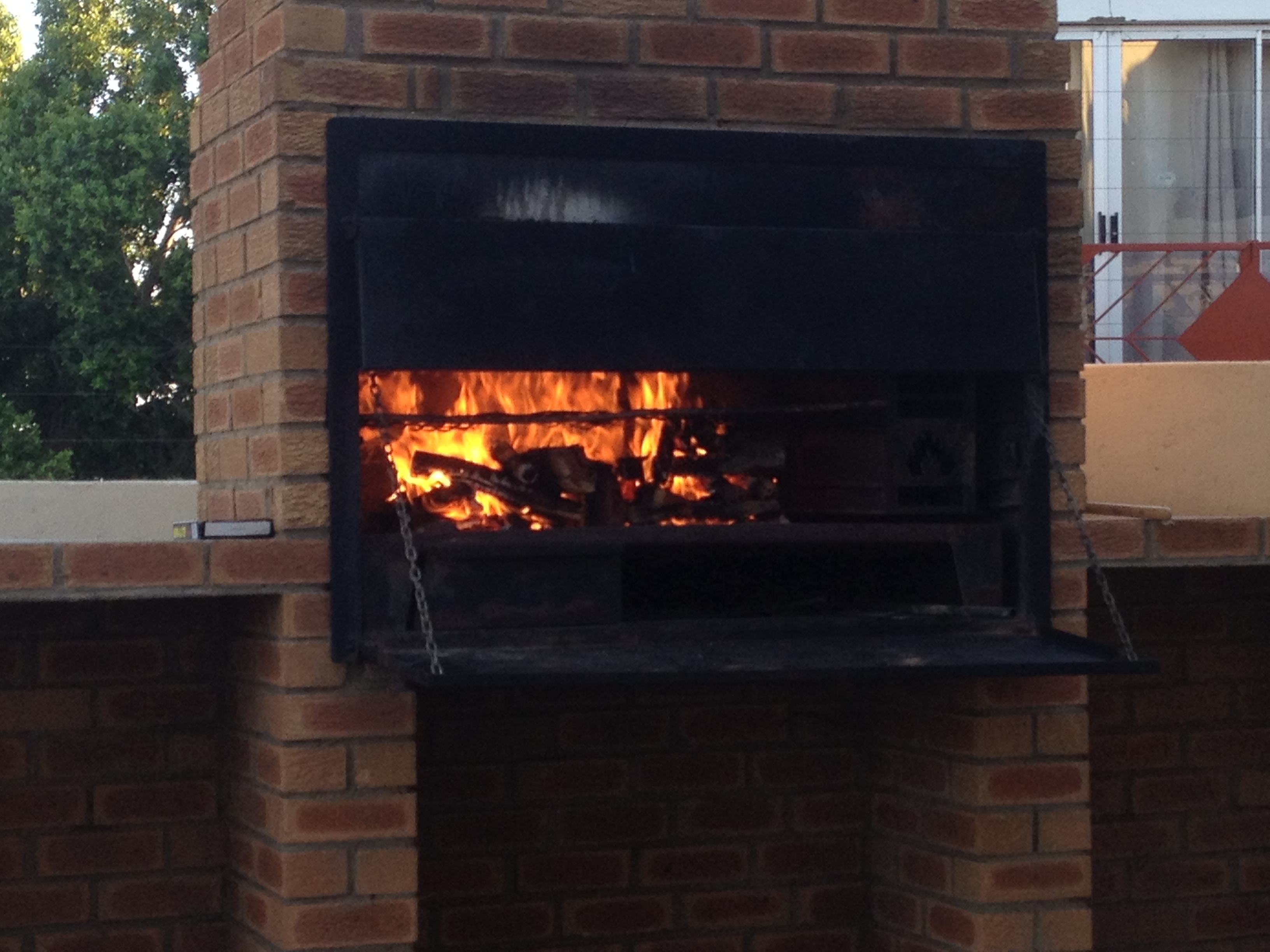
The Braai grill
Overall, a braai was like an African-style barbecue, where at the house the cook mainly Tickey used a special stone-fire grill where he cooked the meat on the top rack and corn on the bottom rack. Certain meats they had were recognizable ones back in North America such as ribs, chicken, and beef.
I also believe there were some exotic ones like oryx. Although I was a vegetarian intensely surrounded by various Namibian meat the braai provided just as much of a filling for myself. Other foods we had were a delicious pasta salad, garlic bread, and corn specially cooked for my dietary arrangements. Sitting outside on the patio of the house enjoying one another’s company during the night was also very pleasurable. The skyline at night was incredibly beautiful to see especially with the bright full moon overseeing the sky. In general, it was a really joyous night from hearing Shaun talk about himself and his day to Tickey jokingly insisting more of the good food even though most of us had been full.
There were even some project leaders who were invited like MaryBeth and Sandra, a leading German volunteer who teaches and assists disabled children to succeed in life, along with her 2 year old son, Lennox. In a nutshell, the dinner was a fantastic start for our time in Namibia.
BNC Introduction
On the first Monday, our group was driven to our main project site being the BNC located within a few miles from the Wadadee House in Katutura. As soon as we arrived it seemed like a very structured and delightful looking school center. Once there we met up with MaryBeth who offered us a tour of the facility along with basic facts and stories that are correlated to the BNC. Inside the BNC grade layout were small classrooms filled with desks and chairs for the little ones. The first one was for first graders had included all supplies and materials that were normally seen in a traditional school classroom. There were even more murals inside some of the classrooms that were drawn to motivate and promote the value of a good education towards the many attending children. Once settling in the room, Mary had sat us down and spoke about the BNC, how it was doing so far during her time and certain needs that are required to assist the children.
The small orientation even gave example to how good-natured she is and hear disciplinarian instincts when asking for cooperation from the children whom she could properly rationalize with. These instances exemplified the polite and good mannered responses from the children who also made sure to exhibit those traits when asking Mary for something. It was also a somewhat depressing conversation as she had even specified further about the abuse most of the children have gone through that could have crucially deterred their education to the ground. Along with living with abusive parents it can also mean uneducated families who rarely can encourage their need for educational prosperity. Some of the parents and locals may even see the BNC as a distraction as education can only come as a secondary of a child’s own individual thoughts and desires such as complete need for sports.
During my time at the BNC, I noticed how some of the children didn’t always want to take advantage of the holiday break’s learning opportunities but rather just go play outside or just commit their time to sports programs. It can be stemmed from the willingness of the children in applying themselves to an education as well. Frequently, problems that have emerged for Mary due to the shebeen adjacently located to the BNC. A shebeen is an illegally operated bar where alcohol is sold excessively without a proper license. Due to this it is often disturbingly loud from the shebeen and it places a dangerous influence of alcoholism among the children. It is said that most people there are drunk all day that even steal valuables at times most notably from the BNC. In which, Mary has to deal with these troublemakers who even endow unnecessary negative influence on the children tied to alcohol, such as using at as an excuse for wrong actions.
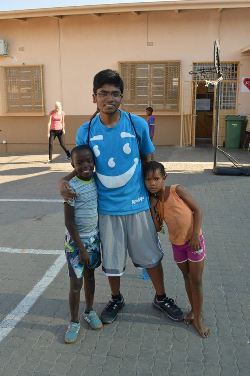
Dino, Christy and I (Harrish) at the BNC-pic by Maegan
They are even known to systematically heckle the BNC, Mary, and the children. In a single phrase, the BNC will be unsuccessful in maintaining education, as the children are nevertheless ‘dumb’ who will eventually succumb to the antagonistic city streets. The way most of the children grew up and the daily affairs they go through can very much cause them to indirectly acquire negative traits in the learning process. It was harsh to hear Mary talk so nonchalantly about the BNC’s persistent obstacles, but it could also be the only way to break through the hardship barrier blocking the children’s learning abilities. It displays the bleak realities of the country from an international perspective when comparing and contrasting the depth of social detriments between North America and Africa.
There was a small outdoor courtyard where sports could be played such as basketball or four square. An excellent mural that showcased Namibian pride and the world map also oversaw the area. It was previously one of the many painting assignments conducted by a previous Brock Namibia group with an inspirational slogan “One World, One Love” In addition, there was a small rectangular area where the children were allowed to play soccer while using trashcans as goalposts. Furthermore, the center also contained a unique playground for the children near the gate entrance of the BNC.
A distinguishing characteristic enrichment of the BNC was also their own developed slogan being “Best Namibian Children.” This phrase is defined through a favorable sentiment that is formed via the children achieving prosperity by prioritizing education. I found it sensational that in the playground there were old tires placed in the sand where the kids were able to skip through the playground by walking on the old tires. In my view, it developed some real innovation in games such as tag for them. The BNC was also home to remnants of an old NGO organization within its radius. The group was Catholic AIDS Action, a Christian Church based institution tied to the BNC’s former founder, Father Bernard Nordkamp.
The group was an advocate for testing, prevention, and tackling of the AIDS epidemic. I believe in relation to Father Bernard the program was set up in response to Catholic AIDS Action to successfully educate the children to help them understand how to anticipate and read the signs of the disease carefully. The BNC’s educational struggle is much associated with breaking the AIDS problem that is formed from various perspectives linked to education. It was also awful having the BNC covered in marijuana smell as many of the locals regularly smoked in the shebeen. Though the children were extremely happy most of the time the negative reinforcement could easily further expose the deep vulnerability that can be integral in the children outside of the BNC.
After hearing of the critical importance of the BNC, we ended up seeing other places in the center. For instance, we saw the 6th grade classroom where most children are responsible for writing their sponsor letters in a structured format thanking for the donations. We soon saw the kitchen where some volunteer staff are able to store or prepare food for the children during lunch time. They were able to get some decent food to help quench their hunger for instance, rice, peanut butter sandwiches, and some gourmet breads. Also, we saw the eighth and ninth grade classroom where a Brock member taught math daily as part of the teacher’s degree.
Attached to the classroom was a small library room where a portion of books were kept. A color key by grade level also designated the books so kids could easily pick out a book they were able to read. Although, at times the students were also encouraged to read a book that was somewhat challenging to their levels. The last site on the mini tour was a large cargo container that had numerous boxes of assorted books ranging from work books to reading books. Mary had a problem with the container as it was filled to the large door opening which was packed extremely tightly. Since it was near impossible to have her do it herself, she never found the time with keeping the BNC spotless along with ensuring the children were doing what they were supposed to do. In her opinion, the job was indeed too strenuous for one person to handle which is why it was an excellent task for a group, along with organizing the books that were most beneficial. However, the job was tedious, as she had also said that some clothes were kept inside but had to be incredibly secretive about it because many people on the streets were tempted to steal it.
It had also been very stressful for Mary as a large minority of the books were deficient to the children. These books weren’t necessarily bad reading material, it was that they weren’t very helpful in accurately educating the kids. Most of these books have also been donated from countries like the US to Africa. Most of these books would either be Disney, Nickelodeon, or other mainstream TV character books. This was problematic as the BNC already had enough of those types of books than they needed. Mary had even delivered a crucial notion that correlates donations; this meaning that people might donate anything that is possibly not applicable to schools because of differentiation in the system from one country to another and the grade level requirements. It could also mean that education is interpreted differently than from the sender’s perspective. It was also sad to hear that when the container stored all the donated items she had to pay large import taxes on the shipment when it came into Namibia. That prospect not worthwhile from the worthless amount of uninformative books for the children’s learning.
First assignment and the kids’ lending hands
The first assignment for the day for me with three of my volunteer members was to clean out the container and organize the books. The books were to be organized into two main subjects, Math and Reading.
We also organized them according to the level of difficulty being beginner or intermediate. We also had made up a pile where all irrelevant books were kept. The job was to pretty fun as we were able to climb through the container to get all the heavy boxes and properly sort them in their piles. We easily got rid of the Disney books as specified by MaryBeth. We also analyzed most of the books’ content to see if they were potentially substantial for the children’s academics and for productive time use. It took some strong carrying and lifting from the container to outside. We were like a human assembly line carrying out the books and classifying by their level of educational relevance. There was such a huge abundance of boxes that they were all stacked together smothered in plastic wrap to be kept safely within the container. So we ended up having to cut and rip off the wrap, which was done faster with the cutely appreciated help from two BNC students, Delano and Sylvester.
Delano and Sylvester were two 2nd and 3rd grade students at the BNC. While working in the container they had come around the corner playing with a ball. They had approached the container and were immensely curious at our actions inside the cargo box. They asked us what we were doing and we had told them were cleaning the container and organizing the books for them and the rest of the BNC attendees.
Subsequently, they ended up offering themselves to help in anyway possible. They helped cut the plastic wrap with scissors or ripping it themselves with their childish strength. They would also collect the entire wrap which they would throw it into the trash bins. It was great hearing them so eager to continuously lend a hand with disposing of the wrap or ‘rubbish’ as they happily called it. It was tremendous to see the amount of educational substance that was enclosed in a majority of the books that would cultivate into brighter knowledge. The job was so long that it took two days to empty the container and organize the books into the storage room.
After getting most of the container finished, it was time to tutor or teach the kids in certain subjects from 2 to around 5 pm. I had engaged myself with the 5th and 6th graders in the 5th grade classroom with reading assistance. I had first worked with Risto, a sixth grader who read aloud a book called Halloween by Jerry Seinfeld to myself. During his reading, I would at times help him with correct pronunciation because of some words distinct vowel sounds. In addition, I encouraged him to try to read the sentences based on their structural punctuation such as if it ended in a question mark, period, or exclamation point. In my opinion, he read the book excellently where he was able to properly keep track of the sentences he read in order and articulated words into their recognizable pronunciations to the best of his ability. He was able to correctly say words such as ‘candy’, ‘treats’, or ‘walking.’ I felt it was also entertaining to hear it in his accent as well.
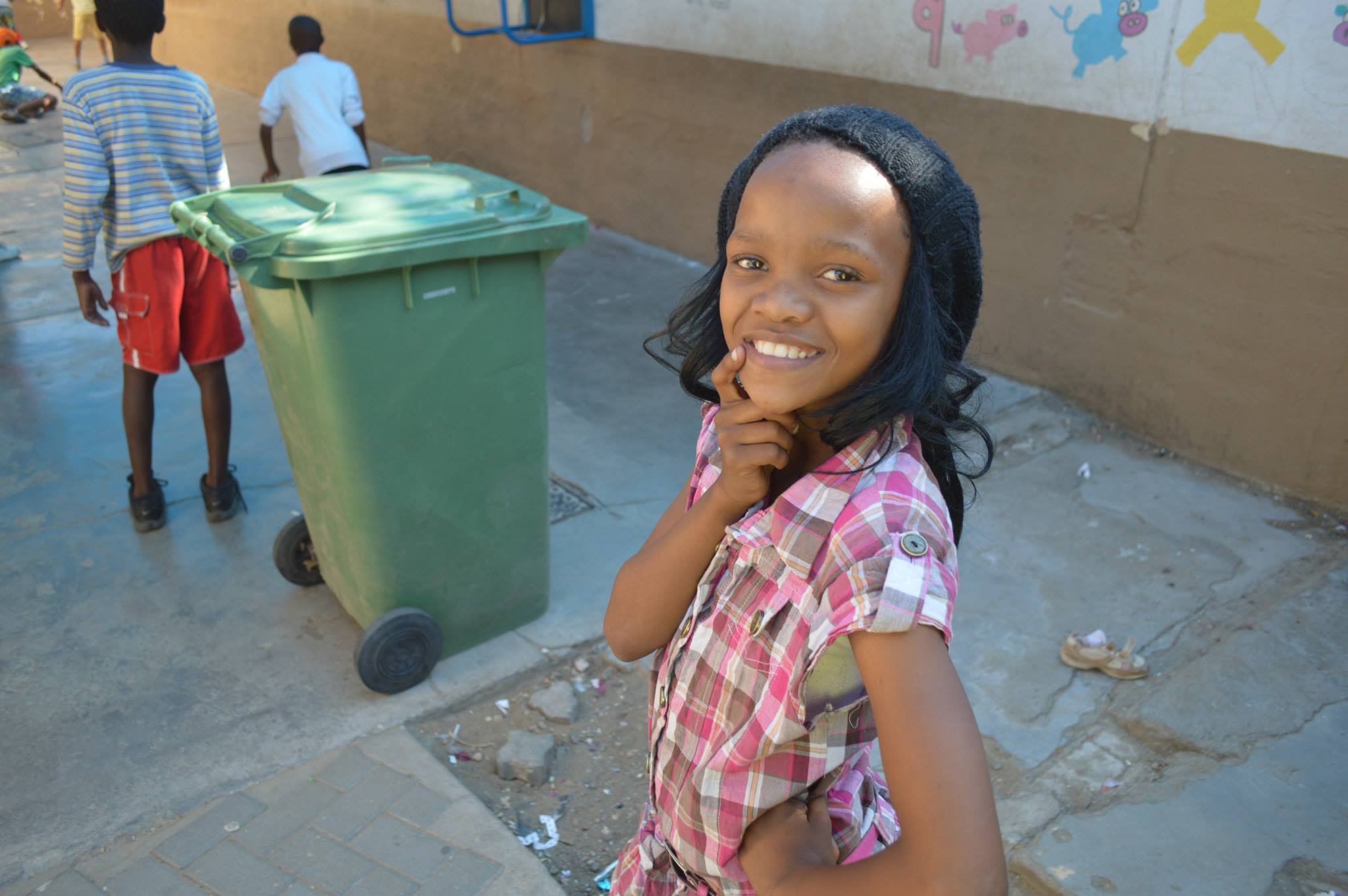
Laurencia ~ pic by: Maegan
Later, I had collaborated with 5th graders, Johanness, Laurencia, Kali, and Ben with constructing a puppet show as suggested by Mary for something fun and stimulative towards learning. The puppet show was very instructional for them as it would advise them to effectively writing down the actual lines with their own handwriting skills along with reading their individual lines to sustain a good performance flow for audiences. With my 5th graders they decided to create a puppet show out of a short story called The Crocodile, Jackal, and Snake. It was a cute story about a jackal and snake and their difficult interactions with the crocodile.
Other than trying to keep some peace and quiet in the room concentrating on rewriting the story it was hectic as the kids were always spirited and talkative to each other. They would always laugh and talk facts about each other especially in their native language. At the BNC, most of the children went for extra educational aid and extracurricular activities and were ethnically Damara. When speaking in their language you would be able to overhear those distinctive click sounds in their dialects. It was amusing because you weren’t able to tell if they were yelling or having a normal conversation. I just really found it fascinating hearing them talk with their mother tongue as it demonstrated their brilliant linguistic skills in both English and Damara. It felt shameful in a way hearing how they were successfully bilingual, whereas in Canada bilingualism is barely represented in any large English or French-speaking populations.
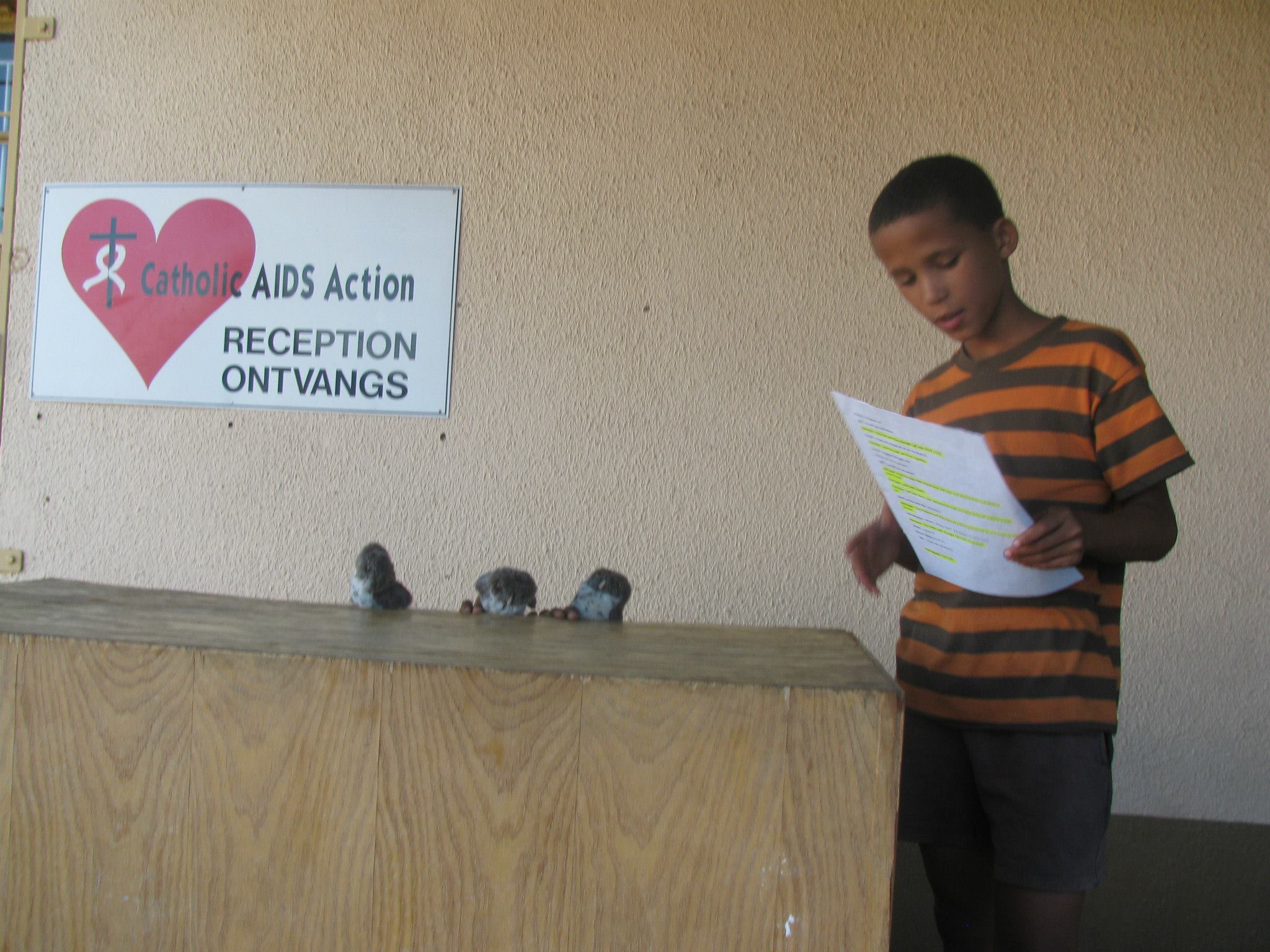
John ~ Narrating the puppet show-pic: Olivia
They also had incredibly strong urges to sing which was honestly great to hear. For instance, I remember hearing them casually sing the Namibian national anthem very proudly and with profound enthusiasm. Their singing made me think that the children are immensely supportive of their Namibian heritage and they maintain strong patriotic ties to the nation regardless of their individual problems that prevent them from prospering. Through my oversight, I found that Johanness and Laurencia were superb in their handwriting. They were able to remember to write their name down and copy the lines word for word in a neat and formulated fashion. I had also made sure to remind them to star their lines as designated by each of their singular part.
The puppet show preparation had continued for the next few days. Soon, it was almost time to leave for the day so the group headed out into the courtyard where we noticed how much energy the kids still conserved after a long day at the BNC. We even got to see more of the playful singing by the kids who sang some American songs as well. Songs from artists like Taylor Swift or Justin Bieber. Seeing all the great smiles on kids’ faces at the end of the day was just really touching to witness. Once leaving, we were already able to see the strong amount of friendly attachment that was emphasized by the children such as running towards the van to still frolic around along with running side by side with the van as it drove off.
From that action and the thorough first day at the BNC it would forever be special for us, as it would constitute our strong connections with the children that would be a precedent for the rest of our volunteering. [To be continued]
(Harrish Thirukumaran is entering second year at Brock University, Ontario in fall 2013)
Related ~ Part I: A Notebook from Namibia: Window on Windhoek: Experiences of a student-volunteer
~ Please note that reader comments are open for this article: