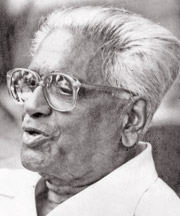
Dr. Colvin R de Silva
By
Dr.Selvi Thiruchandran
(Text of presentation given on 22 May 2013 by Dr. Selvi Thiruchandran at the Republic Day meeting on “For a New Constitution to Strengthen Democracy and National Unity”)
The UF Election Manifesto had a grandiose promise – of course with a conviction of purpose, i.e., to draft, adopt and operate a new constitution to make the country a free, sovereign and independent republic dedicated to the realisation of socialist democracy, guaranteeing fundamental rights and freedom for all. There are and always have been gaps between theory, aspirations and wishes and the practical realisation or implementation of these. The agents or agency of operationalisation may change and hence we will find gaps. My presentation today is not about those gaps but the gaps in the theory itself that guided the making of the constitution.
The break from the constitution of the imperialist British Crown and instilling into it the doctrine of parliamentary democracy and the introduction of fundamental rights clauses are indeed to be welcomed. But regarding various other aspects of the constitution, the principle of dialectics operates rather forcefully. I use the concept of dialectics here in the sense of contradictions between two conflicting forces viewed as the determining factor in their continuing interactions. In my comprehension of the above framework I also take into consideration the process of constitution making in the short prehistory before the 1970s. They both have important ramifications for the post-colonial history of Ceylon. That the 1972 Constitution represented a break from the imperialist colonial past and the hailing and glorifying of this process led to another process of a development of twin interrelated and interlocking concepts of patriotism and nationalism.
In the way these two concepts were operationalised, the country lost hugely, and irreparable damage was done to the polity. In the diversion of their progressive contents and meanings of self-determination, self-respect and dignity and a sense of pride in our historical and cultural formations, which included language and literature, beliefs and religions, we slid into a process of violently denying that sense to others and othering them, calling names and inferiorising other citizens. The questions that beg answers are: Did the 1972 Constitution contribute in any way to this historical tragedy? How did or how do these concepts of democracy and sovereignty function after 1972 with regard to patriotism and nationalism. Without getting into lengthy discussions and debates I will focus on such major themes as democracy, socialism and the major flaws I see in the constitution pertaining to rights of the people. I limit rights to political and cultural rights within an apex of the freedom to live as equal citizens in a democratic country with equal opportunities for personal and collective advancement.
Democracy as a system of government is an overused term lending itself to various interpretations. Who interprets it and from where it is interpreted matters. The will of the people as gloriously spoken of is a misnomer. Which people are we talking of? So we at all times see affirmative action plans for the disadvantaged, marginalised sectors based on caste, class, gender, ethnicity and religion under the general rubric of the subaltern. Democracy as a term is used more as a cosmetic appellation than in terms of the absent phenomenon. There are many things absent; however, constitution drafting can take care of the more important segments, of which pluralism and accommodation of ethnic and religious minority concerns are a sine qua non. A constitution should reflect a progressive, radical, creative spirit in the name of human values. The Kenyan Constitution is a case in point that can be used to draw comparison for the presence of those ennobling human values.
Dr. Colvin R. de Silva, being a well-read and highly intelligent person who commanded a rare intellectual scholarship, had this to say in 1956 when he opposed the Official Language Bill in the House of Representatives and pleaded for parity of status for Sinhala and Tamil.
“If you refuse to help a section of our people of a specific racial stock, having their own separate language, their specific and particular culture, traditions and history, if you deny them their language right then you are running the risk of hammering them in the future into what they yet are not. Today they are but a section distinctive by reason of their particular racial stock and language, from the Sinhalese within the Ceylonese nation. But if you mistreat them, if you ill-treat them, if you misuse them, if you oppress and harass them, in that process you may cause to emerge in Ceylon, from that particular stock with its own particular language and tradition, a new nationality to which we will have to concede more claims than it puts forward now. It is always wiser statesmanship to give generously early instead of being niggardly too late.”
“Parity,” he argued, “is the road to freedom of our nation and the unity of its components. Otherwise, two torn little bleeding States may yet arise of one little State” – prophetic indeed.
But how did he slide from being a statesman to a politician? How did he become a partner in perpetrating Sinhala Buddhist nationalism? There are psychological aspects and political reasons. There are indeed three major flaws in the 1972 Constitution which violated the principles of pluralism by not entrenching secularism and instead enthroning authoritarianism via majoritarian supremacy and by instituting a unitary state. These three taken in totality have violated not only democratic principles but also socialist principles of equality which the 1972 Constitution had promised in its title. Giving constitutional guarantee to the Sinhala Only Act of SWRD Bandaranaike, enthroning Buddhism and giving it a foremost place with state protection clearly gave preferential treatment to one religion and relegated a secondary status to others. “While assuring the rights guaranteed to other religions” is a poorly worded consolation intended to fool the Tamil and the Muslim people and categorically please the Sinhalese. The ideal requirement for a multireligious secular state were thrown away into the dustbin of history.
A cynic, which I am not, may be compelled to ask under the present conditions of Buddhist intolerance, whether the ideology of Buddhist supremacy enshrined in the constitution has paved the way for fostering and protecting Buddhism by a section of the Buddhist clergy, by destroying Christian churches, attacking pastors, building Buddhist shrines in places where non-Buddhists live and finally attacking Islam and hurting the feelings of Muslims by hate speech and the destruction of mosques. Is there a correlation between the ideology in the constitution and the present action?
The Sinhala Only policy had far more disastrous consequences. The 1958, 1977 and 1983 ethnic wars against Tamils have completed the alienating process of Tamils from the state and from the majority community. The deprivation of equal language rights for Tamils has been variously analyzed. I cannot but add to my thesis another point which is hardly discussed. The betrayal by the Left has completely alienated the minority of the neutral Tamil intelligentsia and intellectuals who did not support the Federal Party, and the minority of the Tamil Left, which was a vibrant force in the Tamil community in Jaffna though not in numerical strength. Many of them had to hang their heads in shame, not able to face the attack of Tamil chauvinists or nationalists. They stood aghast. I have a subjective position too in this scenario – my whole family was saddened and felt hopelessly ill equipped and ill prepared to meet the level of very hard criticism from the community, which subsequently became ultra-Tamil nationalist.
It was a personal tragedy. That is not all. Many of the Left, disgruntled and disappointed, became casualties of Tamil nationalism, seeing no road ahead of them or unable to swim against the mainstream current. There is a historical continuity to this factor. Some of the youth, utterly frustrated, took to a fascism of the most brutal kind. Some of those who professed a Left ideology also took to arms; some of the best brains joined the EROS, EPRLF and PLOTE. They destroyed others and destroyed themselves, eliminating many in the prime of life. Can I say that the elders – the Federal Party, which propagated ideas of a verbally violent cult of Tamil nationalism, using a particular language of heroism and valour and adopting an exclusive ideology – and others, Sinhala nationalists more glaringly and most unfortunately the Left in the South, are responsible for the rise of the Tamil militancy? Sinhala Only and its wide attendant evils of discrimination and the subsequent oppression and tyranny of the majority in abstract terms are responsible, apart from the people, for the play of tragedy that our history has witnessed.
The last point I draw from the 1972 Constitution is the character of the state as a unitary one. The constitution did away with the principle of decentralisation and led to the concentration of power in one unit. This is where I link the psychological assumption of the subjective notions of politics and politicians coming into play in the political formation. Dr. Jayampathi Wickremaratne has hinted this in a paper in Tissa Jayatilleke’s edition under the title “1972 Constitution in Retrospect,” published in 2010. Mr. Tharmalingam of the Federal Party asked about the policies of SWRD Bandaranaike regarding decentralising the administration. Sarath Muttetuwagama asserted that the word federalism had become a dirty word not because of its system of government but because of what the Federal Party had advocated. Yes, he was referring to the regressive and utterly conservative and capitalist stance of the Federal Party against all progressive policies such as the schools takeover, Paddy Lands Bill and nationalisation.
Sarath Muttetuwagama as a voice of sanity had suggested regional autonomy. But the UF was totally against any such concept for power sharing. What I am saying is that the drafters of the constitution were subjective and psychological, that is to say not rational, giving into personal subjectivities and lending themselves into psychological action and reaction. “You did not support us, you supported the UNP.” I see a parallel situation where of late, and continuing, all Tamils are equated with the LTTE.
The LSSP thought that the Tamil-led Federal Party did not support it, so it could deviate from parity of status and regional autonomy to Sinhala Only. There were many Tamils who supported nationalisation, the schools takeover and the Paddy Lands Bill. It was indeed strange that the LSSP did not distinguish the Federal Party from the Tamil people. The Federal Party obviously did not consult the Tamil electorate when it voted against progressive legislation. This is the peril of representative democracy. Political parties do not always represent the will of the people. Minority rights, minority demands and equality of status – the principles that should direct and govern the sensibilities of a statesman who is expected to rise above personal prejudices – did not play a part in drafting the 1972 Constitution. The result was that we ended up as the two bleeding states that Colvin R. de Silva prophesied. We bled, Sinhalese bled, Tamils bled and Muslims bled. “The wiser statesmanship” that Colvin thought was necessary “to give generously early instead of niggardly too late” did not prevail. That is the tragedy of the 1972 Constitution despite its good clauses.
To conclude my presentation specific to the 1972 Constitution I will say that I consider the Constitution to be lacking in certain significant aspects, including secularism, pluralism and the non-recognition of the claims and rights of both majority and minority group. It is structured by taking exceptions and entrenching social and political hegemony (David Rampton: 389).
This home-grown constitution, which is supposed to reflect the will of the people, interpreted the people as the Sinhalese majority and entrenched Sinhala nationalism, which would subsequently grow into a whole complex of socio-economic and cultural formations.
I cannot but end this presentation without bringing into focus a contemporary political development that is hotly debated between political parties and in the media – the 13th Amendment, which is very much related to the constitution. It is here I would like to bring in the concept of sovereignty. Let me first relate an anecdote.
A husband and wife lived in a house in a village. One day the neighbor heard some crying and wailing. He pondered for a moment and thought this must be a domestic fight with the affected woman crying. He thought further, should I enter the house to stop the beating? He concluded that the home is a sacred area, a private area governed by its territorial boundaries where others can enter only with permission. He did not intervene. The next day the crying and wailing continued even louder, with verbal abuse. He could not bear it, but he thought that after all a husband and wife relationship is governed by the sanctity of marriage, rituals and rules and is considered sacred. He did not enter the house. The third day he had related this incident to the neighbours and alerted them. When they all heard the woman’s weeping and wailing they entered the house and confronted the man. He angrily retorted, “This is my home and my wife, I can beat or hug, it’s none of your business.” But his arguments did not work in the presence of the wife who was agonised with disheveled hair and bruises. They pulled the man out and together started beating him. The women of the area went in, rescued the wife and tended her with soothing words and treatment. This is the limit of sovereignty, autonomy and territorial boundaries.
I am not a prophet nor do I have extrasensory perception, but we do not want history to repeat itself. I appeal to the politicians on the stage to become statesmen.