By
Marianne David
The conservation of sea turtles is becoming increasingly important, especially in the backdrop of the numerous threats posed to their survival. Sri Lanka has a major role to play in this regard, being home to five of the seven species of marine turtles in the world. Of these five, two are currently critically endangered.
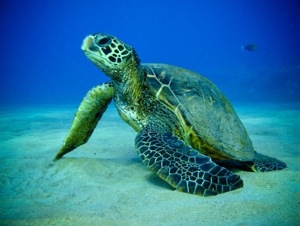
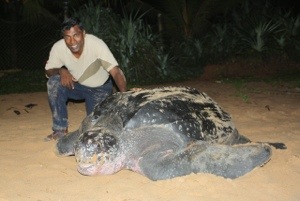
The sea turtles calling our shores home are the Green Turtle, Olive Ridley Turtle, Leatherback Turtle, Hawksbill Turtle and Loggerhead Turtle. The Leatherback Turtle and the Hawksbill Turtle are the two most critically endangered. Species not found in Sri Lanka are the Flatback Turtle and Kemp’s Ridley Turtle.
Threats facing turtles
In an interview with the Daily FT, Thushan Kapurusinghe, the Project Leader of the Turtle Conservation Project Sri Lanka, said that there were many threats facing the turtles at present.
“Firstly, people are still collecting turtle eggs, particularly in the western and southern coastal belts. There are well known nesting beaches located in the western and southern coastal belts and people collect lots of eggs in these areas. We have lost a lot of hatchlings due to these egg poachers,” he said.
A turtle’s eggs are used in a manner similar to how people use a hen’s eggs: People drink them raw, boil them or prepare dishes such as omelettes and also prepare them as a ‘bite’ to be consumed with alcohol, while some people collect eggs in order to sell them to hatcheries.
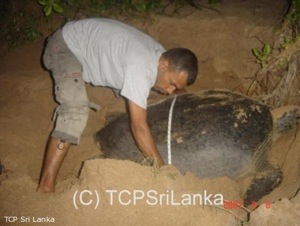
Another threat is from the fisheries industry, with many turtles getting entangled in fishing nets. According to Kapurusinghe, the turtle by-catch is very high in Sri Lanka. There have been a lot of injured turtles in recent months from areas such as Moratuwa and Panadura – mainly due to nylon fishing nets – while the by-catch threat is severe in the north western coastal belt, in the Mannar and Kalpitiya area.
Beach erosion, especially due to rough seas, has also resulted in the loss of many nesting beaches. “We had a lot of nesting beaches along the western and southern coast but we have lost a lot of places, expect for a few places in Bentota, Kosgada, Induruwa and Tangalle, etc.,” said Kapurusinghe.
The destruction of Sri Lanka’s coral reefs due to global warming and alarming rise of the temperature in the sea has also increased the danger to the marine turtles. “Even a one degree change can cause the death of corals reefs, which provide foraging grounds for sea turtles. When corals die, they lose foraging grounds. The sea level rise due to the rising temperature also negatively affects the nesting beaches. Lowland areas are affected and then turtles lose nesting grounds,” explained Kapurusinghe.
The destroying of lagoons and mangroves – such as the Puttalam lagoon – due to pollution, shrimp farming, coastal tourism development activities and the clearing of beach vegetation also destroy the habitats of marine turtles.
“Beach vegetation is very important for nesting. Turtle nests are incubated by the sunlight, which should be filtered through the leaves and branches of beach vegetation. There is no parental role there,” said Kapurusinghe.
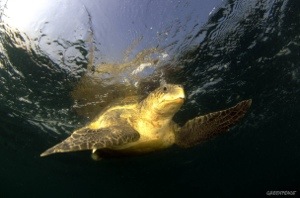
Other threats to marine turtles according to the Turtle Conservation Project are the slaughter of nesting female turtles at rookeries, unsustainable exploitation of marine turtle habitat, uncontrolled environmentally insensitive development of industries close to marine turtle habitat which result in indirect as well as direct effects to marine turtle populations, nocturnal disturbances at rookeries and contamination by agricultural and industrial pollutants.
Turtle hatcheries
Commenting on the role played by turtle hatcheries in sea turtle conservation, Kapurusinghe said that all hatcheries are illegal in Sri Lanka, according to the Fauna and Flora Protection Ordinance (FFPO), which is implemented by the Department of Wildlife Conservation.
“The possession of dead or live sea turtles, collection of turtle eggs and disturbing turtles are illegal activities. We don’t suggest closing down all these hatcheries; they can contribute positively if they manage the hatcheries in a scientific way,” he asserted.
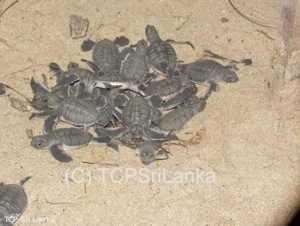
Kapurusinghe also outlined ways in which people can aid sea turtle conservation efforts. “One is they should learn about sea turtle biology, conservation and management. People who are living close to the ocean should make sure not to use bright lights towards the sea. Sea turtles are disturbed by bright lights and they are also attracted by lights. When hatchlings emerge during the night, they go to the sea straight away. But if you have lights coming from anywhere, they go towards the light. If there is traffic, the babies go towards the traffic instead of going to the sea.”
Citing the Kosgoda Bridge as an example, he said that given the large number of vehicles travelling on it, when they carry out conservation activities they see the baby turtles go towards the lagoon instead of the sea since they are attracted to the lights.
Spread the conservation message
Kapurusinghe also detailed how people could help to spread the conservation message: “If they find an injured turtle they can call us or the Wildlife Department. Sri Lanka needs a few sea turtle rehabilitation centres (turtle hospitals) to treat the injured turtles as quickly as possible. Fishermen can contribute effectively by increasing awareness and making them realise that turtles are not the enemies of fishermen. Fishermen believe that turtles destroy nets. As animals they will naturally eat fish but you should not get angry and chop their heads off for this reason.”
In the case of school children, people can teach them why turtles are endangered and create awareness.
“Out of the seven marine turtle species in the world, Sri Lanka is home to five. We have to make sure that their future is secured in Sri Lanka,” emphasised Kapurusinghe.
Conservation efforts can also include encouraging researchers – from universities and foreign agencies, for example – to conduct research in Sri Lanka into the lifecycle of the turtle, since this is poorly understood at the moment.
“Turtles are highly migratory species. They live in all the oceans. We want to know what the other countries are that are shared by our nesting population. They may nest here but they go to other places – for example to Japan or India – to feed and mate. We could have a bilateral or multilateral partnership program; after all, marine turtles are ambassadors of the ocean,” affirmed Kapurusinghe.
Courtesy: The Daily FT
***************************
The Turtle Conservation Project of Sri Lanka:Two Species Critically Endangered
The TCP was established in 1993 and in March 1995 it was registered as an Independent Sri Lankan Non-Governmental Organisation (NGO) with the Central Environmental Authority (CEA).
TCP aims to devise and facilitate the implementation of sustainable marine turtle conservation strategies through education research and community participation. TCP operates according to an approved constitution and is currently coordinated by a committee of seven residents of Sri Lanka. TCP maintains its head office at Panadura and field offices in Rekawa (Tangalle), Kosgoda and Kalpitiya.
As an independent Sri Lankan NGO, TCP aims to assist Government departments, academic institutions and other NGOs in devising and facilitating the implementation of sustainable marine turtle conservation strategies. TCP intends to achieve this via education research and local participation towards communities which are close to important marine turtle habitats.
TCP’s vision focuses upon ‘Sustainable level for sea turtle populations in Sri Lanka” while its mission is to ‘Conduct research, surveys, education and awareness programmes, community based conservation and management programmes to achieve the sustainable level of sea turtle populations in Sri Lanka’.
TCP provides opportunities for foreign nationals to gain experience in community-based conservation by becoming a volunteer of the TCP. Those who are interested can visit http://www.tcpsrilanka.org/ or contact TCP via email turtle@sltnet.lk.
TCP publishes many publications, reports, leaflets, booklets, posters and it has in its possession a decorated collection of slides and video footage collected throughout the years. It also maintains the website http://www.tcpsrilanka.org/ as a source of information for the local and international community.
Turtle evolution and physiology
Marine turtles have inhabited the earth for over 100 million years. They are a successful group of animals that have witnessed the rise and fall of the dinosaurs and until relatively recently have survived in great numbers. Today seven species of these ocean dwelling reptiles remain. All of them are now threatened with extinction, mainly due to man’s destructive activities.
Marine turtles evolved from large land living tortoise-like animals. Over millions of years they have become very well adapted to living in a marine environment. With their long and muscular oar-like fore flippers rudder-like hind flippers and their flattened streamlined shells marine turtles are fast and agile swimmers. Unlike tortoises and freshwater terrapins they are unable to withdraw their head and limbs into their shell.
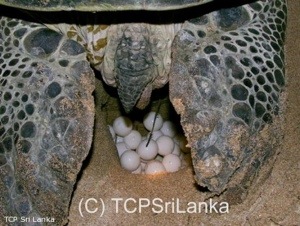
Marine turtles do not have teeth but their sharp beak-like jaws can crush tear or bite depending on their diet which varies according to species. Turtles are reptiles. They are cold-blooded and therefore the environment determines their body temperature. In the morning marine turtles ‘sun bathe’ at the sea’s surface to increase their body temperature. They have lungs and so must breathe air. When feeding, turtles rise to the surface to breathe every 20-30 minutes. At night turtles usually sleep in caves and crevices under the sea. Because they are inactive their body does not need much oxygen and so marine turtles can spend a whole night underwater without breathing.
We do not know exactly how long turtles live but they are generally assumed to have a lifespan greater than 80 years. It is thought that marine turtles become sexually mature at about 30 years of age. Until maturity it is difficult to distinguish between male and female turtles. When they reach maturity male turtles develop a long claw on each fore-flipper and a long tail.
The only time marine turtles leave the ocean is when the females come ashore to nest. The males spend all their time at sea and little is known about their habits. Most species are highly migratory, moving between nesting and feeding grounds, which can be thousands of kilometres apart.
The way that an egg-burdened female finds her way to her nesting beach is still a mystery! Some scientists believe that marine turtles are sensitive to the earth’s magnetic field and use it for navigation. All we know is that turtles are very good at it. They are often found using not only the same sandy beach but also the very same stretch of beach they used in previous years.