By
Marianne David
INTRODUCTION
A trade union for journalists in Sri Lanka, the Sri Lanka Journalists’ Trade Union (SLJTU), was launched in Colombo on Tuesday.

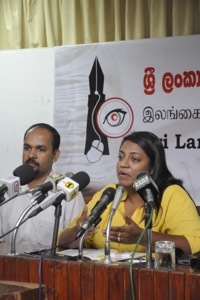
At its inaugural press conference held at the National Library Services Auditorium, the union announced that it would be commencing broad intellectual discussions on key issues faced by media personnel, while focusing on the Government’s proposed code of ethics for the media as a matter of priority in the days ahead.
According to SLJTU President Mandana Ismail Abeywickrema, the union, which is registered with the Labour Department, was formed with the intention of addressing issues faced by Sri Lankan journalists when engaging in their profession.
Following are excerpts of an interview with Abeywickrema:The Interview was obtained exclusively for this blog
Q: What purpose will this trade union serve?
A: The SLJTU was formed with the intention of addressing issues faced by Sri Lankan journalists when engaging in their profession. There are many issues faced by journalists and despite many discussions being held about them, there haven’t been proper solutions to address them. For example, the issue of freedom of expression has been discussed for years and is yet being discussed and another area is the right to information.
As the SLJTU, we will focus on the social responsibility of a trade union while standing for issues like wages and welfare of media workers. We will initiate programmes to uplift the standards of the media personnel in the country and want to build a broad intellectual discussion on the key issues faced by the media workers. We must create a discussion and organise ourselves. The only way media workers could win solutions to their problems is to build strength by organising themselves and we will take the initiative in creating this environment.
The right to engage in a profession of one’s choice has been constitutionally guaranteed to every citizen. This right applies to us (media personnel) as well. We have written and spoken about everyone else’s rights, but have failed to make a strong call for our rights. If we, as the media, remain silent, we cannot expect society to support our cause.
Q: Is there a requirement and space for a journalists’ trade union in the country, given the existing bodies?
A: Yes, there definitely is space and a requirement. The SLJTU is the first trade union for journalists. The mere fact that we still discuss issues faced by journalists, including those that have lasted for decades, clearly indicates the need for the mobilisation of media organisations in all forms to work for a common cause.
There are several media organisations in the country and they have continuously spoken and fought over issues related to freedom of expression, but the problem still remains. Until and unless we manage to mobilise every member in the media industry, we cannot find solutions to our problems. In order to achieve this target, we need to have more organisations and unions that could bring together more media workers into an active forum.
We have already held discussions with our fellow media organisations and explained our motives. They have expressed their support to us and given us their best wishes as well. We have seen that the younger generation who join the media industry most often limit themselves to just doing their job. The reasons range from the lack of confidence to engage in media activities to the lack of proper knowledge of the profession. We are responsible for this situation. It was our complacency that has created this situation and must at least now work to gain the confidence of the young media workers. They too need to feel the passion for their profession the way we felt when we started out in the media field.
Q: How was the launch of the union received and how many members does the union have now, post inauguration?
A: We had our inaugural press conference on 25 June and we received the support of many media institutions. In fact, almost 50% of the journalists who attended the press conference became members of the union that day. Even some media institution heads have expressed their support and said they too would join and support us.
We formed the union with a membership of 20 journalists from electronic, print and web media covering Sinhala, English and Tamil languages. After receiving the registration with the Labour Department, the number of members increased to 50 and now it has further increased. We are now in the process of meeting with media institution heads and visiting newsrooms and editorials on a membership drive.
Q: What are the issues the union will seek to address in the near future?
A: A key issue we will focus on will be the widely-discussed issue of a code of ethics for the media.
Q: Are there any upcoming events planned by the union in the month ahead?
A: Yes, we are planning on organising a broad discussion on the code of ethics for the media. In two weeks’ time we will hold a panel discussion on the matter with professionals in the media field, business leaders and Government representatives.
Q: Could you outline the union’s plans with regard to the Government’s proposed code of ethics for the media?
A: There have been many views expressed about the code of ethics for the media. The Media Ministry released what they called a draft proposal for a code of ethics for the media. A few media institutions and media professionals discussed the matter. The President later said the code of ethics put forward by the Media Ministry would be held back and that such a code should be prepared from the media industry. However, to date there hasn’t been an intellectual discussion on the matter.
We believe that there needs to be a discussion on the code of ethics, which should range from the idea of not having a code of ethics to the necessity of having a code of ethics and what should be included in it.
We have to be mindful of the fact that the two codes of ethics – one prepared by the Editors’ Guild and the other incorporated in the Press Council Act of 1981. There have been many developments in the media industry since these codes were formulated, especially in the electronic and new media. Therefore, the SLHTU will initiate a discussion at different levels, culminating in an intellectual discussion on the code of ethics for the media.
Q: What did SLJTU’s preliminary discussions with Media Minister Keheliya Rambukwella and Media Ministry Secretary Charitha Herath entail?
A: We first explained about the SLJTU and its motives. Both Rambukwella and Herath expressed their support to the union. They noted that there was a need for an independent media body that could make critical analyses of media as well as national issues. We then discussed the issues of right to information and the proposed code of ethics for the media.
Rambukwella said that the code of ethics put forward by the Ministry was a discussion paper and assured that it would not be made into legislation. We had a healthy exchange of views and invited the Minister and the Secretary to participate in the discussion we would be initiating. They both agreed and said they wanted the media and society pose questions to them.
Q: What role will the trade union play in relation to managements and proprietors of media organisations?
A: The common local concept of a trade union is of continuous struggles for wage increases and other welfare measures. Trade unions in Sri Lanka are identified with strikes and agitations. Hence, the word trade union rings alarm bells in the minds of media heads. But we must remember that the agenda of a trade union is much more than that.
The SLJTU as I said earlier will stand for wage and welfare issues of media workers, but will focus more on social responsibilities. We are looking at a broad approach for professional rights. The SLJTU will meet with media owners and explain to them the union’s principles and show them the ‘other side’ of a trade union. We have no intention of clashing with any media management. We understand that it is a business venture for the owners and that employees also have rights. If one of our members faces any issue, we will initiate a dialogue with the management. We believe that any issue could be resolved through negotiations.
Q: Will the union be affiliating with any other bodies, local and/or foreign?
A: Yes, we want to build affiliations with foreign and local trade unions depending on either party’s objectives. Through these affiliations we plan to initiate programmes that would help the personal development of media workers. We are also meeting with local trade unions representing all sectors since we are a trade union and would need their support as well. We must reiterate that the SLJTU will not be affiliated to any political movement.
***********************************
Core principles of the SLJTU
1. To raise the status of all the members of the journalistic fraternity.
2. To promote generally the interests of journalists and journalism in the country.
3. To stand by and support its members in protecting their legitimate rights regarding to wages and conditions of service.
4. To provide for the protection of its members in the event of a trade dispute.
5. To promote unity among journalists in the country.
6. To promote the cause of the working class in general and to enter into affiliations with trade unions based on issues.
7. To support job security among journalists and assist members, where necessary, in securing employment.
8. To ascertain the law and practices relating to journalism and to promote amendments to legislation when designed and to assist journalists in their professional duties.
9. To defend, maintain and struggle for freedom of the media.
10. Lobby for legislation on the right to information.
11. To support the rights of journalists to organise as guaranteed by the International Labour Organisation (ILO) conventions that have been ratified by Sri Lanka.
*********************
Office bearers of SLJTU
President: Mandana Ismail Abeywickrema (Associate Editor, The Sunday Leader)
Secretary: Priyantha Karunaratne (Editor, Lanka newspaper)
Treasurer: Kelum Shivantha (Editor, Sri Lanka Mirror)
Vice President: Saroja Thiruppathy (Deputy Chief Sub Editor, The Sunday Leader)
Assistant Secretary: Shalika Wimalasena (Mawbima newspaper)
Committee Members: Arthur Wamanan (Deputy News Editor, The Nation), Randima Himashi (Editor, Mirror Girl) and Shanuka Karunarathne (ABC Medias Network).