By
Dushiyanthini Kanagasabapathipillai
Mahasivarathri or ‘the great night of Lord Siva’ is a celebration of Siva’s spirit, celebrated by Hindus the world over.

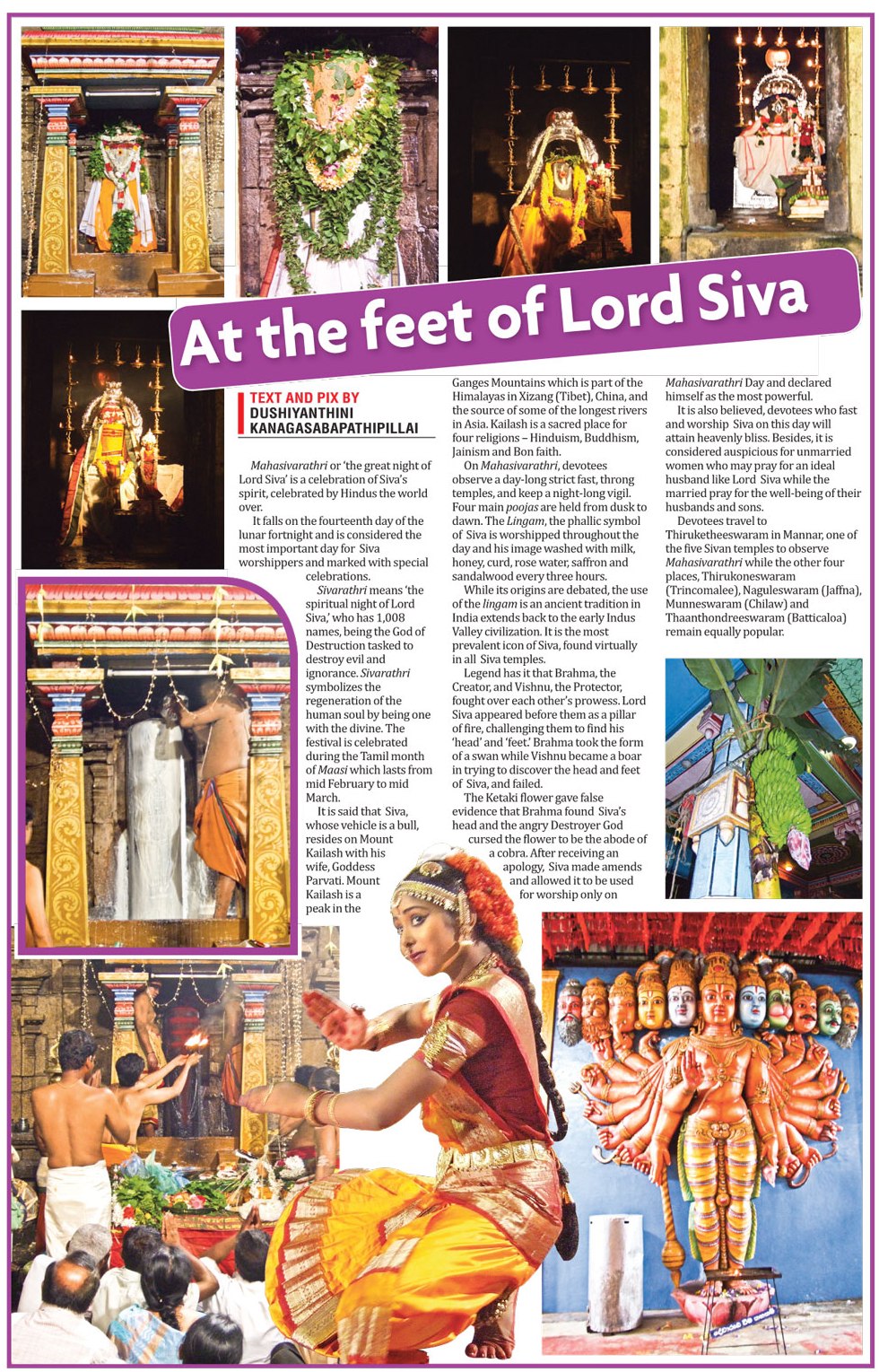
Hindus around the world celebrating “MahaSivarathri” today – pic by: Dushiyanthini Kanagasabapathipillai
It falls on the fourteenth day of the lunar fortnight and is considered the most important day for Siva worshippers and marked with special celebrations.
Sivarathri means ‘the spiritual night of Lord Siva,’ who has 1,008 names, being the God of Destruction tasked to destroy evil and ignorance. Sivarathri symbolizes the regeneration of the human soul by being one with the divine. The festival is celebrated during the Tamil month of Maasi which lasts from mid February to mid March.
It is said that Siva, whose vehicle is a bull, resides on Mount Kailash with his wife, Goddess Parvati. Mount Kailash is a peak in the Ganges Mountains which is part of the Himalayas in Xizang (Tibet), China, and the source of some of the longest rivers in Asia. Kailash is a sacred place for four religions – Hinduism, Buddhism, Jainism and Bon faith.
On Mahasivarathri, devotees observe a day-long strict fast, throng temples, and keep a night-long vigil. Four main poojas are held from dusk to dawn. The Lingam, the phallic symbol of Siva is worshipped throughout the day and his image washed with milk, honey, curd, rose water, saffron and sandalwood every three hours.
While its origins are debated, the use of the lingam is an ancient tradition in India extends back to the early Indus Valley civilization. It is the most prevalent icon of Siva, found virtually in all Siva temples.
Legend has it that Brahma, the Creator, and Vishnu, the Protector, fought over each other’s prowess. Lord Siva appeared before them as a pillar of fire, challenging them to find his ‘head’ and ‘feet.’ Brahma took the form of a swan while Vishnu became a boar in trying to discover the head and feet of Siva, and failed.
The Ketaki flower gave false evidence that Brahma found Siva’s head and the angry Destroyer God cursed the flower to be the abode of a cobra. After receiving an apology, Siva made amends and allowed it to be used for worship only on Mahasivarathri Day and declared himself as the most powerful.
It is also believed, devotees who fast and worship Siva on this day will attain heavenly bliss. Besides, it is considered auspicious for unmarried women who may pray for an ideal husband like Lord Siva while the married pray for the well-being of their husbands and sons.
Devotees travel to Thiruketheeswaram in Mannar, one of the five Sivan temples to observe Mahasivarathri while the other four places, Thirukoneswaram (Trincomalee), Naguleswaram (Jaffna), Munneswaram (Chilaw) and Thaanthondreeswaram (Batticaloa) remain equally popular.