By
Ranjan Mathai
I hope to suggest some ideas to take stock of where the [US-India] relationship is. I am part of the squad called upon to sustain the remarkable transformation that has brought the US and India closer together than we have ever been in the past. It is worth emphasising that the nature of this change has been unprecedented.
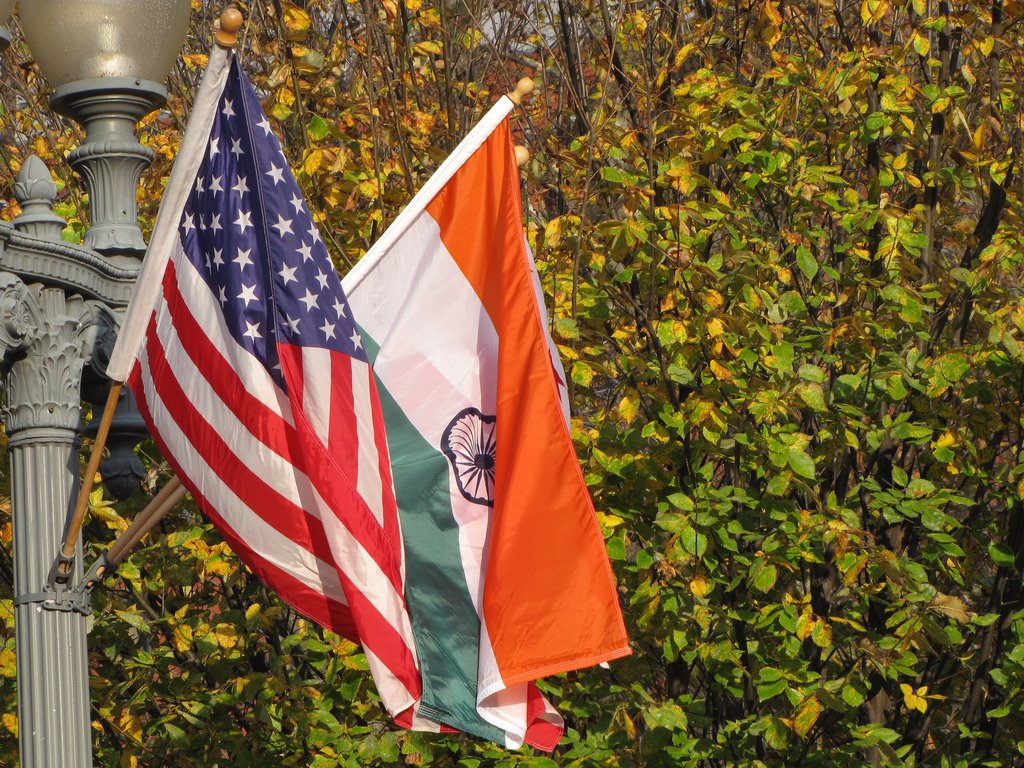
Decorative US-India flags in Washington DC during Prime Minister Manmohan Singh’s visit to The White House in Nov 2009-pic: K.T Kumaran
The centrepiece was the India-US civil nuclear arrangement and all that went into it and has since emerged from it.
The problem, of course, is that everything since that definitive moment tends to be compared with the audacity of what we dared to do together in putting this arrangement in place. This places a somewhat unfair strain of expectation. But I think it is also misplaced. Because the truth is that much that has happened since is equally significant in the game of nations in which we have evolved a “new normal” in the relationship.
Let me cite a few instances of what I mean by the new normal… It is now normal that we have over one hundred visits at the senior official level and higher-level exchanges per year. It is normal that our dialogue architecture covers the gamut of governmental activity — from social sector measures to trade and global financial policy coordination, from energy to defence, counter-terrorism and homeland security…
And it is now entirely normal that our foreign offices consult each other on a wide range of global and regional challenges. Already, we have held three rounds of a trilateral between the US, Japan and India… Just two days ago, we hosted the second round of our trilateral dialogue with Afghanistan. We hold regular consultations on strategic security issues, covering non-proliferation, disarmament and export controls; we are working together closely on India’s membership of the four multilateral export control regimes. We hope to expand these dialogues to cover many more areas of interest. And that is also now normal.
In short, in a few years, consultation has become a habit. We have created a comfortable space to exchange opinions as trusted partners, with both candour and, often, convergence… As India’s horizons expand with the growth of our strategic and economic interests, we will need to talk regularly about real-world concerns to the US, which continues to have both critical interests and a vital presence across the entire globe… I do not suggest that the partnership is already at a stage of maturity or that we are in complete accord on all issues… it is probably not in the nature of either of our nations to be in complete agreement with any other on many issues…
I think I should address a misconception that has secured the force of conviction through multiple reiteration. India does not harbour misgivings over your re-engaging — or rebalancing, or indeed, pivoting — towards Asia… Enhanced American economic, diplomatic and maritime engagement in the development of the Indo-Pacific region… synchronises with India’s own enhanced engagement with our extended neighbourhood…
Afghanistan is one of the key areas in which we need to continue to hold close and candid consultations. It is also an area in which there is greater need for us to be absolutely frank with each other… We are yet to see any evidence that supports the notion of a dividing line separating al-Qaeda from other terrorist and extremist groups, or indeed, that these groups and those who support them have either had an epiphany or made a strategic reassessment of their objectives. To us, it makes little sense to draw lines of distinction that most of these groups or their sponsors are themselves not prepared to do, either in word or deed.
In this context, I cannot overemphasise the point that terrorism is and will remain a pre-eminent security challenge for both our countries. Our convergence on the source and nature of the threat in our region has never been greater. It is therefore a challenge that provides an opportunity for enhanced cooperation in combating terror and protecting our people from it… counter-terrorism is a key dimension of our partnership. Quite obviously, it also has a strong public resonance. It is an area of our work which we must continue to strengthen, including in exchanging information and working to bring terrorists to justice. We are aware of the specificities of legal procedure and their requirements, but we need to commit to the goal of assisting our authorities in the pursuit of justice.
(Ranjan Mathai is foreign secretary. Excerpts from a speech at the Carnegie Endowment for International Peace in Washington DC on February 21)