By
The Sunday Times Political Editor
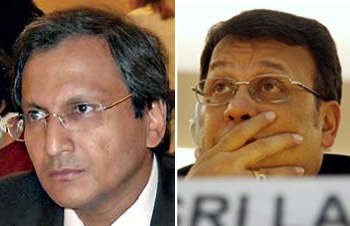
Ravinatha Aryasinha & Mahinda Samarasinghe
The issues at the UN Human Rights Council, currently in session, continue to be in focus. Having originally decided to field a low key delegation, the Government changed its mind at the eleventh hour. Just three days before the Council sessions began, President Rajapaksa asked Minister Mahinda Samarasinghe who is also his Special Envoy on Human Rights to head the country’s delegation. Earlier, it was decided to leave Sri Lanka’s destiny in the hands of Ambassador Aryasinha. The Ministry of External Affairs liked it that way too. Clearly, the President didn’t place much confidence in Aryasinha.
Besides Minister Samarasinghe and his personal secretary, there is a ten member delegation from Colombo. They are six from the Attorney General’s Department – Suhada Gamlath (Additional Solicitor General), Shamindra Fernando (Deputy Solicitor General), Buveneka Aluvihare (Deputy Solicitor General), Janaka Silva (Deputy Solicitor General) and Nerin Pulle, (Senior State Counsel); Ministry of External Affairs – Maduka Wickremarachchi and Dilini Goonasekera. The current Sri Lanka delegation is in marked contrast to a contingent of more than 50 who were present last year.
Though relatively junior in their service, both officials from the EAM function as Assistant Directors in the UN Division of the Ministry of External Affairs. Wickremarachchi, a former Sinhala journalist, has served under Ambassador Aryasinha for a year whilst Goonasekera was recruited to the Foreign Service only a year ago. Ambassador Aryasinha had asked for a senior military official to be on hand in Geneva. The request, however, was turned down by the Ministry of Defence. The UNHRC sessions in Geneva are easily one of the most important events for Sri Lanka. Yet, the absence of top rung EAM officials including its Secretary, Additional Secretary, Director General, Directors both senior and junior, Deputy Directors was the talking point in the corridors of the EAM. Only one EAM official, Shashikala Premawardene (now attached to the MoD) attended the Council sessions on Universal Periodic Review (UPR) in September last year. It is another clear indication that the EAM has lost focus on the issues confronting the country, or was not supporting Minister Samarasinghe in this national task, or both.
There has been a marked shift in Sri Lanka delegation’s strategy this week. Earlier, diplomatic overtures were made to the United States through different channels to ‘water down’ its second resolution on Sri Lanka. This was through countries friendly with the US. The other was the consultations Ambassador Aryasinha had with his American counterpart Eileen Chamberlain Donahue in Geneva. However, this week, the Sri Lanka delegation has taken a step backward from this approach. Instead, some lobbying is under way to persuade friendly member nations on the UNHRC to back Sri Lanka’s cause. Yet, a Sri Lankan diplomatic source in Geneva said yesterday that the country was unlikely to seek a vote when the resolution comes up, most likely on March 21. There was a fear that the result might be worse than the last time.
The same source added that the United States was bringing “enormous pressure” on member countries of the Human Rights Council to support its second resolution. Ahead of the formal presentation of the resolution, the US delegation to Geneva is expected to consult members of the Council in what is called an informal metting. The Sri Lanka delegation will be on hand to obtain a first-hand account of the contents of the new finalised resolution. The latest draft was revealed exclusively last week in the Sunday Times (Political Commentary).
The only official task for Minister Samarasinghe, named delegation leader at the last moment, was to address the high level segment of the Council on Wednesday. Thereafter, he was busy conducting one-on-one meetings with heads of delegations over what one Sri Lanka diplomat said was to “test the waters”. He said yesterday, “We want to find out what each country thinks of the resolution.” Whilst mnisters are allowed 20 minutes speaking time from the rostrum, heads of missions leading delegations are entitled to only two minutes. That was another reason that made the government despatch Samarasinghe. Other than foreign and justice ministers of some countries, the only minister with a different portfolio (Plantation Industries and President’s Special Envoy on Human Rights) attending the Council sessions is Minister Samarasinghe.
COURTESY:SUNDAY TIMES