by
Vishnuguptha
“Democracy is a device that ensures we shall be governed no better than we deserve.”
– George Bernard Shaw
It is history, but recent enough to be discussed: 3 July 2011 marked a historic day for Thailand: A country whose people hold their ceremonial Monarch in awe and veneration, elected for the first time in their history, a woman Prime Minister, Yungluck Shinawatra, younger sister of ousted former Prime Minister Thakshin Shinawatra. Thailand, where nearly 30% of companies are led by CEOs of the fairer sex, elected a woman as the mother of all CEOs – Prime Minister. The elections were universally accepted as free and fair, a phrase that eludes any meaningful mention in the context of Sri Lankan elections. A process which stands the test of trial and time seems to have taken root in the kingdom of Thailand. What more can one ask for, from a people whose women folks’ main livelihood, in the popular mind, is of questionable moral fibre? Most of the Ladies of the Evening would have rallied round a formidable woman, a successful businesswoman and a leader of the first order. However, her being the sister of the ousted Thakshin seems to be a sore point, especially among her critics. Accident of birth seems a very powerful qualification in political succession stories in Asia; be it India, Bangladesh, Pakistan and of course Sri Lanka.
Importance of the process
The process is of paramount importance. Free and fair, just and transparent, accountable and accounting, respecting and assertive – these are the adjectives that one uses to describe a process, a process that is beyond questionable practices and abuses. Be it in the government or opposition, the State or the subject people, majority or minority. The process that set in motion a chain of events that ultimately propelled a private sector business executive along the political path bore fruit not only for herself and her party, but also for the larger institution of democracy and freedom. Compare that to what’s going on in Sri Lanka. It’s pathetic. No election held after 1977 has been fair and free, no government transaction has been just and transparent; no parliamentarian or government official is accountable and accounting and above all else, the people at large have been paying no respect to others’ rights nor are they asserting their own rights – sure symptoms of decay and decline.
The Constitution, the source of all law and power, was amended for the 18th time with the introduction of the now infamous 18th Amendment. Term limit imposed on the Executive was removed, just to pave the way for the current holder to fight another battle, another day. A democratically-elected President became the sole authority and ultimate arbiter of commissions, whether it’s public service, Judiciary or police. To cap it all, when the opposition woke up from its pitiable slumber and introduced The Right to Information Act, it was virtually shut down, making the ‘Temple of Democracy,’ Parliament look like a slaughter house. The Ruler (or the Executive) of the land declared that such an Act was not necessary, that all such queries should be addressed to him and he would determine whether to release such information or not: The Judge, the Jury and the Executioner, all in one.
Commitment to an ideal
Breakdown in democratic institutions is the beginning as well as the end of man’s march towards full attainment of ideal society. However impractical it may look or sound, however hard and laborious it may be, demanding unspeakable sacrifice in blood, sweat and tears, man has kept his faith in himself and his beliefs to strive towards a concerted commitment to an ideal and that has kept him from total extinction.
What is even more significant in the aftermath of the Thai election is the customary stepping down from party leadership by the outgoing Prime Minister Abhisit Vejjajiva, paving the way for a successor. Thailand’s Democratic Party, according to its former party Secretary-General Soutep Thagsuban, was expected to hold its general convention later to choose a new leader to replace Abhisit Vejjajiva, who resigned from party leadership to take responsibility for his party’s loss to the opposition Pheu Thai party in the General Election. Now compare that with Sri Lanka’s opposition leader’s stance.
After losing election after election, for almost a generation (from1994), our Leader of the Opposition and United National Party clings on so greedily to the mantle of party leadership. Once the pride of Sri Lanka’s elite and the ordinary, the party of development and order, the party of discipline and drive is still trying to clear the cobwebs and wake up from its deep slumber, lethargy and inaction. One is reminded of a rudderless boat, floating its weary way in the murky waters of corrupt and disorderly politics. Instead of taking some drastic measures, its membership rushed to augment a weak leader’s powers and thereby enthrone a loser for six more uninterrupted years; the relentless gush will ultimately submerge the party and the opposition. Ranil Wickremesinghe is indulging in his customary furloughs, canvassing in Tamil Nadu and Bonn; in Sweden, Italy and Norway, in New York and Los Angeles, without realizing that those denizens don’t have the vote in Sri Lanka.
Canvassing the voters
While the Rajapaksas are in a gruelling campaign in their own country, Ranil chooses the safe havens of the West. In 1960, during the presidential nomination process of the Democratic Party in the USA, John Kennedy decided to give it a try. His first task was to get the party nomination for which he had to muster as many delegates as possible at the Democratic Convention. In New Hampshire, where the first primaries are held, Kennedy met with some very influential party supporters. Into this meeting barged in Bob Kennedy, John’s brother and campaign head. Seeing the very distinguished gathering he inquired from his brother as to who they were. John started introducing his younger brother to the guests. Bobby asked as to how many delegates there were. There was none. Bobby took John to a side and used a colourful profanity and demanded that he send them away as soon as possible, for all that mattered at that time was meeting the delegates who had the vote at the Party Convention. Wickremesinghe is canvassing influential people in the West, while the local scene is infested with inaction, indiscipline and impotence. Arbitrary appointments of his friends and soul mates to important party offices and paying scant respect for party regulations, norms and traditions contributed to the acceleration of the decaying process. The people must be given an alternative. If the alternative is worse than or as bad as the government, what other options do they have?
Likeability factor
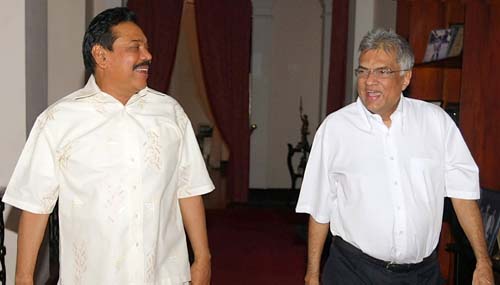
When the United National Party as it is officially constituted today, is offering itself as a mere substitute for the current regime that is deeply embroiled in its own corruption, inefficiency and nepotism, it’s time the people decided to look for a real alternative. In fact, when confronted with a choice between Mahinda Rajapaksa and Ranil Wickremesinghe, the voter’s task becomes even easier. Mahinda looks in every which way one can imagine, a better choice, first as a person, second as a ruler and third as a politician. Mahinda was a better leader when he was in the Opposition too. In modern day politics, especially in the context of Presidential Elections, the ‘likeability’ factor is of paramount importance. The people, when faced with a choice, if all other factors are equally shared by the two candidates, the voter goes with the person whom they like better. In this field, Mahinda Rajapaksa has no match today.
Now even Ranil’s capacity for leadership and management of politics is being questioned. When a leader’s capacity is questioned, the leader must realize that it’s time he said good bye.
Yet Ranil, on the contrary, is further entrenching himself, along with his cohorts, in his own comfort zone. The corruption that has been eating into our system of government has crept into the Opposition and its devouring process is continuing with greater alacrity and zest. We are really caught between a rock and a hard place.
George Bernard Shaw said: “Democracy is a device that ensures we shall be governed no better than we deserve.” The most unfortunate thing is that we deserve not only the government that we elected but the opposition too.
COURTESY:CEYLON TODAY