By Risidra Mendis
There are only a few places in the world, where the amazing beauty of the largest mammals on Earth, can be observed from close proximity. And Sri Lanka is one of those fortunate paradises, where the gigantic sea mammals, whales, come closer to the shores, giving an opportunity for humans to observe their frolics in the blue waters of the Indian Ocean.

pic: defence.lk
Mirissa is one of the choice locations of the whale watchers, who in their dozens, go out to the sea in motorboats with diesel powered engines, in order to get close to the whales.
Unfortunately, the increasing number of boats going out to sea, to spot the large animals, is now posing a threat to the existence of the very same animals.
Blue whales are the most popular sightings at Mirissa. However, due to the careless and inconsiderate attitude of the visitors, the animals are now moving away from the shore towards the deep ocean.
Marine Environmentalist, Prasanna Weerakkody told Ceylon Today, prior to whale-watching was popularized in the area, the whales could be seen two-three kilometres from the shore.
“But after the boat tours to see the whales commenced, the creatures have moved further away from the shores. Mirissa is popular for its blue whales. Apart from them, sperm whales, killer whales, pilot whales and several species of dolphins, including the spinner dolphins, can also be spotted in Mirissa,” Weerakkody said.
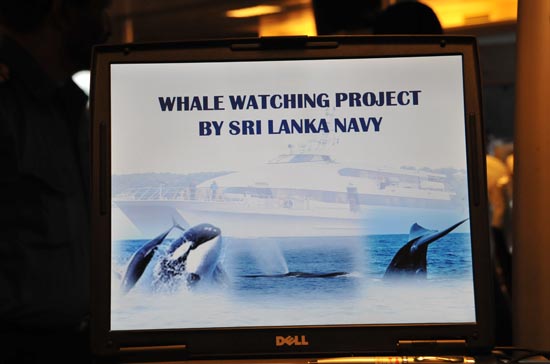
pic: defence.lk
Driving them away
He added pods of dolphins and whales can be spotted throughout the year on the coastline and that these animals can be especially seen in large numbers during the beginning and end of the monsoon seasons.
“As soon as the whales are spotted, all the boats rush to that area and surround them with the intention of getting a closer look at the animals. When the boats surround the creatures and come into close contact with them, they are prevented from coming up for air,” Weerakkody said.
According to the Marine Environmentalist, whales also come close to the shore’s surface edge to feed. “However, due to the many boats that take visitors on whale-watching tours, these animals are also prevented from coming close to the shore’s edge,” he explained, revealing that if the whales are prevented from coming to the shore in search of food, they will move away towards the ocean. “The whales are not trapped like elephants or leopards who have a limited area to move around. If they are disturbed by the boat tours, they will move away as they have access to the entire ocean, which is a vast area,” Weerakkody said.
He also stressed it is the whale-watchers who are pushing these animals away from the shore and said the whales are now moving towards the shipping lines and are getting injured by the ships.
“When the whales move 20 kilometres outwards into the ocean, the boat tour operators are going to face a problem. The expenses incurred by the tour operators to take their clients out to sea to spot the whales would thereby increase. It is the tour operators who will ultimately suffer, as a result of the whales moving towards the ocean. This is a sustainable industry, but has to be managed properly, if it is to continue to thrive,” Weerakkody pointed out.
Within regulations
Ganidu Rochana of the Southern Whale Watching Tours told Ceylon Today, the whales can be spotted easily in Mirissa. “This is a good area to spot the whales. I conduct boat tours in this area and within one to two hours you can see the whales. At times, the blue whales, sperm whales and dolphins can be spotted in less than an hour,” Rochana explained.
The tour operator said, in most cases, the whales are spotted in groups, but sometimes even a single whale or two of them can also be seen.
“Our boat rides generally last for three hours. A boat can take about 40 people at a time. We operate tours from November to mid-May, as the sea is not rough during this time,” Rochana said.
Commenting on the accusations made against them by the environmentalists Rochana said they adhere to the rules of not harassing the whales and dolphins while out at sea and that whales can be seen close to the shore.
“We don’t take our boats close to the whales and disturb them. We don’t harm the animals and make sure we stay at a safe distance.
Around 10 boats go out to sea at a time. About two to three years ago, we had a problem with regard to whale-watching. But now the tour operators ensure the whales and dolphins are not disturbed. We survive on this business and it is our duty to protect these animals from harm and harassment,’ Rochana said.
COURTESY:CEYLON TODAY