By Thulasi Muttulingam and Megara Tegal

Pix by Megara Tegal and Manjula Dayawansa
For the thriving industrial hub of a country, Colombo has not done too badly when it comes to tree cover. Old and massive trees take pride of place on many sidewalks and pavements; pavings, roads and walls have been built to accommodate their stately presence, in many areas.
Pedestrians and motorists alike might have to swerve round them but few complain. After all, they don’t lend only their shade. They also provide the city with a presence and personality that many people are appreciative of.
Colombo was planned as a ‘garden city’ by the British colonial administrators, according to environmental lawyer Jagath Gunawardana. “They planted both indigenous as well as exotic trees in the cities of Colombo and Bangalore, whereby both came to be well-known as the garden cities of South Asia. In 1985, I did a personal survey of the trees in Colombo, where I found many rare trees, out of place but fascinating in their aspects and history. The British had planted a number of colourful trees of different blooming seasons so that the city would be colourful throughout the year.
Therefore, we have the Jacaranda trees blooming purple all year round, the copper pod trees blooming a deep yellow in the second quarter of the year, the Walahala trees which break out in sudden golden bloom in April and May, the Tabebuia rosea which blossoms in pink in the first quarter of the year, the flamboyant trees with their fiery red blooms in the following quarter, and many more. The British left Colombo to bloom in a riot of colour throughout the year,” says Gunawardana.
And therein seems to lie another problem. Many of the trees in Colombo date back to colonial times which mean they have been there ever since even our most senior citizens can remember, and have many varied and interesting histories of their own. However it also means that some of them just might be nearing the end of their lifespans. Disquiet has hit the city’s residents recently over the sudden felling of trees in different areas.
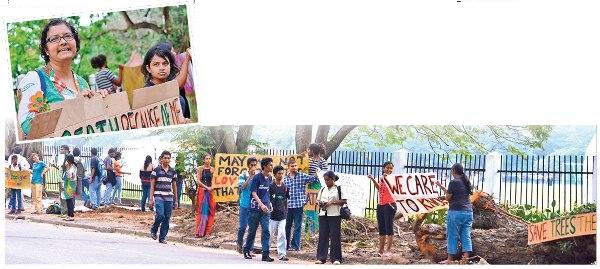
The latest victim is Reid Avenue where a number of Nuga (banyan) as well as Andare trees were cut. They were hoary old trees with cantankerous personalities of their own. Widespread, thick roots everywhere, massive trunks taking up the entire sidewalk as well as sometimes encroaching on the road… but there was no doubting the charm and personality they lent the avenue, not to mention the shade.
Passers-by on the road had no inkling of what was going to happen and were horrified when they saw Colombo Municipal Council (CMC) workers sawing off those trees last week. Protests flared up immediately, with many people in a temper, demanding to know what was happening.
One of the protestors, well-known artist Chandraguptha Thenuwara, said he had no idea what the authorities were up to, which was precisely the problem. “Earlier, they cut many of the shrubbery by the Galle Face Green because they said that terrorists were hiding there. Now what’s the problem? There are no longer any terrorists, only people in a so called ‘democracy’ so why aren’t we informed of what’s happening and why don’t we have any say in it?”
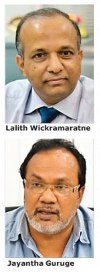
According to engineer and Director, Works at the Colombo Municipal Council (CMC), Jayantha Guruge, the trees were cut down because their roots were clogging the drainage system. “I am personally looking into the project because I am a lover of trees too. We are not cutting the trees arbitrarily. We have planted far more trees than we have cut down, but how come people don’t see that? Why are only negative aspects highlighted in the media? Haven’t you seen the various progressive developments that are happening around Colombo?” he asked.
According to him, the roots were disrupting the footpaths as well as taken hold of the drainage system. Trimming the roots alone would be inadvisable as the trees could become unstable and topple. He also said that the Andare trees were a particular nuisance because their leaves did not decompose easily, thus again, clogging gulleys and drains.
Drainage problems
“During rainy seasons, the water is not draining properly due to these problems. We are not simply cutting down those trees. We are replanting others in their place. On Reid Avenue, we have planted Burutha(Satinwood) and Mee trees because the way their trunks and roots grow, they are more conducive to be roadside trees than the Nuga(Banyan) and the Andare.”
According to Guruge, they are revamping roads to be more conducive to the ever increasing traffic and commuters, while at the same time modernizing those roads to be more disabled friendly.
“We are currently working on several roads such as Jawatte Road, Vauxhall Street, Reid Avenue and Havelock Road. Next month, we’ll move on to Galle Road and Duplication Road. We have already planted a number of trees on Galle Road along the Bambalapitiya to Colpetty stretch. There were very few trees there previously.
We are also introducing a number of new features so that the roads are more user- friendly for the disabled such as smoother tarmac for wheel chairs, tactile features for the visually- impaired, pelican crossings and raised pedestrian crossings,” he said.
Part of that process presumably would be to get rid of a number of trees with massive roots branching all over the sidewalk, which are a problem even to those with all their faculties intact. If Colombo’s roads are becoming more disabled- friendly, which is definitely a good thing and long overdue, part of that progressive development is going to be the cutting down of certain trees, no matter their value or charm.
According to Guruge, the CMC has thus far worked to accommodate a number of ‘troublesome trees’ in various parts of the city but they are soon going to go, because on weighing the balance between access to, and safety of people versus the need to save the tree, the balance tips definitely in favour of cutting.
“On Stanley Wijesundara Mawatha for example, there is a huge tree jutting onto the road, which we have thus far strived to accommodate. But it causes a number of accidents. There were three serious accidents on one particular day.
It is going to be cut. At the end of Bagatale Road, there is another such tree which numerous buses run into. We have always had a policy of saving as many trees as we can. And we are still doing that, going to the extent of paving round trees wherever possible but some trees are going to have to go.”
According to Kamini Meedeniya Vitarana, president of Ruk Rekaganno (the Tree Society), which was founded in 1975 to help preserve trees in the Sinharaja Forest, Colombo urgently needs a tree surgeon.
“Other countries have tree surgeons to treat their trees and preserve them as much as possible but when we suggested it 20 years ago here, people laughed,” she says. “Colombo’s trees are full of parasites eating into them. They need to be treated. Some years ago, we did an intensive study of many of these trees and identified which ones needed attention and treatment.
We took the study to the CMC and they were receptive to our recommendations but unfortunately when Uvais Mohamed Imtiaz became the Colombo Mayor, there were some political shenanigans due to which the municipality collapsed – and so did the progress on our recommendations.” She also noted that it could be true that some of those trees could be coming to the end of their lives as Ruk Rekaganno had identified 800 trees in their survey which needed special attention.
Tree surgeons
Colombo however still does not have a tree surgeon. According to the Director of the Landscape Division of the CMC, Lalith Wickramaratne, they have newly created a post of tree surgeon but the position is yet to be filled. “Committed scientists wouldn’t want to work full-time at the CMC as it would be a very narrow job description for them, working on the city’s trees. Those with the passion to pursue that kind of education prefer to work in botanical gardens or forests.
“Currently we have only civil engineers and an unskilled labour force in this division to prune and maintain the trees. We get by on our years of experience but we do wish that we had some horticulturists and scientists working with us.”
Independent tree experts and landscape architects for their part, say they would be more than happy to volunteer their knowledge and expertise if the CMC were to ask for it. The common complaint across all other sections of concerned society was that they had no idea what was going to happen in their midst and by the time they did, it was too late.
Both the consultant conservationist at Ruk Rekaganno, Bathiya Sumithrarachchi and President of the Sri Lanka Institute of Landscape Architects, Professor Shiranee Balasuriya voiced this same concern. Says Professor Balasuriya, “It would have been best for the CMC to have written an article outlining the reasons that necessitated the cutting down of these trees. We would in fact support them if their reasons for cutting down the trees are valid. And we would help them in planning and planting more trees.”
She added that she had made several attempts to contact the CMC but was unable to speak to those involved in the Reid Avenue tree-felling. As an alternative to felling the grand trees due to the roots interfering with the drains, she suggested making a trench.
“It is expensive in the long run but it would have been a way in which the trees could be preserved.” She added that until a proper discourse could be held between the relevant organisations and the authorities, she could only guess at what the problems might have been. “However, we would like to express our interest in helping the CMC in the future; each tree must be inspected individually and determined if they pose a threat to the public. We can help them conduct these inspections.”
Balasuriya added that Singapore was modelled on Colombo for its hefty and grand trees and it would be a shame for Sri Lanka to lose that. However, according to the CMC the public will have to bear with some years of a sunny, unsightly city but Colombo will be far more ‘greener’ than it is today. courtesy: CeylonToday