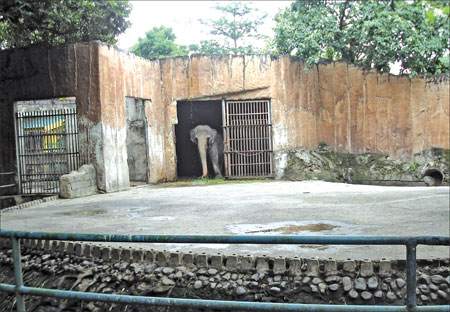
Mali’s abode of 35 years. Courtesy PETA
by Aditha Dissanayake
“Dear All,
Please do your best to help me. I am Mali from Sri Lanka currently living in a South East Asian country.
When they killed my mother even as I was sucking at her breast, I thought this is surely the worst thing that could ever happen to me. Little did I know my future would hold even darker moments.
They called me an orphan back then, back in the year I was born, 1974. I didn’t mind. I missed my mother at first, but soon my foster aunts and cousins took me into their midst – loved me as one of their own. I was happy in my motherland.. the daily baths in the river with my adopted brothers and sisters, the lush green surroundings, the feel of grass under my feet… is that really me that I see in these pictures in my mind’s eye? Thirty five years in this room, on my own, going nowhere, doing nothing is far too long a time to recall the exact details of those happy days. Will I ever know a world like that again?”
Does this look like a spam mail that lands in your inbox when someone hacks into someone else’s email account? Relax. This is not one of them. In fact, this is not even a real email. This is the message Mali would have sent if she had access to email.
If only she could voice her thoughts. If only she could share with the world the loneliness of her life, the pain of walking on cracked feet, the companionship of the kinsmen she yearns for, the wish to ramble across vast stretches of land, nibbling at leaves, scratching her back on a tree , trumpeting loudly and listening to the answering call from a neighbour, close by.
Though Mali bears her sorrows silently, there are those who have begun to give a voice to her silent cries and demanding that she be given another chance at life.
Environmentalist and Wildlife Enthusiast Srilal Miththapala, speaking on behalf of Mali says elephants are highly social animals and thrive on constant interaction with others, “if you watch them in the wild they are always rumbling – talking to each other, touching, smelling and interacting.” Even if ill health or ill treatment are not issues for Mali at the foreign zoo, he thinks she must be sympathized with because she is ALONE.
Irangani de Silva, President of Animal Welfare Trust, joining the petition asking for Mali’s release says “We human beings should see ourselves as caretakers of Mother Nature, not be her destroyers. “As in the case of Mali, the world would be a better place for all the children of nature, if mankind learns to empathize with their animal counterparts.”
The good news is, some of us have already begun to do so. PETA Asia-Pacific, an affiliate of PETA US, the world’s largest animal rights organization, is doing their best to make us all ’empathize” with Mali. “Try to imagine living your whole life in a room the size of a bedroom, seeing the same four walls every day. You’d have no friends or companionship and nothing whatsoever to pass the time or provide you with comfort. You’d never get to leave.
That’s exactly what life is like for Mali,” writes PETA on their petition campaigning for Mali’s right to a sanctuary which has already gathered over 37,844 signatures.
Reminding the world “Mali is a mere shell of the magnificent being she is meant to be” PETA says if the foreign authorities will release Mali she would be transferred safely to an elephant sanctuary and that PETA is willing to bear all the expenses.
Not everyone though, is convinced Mali is in bad health, is ill treated at the zoo and will thrive if she is returned to the wilderness (or pseudo wilderness) of a sanctuary. Among them is veteran advertising photographer John Chua, who has been Mali’s volunteer caretaker since 2001. “Don’t tell me she’s sick or that she’ll die if she’s not moved. I’ve taken care of her for 10 years. That’s no joke,” says Chua in an interview with Jaymee T. Gamil in the “Philippine Daily Inquirer”.
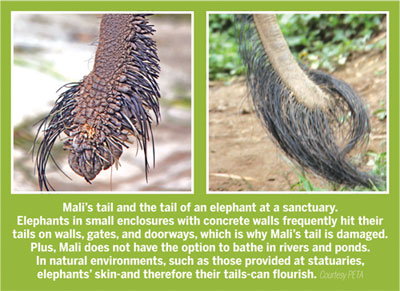
The article records how he treats her almost every day to her favorite food like mangoes, bananas, even orange-flavored popsicles, gives her a shower and a soothing spray on her massive feet, and puts her through what he calls an “enrichment program” that includes “coconut football” or a lazy dip in a puddle. Chua himself has donated a water pump for Mali’s enclosure, found private sponsors for other improvements at the site, and even trained how to handle such an animal in Singapore and at the Pinnawala elephant orphanage where Mali comes from-all to “make her life better” writes Gamil. Chua is suspicious of PETA’s objectives in trying to help Mali, though, and insists “if they (PETA) really care for her, (they should) care for her now.”
Authorities who are in direct contact with Mali continue to guarantee Mali is in good health and is not ill treated at the zoo. Especially so, as the zoo has improved Mali’s living quarters after the suggestions made by certain authorities, expanding her “room” and installing a water fountain in it. Manila Zoo’s chief veterinarian Donald Manalastas, in a statement issued to the Agence France-Presse says “We have expanded the enclosure of Mali and increased her food with more nutrients. We have proof and papers of what we feed her. We do not torture her.” According to Deogracias Manimbo, head of Manila’s Public Recreation and Parks Bureau, which oversees the Manila Zoo, Mali “is used to this kind of environment,” and explains in a statement issued to the Philippine Daily Inquirer “she might not withstand a different environment from what she has gotten used to.”
Yet, PETA remains unconvinced.
In an exclusive interview with the Daily News, Ashley Fruno Senior Campaigner, PETA Asia, reiterates the point of every animal lover who abhors to see animals in zoos. “Study after study tells us that housing these complex and intelligent animals alone is severely detrimental to their mental health.” says Fruno and adds “female elephants should never be housed alone.”
Countermanding the fear that Mali will not survive in a new environment, or know how to interact with other elephants, having lived for so long alone, Fruno explains “Renowned veterinarian and elephant expert Dr. Mel Richardson has examined Mali and believes that she is fit to travel to a sanctuary. Around the world, many elephants are transported from zoos to other zoos and zoos to sanctuaries each year without problems. Experts have said that they have seen many elephants who have been housed alone for a great number of years adjust quickly to sanctuary life, and we believe that will be the same for Mali.”
If all goes well, if Mali is released from her present location, PETA intends to transfer her to Boon Lott’s Elephant Sanctuary (BLES) in Thailand. Currently housing 12 Asian elephants, the sanctuary spreads over 500 acres and is run by staff who are knowledgeable in rehabilitating elephants. “The staff would never force the elephants to interact if they don’t want to” assures Fruno.
Detailing Mali’s future in the sanctuary Fruno adds “after Mali is transferred to the sanctuary, she will be housed in a separate pen of several acres for the first 6 months. She will be able to interact with other elephants through a fence if she wants to. After the initial 6 months, she will be free to leave her area and interact with the other elephants if she chooses to.”
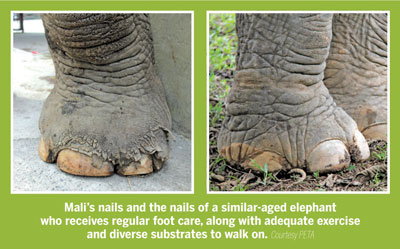
Life at BLES would provide Mali with everything she has missed ever since she arrived at the zoo, thirty five long years ago: acres to roam the land as she wishes, a chance to splash and play in rivers and ponds, fruits and leaves to forage for, and most importantly, the company of other elephants.
Mali’s solitude has not been in vain. Her condition has melted the hearts of many animal lovers from all over the world, hopefully paving the path for better conditions of her brethren. Among those who are speaking on behalf of Mali are World-Renowned Animal Expert Dr. Jane Goodall, heads of many animal protection groups and the two-time Booker Prize winner J. M Coetzee.
Before I rest this sincere attempt to construe a case on behalf of Mali, let me quote Coetzee, for he says it best. “…..Mali has paid the penalty for not being fortunate enough to be born human. Now it is time to release her.” courtesy: Daily News