By Dilrukshi Handunnetti
Pix by Dushiyanthini Kanagasabapathipillai
The day starts slowly for the people in the sleepy village of Periyathampanai in the Vavuniya District. To the visitor’s eye, it is a peaceful location that belies its recent violent history with acres and acres of paddy fields and vegetable plots greeting you. Today, it bears all tell tale signs of a prosperous and peaceful village.
During the height of the war however, Periyathampanai regularly grabbed news headlines and was often described as an ‘LTTE stronghold’ where ‘mines were recovered’, ‘LTTE cadres were killed’ and ‘arms were recovered’. Three years after the war’s conclusion, Periyathampanai is almost a model of post-war recovery with several successful resettlement initiatives having already completed. Few tend to recall the village’s previous identity as a hot bed of violence.
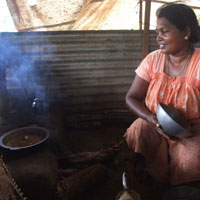
In a new settlement in Periyathamanai, village men were busy at work on a Saturday morning while their wives and children stayed at home. Kamaleswary Sellaiah (38) is the proud owner of a small home garden in this village, one heavily mined both by the Sri Lanka Army (SLA) and the Liberation Tigers of Tamil Eelam (LTTE). Though living in a tin sheet-roofed home with a single room, this mother of two was happy to be back after three years of camp life. A Menik Farm returnee, she was displaced twice along with his mother and was now finally resettled where her original home, ravaged by war, was once situated.
No electricity
“I have no electricity and water supply. Some areas in the village have electricity and we are told, we will soon be connected to the grid. The biggest issue here is drinking water. People have to depend on the weekly bowsers. The scheme also does not have enough sanitation facilities,” she said. Though resettled, she like many others feels that Periyathampanai is far from being ready to receive people. When we tell her that among the visited, this is indeed a resettlement village which is of a higher standard, she grimaces and quips, “You should talk to the people about their grievances. We are all happy to return, but it is also about what we have to return to.”
Her niece, Brintha Mahendralingam (8), was talking to an emaciated kitten inside her aunt’s home when we walked in. A Grade Three student at the nearby school, Periyathampanai Maha Vidyalayam, she said she would want to become a teacher when she grows up. “I want to be useful to my village,” she beamed.
It was Brintha who proudly showed us the carefully tended vegetable plot in the backyard. Yet, bordering Kamaleswary’s land was an abandoned bunker, a reminder that Periyathampanai was indeed one of the ‘hot spots’ during the final phase of the war.
Assistance for resettlement
Kamaleswary’s statement proved prophetic when other villagers also speak of sanitation and water supply as their first concern, and the second being proper assistance for resettlement. “We had some support from ZOA, an international nongovernmental organization when we commenced rehabilitating our homes. There was government assistance as well. But, to actually resettle, we need more support,” villagers chorused.
Shanthini Kamalasabai (59), a retired teacher from the Periyathampanai Maha Vidyalam too was happy to return. But, as in the case of Kamaleswary, her complaint was that the sanitation component of a resettlement scheme has not been sufficiently addressed. “We have to queue up and share. Often there is no water. We have dug wells but, the water cannot be used for even purposes of washing,” she complained.
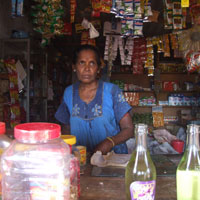
The village does not have too many shops. There is a small co-operative shop that does not attract too many people whereas Nageshwary Murugesu’s small boutique remains the village favourite. “I have everything the village wants,” she says with a smile the boutique bears testimony to the simplicity of the village folk and their needs. It is Murugesu (55), who owns the only refrigerator in that part of the village.
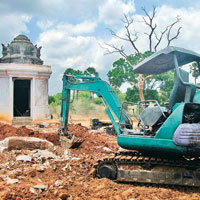
Several men were at the Varasiththy Vinayagar Temple premises, volunteering their time and spending the little money they have as a resettled community, to restore the temple, damaged by two shell attacks. As their lives slowly recover and return to normalcy, these simple village folk also want their Gods and Goddesses also to be resettled, not relocated. Hence, the village kovil restoration initiative.
Senthilvel Sundararaja (47), was keen that people have a place to worship, now that they have returned home. The foundation stone was laid in 1951 and constructed in 1960, and the villagers are extremely proud of the temple’s Dravidian architecture. ‘The designs are old,’ a proud Sundararaja said.
In Periyathampanai, most buildings look new. The old ones have large sections renovated, clearly the scars of war. In close proximity to the Vinayagar Temple lies yet another, the damaged Naagabooshan Amman Temple. This temple too is currently being rebuilt, allowing the villagers places of worship.
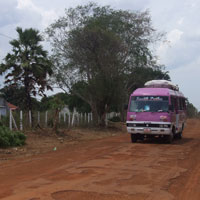
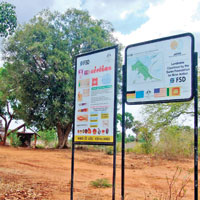
There boards that announce new housing schemes under the Uthuru Wasantham, the government’s post-war rehabilitation and resettlement programme in the North. Under this, new water supply and electricity schemes are visiting the village of Periyathampanai. The road is being developed and villagers are proudly awaiting their first ever ‘carpeted road’ in the coming months. A couple of resettlement villages are also coming up, one by an International Non-Governmental Organization (INGO) while the other is by a prominent Colombo-based business holding.
Pix by Dushiyanthini Kanagasabapathipillai
Periyathampanai was also one of the most mined areas in Vavuniya and the deminers working at ground level confirm that it took many months of work to ensure that the village was ready for prosperous of resettlement.
Mine clearance
“It was a heavily mined area but with expeditious mine clearance programmes, we have been able to expedite resettlement. Villagers have all been resettled in their places of origin and their lands and homes have been returned to them,” explained Government Agent of Vavuniya, Bandula Harischandra.
As these villagers resettle in their places of origin, they are now compelled to think of livelihood options other than paddy cultivation and fishing. The scars of war are such that having lost their gear, they have to now invest in equipment in order to recommence their previous livelihoods.
Anthony Caleesious, the Programme Manager of ZOA, an INGO assisting the community in relief and recovery believes that livelihood assistance should be the next biggest initiative to help the community. “Resettlement is many-faceted. These people had homes and jobs before. Now they need assistance to start from scratch. It is emotionally and economically costly,” he said. courtesy: CeylonToday