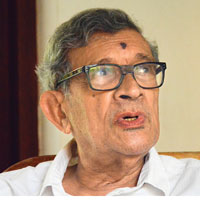
Ernest Macintyre ~ pic by: Manjula Dayawansa
By Thulasi Muttulingam
Ernest Macintyre is one of the most famous names in Sri Lanka’s golden era of theatre but having emigrated to Australia in 1973 to provide a better education for his children, he might not be so familiar a name to the generations that have come after.
Acting and directing plays since his student days at the Peradeniya University, Macintyre has been into theatre for well over 50 years.
As is the case for most creative artistes of Sri Lanka, Macintyre had to sideline his passion to a hobby as he had to earn his daily bread. However, with a varying career including seven years in the Sri Lankan Air force and four in the United Nations, he has managed to contribute substantially to Sri Lankan theatre, both in Sri Lanka and Australia. At the packed auditorium recently at the ICES (International Centre for Ethnic Studies), he shared some of his views.
Theatre and drama
At the outset, he claims that theatre and drama are two different things; drama he says is the exploration of emotions and relations between the characters, both intellectually and emotionally while theatre is mostly the props, choreography and the ‘show’ part of it. As such he thinks some plays make good dramas but not theatre and vice versa.
While exploring in depth the context and meaning of the plays he had written, he also said that many Sri Lankans assumed that there had to be a message in the play. Which he made clear was not a view he shared. “There is an American saying; ‘If you want to send a message, go to the post office.’ The arts are not post offices. We don’t necessarily have to relay messages.
I believe in the ancient Hindu idea of Natya (drama) and Loka (world), where drama and theatre are intertwined with and inspired by the world, but I don’t believe in sending out explicit messages. If you can clearly discern a message from a play, then in my opinion, it is a poor play.”
Speaking to Ceylon Today, he further elaborates when asked what inspires him to write plays;
“Natya and Loka of course. The ancient Sanskritists used these words in conjunction because for them, theatre was a part of the world, not part of entertainment.”
Inspiration
“I too draw my inspiration from what is happening around me. The first successful play I wrote, The Education of Ms. Asia, was directly a result of the JVP insurrection. So Loka led to Natya.”
The play, a text in the local G.C.E O’Level syllabus for over ten years, while exploring youth ideas, perceptions and identities does not have an explicit message at the end of it. Because the world does not necessarily deliver clear messages through its circumstances or events and so, neither do Macintyre’s plays, inspired by the Loka.
In his exploration in the microcosm of the macrocosm however, he tries to replicate what he sees and thus provides food for thought to the audience about the society they are living in and the societal constructs they live with. Thus, he might not believe in writing ‘bad plays’ with ‘clear messages’ but he believes in presenting the world they live in to people in the form of drama and theatre, for them to form their own conclusions.
For example, the play he staged in Australia; Let’s give them curry, explored issues of a Sri Lankan family that had migrated to Australia. Although having migrated to a new country they were solid in holding onto the beliefs and culture of the old country which led to many problems.
Crisis hits when the daughter of the family falls in love with an Australian and the parents are outraged that she has not waited for them to select a bridegroom for her from their own country, region, ethnicity, class and caste.”
In his exploration of this Sri Lankan family and their prejudices, a clearer picture would have emerged to the Australians of the Sri Lankans living amongst them. Does not this representation of Loka as Natya then lead to accusations from his own community of ‘washing dirty linen in public?’
“Of Course” he replies. “I get that response a lot, but with some plays, more than others. Let’s give them curry for example didn’t draw as much inner-community criticism as Irangani – my latest play. It was very difficult to find Sri Lankan cast members for the play when I staged Irangani in Australia. I had to depend on close friends and relatives.”

The fictional play, explores in depth the issues of war, peace and political solutions in contemporary Sri Lanka. The book launch held in Colombo however saw a number of prominent Sri Lankan theatre artistes supporting him with readings of excerpts from the play.
He also mentioned that the Australian audiences’ response to Let’s give them curry was that they simply enjoyed the play, while the Sri Lankan Australians rooted for the parents’ cause of bringing their daughter round somehow to their way of thinking, and getting her to marry a bridegroom from back home. They had apparently been disappointed when in the end she married her White Australian boyfriend, but on the whole, took it rather well.
Even the reaction then, was a representation in the microcosm of the macrocosm. This is a well known story in diasporas; the first generation fights to hold on to the old culture and is bewildered by the next generation not being of the same culture and belief systems. The parents might espouse traditional, hierarchical values at first, but also accept the inevitable with good grace eventually – should it indeed prove inevitable.
Macintyre meanwhile, still batting strong in his late seventies, has been a regular visitor over the last few years to the country; the Jaffna peninsula in particular. He wants to build up drama and theatre, which has been neglected for so long in that peninsula and is thus dedicating a lot of effort and time towards it.
“Tamil drama as a whole has not moved forward much in Sri Lanka,” he explains. “The huge dominance of South India is probably a reason why. The Sinhalese have no such heritage to fall back on and so they have had to exert themselves to create their own arts.
“There are also other circumstances which led to the suppression of the creative arts in Jaffna. Batticaloa did not have the same problems and so they have developed their theatre to a certain extent but the aspiring young artistes of Jaffna need help.”

He also believes in the reconciliation process and reaching out to the youth, to facilitate that reconciliation but says that a lot of work remains to be done.
“I find that the young people of Jaffna are willing to reach out across the racial divide. But at the same time, they have a deeply felt intrinsic need to be recognized as equal citizens of this country. That equality cannot come from well-meaning people simply telling them, ‘You are equal to us.’
It has to be recognized constitutionally. Even in a case as simple as romantic love, unless it is recognised constitutionally as marriage, neither partner has any rights. Marriage protects the rights of both parties. In that sense, the Sinhalese and the Tamils need to be ‘married’ to each other and for that, they need to constitutionally recognize each other’s rights.” Courtesy: Ceylon Today