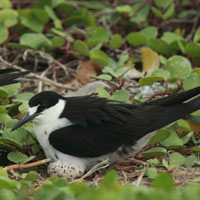
Pix by Kithsiri Gunawardana
by Risidra Mendis
A study conducted by the Joint Secretary of the Ceylon Bird Club (CBC), Kithsiri Gunawardana, on ground nesting Terns at the Adams Bridge Islands in Mannar, has revealed that many species are breeding and producing young successfully.
The Adams Bridge Islands and Thalaimannar have become a breeding ground for a wide variety of Terns, including Little Terns, Roseate Terns, Bridled Terns, Saunders Terns, Large Crested Terns and Sooty Terns, since the end of the war.
However, the breeding of Saunders Tern was recorded on the island for the first time in five decades
Gunawardana visited the islands with fishermen from the village of Urumalai during the war. But due to security concerns, he was only able to visit the first island at that time.
However, two years after the conclusion of the war, Gunawardana and avid birder Uditha Hettige, were able to visit the Islands on three occasions. The first took place from 17 to 21 May 2011, the second from 10 to 11 June 2011 and the final from 2 to 3 July 2011.
The duo was successful in photographing the breeding of the Saunders Tern when they visited Adams Bridge Islands in May. Gunawardana told Ceylon Today he and his companion had to be extremely patient and crawl for more than 30 meters on hot sand, under the blazing sun, to get close to the bird and photograph it sitting on the nest.
“The exercise was well worth the effort, as it was more than five decades since any one had recorded the breeding of this bird on the Islands, he said, adding that they had also seen Bridled Terns nesting.
“By observing the amount of white on the outer tail feathers, we together with bird specialist, Deepal Warakagoda were able to confirm that the bird belonged to the race Antartica,” Gunawardana said.
Nesting of Roseate Tern
The nesting species of the Roseate Terns had also been observed by Gunawardana, who said the graceful birds, had their nests very close to each other. “They would fly up, upon being disturbed, but would very quickly descend and settle on the eggs to ensure they are not affected by the exposure to sunlight,” he explained.
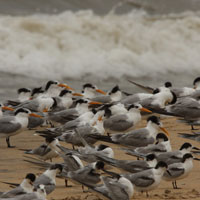
According Gunawardana Bridled Terns usually nest in a slight depression at the end of a six to eight inch hollow made in the grass or in a bush, though some nests can be found under large bushes. The eggs meanwhile are laid on bare ground.
“Most nests of the Roseate Tern were built on human palm-sized circular depressions on the ground and made with small twigs close to each other on small earth mounds, covered with vegetation. About 20 nests were built at a distance of 10 x 10 feet. Seven of the nests had two eggs each, while the remaining nests had a single egg each,” Gunawardana elaborated.
The nesting of the Saunders Tern, according to Gunawardana, is similar to that of the Little Tern. “There were one to three eggs laid in a small depression on bear sandy open ground, with no vegetation around. In a 2 x2 metre area, six nests were found, of which four had three eggs and the other had two eggs,” he said.
The sand banks had also been home to an Indian Sky Lark, a single Bar-Tailed Godwit, a few Turnstone, eight Lesser Sand Plovers and Large Crested and Lesser Crested Terns. All of them had been found perched close together at a point where the waves break on the beach.
“When we visited the islands from 10 to 12 June, there was an increase in the number of nests. About 80 to 100 pairs of Roseate Terns were nesting on a few sand mounds covered with Bimthamburu vines Ipomoea pes-carpe. Some had not built any nests, but the eggs were deposited at the centre of a collection of a few dead leaves on a palm sized clearing among the vegetation,” Gunawardana said.
Some of the Terns had built nests using the dead leaves and dried stems of the Bimthamburu vine. The height of the nests had been about 3cms from the ground. “The distance between each nest was about six inches to one foot. Most of the nests had eggs, while some had new born chicks covered in brown coloured down,” he said, adding that one adult would keep its young covered under its wings, while the other would bring small fish to feed it.
Gunawardana said that he had observed one adult bird, which had its own chick under its wings, snatch an unguarded chick of the same species with its beak and drop it some distance, upon seeing another bird. “The bird was most probably the parent of the unfortunate chick, arriving with a fish in its beak,” he observed, elaborating that while the bird was looking for its chick, the fish was snatched from its beak and fed by the sitting bird to her chick.
“The adults that bring fish had to often fly away without feeding and engage in a search for their chicks. These birds are able to identify their own chicks under the chaotic conditions,” he said.
Gunawardana also observed that most nests had two eggs, while some had only one. “ For example, if one is able to lie down and conceal him/herself, keeping a distance of about 10 feet from the nests, the Terns would arrive and settle down in their nests in a matter of minutes,” he said.
Increase in number of nests
Gunawardana had observed that the number of nests of the Bridled Terns had also increased to about 500, when compared to the earlier visit. Even though he did not observe any nest building, he found most of the nests had been built at the end of a tunnel shaped clearing made in the grass or other vegetation, which gave it shade from the hot sun. He had also found that most of the nests contained one egg each, while some had a new born chick covered in dark brown down.
Some nests had been found under bushes and a few on the ground without any shade. “Even though some of the nests were built about a foot away from each other, these birds were not nesting grouped together as was the case with the Roseate Terns or the Large Crested Terns, he said, explaining that he had also observed what appeared to be a courtship display of the terns.
“They raise their wings, which remain folded and one would go around the other extending the neck and moving the head from side to side,” Gunawardana explained.
On one sand dune covered with Bimthamburu vine, he had observed about 60 to 70 Large Crested Terns nesting together. “The nests were built only a few inches away from each other. The nests had one egg each. We did not observe any nest building and the eggs were just laid on small clearings, without even a hint of a nest,” he said.
Gunawardana also said that it was apparent that the larger terns appeared to have taken over a sand mound where the smaller Roseate may have begun nest building, as some of the active nests of the Large Crested Tern were on abandoned nests of the smaller terns.
“However, there were a few Roseate Terns that were constantly in battle with the larger terns, and had succeeded in raising young birds in the middle of this colony of the much larger terns. Two Roseate Tern chicks were seen among these larger terns which did not appear to attack them in any way,” Gunawardana said.
The duo had also observed one Sooty Tern and spotted two Shearwaters flying just over the waves, as evening approached. However they had not been able to identify the species due to the distance.
Little Terns nesting in the open sandy areas of the islands had also observed. “Their nest is a small depression of about 3.5cms on the bare sandy ground made by the birds by digging with their feet. There were many tiny chicks as well on the sandy areas of islands, he said, adding that there were two Grey Herons, a Turnstone and an Indian Skylark performing their characteristic courtship display by flying up while singing continuously. One Terek Sandpiper has also been observed on the sand islands along with a few Lesser Crested Terns.
Significant increase in numbers
“When we visited the islands for the third time from 2 to 3 July, there was a significant increase in the number of birds. We saw Sooty Terns breeding. We noticed these terns among the large number of Bridle Terns and were curious as to why these birds were perched on the ground as a group, away from the other birds and why they returned to the same location. There were nine birds perched close to each other on the ground covered with Bimthamburu vines,” Gunawardana said.
Upon closer examination, they had discovered that one bird was sitting on an egg. No nest had been observed and the single egg had been laid on the bare ground. The nesting bird had permitted Gunawardana and his colleague to get close enough to photograph her sitting on the egg. The bird had also periodically adjusted the position of the egg with its beak and settled on it with puffed up chest feathers. “We also observed five Lesser Noddies perched on a low bush of about seven feet, in one corner of the island. The Brown Noddy was also present on the island. However, no signs of nesting were observed,” he said.
However, they had found the Roseate Terns had increased in number to about 800 and had bred successfully. There had been chicks of varying sizes, some just able to fly, others appearing to have just emerged from the shell. In addition, there had also been a number of female birds sitting on 50 to 60 eggs.
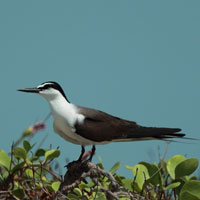
“The Bridled Terns had also increased in number to about 1500. Except for a few nests, which contained a single mature egg most of the nests had a single chick. Around midday, we observed that the eggs were splashed with water. Perhaps the birds use this method to keep the mature eggs cool,” Gunawardana observed.
One Gull Billed Tern had also been observed flying over the island and six Caspian Terns seated on a sand bank with a flock of Large Crested Terns. Only one chick of the Large Crested Tern had been observed. However, it had been chased and pecked by the Roseate Terns, despite the best efforts of the parent birds to chase the Roseate Terns away.
A Saunders Tern had been observed on the sandy ground towards evening with a tiny chick under its wings. Summer loiterers, such as the Bar-Tailed Godwit, Lesser Sand Plover and a Common Red Shank had also been observed by Gunawardana and Hettige, who say they greatly appreciated the support extended to them by the Sri Lanka Navy during the period of their study. courtesy: Ceylon Today