On August 13, Sri Lanka approved the arrival of a Chinese satellite-tracking vessel to its southern Chinese-funded Hambantota port. It was the second approval from the island nation’s Ministry of Foreign Affairs, after it first cleared the visit on July 12. In the weeks in between, India raised concerns over the ship’s visit with President Ranil Wickremesinghe, and officially commented on it, while Indian media splashed headlines of a “Chinese spy ship” hovering in the Indian Ocean. Caught in a delicate diplomatic and geopolitical spot, Colombo gave its nod after “extensive consultations” with “all parties”.
What is the vessel?
Yuan Wang 5 was described by the Sri Lankan government as a “scientific research ship”. The BRISL (Belt & Road Initiative Sri Lanka), a Colombo-based organisation studying China’s ambitious connectivity project, was the first to draw attention to the visit in a Twitter post late July.
It said that the Yuan Wang 5 will conduct “satellite control and research tracking in the northwestern part of the Indian Ocean Region” through August and September. Vessels of the Yuan Wang class are said to be used for tracking and supporting satellite as well as intercontinental ballistic missiles by the People’s Liberation Army Strategic Support Force.
The Chinese Yuan Wang 5 vessel, whose arrival was mired in a geopolitical tussle, docked at the Hambantota Port yesterday (16), with a welcome ceremony attended by prominent MPs, where the Chinese Ambassador to Sri Lanka Qi Zhenhong stated that the docking of the vessel is a “normal exchange” between China and Sri Lanka.
The scientific research vessel from China attracted controversy earlier this month, as neighbouring India raised several concerns ovet the purpose of its visit. The Government of Sri Lanka (GoSL) even rescinded its initial approval to the vessel to dock at Hambantota, and asked China to defer its visit. Permission was again granted for the vessel to dock yesterday (16).
Responding to media questions at the event held yesterday, Zhenhong said that the “scientific research vessel docked successfully and smoothly” at the Hambantota Port, and that this is “a normal exchange between our two countries because Sri Lanka and China enjoy a longstanding friendship”.
China’s satellite tracking vessel Yuan Wang 5 on August 16 arrived at Sri Lanka’s southern Hambantota Port, despite India and the U.S. voicing concern with Colombo over the military ship’s visit. Hours after the vessel reached the Sri Lankan port, China said the “marine scientific research” activities of the vessel were “consistent with international law” and did not impact “any other country’s security interests”.
According to Colombo-based official sources, both India and the U.S. had conveyed their apprehensions to the Sri Lankan Government at the highest level, citing the vessel’s “military capabilities” while in the Indian Ocean Region. Apparently addressing the concerns, Chinese Foreign Ministry spokesperson Wang Wenbin on August 16 said, “I want to stress again that the marine scientific research activities of the Yuan Wang 5 ship are consistent with international law and international common practice. They do not affect the security and the economic interests of any country and should not be obstructed by any third party.”
China earlier slammed New Delhi’s apprehensions as “unjustified” and “morally irresponsible”, and “urged” New Delhi to “not disturb normal exchanges” between the two countries. New Delhi “rejected insinuations” that Sri Lanka was pressured.
The Government has decided not to go ahead with the recommendations mentioned in the final report of the ‘One Country, One Law” Presidential Task Force (PTF) headed by Bodu Bala Sena General Secretary Ven. Galagodaaththe Gnanasara Thera, as many important issues that need to be addressed urgently have arisen in the current situation, and taking into account the objections of several parties, The Morning learnt.
Speaking to The Morning, well-placed sources stated that in the current situation, a number of other important issues have arisen that require more attention than the concept of “One Country, One Law”, adding that the recommendations mentioned in the final report of the PTF would therefore not be implemented.
“In view of the crisis that has arisen in the country, the formation of an all-party Government is extremely important in obtaining the support of international institutions such as the International Monetary Fund (IMF). Against this backdrop, many parties that the Government and President Ranil Wickremesinghe expect to join the all-party Government have expressed their displeasure with the committees appointed by former President Gotabaya Rajapaksa, including the PTF in question,” the sources added.
Scottish national Kayleigh Fraser, who participated in the “aragalaya” (struggle) in Sri Lanka, will be given time to leave the country, said the Department of Immigration and Emigration, following yesterday’s (16) dismissal by the Court of Appeal of her writ petition filed challenging her deportation by the Department over alleged visa violations.
The Media Spokesperson of the Department, speaking to The Morning yesterday, noted that the court had dismissed the petition on the grounds that the individual lacked the authority to file such action against the decision taken by the Department, in which she had named the Controller General of Immigration and Emigration as a respondent to the petition.
Hundreds of Tamil mothers engaged in a rally last Friday (12) in Kilinochchi District to mark 2,000 days of protests and activism to seek justice for their sons who they claim were forcibly disappeared during and after the civil war.
The protests commenced in February 2017 during the Yahapalana Government, which promised justice to the families of the disappeared, to demand answers about the fate of their loved ones.
Devoting the first Saturday article of each month to a film, film personality or film-related topic is a practice being followed by this column in recent times This week’s article therefore will focus on versatile filmmaker Vasantha Obeysekera’s milestone movie “Dadayama” (the Hunt). I have written about the film and filmmaker before and will re-visit those earlier writings. “Dadayama” released in May 1983 won numerous Presidential and “Sarasaviya” awards for Vasantha and other artistes and technicians involved in the venture. Vasantha, born on 29 December 1937, was 79 years of age when he passed away peacefully in Colombo on April 8,2017.
There are many who regard “Dadayama” as the finest film made by Vasantha. It was selected by the Government as one of the ten best Sinhala films made during the 50 year period between 1947-1997. The film was an artistic triumph and commercial success. However there is another sentimental reason also for me to write about Vasantha’s ‘Dadayama’.
Of all the film directors I knew in Sri Lanka, Vasantha Obeysekere was the one I was closest to. There was a warm friendship between us during the years 1983 to 1988. Our friendship began in 1983 when I first met him and continued until 1988 when I left Lanka for North America. We lost touch thereafter. By a quirk of fate our friendship began in 1983 due to the film ‘Dadayama’ and my friend and fellow journalist on ‘The Island,’ Ajith Samaranayake.
(This article written last year is being re-posted without any changes to commemorate the 17th death anniversary of former Sri Lankan Foreign Minister Lakshman Kadirgamar who was assassinated in Colombo by the LTTE on August 12th 2005)
Former Sri Lankan Foreign Minister Lakshman Kadirgamar was assassinated in Colombo by the Liberation Tigers of Tamil Eelam (LTTE) on 12 August 2005. This column intends focusing on the man regarded as Sri Lanka’s finest foreign minister this week even as his 16th death anniversary draws near.
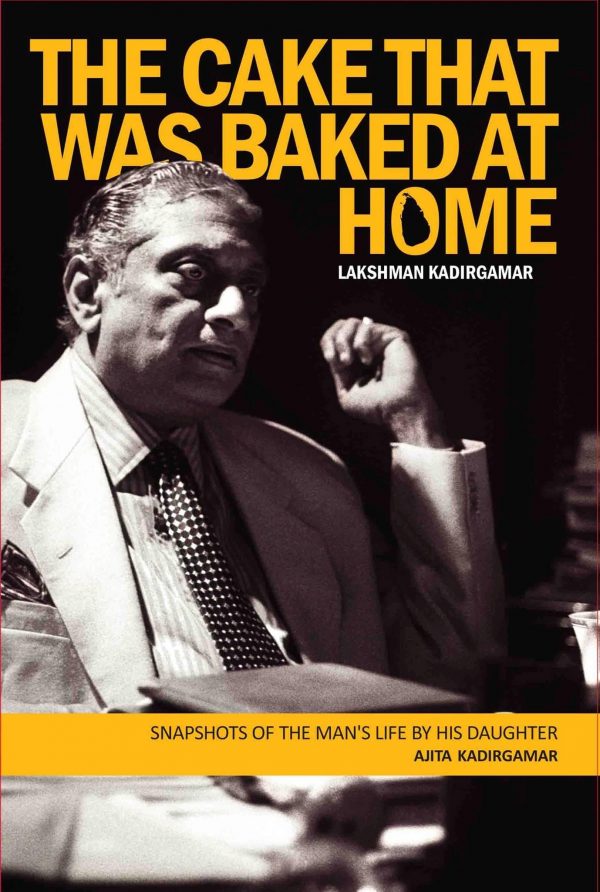
I have written extensively about Lakshman Kadirgamar over the years, so much so that his only daughter Ajita has stated in her book about her father that “D.B.S. Jeyaraj has written about LK possibly more than any other journalist.”
Ajita Kadirgamar’s eminently readable book about Lakshman Kadirgamar titled ‘THE CAKE THAT WAS BAKED AT HOME’ has 78 references to lines and passages from my articles. She even says on one page that she ‘would almost term me as “LK’s unofficial biographer”’.
The winding down of the iconic ‘aragalaya’ (struggle) site at the Galle Face Green this Friday as the police hauled away the last remaining tents, was met by its onetime occupants, not with sadness or resignation but, interestingly enough, a calm jubilation.
State aggression met by counter-aggression
‘This Government has shown that it has not understood the nature of this struggle,’ one young woman said, ‘we did not do this for months, forgetting our families, braving the risks, standing up against the State, for fun, our anger was against Sri Lanka’s corrupt political culture, that anger has not changed, it is still alive, we will learn from our mistakes and rise again.’
Elsewhere, the emerging narrative, pushed by eager purveyors of the country’s military State, the Deep State, as it were, is that the protest movement does not have a right to call itself ‘peaceful.’ How can crowds that forcibly entered the Presidential Secretariat, the official residence of the President and Temple Trees be called, ‘peaceful,’ they ask?
Yet there is a grim paradox in that question. The protests at Galle Face Green were indeed peaceful until they were brutally attacked by goons of former Prime Minister Mahinda Rajapaksa and his Ministers, on May 9th 2022.
This brutality was met by counter-brutality, in attacks on attackers by the public at large of which the protestors were the most visible part, the targeting of parliamentarians and (some would argue, the instigated) burning of their houses. That surge of counter-brutality must be categorically rejected.
However, it must never be forgotten that the initial aggravation came from the Sri Lankan State, reverting to its historically tried and tested methods of repressing dissent, through thuggery and racist rhetoric (ie; labelling protestors as Muslim, the State’s ‘new’ enemy’).
Sri Lanka on Saturday cleared the arrival of Chinese space and satellite tracking vessel Yuan Wang 5 on August 16 at the southern Hambantota port, a day after New Delhi reiterated its security concerns over the vessel’s visit earlier scheduled on August 11.
Even as Colombo was put on a delicate diplomatic spot, dealing with two of its close partners with competing geostrategic interests in the island, Sri Lanka’s fresh approval, announced by its Ministry of Foreign Affairs in a statement, effectively points to a five-day postponement of the arrival of the Chinese ship, and a week’s stop as was earlier planned.
Author Salman Rushdie, who suffered years of Islamist death threats after writing The Satanic Verses, has been stabbed on stage in New York state.
The Booker Prize winner, 75, was speaking at an event at the Chautauqua Institution at the time.
New York State Police said a man ran up onto the stage and attacked Mr Rushdie, who is now undergoing surgery at a local trauma centre.
Police detained a suspect named as Hadi Matar, 24, from Fairview, New Jersey.
No motive or charges have yet been confirmed by police.
Mr Rushdie was stabbed at least once in the neck, and at least once in the abdomen. He was taken to a hospital in Erie, Pennsylvania, by helicopter.
The interviewer who was also on stage, Henry Reese, suffered a minor head injury and was taken to a local hospital. Mr Reese is the co-founder of a non-profit that provides sanctuary to writers exiled under threat of persecution.
Police told a press conference that staff and audience members had rushed the attacker and took him to the ground, and he was then arrested.
Hundreds of Tamil mothers on August 12 took out a rally in Sri Lanka’s northern Kilinochchi district to mark 2,000 days of their relentless struggle, seeking truth and justice for their loved ones forcibly disappeared during and after the civil war.
Women wearing black sarees and headbands marched in Kilinochchi carrying photographs of their missing relatives. “Where are children who surrendered to the army?”, “Arrest Gotabaya who was involved in a genocide”, “We want justice”, they chanted.
“We’ve been agitating for 2,000 days now, but justice has not been served. We want to draw attention to our struggle and highlight this long-pending issue before the Human Rights Council session meets in Geneva next month,” Kadirgamanathan Kohilavani, leader of a Kilinochchi-based group of families of disappeared told The Hindu. “We really hope they [Council] will do something to ensure justice for us,” she said.
The Sri Lanka Government today (August 12) granted permission for the Chinese tracking vessel Yuang Wang 5 to dock at the Hambantota Port after the Indian and US Governments failed to give “concrete reasons” for why they opposed its arrival.
Yuang Wang 5 will now berth at the Hambantota International Port on August 16, five days later than scheduled. It was originally due to arrive on August 11. This was delayed after India raised strong concerns citing national security.
Sri Lanka requested China to defer the visit until “further consultations” were held on the matter. The vessel abruptly changed track earlier this week. However, it is now heading towards Hambantota again.
For the first time in the history of Sri Lanka, the nation experimented with a ‘Peaceful Protest’ to oust a leader they came to hate. And they succeeded! Sri Lankans across the nation, crossing boundaries of ethnicity, religion and social class came together in what came to be known as the ‘Aragalaya’ (Sinhala term for a protest), with one aim in mind — to rid the country of the once hero-worshipped Rajapaksa regime.
En masse, they literally chased away the Prime Minster, Mahinda Rajapaksa from Office followed by his brother, President Gotabaya Rajapaksa. The latter was forced to flee the country. It all began in early March, 2022 with small candlelight vigils against long-drawn-out power blackouts. The protesters who gathered in the evenings after working hours were mainly peaceful. But the protests rapidly spread throughout the country.
From power blackouts, they then went on to also agitate against Sri Lanka’s worst economic crisis since independence. Survival for the average citizen had become difficult with the breakout of the Covid-19 pandemic but the hardships reached the next level with the Rajapaksa regime’s mismanagement of the country’s economy and blatant corruption.
A severe shortage of basic essentials – food, fuel, medicine and cooking gas – was the last straw for the suffering average citizen. Their fury was further fueled by the blatant extravagances of politicians and their families and an over confident government with a two-thirds majority in parliament, turning a blind eye to the suffering of the masses. The cries of the vox populi fell on deaf ears.
The article I wrote titled “Ranil’s Destiny” and published in the Daily FT last week, had received the attention of a large number of readers; also there were several criticisms published against it. Many people in Sri Lanka seem to have lost the ability to think logically not only on the issue of the appointment of Ranil Wickremesinghe to the presidency but also on the issue of the crisis facing the country.
I was surprised to watch a video where a leader of a leftist party was asking the expatriate Sri Lankans to refrain from remitting foreign currency to the country until the present rulers of Sri Lanka are changed. I understood this request to imply that it does not matter for them even if the country is destroyed until they come to power. The person who made this request belongs to a political party that appears to be gaining significant public recognition at the moment. How possible that a destructive approach like that could contribute to the benefit of that party and the nation?
Regrettably the struggle for securing the political power of the country is also being carried out in an atmosphere where the unique nature of the crisis facing the country has been completely ignored. When a house catches fire, the instant action taken should be to put out the fire immediately and not to look for those responsible for it. But what happened in Sri Lanka was to allow the fire to spread and to search for those responsible for it.
The way some people think of Ranil is also confusing. I am not a political follower of Ranil. There were times I have criticised him strongly; and also times I have praised him lavishly. Notwithstanding his limitations, he is the most colourful leader left of the old generation of politicians in our country. It is important that I should explain the ideological connection I have with him now. This connection has developed consequent to a consensus we have reached in regard to a structural reform program to be launched to bring about a profound change in the system. Late Mangala Samaraweera also took part in the initial discussions held in this connection; had he been alive today, he would certainly have been a strong supporter, a champion of the proposed reform program.
Protestors of the “aragalaya” (struggle) attached to the “RanilGoGama”, formerly “GotaGoGama”, at the Galle Face – whose protest site at the Galle Face Green was vandalised on multiple occasions, and whose activism led to the resignation of former President Gotabaya Rajapaksa and former Prime Minister Mahinda Rajapaksa – have vacated the site which was in operation since early April.
Speaking at a recent press conference, a key and active member of the “aragayala”, Ven. Koswatte Mahanama Thera, said that even though the Occupy Galle Face movement came to an end yesterday (10), the “aragalaya” would however continue in different forms.
“During these four months of the ‘aragalaya’ against the State leadership and politics in the country, we brought every ethnicity together, and had a lot of victories. I think that it’s a considerable achievement. The ‘aragalaya’ that started on 9 April has made many achievements, but now we have to fight against President Ranil Wickremesinghe, his Emergency Law, and the Prevention of Terrorism (Temporary Provisions) Act as amended (PTA), which have to be taken away, and also fight towards abolishing the Executive Presidency, which is of the utmost need at the moment in order for democracy to prevail in Sri Lanka. The political unrest and economic crisis will worsen in this undemocratic system of Wickremesinghe and therefore, we will continue our fight against it “
Further, speaking to The Morning, activist Lahiru Fernando said that more than 43 tents were established at the site, and charged, however, that the majority of the tents had since been stolen by third parties.
On Tuesday August 9, Sri Lankan President Ranil Wickremesinghe paid his first official visit to the Army HQ in the outskirts of Colombo and addressed the troops even as protesters were planning to renew the agitation to oust him from the Presidency.
As it turned out, the function at the Army HQ went off without a hitch and calm prevailed in the island with no sign of the planned stir.
But it did appear as if Wickremesinghe had deliberately chosen August 9 to make a ceremonial first visit to the Army HQ. It symbolically challenged the protestors’ bid to launch another wave of their agitation to bring down his government and force fresh elections.
In his address at the Army HQ, the President praised the troops for the sagacious way in which they protected parliament from a group determined to storm and seize it. By preventing the seizure, the troops had saved the constitution of Sri Lanka, he said. If the violent crowd had barged into parliament, government would have fallen and the course of Sri Lanka’s history would have been different, he noted. But the troops on duty managed to prevent the catastrophe, and he was grateful to them for that.
Former Sri Lankan president Gotabaya Rajapaksa has requested entry into Thailand for a temporary stay in a second Southeast Asian country after fleeing his island nation last month amid mass protests, the Thai foreign ministry said on Wednesday.
Rajapaksa fled to Singapore on July 14 following unprecedented unrest caused by Sri Lanka’s worst economic crisis in seven decades, and days after thousands of protesters stormed the president’s official residence and office.
The retired military officer then resigned from the presidency, becoming the first Sri Lankan head of state to quit mid-term.
Rajapaksa is expected to leave Singapore and head to Thailand’s capital Bangkok on Thursday, two sources said, asking not to be named. Sri Lanka’s foreign ministry did not immediately respond to requests for comment.
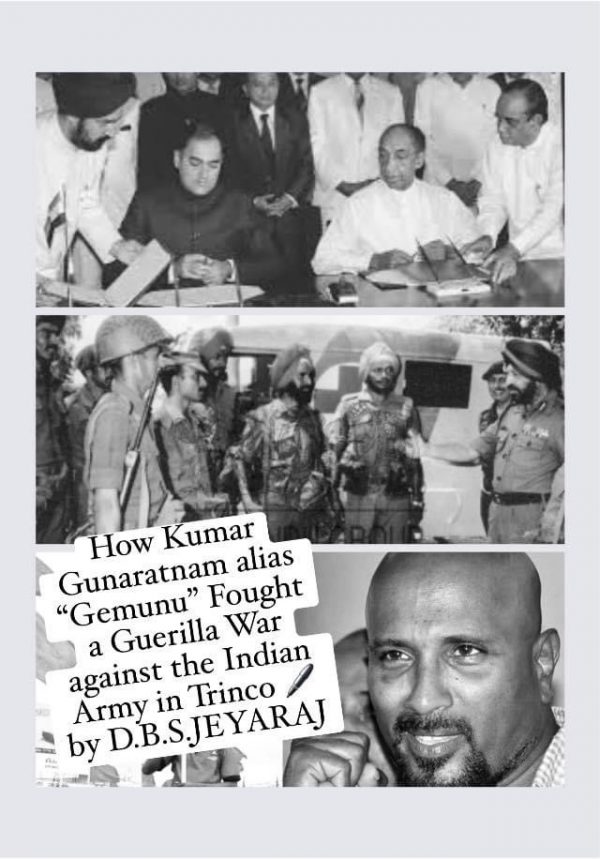
Last week’s article was about the guerilla war fought by the Janatha Vimukthi Peramuna(JVP) against the Indian Army in the Trincomalee district. The JVP campaign in Trinco was then led by Kumar Gunaratnam alias “Gemunu”. Gunaratnam later split from the JVP and co-founded the Frontline Socialist Party(FSP). Kumar Gunaratnam alias Kumar/Kumara is currently the leader and general secretary of the FSP.
This week’s article focuses on the Indo-Lanka accord. It was in the aftermath of the accord that the Indian Army was deployed in North -eastern Sri Lanka. Friday July 29th was the 35th anniversary of the Indo-Lanka Accord. It was on 29 July 1987 that former Indian Prime Minister Rajiv Gandhi and then Sri Lankan President Junius Richard Jayewardene signed in Colombo the agreement between India and Sri Lanka known as the Indo-Lanka Accord. There was also an exchange of two letters described as annexures.
The accord among other things bestowed upon India the responsibility (shared with Sri Lanka) of ensuring and protecting the security and safety of all communities living in the Northern and Eastern Provinces of Sri Lanka. Clause 2.16(e) says: “The Governments of Sri Lanka and India will cooperate in ensuring the physical security and safety of all communities inhabiting the Northern and Eastern Provinces.”
(Anushka Wijesinha is a Colombo-based economist and co-founder of the public policy think tank, Centre for a Smart Future)
Sri Lanka’s economic crisis has been brewing for a while. Years of policy missteps and a problematic growth model came to a head at the start of 2022, with a debilitating foreign reserves crisis.
Shortages of essentials hurt families and firms. A precarious balance of payments position left little buffers to face the shocks emanating from global markets. All this culminated in the people’s rejection of the regime that oversaw the economic collapse, an uprising that lasted many months, and the installation of President Ranil Wickremasinghe under extraordinary circumstances, in July.
Since the government’s announcement in April of a suspension of foreign debt payments, discussions with the International Monetary Fund (IMF) on a bailout — an Extended Fund Facility programme — have progressed, and a staff-level agreement (SLA) is being finalised.
In recent weeks, there has been a tendency by those in power to blame the people’s protest, terming it as “anarchy” and “unrest”, for the delay in firming up an IMF deal. This is not only disingenuous but unhelpful in understanding the rocky road ahead.
When Russia invaded Ukraine in February this year, Ranil Wickremesinghe’s views on the resultant crisis differed somewhat from other MPs. Holding the one and only seat allocated to his party in Parliament, Wickremesinghe argued that Ukraine had antagonized Russia without seeking a peaceful diplomatic solution, and that the West played a game in creating the crisis.
By all accounts, his opinion was biased towards Asia. Ranil in his local interviews urged Indonesia, as ASEAN leader and the current Chair of the G20, to play a cardinal role in mitigating the adverse effects of the War.
These comments compelled coverage and commentary from major media houses in Jakarta in early March and Ranil was extensively featured in interviews with Indonesian media, where he came out more strongly in his opinion about the role of the country in the unfolding War.
“With your historical background on international coalition building through the Bandung Asia-Africa Summit I suggest Indonesia, together with China, India and the United Arab Emirates to hold a conference of all Asian countries.” (Interview with Tempo.com, March 7, 2020)
Indonesia had no intention of getting involved in such a diplomatic endeavor, at least then.
In his engagements with Indonesian media Wickremesinghe was critical of the West, predicting Asia’s rise as a world power in the next decade. As far as he was concerned, Asia should be able to stand on her own and make its voice heard aloud, ensuring a similar response to the West from Africa.
Things in the country are happening in a ludicrous manner. Regardless of the likes or dislikes of the people engaged in the Aragalaya (youth struggle) there is one important outcome that the Aragalaya has produced in the political sense: It has been able to oust Gotabaya Rajapaksa from his office who lacked adequate knowledge for statecraft, but was able to be elected as the Head of State by a massive popular mandate when he had completed only half of the official term, and pave the way for Ranil Wickremesinghe who could be reckoned to be a mature Politician possessing a keen knowledge of the art of conducting State affairs despite he had only one seat in the present Parliament, to be elected as the President with the consent of the majority of the Parliament.
The weak management style of Gotabaya also led to this situation. It is interesting to note that Ranil Wickremesinghe, within the first 48 hours of assuming the office of Presidency, mobilised the security forces and restored the Government control of some sections of the State the Aragalaya people had temporarily snatched away and was able to vitiate the anarchic atmosphere that prevailed in some areas of State administration, to a considerable extent. Although the policy of the new President has led to enhance and intensify the anger of the activists of the Aragalaya, as if by an irony of fate, Wickremesinghe is now destined to be the person chosen by the history, not by the public, to play the role of opening the doors of the state for a program of structural reforms for a ‘profound change in the system’ that can be considered as the main aspiration of the latter.
Colombo Chief Magistrate Nandana Amarasinghe yesterday (8) rejected a request made by the Police to issue a restraining order against a protest planned to be held today (9), organised by several political parties and civil organisations, against President Ranil Wickremesinghe and the current Government.
While informing the court that several political parties and civil organisations have planned to hold a protest at the Viharamahadevi (Victoria) Park in Colombo today, the Cinnamon Gardens Police had requested the Colombo Magistrate’s Court to issue an order preventing the said protest from being held.
Ceylon Teachers’ Union (CTU) General Secretary Joseph Stalin, who was released on bail after being remanded for allegedly violating a court order, was received by a large group of teachers and principals near the Lipton Circus Roundabout in Colombo yesterday (8).
Stalin, a well known trade unionist, was produced before the Colombo Fort Magistrate’s Court yesterday (8). At that time, Colombo Fort Chief Magistrate Thilina Gamage ordered that he be released on two personal sureties of Rs. 500,000 each.
Meanwhile, before he was released on bail, a group of teachers and principals had organised a protest near the Lipton Circus Roundabout in Colombo, demanding his release. Stalin, who was subsequently released on bail, also arrived at the venue last evening and was welcomed by the assembled teachers and principals.
China said yesterday (8) that it was “senseless and unreasonable” to “pressure” Sri Lanka to defer the planned docking of Chinese space and satellite tracking research vessel Yuan Wang 5 at the Hambantota Port citing security concerns, in a thinly veiled reference to India, which has expressed strong objection to Sri Lanka over the planned docking.
Chinese Foreign Ministry Spokesman Wang Wenbin, at a media briefing in Beijing, asserted that “the co-operation between China and Sri Lanka is independently chosen by the two countries, and meets common interests” and “does not target any third party”.
He urged “relevant parties” to not be unreasonable about the ship’s arrival.
“China urges relevant parties to see China’s scientific explorations in a reasonable and sensible way and stop disturbing the normal exchange between China and Sri Lanka. Sri Lanka is a sovereign State. It can develop relations with other countries in the light of its own development interests,” Wang said.
Amidst a potential diplomatic clash with far-reaching consequences, the Government of Sri Lanka (GoSL) is engaged in “quiet diplomacy” to persuade China to agree to its request to defer the docking of the Chinese vessel Yuan Wang 5 to dock at the Hambantota Port this week, diplomatic sources told The Morning, while the Chinese Embassy in Sri Lanka had requested an urgent meeting with senior Sri Lankan authorities over the matter.
Quiet diplomacy involves efforts by one State to influence the behaviour of another through discreet negotiations or actions, and is being employed by the GoSL in an effort to ensure that it antagonises neither China, which is crucial to its hopes of obtaining an International Monetary Fund (IMF) bailout, nor India, which has virtually bankrolled Sri Lanka amidst an unprecedented economic crisis.
President Ranil Wickremesinghe’s nonchalant claim that the law operates equitably in Sri Lanka (‘the law is the same for you, me and everyone’) in a carefully calibrated address at the ceremonial opening of the ninth session of Parliament this week, bears an uncanny resemblance to what his Presidential predecessor Gotabaya Rajapaksa had been fond of saying.
Absurd assertions on the law
That Rajapaksa mantra was taken to the extreme point of deputizing a Buddhist priest, known for inciting communal hatreds, to head a task force to bring about, ‘one country, one law.’ This was yet another of the many profound absurdities that we saw, along with the banning of chemical fertiliser, the placing of inept military men into key public sector positions and allowing an incompetent band of charlatans to drive the country into bankruptcy.
Wednesday’s assertion by the United National Party’s leader, who was handed the Presidency on a plate as it were, is no less absurd. Why are Sri Lankan Presidents so fond of claiming equity in the operation of the law when the contrary is so plain that a child can see it? An example close at hand is the starkly differential treatment meted out to two prominent trade unionists, both of whom participated in civic protests. One, a politically compromised (close to the United National Party) trade union leader (Saman Ratnapriya) was conferred the grand post of Director General, Trade Unions under Wickremesinghe’s aegis.
The other, a longstanding campaigner for workers’ rights and Secretary of the Sri Lanka Teachers Union, (Joseph Stalin) was summarily arrested. Both were involved in substantially the same act, standing alongside each other in protest marches on May 28th 2022, as they called for ‘Gota to Go.’ That, by itself, is not a crime, an offence causing damage to public property or illegal entry to state buildings. But one is ‘rewarded’ and the other is ‘punished.’ From whence comes this distinction, this very specific differentiation sans logical classification?
Searching for the meaning of the word “legitimate,” I referred dictionaries. Piled up a cross-section of the meaning in Collins, Webster’s, Cambridge and Britannica, as given below: They define legitimize/legitimacy as to make something legal or to make it acceptable, permissible or correct.- to give official or formal sanction; to authorize, to make lawful; give legal status. In law, “legality” is distinguished from “legitimacy.” An act can be legal but not legitimate or it can be legitimate but not legal.
DS Senanayake took oaths as First PM in 1947, [with the help of some independents and Tamil parties who opposed UNP at elections], though he gathered only 39% of the total votes cast, which gave the UNP only 43 seats in a house of 96. The appointment was Legal; but was it Legitimate? Dudley Senanayake, the son of DS, was legally appointed to succeed his deceased father as the new PM, overlooking other seniors, like Sir John Kotelawala in 1952: the decision was legal, but was it legitimized? Our political history is inundated with similar events.
As for Ranil Wickremesinghe, his opponents say his election by parliament is legal, but not legitimized for the reason he failed to win a seat or he was rejected by the voters at last elections. There are certain negatives; his childish behaviour in the August assembly and appointing his chum, a dubious character as the Governor of Central Bank; a huge blunder that resulted in billions of rupees frauds under his administration.
Even his critics have confidentially expressed, reluctantly though, the fact that he will haul this country out of its backward status, and give back his people some self respect. That’s the optimism we all must share. Ranil Wickremesinghe, may be the most unpopular and hitherto unsuccessful political leader of our lifetime, whereas Mahinda Rajapaksa was the most popular and charismatic leader ever reigned. But today, Ranil remains the only capable leader who can pull us out of this calamity.
(The writer is a former editor of The Sunday Island, The Island, and consultant editor of the Sunday Leader.)
George Orwell in ‘Nineteen Eighty-Four’ writes a story of a ‘Non-Party’ man (Winston) being tortured by Party Man (O’Brien) who is trying to make him accept that if all records pertaining to the past are destroyed; his memory is erased permanently and the only source of information about the past is what the Party says, it will control the past (history) and who controls that past will control the future and who controls the present will control the past.
The relevant excerpt reads: O’Brien looking down at him speculatively with the air of a teacher taking pains with a wayward but promising child.
‘There is a Party slogan dealing with the control of the past. Repeat it,’ he said.
‘Who controls the past controls the future: who controls the present controls the past,’ repeated Winston obediently.
‘Who controls the present controls the past,’ said O’Brien, nodding his head with slow approval. ‘Winston, that past has real existence?’
All this may sound like some kind of Orwellian metaphysics to readers but reflecting on Sri Lanka’s immediate historic past, its present and future, it does seem that the 20 million Sri Lankan populace is in the same quandary as Winston of Nineteen Eighty-Four and are being subjected to similar insufferable torture.
Is Orwell’s Nineteen Eighty-Four being re-enacted in Sri Lanka in 2022?
Protestors of the “aragalaya” (struggle) have declared 9 August as a “national day of protest” (Jathika Virodatha Dinaya) in their respective cities and regions.
According to sources, people will gather in their own towns to protest against State repression, especially demanding that the Government abolish the state of emergency, emergency law, and the Prevention of Terrorism Act (PTA), as well as that it release all protestors who have been arrested and that it cease the hunting down of protestors.
A leaflet of new demands and the way forward is to be distributed during the regional protests on the same day.
The National Trade Union Co-ordination Centre (NTUCC) will be organising a rally on Viharamaha Devi grounds in Colombo on 9 August at 2 p.m.
The Government on Thursday (4) decided to rescind the permission granted to the Yuan Wang 5 Chinese research vessel with the relevant official communication to the Chinese Embassy in Colombo being delivered on Friday (5), The Sunday Morning learns.
The Yuan Wang 5’s visit to Sri Lanka that was earlier scheduled for Thursday (11) caused much controversy, with India posting strong concerns and protests over permission being granted for the Chinese vessel to dock in Sri Lanka as the vessel has satellite and missile tracking capabilities.
The Sri Lankan Government made several efforts, including several unofficial discussions being held between the President and the Indian and Chinese envoys in Sri Lanka, to resolve the diplomatic row over the Chinese vessel.
(excerpt from the “Ceylon Politics” Column titled “Sajith boycotts Ranil’s Tea Party in the “Ceylon Today” of August 6th 2022)
After the President’s Policy Statement, Opposition Leader Sajith Premadasa got SJB MPs together and started to discuss about the speech.
At that time, Chief Opposition Whip Lakshman Kiriella asked Premadasa whether they were going to attend the traditional Tea Party. Rajitha Senaratne said the SJB should attend the occasion.
A majority of the SJB MPs had said the party should attend the tea party, except a few who were listening to Premadasa’s speech. MPs Harsha de Silva and Eran Wickramaratne also said they should attend the occasion.
Several incidents of people being shot dead and dead bodies washing ashore along the Colombo coastline, especially at Galle Face, have been reported in Sri Lanka in recent weeks, leading to the country being engulfed in a climate of fear and indicating a breakdown in law and order.
Shooting incidents in the last two weeks alone have resulted in 11 deaths since 26 July – seven dead in shootouts in the last week of July, one on 2 August, another two on 4 August, and one yesterday (6) afternoon.
According to the Police, nearly 20 shooting incidents have been reported in Sri Lanka from 30 May to date, leaving 22 individuals dead.
Two weeks after being elected to office by Parliament, President Ranil Wickremesinghe on Wednesday (3) delivered a wide-ranging policy statement to the legislature where he outlined a series of political and economic reforms. He also renewed his appeal for parties in Parliament to come together to form an all-party government to resolve the prevailing crisis and establish stability.
President Wickremesinghe’s first statement of government policy was largely well received by both the government and opposition. While outlining immediate solutions, Mr Wickremesinghe also focused on the long term, speaking of his aim to create a surplus in the primary budget by 2025 and a solid economic foundation for the country by 2026.
He revealed that the government was preparing a “National Economic Policy” for the next 25 years. While there might be calls for him to step down, the speech made it crystal clear that this is a President who intends to settle in for the long haul.
The sullen growling of the Sri Lankan populace looking resentfully on as the nation’s political establishment consolidates itself once more, in the wake of an unparalleled surge of people power leading to the fleeing of former President Gotabaya Rajapaksa amidst the tactical retreat of the Rajapaksa family, must not be mistaken for weakness.
Farcical exercises of power
We have a ‘new’ President in place, no doubt. But a President ‘chosen’ by a Rajapaksa Parliament, while perfectly within the confines of the subversive Constitution that Sri Lanka is saddled with, is certainly not the moral solution to the extraordinary crisis of the State that we see. That solution is rendered even more hideous by the fact that President Ranil Wickremesinghe was resoundingly rejected by the electorate at the polls and only entered the House through the vagaries of the
National List.
A cynic may well respond that electoral mandates mean little when a President who, just a few years ago, obtained a ‘stunning’ peoples’ mandate, was literally chased away from his house. That said, what we have now is hardly a ‘stable’ or ‘secure’ Government conducive to setting the economy to rights, as global financial rating agencies have themselves affirmed. It does not require much punditry to work that one out surely. Jostling heads of parliamentarians to have an ‘all party’ Government of the same rogues who brought this crisis on the heads of Sri Lankans is hardly the answer.
(Shantayanan Devarajan is Professor of the Practice of Development at Georgetown University’s Edmund A. Walsh School of Foreign Service and a former Senior Director for Development Economics and Acting Chief Economist at the World Bank. Homi Kharas is Senior Fellow at the Centre for Sustainable Development at the Brookings Institution. This article was first published by Foreign Affairs on 4 August)
Sri Lanka is in the midst of the worst economic crisis in its 74-year post-Independence history. Sri Lankans have clearly laid the blame for their country’s economic woes at the Gotabaya Rajapaksa Government’s feet, but Sri Lanka is not the only developing country at risk of tipping into a debt crisis.
The question now is whether Sri Lanka’s implosion will prove an isolated event, the result of uniquely poor economic management, or a harbinger of a regional or even global debt crisis. Previous defaults have come in waves, sweeping through Latin America in the 1980s and East Asia in the 1990s. A similar string of defaults could hit highly indebted developing countries across the world as they cope with the lingering effects of Covid-19, Russia’s war in Ukraine, and rising interest rates in the developed world.
The good news is that international financial institutions such as the World Bank and the International Monetary Fund (IMF) have become more proactive about preventing, rather than reacting to, debt crises. The bad news is that friction between China and Western countries has made it harder for developing nations to renegotiate their debt, since Beijing does not want to bail out private US or European financial institutions, and Western governments do not want to bail out Chinese financial institutions.
To stave off a string of devastating defaults in the developing world, two things will have to happen at once: at-risk countries will need to seek help from international financial institutions before it is too late, and Chinese and Western creditors will need to do a better job of co-ordinating their debt restructuring processes.
Sri Lanka’s President Ranil Wickremesinghe on Thursday affirmed the island nation’s commitment to the ‘One China Policy’ and asked countries to “refrain from provocations”, in a message apparently directed to the United States, days after U.S. House Speaker Nancy Pelosi’s controversial visit to Taiwan.
In a series of tweets, Mr. Wickremesinghe said: “During a meeting with H.E. Qi Zhenghong, Ambassador of China, I reiterated Sri Lanka’s firm commitment to the one-China policy, as well as to the UN Charter principles of sovereignty and territorial integrity of nations. Countries must refrain from provocations which further escalate the current global tensions. Mutual respect and non-interference in the internal affairs of countries are important foundations for peaceful cooperation and non-confrontation.” The Chinese Ambassador “discussed the manner in which the bilateral relations could be further strengthened,” the President’s office later said in a statement, of their meeting held Wednesday afternoon, hours after Mr. Wickremesinghe delivered his inaugural address following his election as President.
On July 20, a majority of lawmakers backed the six-time Prime Minister and senior politician for Presidency after the top office fell vacant after mass citizens’ protests ousted former President Gotabaya Rajapaksa in the wake of a severe economic downturn. Ambassador Qi met Mr. Wickremesinghe on July 22 to convey a congratulatory message from Chinese President Xi Jinping, among the first world leaders to reach out to Mr. Wickremesinghe. “I attach great importance to the development of China-Sri Lanka relations and am willing to provide support and assistance within our capacity to President Wickremesinghe and the Sri Lankan people in their efforts,” President Xi had said in his message.
President Ranil Wickremesinghe yesterday ceremonially declared opened the third session of the ninth Parliament. Following the ceremonial opening at 10 a.m. the President presented the Government’s policy statement in accordance with powers vested in him through Article 33 of the Constitution. Addressing Parliament for the first time after being elected, President Ranil Wickremesinghe stressed on the need for MPs along with the entire populace to contribute with their own strength towards the efforts of nation building. He explains the planning framework which will be the basis for the country’s future journey.
Following are excerpts of the President’s speech.
I was elected as the President on the 20th of last month, as having secured the trust of the majority of the Members of Parliament. Today I am addressing you for the first time as the President.
This House represents the various communities of Sri Lanka. Whether you are Sinhalese, Tamil, Muslim, Burgher or any other ethnic group, you are gathering here as the Parliament of Sri Lanka.
Representatives of the Parliament were elected by people belonging to the various ethnic groups. However we are all Sri Lankans, no matter which ethnic group we represent.
Today, I am addressing you as the President of every Sri Lankan citizen.
Our country consists of communities belonging to different cultures, following different religions and speaking different languages. I defend the right of all of you to maintain cultural practices, follow your religious beliefs and use your language.
I am also constitutionally bound to give Buddhism the foremost place and accordingly protect and foster the Buddhasasana, while assuring all other religions in the country their rights.
We have been blessed with an ancient legacy not only religiously, culturally and socially, but also economically. It has been nurtured by different cultures. That is how the concept of “Satharawaram Deviwaru” is related to Buddhist culture. Today, we are entrusted with the responsibility of building the future based on these ancient legacies.
I took over a country that was in disaster. Severe economic crisis on one side, massive public opposition on the other. However, I decided to accept this critical challenge, on behalf of my people and the country, based on the premise that it is my duty to light even one lamp for the country rather than cursing the darkness.
“Nations are made not of oak and rock but ofmen,and as the men are, so will the nations be” – Milton Meyer (They thought they were free)
Sovereign defaults have a long history. Imperial Spain, imperial Britain, revolutionary Russia, republican Spain, they all did it. In 2020 seven countries defaulted, Argentina for the ninth time. But the Rajapaksa-sovereign default is in a class of its own. Generally countries do not wait till foreign reserves hit rock bottom before defaulting. We did. Lebanon, which defaulted for the first time in 2020; has a foreign reserve of $ 11 billion. We have a hard time finding a few millions to pay for fuel or medicine.
The dilatory nature of our default was due not to design but to denial. Until late March 2022, the Rajapaksas insisted that we were facing a passing squall rather than a tsunami. Ignorance and the complicity of the upper bureaucracy enabled the Rajapaksas to occupy their separate nothing-much-is-the-matter reality as the economy unravelled.
A similar unwillingness to face political reality is evident in the Government and the Opposition today. The Government is labouring under the delusion that targeted repression of dissenters can bring about political stability. The Opposition seems to believe that ousting Ranil Wickremesinghe is Lankan people’s current preoccupation.
According to the World Food Programme’s Food Insecurity Assessment, 6.3 million Lankans (nearly 30% of households) do not know where their next meal is coming from. 6.7 million Lankans are not consuming acceptable diets, a deprivation that especially affects pregnant women, babies and children. Foreign remittances which increased slightly in May dropped again in June. Exporters are reportedly stashing about $ 800 million a month outside the country. Punitive legislation is not the answer. The only solution is to regain national confidence. That requires not brittle repression but a political truce.
Ninth of July 2022 would long be remembered in Sri Lanka as the day the three-month long ‘Aragalaya’ peoples protest movement succeeded in forcing their elected President Gotabaya to agree to resign on July 13. However, the President agreed to resign only after protestors forcibly occupied the President’s House and secretariat and laid siege to the prime minister’s Temple Tree residence on July 9. They forced him to flee from Sri Lanka to Maldives and later end up in Singapore. His resignation came by e-mail to the Speaker four days later from Singapore. His future continues to be as uncertain as the country clawing its way from bankruptcy.
The month also saw the change of fortune of Ranil Wickremesinghe, long time presidential aspirant, who never got elected. Wickremesinghe was brought in as prime minister by President Rajapaksa after public protests on May 9 forced PM Mahinda Rajapaksa to quit and seek safe haven. On the fateful night of July 9 irate mobs set fire to PM Wickremesinghe’s private residence to punish him for his association with the President. It is ironic that the continuing Aragalaya protests have paved the way for PM Wickremesinghe to be elected president by majority of parliamentarians.
In a secret ballot held on July 20, he secured 134 votes, with a comfortable margin of 52 votes over his nearest rival Dallas Alahapperama of SLPP. Dallas had wanted Rajapaksas to quit and apparently this had cost him the election, despite the support of the main opposition party SJB led by Sajith Premadasa.
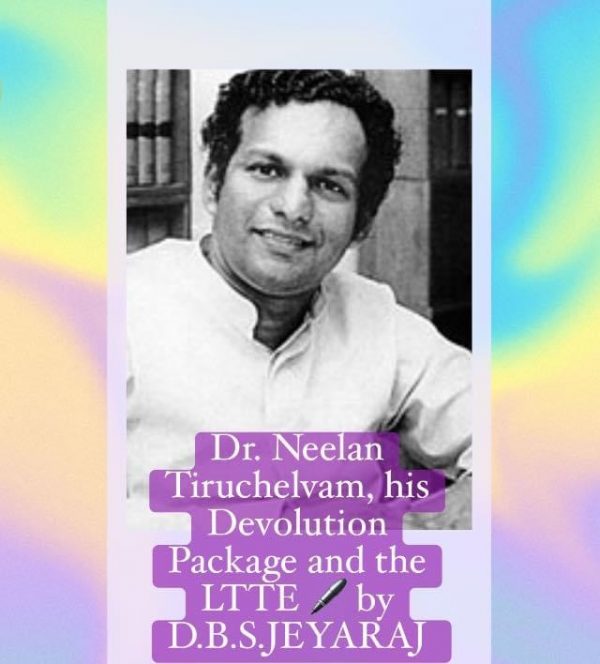
“Any man’s death diminishes me because I am involved in Mankind,” wrote the metaphysical poet John Donne.The ethnic conflict in Sri Lanka has extracted a heavy human toll. In my personal capacity as a Sri Lankan Tamil and in my professional capacity as a journalist , I have lost count of the number of people related or known to me who have encountered violent deaths.But no man’s death as a result of the ethnic crisis in Sri Lanka has diminished me as that of Dr. Neelakandan Tiruchelvam.
Born on January 31st 1944, Neelan Tiruchelvam, was brutally assassinated by the Liberation Tigers of Tamil Eelam (LTTE)on July 29th 1999.He was 55 at the time of his death. Ever since his demise, I have written several articles about Neelan.Drawing much from such writings I write this article to mark the 23rd death anniversary of Dr.Neelan Tiruchelvam on July 29,2022.
I always recall with grief the last 50 minute telephonic conversation I had with him just 35 minutes before he was killed.I was one of the last persons to speak to him on that fateful day. I spoke with him on the telephone from Toronto for 50 minutes from 7.50 am until 8.40 am (Sri Lankan time). I used to call him regularly those days. Usually he winds up the conversation after a while saying “you are going to run up a massive phone bill”. But on that day he was in a mood to talk and was pensively reflective .When I ended the conversation he seemed a little surprised.
United States House Speaker and veteran Democratic politician Nancy Pelosi arrived in Taiwan on Tuesday evening, marking the most high-level political engagement between the U.S. and Taiwan in 25 years.
China condemned the visit as “a major political provocation” and said it would launch “targeted military operations” as countermeasures, even as Beijing on Tuesday scrambled Su-35 fighters across the median of the Taiwan Strait in a show of force, placed restrictions on several Taiwanese exporters, and announced live-fire drills to be held in six regions surrounding the island of Taiwan from Thursday to Sunday.
China’s Defence Ministry said it is “on high alert” while the PLA Eastern Theatre Command announced it will hold joint sea and air exercises in the sea and airspaces of northern, southwestern and southeastern Taiwan and also carry out missile tests.
Evidently, the Aragalaya (struggle) did not have a clear idea about the goals it hoped to achieve. Also, it did not have a clear idea about the limitations of its strength. The developments of the Aragalaya, especially the fact that President Gotabaya relinquishing the presidency and fleeing away can be considered as a special situation caused by the weak and foolish manner in which President Gotabaya Rajapaksa faced the challenge posed by the Aragalaya rather than an outcome of the strength or wisdom of the Aragalaya itself.
Gotabaya Rajapaksa did not possess an in-depth understanding of the State or its administration. Apart from that, he could be considered as a leader who had a military (barracks) temperament and Sinhala Buddhist sectarian mind. Even before he had assumed a high position of the stature of the presidency, he had acted on a policy of mercilessly crushing all kinds of non-Buddhist and non-Sinhala struggles. But surprisingly, in regard to the recent Aragalaya which is described as the struggle of “love” by some of its proponents, President Gotabaya too, seems to have swayed with a policy of loving it rather than crushing it.
While the Aragalaya was in progress, I happened to meet the President with Herman Gunaratne, a planter and an author of books, to get the doors open for initiation of a public-oriented reform program. At the end of the discussion, I requested the President not to attack the strugglers even if they commit a mistake. I was surprised by the President’s response. He quipped instantaneously that he had cautioned the police and security forces not to resort even to a baton charge against them, let alone shooting them.
On April 2, 2022 you tweeted “Sri Lankans have a right to protest peacefully–essential for democratic expression. I am watching the situation closely, and hope the coming days bring restraint from all sides, as well as much needed economic stability and relief for those suffering”
Salutary words Madam. Neither the then incumbent President, the opposition, the Aragalaya or anti Aragalaya forces nor the members of the ordinary general public to which I belong, tweeted, face booked, instagrammed any objection to this rational and admirable point of view and justifiably so.
When you declared that Sri Lankans have a right to protest peacefully we presume that right to peaceful protests you condone are those that are truly peaceful, held in a manner where no laws are flouted. We presume you would not condone any protests, where protesters occupy state property and refuse to vacate the premises forthwith, when court orders are issued, directing them to do so. A protest, based on the upholding of democracy and eradication of corruption, must practice what they preach and violate no laws themselves. A protest engaged in defacing public and private property in the name of democracy, a protest with slogans violating the constitution of our country cannot be defined as a peaceful protest by any means!
The India – Sri Lanka Accord was signed by former Indian Prime Minister Rajiv Gandhi and ex-Sri Lanka president Junius Richard (JR) Jayewardene on July 29th 1987 in Colombo. The 35th anniversary of the pact known generally as the Indo-Lanka accord will be observed this Friday (July 29).
The Rajiv-JR accord was signed with the laudable objective of bringing peace to Sri Lanka by ending the war between the Sri Lankan armed forces and armed Tamil militant groups. A ceasefire was declared and Indian army personnel with the nomenclature of Indian Peace Keeping Force(IPKF) were stationed in the Northern and Eastern provinces of the Island to maintain peace.
On July 9, it looked as if Sri Lanka was undergoing a revolution through raw peoples’ power. Massive crowds had converged on Colombo to force the incompetent President Gotabaya Rajapaksa to quit. The Presidential palace, the Presidential Secretariat and the Prime Minister’s office were stormed, vandalized, and occupied. But the most barbaric act was the burning of Prime Minister Ranil Wickremesinghe’s personal residence, that housed thousands of books and rare objet d’art.
Shockingly, a member of the opposition in parliament and a former army chief, Field Marshal Sarath Foneska, even appealed to troops not to obey orders. Unhelpful Western diplomats kept urging the government not to use force to stop the protesters while turning a blind eye to arson and vandalism indulged in by the so-called “peaceful protesters.”
The Gotabaya Rajapaksa government did totter soon enough. The President fled to Singapore and resigned by email from there. Sri Lanka had had its first successful revolution, the media crowed, as previous attempts in 1962, 1971 and 1988-89 had failed. The hated Rajapaksas had been banished and the country was thought to be on the threshold of a new order with the common man in the driver’s seat.
Conventional politicians went on a “pilgrimage” to the agitators’ camp to pledge support and seek “guidance” from the motely crowd. The media, both local and international, sang hosannas for the Aragalaya (Sinhalaese word for struggle), while totally blacking out the vandalism and arson committed by the agitators.
Noting that an intelligent and disciplined group of young people pioneered the people’s struggle or “aragalaya”, which demanded the resignation of former President Gotabaya Rajapaksa and his Government, the National Movement for Social Justice (NMSJ) claimed however, that a few inappropriate people who joined it later disrupted the movement and caused violence.
Speaking to The Morning, NMSJ Chairman Karu Jayasuriya said: “The youngsters who started the struggle wanted to create a society with justice and fairness. A very intelligent and disciplined group of young people were instrumental in driving out an unjust regime and this no political party or civil society could achieve. They had reasonable demands, but of late, a few persons disturbed this movement and created violence.”
Recalling that the NMSJ has been working very closely with many groups involved in the struggle, Jayasuriya, who is also a former Speaker of Parliament, said that the NMSJ however cannot approve of the killing and harassing of people’s representatives (MPs), burning their houses, and damaging other properties.
Sri Lanka’s new president said the country has experienced the worst of its economic crisis and that restoring political stability will allow it to begin turning a corner, starting with finalizing negotiations for an International Monetary Fund bailout that had stalled due to recent turmoil.
“I think we’ve already hit the bottom,” Ranil Wickremesinghe said in an interview Sunday with The Wall Street Journal. “I can see the light at the end of the tunnel; it’s how fast we can get to it.”
He also acknowledged that it will take months before most Sri Lankans, who have faced runaway inflation and long queues for fuel and cooking gas, will begin to see their economic circumstances improve markedly.
Speaking from his office in the Presidential Secretariat, which Mr. Wickremesinghe only moved into on Wednesday after it had been occupied earlier in July by protesters, the president said he expected the IMF staff-level agreement to be reached by the end of August, after which the country would be able to further talks with sovereign bondholders and bilateral creditors. Any preliminary agreement would still require IMF board approval for the disbursement of funds, a process that could take months.
“We are down to the nitty-gritty,” he said. “We would have had it this month [July] if it were not for the unstable political condition.”
India has raised the scheduled visit of a Chinese research vessel to a Sri Lankan port with President Ranil Wickremesinghe, after the Ministry of Defence in Colombo confirmed the ship’s arrival, despite New Delhi giving a “clear message” on its concerns.
While there is no official statement so far from either the Indian mission in Colombo, or the President’s office in this regard, the matter “was raised at the highest level by the Indian side,” an official source in Colombo, familiar with the development, told The Hindu on Monday.
Following media reports last week of ‘Yuan Wang 5’ — a Chinese vessel involved in space and satellite tracking — calling at Sri Lanka’s southern Hambantota Port, the Ministry of Defence denied such a vessel was arriving. However, taking back its denial within days, the ministry said last weekend that it had cleared the vessel’s entry into the Chinese-built Hambantota Port, where it would dock from August 11 to 17.
(This article was published last year and is being re-posted without any changes to denote the 39th anniversary of “Black July”)
July 24th 1983 was the day on which a destructive spree of anti-Tamil violence commenced in Jaffna in the early hours of the morning and began spreading to Colombo in the later hours of the evening on the same day. It continued to other parts of the Island in the following days. The 39th anniversary of those dark days – etched in history as “Black July” revives bad memories among most Tamils who lived in Sri Lanka during July 1983.
JR Jayewardene , the Kanatte Mass Funeral and the July 1983 Anti-Tamil Pogrom – by D.B.S.JEYARAJ
The week long spree of anti-Tamil violence saw over 4,000 Tamils and some Muslims – mistaken for Tamils – being killed. Thousands were injured. Some of the injured were killed in hospitals. There were close upon 300,000 displaced persons as a result. Around 130,000 of these were housed in makeshift refugee camps. More than 2,500 business enterprises ranging from factories to petty boutiques were damaged or destroyed. The number of houses and dwellings and vehicles damaged or destroyed has not been correctly estimated yet.
Sri Lanka’s Defence Ministry on Thursday denied reports that a Chinese research vessel involved in space and satellite tracking would enter the Hambantota port in August this year, even as India sent a “clear message” that it was monitoring the ship’s progress “carefully”.
“We have no confirmation of such a vessel calling at the Hambantota port,” a Defence Ministry spokesman told The Hindu in Colombo, when asked about the reports. The vessel’s arrival was highlighted by BRISL (Belt & Road Initiative Sri Lanka), a Colombo-based organisation studying China’s ambitious connectivity project.
On its website, the BRISL said “Yuan Wang 5, which set sail from the Chinese port of Jiangyin on July 13, and passed by Taiwan is now in the East China Sea, and was expected to dock in Sri Lanka’s Hambantota port from August 11-17 for ‘replenishment’ while it continues to conduct Space and Satellite control and research activities in the north-western part of the Indian Ocean Region” through August and September.
“The visit of Yuan Wang 5 to Hambantota Port will be excellent opportunity for Sri Lanka and the regional developing nations to learn and develop their own space programmes,” the report published by the “education and consulting platform” BRISL said last week.
Sri Lanka – Civil Society Statement on attacks and reprisals against peaceful protesters
28th July, 2022
We, the undersigned individuals and organizations strongly condemn the ongoing attack including violence, false labeling and legal reprisals against unarmed peaceful protesters
by the Sri Lankan government. We call for an immediate end to reprisals against those exercising their constitutionally protected rights to advocate for change.
We are extremely concerned by disturbing developments of abduction, arrest, intimidation,and reprisals against protesters that have been ongoing and increased over the past several days. On 25th July, media reported that Colombo Magistrate Court had issued a
travel ban on Fr. Jeevantha and several other prominent human rights defenders involved in the protests and on 27th July, a church was visited by local police, who had told the priest resident there that they had received orders from Colombo to arrest Fr. Jeevantha.
On 26th July, a person involved in protests at the Galle Face was arrested from a flight that was about to leave from the Bandaranaike International Airport, after he had legally cleared immigration. Uniformed police officers and reasons for arrest was only given after protest by fellow passengers.
On 27th July, Veranga Pushpika, an active protester at the Galle Face, a former student activist and journalist, was abducted from a bus in broad daylight by men in civil. Police had later acknowledged his arrest, but not given clear indication of his whereabouts to
lawyers and the Human Rights Commission for several hours.
India, which is trying to expand its influence in crisis-hit Sri Lanka after China made deep inroads there, said on Thursday it was aware of reports about the planned visit of a Chinese vessel to a Sri Lankan port built with money from Beijing.
Shipping data from Refinitiv Eikon showed research and survey vessel Yuan Wang 5 was en route to the southern Sri Lankan port of Hambantota and was expected to arrive on Aug. 11.
“The government carefully monitors any developments having a bearing on India’s security and economic interests, and takes all necessary measures to safeguard them,” India’s foreign ministry spokesperson Arindam Bagchi told a weekly media briefing.
Key figures of the “aragalaya” (struggle) are facing intimidation at the hands of the Government, the Police, and the military, activists allege, with arrests as well as surveillance measures, including wiretapping their phones, taking place.
According to sources, Attorney Nuwan Bopage, Catholic priest Fr. Amila Jeewantha Peiris, Inter-University Students’ Federation (IUSF) Convener Wasantha Mudalige, and former IUSF Convenor Lahiru Weerasekara are facing intimidation by the Government.
It is also alleged that the security forces are following these activists while tapping their phones and trying to intimidate the people who support them.
The Proclamation on the State of Emergency, announced by then-Acting President and incumbent President Ranil Wickremesinghe on 17 July followed by a Gazette on 18 July, was debated and passed in Parliament yesterday (27), with 120 votes in favour of it and 63 against.
This proclamation was made by Wickremesinghe through the Special Gazette No. 2288/30 and according to the legal provisions, if the approval of Parliament is not obtained within 14 days for the said proclamation, it will be cancelled.
Speaking during the debate, Opposition and Samagi Jana Balawegaya (SJB) Leader Sajith Premadasa said that the real emergency remains in people dying in fuel queues, mothers not having milk powder for their babies, schools being shut due to there being no transport for students, there being no medicines for the healthcare sector, and where people cannot eat three meals a day in a bankrupt country.
“However, today, we are debating on the emergency to enforce State terrorism. For months, protestors protested peacefully in front of the Presidential Secretariat. Was it not a very peaceful display of their democratic rights? Where did the violence start and who started it? It was the former Prime Minister and incumbent Government MP Mahinda Rajapaksa, who started the violence from the Temple Trees on 9 May.
“We did not anticipate this massive public power. Even I did not believe that such a thing would happen, where both the Prime Minister and the President had to go home. What started at the Temple Trees was terrorism. What followed later that day on 9 May was also terrorism. That is not humanity. Civil members of society do not behave like that. I do not know which stupid person gave this dumb advice to President Wickremesinghe on the night of 22 July to attack the protestors at the Presidential Secretariat, right after he took oaths as President. There were mothers, children, disabled soldiers, journalists, and civil society members, all of whom had said that they would leave the Secretariat the next day. Then why was this State terror unleashed on them? I cannot believe that an experienced person like Wickremesinghe would do something so stupid,” said Premadasa, in condemnation.
The International Monetary Fund (IMF) said Sri Lanka should kick off debt restructuring talks with its bilateral lender China, while the island state’s government seeks a financing loan from the Washington-based fund.
“China is a big creditor, and Sri Lanka has to engage proactively with it on a debt restructuring,” Krishna Srinivasan, director of the IMF’s Asia and Pacific Department, told Reuters in an interview on Tuesday.
Singapore has extended a short-stay visa for Sri Lanka’s deposed president Gotabaya Rajapaksa, local media in the city-state reported on Wednesday.
Mr. Rajapaksa fled his country on July 13, after his official residence was stormed by thousands of protesters who had demonstrated for months against the island nation’s painful economic crisis.
He first escaped to the Maldives in a military plane and travelled on to Singapore, where he has been staying on a short-term visit pass since July 14.
Mr. Rajapaksa’s 14-day visit pass has been extended, allowing him to stay until August 11, the Straits Times newspaper reported Wednesday, without citing a source.
A suspect named Dhaniz Ali, who is alleged to have entered the Sri Lanka Rupavahini (Television) Corporation (SLRC) premises in Colombo 7 and interfered with its broadcasting, was ordered to be remanded till 5 August by the Colombo Fort Magistrate’s Court yesterday evening following his dramatic arrest by Criminal Investigation Department (CID) officers aboard a flight to Dubai UAE on Tuesday (26).
In the videos related to the incident, a group of officers of the CID who had boarded the relevant aircraft that was about to depart from the Bandaranaike International Airport (BIA) in Katunayake was seen arresting the suspect amidst opposition from the suspect himself, as well as other passengers. The other passengers who were aboard the flight were seen asking the CID officers why airport officers had cleared the suspect if there was an arrest warrant issued against him.
In a press release issued by the Police Media Division (PMD) after his arrest, it was stated that the suspect was arrested for allegedly entering the SLRC premises located in the Cinnamon Garden Police area, and making a threatening statement on live television, thereby suspending its broadcasting for a certain period.
The arrest of the suspect, a 31-year-old resident of the Kurunegala area was, according to the PMD, made by the officers attached to the CID unit established at the BIA.
Wajira Abeywardana was sworn in as the United National Party’s (UNP) National List Parliamentarian yesterday (27), while Minister of Education Dr. Susil Premajayantha was appointed as the new Leader of the House and Minister of Urban Development and Housing Prasanna Ranatunga was re-appointed Chief Government Whip.
Abeywardena took oaths before Speaker Mahinda Yapa Abeywardena. He was elected to Parliament for the first time from Galle District representing the UNP at the 1994 election. Thereon, until 2010, Abeywardana was elected to Parliament at every election from Galle District representing the United National Party. In the 2015 Parliamentary Election, he was elected to Parliament representing the Galle district.
He has worked in the capacity of the Minister of State Administration, Home Affairs, Provincial Councils, and Local Government, and as Minister of State Administration, Management, and Reform Projects. He is currently the Chairman of the United National Party (UNP).
Abeywardana, born in 1961, is an alumnus of Mahinda Vidyalaya, Galle. He also holds a degree in engineering from the University of Moratuwa.
“Gota Go Home” was the clarion call aroind which the people launched their “Aragalaya” or Struggle many weeks ago. It has now achieved its primary goal. Gota has been made to go , but to which permanent home remains an unanswered question still.It is also unclear as to whether he would be able to find a safe abode in a country of his choice. Gota would of course like to return to California where his only son resides and where he himself lived for over 12 years. At the same time ,it would render him vulnerable to legal action without presidential immunity. As for now the certainty is that Gota has gone and the Aragalaya is celebrating the sweet smell of success.
A remarkably significant outcome of the Aragalaya has been the emergence of the “Peratugami Samajavadi Pakshaya”( Frontline Socialist Party as an influential player in Sri Lankan politics. The FSP along with its undergraduate front “Anthar Vishvavidyaleeya Shishya Balamandalaya”( Inter-University Students’ Federation) played key roles in the struggle. Veteran political journalist Victor Ivan opines that the FSP took control of the uprising and claimed ownership of the struggle. Here are relevant excerpts from Victor’s latest article “What could be the end of the revolution?” in the “Daily FT”of July 15th 2022-
Extraordinary foresight is scarcely needed to have predicted the State’s attack on Sri Lanka’s globally feted protest site at the Galle Face Green in the wee hours of Friday morning, July 22nd 2022.
Why this provocative show of strength?
As formidable contingents of baton wielding masked military and the police took ‘control’ of the site, they set about systematically dismantling protest structures, including the library and the medical tent, badly beating up unarmed lawyers, priests, journalists, dragging away and arresting young men and women peacefully walking on Galle Road towards the Galle Face. Hours later, an inflappable President Ranil Wickremesinghe presided over the swearing in of his Cabinet, chockfull of the same political rogues.
The contrast between these two happenings could not have been more stark. Why, some perplexed Sri Lankans ask, did the country’s eighth Executive President embark on this provocative show of strength, on his first day in office? This was despite the protestors assuring that they would ‘hand over’ the protest site on Friday afternoon and give the ‘new man’ some time to tackle the country’s most pressing economic ills. The answer to that question is also predictable.
Any appearance of concession, the very thought of meekly ‘accepting’ a ‘hand over’ by protestors on the basis of a ‘trial period to govern properly’ is nothing short of anathema to the new President, it seems. Originally named as ‘GotaGoGama,’ this was far more than a camp with tents. Despite being infiltrated by elements of the Janatha Vimukthi Peramuna (JVP) and its offshoot, the Frontline Socialist Party (FSP) to its discredit, it remained a potent ideal of people power. That ideal is what is sought to be crushed, ironically after the departure of the President who inspired it.
A pincer move to crush genuine gains of protestors
When the United National Party (UNP) was all but wiped out at the 2020 parliamentary elections, many were quick to write off the party and its leader Ranil Wickremesinghe as a spent force in politics. It took almost a year of squabbles within the party for Mr Wickremesinghe to even be appointed to the UNP’s sole national list seat. He took oath as an MP on June 23 last year.
Just 13 months later, last Wednesday, he cemented one of the all-time great comebacks in politics when Parliament elected him as Sri Lanka’s 8th Executive President.
To say what happened was remarkable would be a gross understatement. A man who saw much of his party abandon him, and who presided over the UNP’s worst-ever electoral defeat, finally achieved his long cherished dream of becoming president. The overwhelming majority of those who voted for him were those who had been his staunchest political opponents until three months ago.
Wednesday’s vote was historic as it was the first time that Parliament held a secret ballot to elect a president. In 1993, Parliament unanimously elected Dingiri Banda Wijetunga as president following the assassination of Ranasinghe Premadasa.
With three candidates putting forward their names to replace Gotabaya Rajapaksa as president, however, a vote had to be taken in terms of the constitution.
(The writer is the former editor of The Sunday Island,
The Island and consultant editor of the Sunday Leader)
Both pundits and the hoi polloi now agree that when Sri Lanka was at the critical juncture in deciding whether to take the straight and narrow hard way or muddle through and be engulfed in chaos, a correct decision was made to go to the IMF.
However, it was not wisdom that resulted in going to this UN institute with 189-member countries but the stark reality of bankruptcy threatening the nation.
Military men do not like to obey the dictates of others. And Lt Col (Retd) former President Gotabaya Rajapaksa was in no mood to listen to the dictates of others– not even of the IMF. The IMF, it was well known, imposes ‘conditionalities’ on its borrowers, like most money lenders, and Rajapaksa at the height of his power was in no mood to obey.
He had won the Presidential election polling 6.92 million votes (52.25 percent) and following that victory the Pohottuwa (Rajapaksa Party) swept the parliamentary polls winning a two-thirds majority. He then proceeded to enact the 20th Amendment which gave him powers that no other executive president has ever had.
Prime Minister Narendra Modi has sent a congratulatory message to Sri Lanka’s newly elected President Ranil Wickremesinghe, nearly a week after his rise to the island nation’s helm amid political upheaval triggered by a severe economic meltdown.
Mr. Modi’s outreach to Mr. Wickremesinghe follows messages from Chinese President Xi Jinping and Russian President Vladimir Putin to the Sri Lankan leader, who is counting on urgent international support to cope with the deepening crisis. The Indian High Commission in Colombo, which put out a tweet on July 20 — the day of Mr. Wickremesinghe’s election in Parliament — noted the development but stopped short of congratulating him. This was hours after the Indian mission “categorically denied” media reports of India attempting to “influence” the key parliament vote.
“You have assumed the high office at a critical time for Sri Lanka,” Mr. Modi said in the letter dated July 25. Expressing hope that Mr. Wickremesinghe’s tenure would “nurture” economic stability and “fulfill the aspirations of all citizens”, the Indian Prime Minister said: “As a close friend and neighbour of Sri Lanka, India will continue to be supportive of the quest of the people of Sri Lanka for stability and economic recovery, through established democratic means, institutions and constitutional framework.”
“A wandering fire at a terrible height –
can it be a star shining like that? Osip Mandelstam (Poem 101)
A walking path bordered by the sea and a bit of lawn with few struggling saplings; a ‘marina’ sans yacht or boat (like that airport with no planes). Port City Marina Promenade, inaugurated in January 2022 by President Gotabaya, PM Mahinda and Chinese foreign minister, became an instant wonder. Almost 90,000 people visited it one week.
In January 2022, as masses thronged a sea-path masquerading as a marina, the economy was crumbling, gas and milk powder queues had begun, and poverty and unemployment were accelerating. Yet there was no demand for the Rajapaksas to go. According to an IHP tracking poll, Gotabaya Rajapaksa’s favourability ratings were high still, higher than Sajith Premadasa’s or Anura Kumara Dissanayake’s. If the anonymous social media campaign which kicked off one of the most successful popular resistance movements of the century had begun in January instead of April, it would have flopped.
The U.S. is doing a small developing country’s dirty work in prosecuting its ex-ambassador for fraud, and it may eventually be cause for discomfort along Embassy Row.
In normal cases, for a foreign diplomat with an instinct for pilfering from their own government, Washington represents a safe posting. Far from home, entertainment expenses can be padded, real estate prices exaggerated, lobbying and PR-consultant fees manipulated. The only thing the bean-counters back at the foreign ministry need to know is that the American capital is an expensive place.
Thanks to diplomatic immunity, whatever workplace scams get cooked up are unlikely to interest the local authorities here.
Still, an unusual proceeding that quietly concluded in a federal courtroom this week suggests there are limits, even with immunity.
The case of former Sri Lankan Ambassador Jaliya Wickramasuriya, who pleaded guilty to defrauding his own government out of $332,000, has gotten significant play in his crisis-stricken home country, where anti-corruption protests this month ousted the president. One of the major complaints against the now-former leader (and his brother, another former president; and their brother, the just-ousted finance minister; and their other brother, a former speaker of parliament) was that they filled the government with crooked relatives.
Highly respected economists and former Central Bank Governor Dr. Indrajit Coomaraswamy has said the economic recovery will require painful treatment whilst expressing hope that President Ranil Wickremesinghe would take all the tough decisions to avoid the disastrous situation.
“President Wickremesinghe is economically very literate. He knows what has to be done. At times, it has been difficult for him or any other politician to get it done, given the political dynamics and that toxic populist politics and entitlement culture that has driven the economy to where it is today. But, if President Wickremesinghe understands, he can get it done,” Coomaraswamy said in an interview with The Wire on Saturday.
He said the President seems that he was ready to bite the bullet, noting that if he does not, Sri Lanka will go down the abyss and it will be a disaster.
“First, we need to get an IMF agreement because, at the moment, we neither have foreign exchange nor rupees. The Government does not have fiscal revenue and thus it puts enormous pressure on the Central Bank to print money.
In what friends and admirers, especially in Colombo’s overseas diplomatic corps, had not expected of him, Sri Lanka’s new President Ranil Wickremesinghe ‘swung’ into action on his day one in office to restore law and order in the country that had been badly affected since the ‘Aragalaya’ protests against the then reigning Rajapaksa clan, weeks ago. If the forced, and at times violent, removal of the protestors from the main venue that included the President’s Secretariat, was only a beginning in this regard, Wickremesinghe also did not mince words with Western diplomats who condemned the joint police-military action at midnight, in double-quick time as in the past weeks and in no uncertain terms.
In what was said to be in lighter vein, President Wickremesinghe asked Western diplomats whom he invited for an evening meeting, on their face, what would have their governments done if ‘peaceful protestors’ had similarly occupied the office and residence of their President, back home. If nothing else, this was not the Wickemesinghe that they had known in the past, and had not expected as president, either. In particular, he pointed out how the US deployed troops to vacate violent Trump supporters after they had stormed into the Capitol, leading to firing-after their candidates had lost the presidential election last year.
Ranil wickremesinghe is a familiar sight to anyone who has taken even a passing interest in Sri Lankan politics in recent decades. First elected to Parliament in 1977, he has held a variety of cabinet jobs over the years, including, on six occasions, that of prime minister. His most recent stint was in the service of Gotabaya Rajapaksa, whose tenure as president came to an ignominious end on July 14th when he tendered his resignation by email from Singapore, having fled the country in the dead of night the day before.
Fearing prosecution for alleged corruption and crimes committed during Sri Lanka’s civil war, the disgraced ex-president is expected to lay low abroad for the foreseeable future. But Mr Wickremesinghe (pictured in effigy) will remain a familiar face around Colombo, the capital. After taking over from his boss in an acting capacity the week before, he was officially elected president by a clear majority of 134 of the 225 members of Parliament on July 20th. He is expected to serve out the remainder of Mr Rajapaksa’s term, which ends in 2024.
His election raises hopes that Sri Lanka, which has been in economic and political turmoil for months, will at last regain the political stability required to solve its economic problems. But Mr Wickremesinghe’s chances of success are complicated by his willingness to work with the Rajapaksas. The protesters who chased Mr Rajapaksa from office had also demanded Mr Wickremesinghe’s resignation as prime minister. Their idea of his stepping down hardly involved a promotion to the highest office in the land. That bodes ill for his chances of uniting Sri Lankans behind him in a time of crisis.
For his admirers, Ranil Wickremesinghe is the president Sri Lanka has lost and found. The late former minister Mangala Samaraweera once described Wickremesinghe as the best president Sri Lanka never had.
In his previous two outings as a presidential candidate, the victory was his, but on both occasions Wickremesinghe lost through no fault of his own. In 1999, opinion polls predicted Wickremesinghe’s victory at the presidential election, but a botched assassination attempt by the separatist Liberation Tigers of Tamil Eelam on his rival and then President Chandrika Kumaratunga on December 18, just two days before the election, created a sympathy wave and helped the severely wounded president to win with a record majority.
Again in 2005, Wickremesinghe was confident he would win the presidential bid with the Tamils voting overwhelmingly for him. But on the day of the election, an alleged secret deal between the LTTE and rival candidate Mahinda Rajapaksa’s campaign managers saw separatist leader Velupillai Prabhakaran ordering the Tamils to boycott the election. The result: Wickremesinghe lost the election by a narrow margin.
Had he won the 2005 presidential election, he, too, like President Mahinda Rajapaksa, would have ended the war, but in a more dignified manner. He would have fully utilised the domestic support and the favorable international environment, leaving no room for war crimes allegations.
He led his United National Party to victory at two parliamentary elections and became prime minister, but on both occasions, the then executive presidents — Chandrika Kumaratunga and Maithripala Sirisena – did not give him a free hand to implement his development programmes largely due to their fear that he would emerge stronger to win the next presidential election.
Unfairly denied the presidency twice, Wickremesinghe bade his time, perhaps believing that the wheels of justice, though turn slowly, will grind exceedingly fine for him.
His political misfortunes largely stem from his passive or not-so-aggressive approach to politics. He allows his opponents to pejoratively define who he is, yet would not fight back.
Although two Samagi Jana Balawegaya (SJB) National List Opposition MPs had expressed their desire to resign from their positions as MPs to enable former Speaker of Parliament and incumbent National Movement for Social Justice (NMSJ) Chairman Karu Jayasuriya the opportunity to enter Parliament, Opposition and SJB Leader Sajith Premadasa had allegedly vetoed the move, The Morning learnt.
Speaking to The Morning, sources close to Premadasa claimed that in the early days of the talks regarding the formation of an interim all party Government in the wake of the economic crisis in the country, there were discussions within the SJB about giving Jayasuriya the opportunity to enter Parliament.
The sources further claimed that during those discussions, two National List MPs representing the SJB, namely Mayantha Dissanayake who is also related to Jayasuriya, and incumbent Minister Harin Fernando, had expressed their consent to resign as MPs and to give Jayasuriya the opportunity to enter the Parliament. According to the sources, discussions had been held regarding offering Jayasuriya a high-level position in an interim Government to be formed according to that plan.
Disruptive and violent populist movements have undoubtedly registered successes, ending oppressive regimes and giving the dumb millions a voice to express dissent forcefully. But in the long run, these movements have delivered only partially and that too, briefly, literature on the subject shows.
The question that is in the minds of observers of the Sri Lankan Aragalaya movement is: Will it go the way of similar movements in other countries in the past or will it have a lasting salutary effect?
Sri Lankan security forces have carried out a violent early morning raid on the main anti-government protest camp in Colombo, beating protesters, destroying tents and arresting nine people.
Friday’s raid saw thousands of police and troops armed with riot gear descend on the protest camp, known as Gota Go Gama, where hundreds of people have been living for over three months. More than 50 people were injured and three people were sent to hospital in the attack, according to St John Ambulance volunteers at the scene.
The crackdown came a day after Ranil Wickremesinghe, who is an unpopular figure, was sworn in as Sri Lanka’s new president following the toppling of president Gotabaya Rajapaksa, who was forced to flee the country amid huge public anger.
According to those present for the raid, armed military officers in black uniforms began violently clearing tents close to the Presidential Secretariat building, the offices of the president which have been occupied by protesters since an anti-government protest last week.
Nine people were arrested, a police spokesperson said, adding that the protesters had “no legal right to hold the area”.
A huge military contingent, along with police, raided Galle Face in Colombo early on Friday, where anti-government protesters have peacefully agitated for over three months in the wake of the island nation’s grave economic crisis. Several protesters were assaulted by soldiers, eyewitnesses said.
The military attack on the main agitation site comes less than 24 hours after Ranil Wickremesinghe was sworn in as President, amid political tumult in the island after dramatic citizens’ protests on July 9 led to former President Gotabaya Rajapaksa fleeing Sri Lanka.
As Acting President Mr. Wickremesinghe declared an Emergency on Monday, two days ahead of a crucial parliament vote in which he was elected President.
The military’s aggressive takeover of the protest site in the early hours on Friday shocked many, as activists had announced they would vacate the area by Friday afternoon. At least eight persons, including lawyers and activists, were arrested.
The military in Sri Lanka has taken control of the presidential secretariat in the capital after “brutally assaulting” the protesters.
Soldiers also destroyed tents at the adjacent GotaGoGama protest site, arrested several protest leaders and cordoned off the area together with about 100 protesters.
The military assault came hours after the protesters withdrew from the camp in front of Temple Trees, the prime minister’s official residence. The protesters had already announced their intention to withdraw from the presidential secretariat on July 22.
The new Cabinet of Ministers were sworn in today before President Ranil Wickremesinghe in the Prime Minister’s Office.
Accordingly, 18 cabinet ministers including former minister Ali Sabry were sworn in today.
Former minister of Foreign Affairs G.L Pieris who proposed Dullas Alahapperuma as the presidential candidate has been removed from his ministerial portfolio and replaced with Ali Sabry.
Ranil Wickremesinghe, who was sworn in President of Sri Lanka on Thursday, is expected to appoint long-time Rajapaksa loyalist and senior politician Dinesh Gunawardena as Prime Minister, a source close to the President’s office told The Hindu.
Further, Mr. Wickremesinghe will continue with the last-appointed Cabinet until Opposition parties are “ready to cooperate” in an all-party government, the source said, requesting anonymity.
President Wickremesinghe, who faces fierce public criticism for joining the discredited Rajapaksa government earlier, has invited all parties to join his government to combat the national economic crisis, which set off political upheaval and led to changes at the island nation’s helm. Opposition parties are yet to signal their willingness.
Six-time Prime Minister and acting President Ranil Wickremesinghe was on July 20 elected President of Sri Lanka — a post that has eluded him despite a near-half century political career — in extraordinary circumstances of a political crisis triggered by the island’s economic crash.
Mr. Wickremesinghe won 134 votes in the 225-member Parliament, securing a comfortable victory margin in a three-way contest. Dullas Alahapperuma, a formerly Rajapaksa-aligned, now independent MP, won 82 votes, despite several independent lawmakers, the main opposition, and most minority parties pledging to back him on Tuesday. The leftist Janatha Vimukthi Peramuna’s candidate Anura Kumara Dissanayake won just three votes. Two MPs abstained from the vote.
“The time for division is over,” Mr. Wickremesinghe said in his first remarks after clinching Presidency. He urged all political parties to come together to take the country on the path of economic recovery.
Perseverant Ranil Wickremesinghe yesterday reinforced his often underestimated prowess by becoming Sri Lanka’s 8th Executive President, comfortably winning a secret ballot from Parliamentarians with support mainly from colleagues loyal to ousted Rajapaksa regime.
Pic via Daily Mirror
Of the 225-member Parliament, 223 voted with 2 MPs (MPs Selvaraja Gajendran and G.G. Ponnambalam) abstaining and 4 ballots rejected as invalid.
Wickremesinghe received 134 votes against the 82 received by Dullas Alahapperuma. JVP Leader Anura Kumara Dissanayake managed only 3 votes.
Though political activists questioned the legitimacy, the victory fulfils a long-cherished dream of the 73-year-old veteran who marks 45 years in Parliament and has served a record six times as Prime Minister.
“My life has been in this Parliament,” said an enthusiastic Wickremesinghe in his brief address in the House after winning. Fittingly on his wishes, Wickremesinghe will be sworn in today at 10 a.m. in Parliament, a departure from his predecessors who opted for more grandiose or religiously important locations. He will serve the remainder of the term of the ousted President Gotabaya Rajapaksa till end 2024.
President and United National Party (UNP) Leader Ranil Wickremesinghe yesterday (20) invited all political parties in Parliament to join hands for the betterment of the country, while thanking the majority in Parliament for electing him as the 8th Executive President of the country.
“I spent 45 years of my life in this Parliament. My life was spent in this Parliament. I thank this Parliament for giving me this honour. In 1993, when former President R. Premadasa was assassinated, we convened to select a new President. That was done so without an election. For the first time, in this second instance, we had an election. On the one hand, we showed that this Parliament can select a new President through a vote. I thank everybody who voted for me, and I also thank everybody who participated in this election,” said Wickremesinghe.
He said that the country is in a deep crisis today, with the economic crisis, and noted that the youth are demanding a system change.
Army yesterday issued a tougher warning to unruly protestors saying that its soldiers have been empowered to use force to protect lives and State property from any harm.
In a statement Army said members of the armed forces and the Police in terms of provisions, vested in them by the Constitution of Sri Lanka have been empowered to enforce law and order of the country and maintain the same in order to protect her people, public property and the country at large at the expense of their own lives.
This has been practised since the country became an independent State and a free nation, through which the sovereignty of the republic, freedom of expression and free movement of the public as enshrined in the Constitution are upheld and exercised as it has been distinctly manifested in the most recent months during the series of public protests that began in May this year.
Former President Mahinda Rajapaksa said that his party’s candidate was unable to win the Presidential election in Parliament today.
“We presented Dullas. We voted for him, but lost. Somebody has to win,” he told media in parliament.
“He (Ranil) got more votes, so he became the president. That’s what has happened. We are waiting to see what will happen in the future. Whatever the government is, it must work for the people of the country,” he said.
Sri Lanka will witness a three-cornered race for Presidency on Wednesday, as the island awaits a new leader and government after an astounding people’s uprising ousted Gotabaya Rajapaksa last week.
Acting President Ranil Wickremesinghe; the formerly Rajapaksa-aligned, and now independent Dullas Alahapperuma; and the leftist Anura Kumara Dissanayake were on Tuesday nominated by parties in Parliament, a day ahead of the poll through a secret ballot.
Although Opposition Leader Sajith Premadasa had earlier announced he would contest, he withdrew his bid on Tuesday morning. “For the greater good of my country that I love and the people I cherish I hereby withdraw my candidacy for the position of President. @sjbsrilanka [Samagi Jana Balawegaya – SJB or United People’s Power] and our alliance and our opposition partners will work hard towards making @DullasOfficial victorious,” he said in a tweet, pledging support for Mr. Alahapperuma.
Mr. Premadasa later urged India to help Sri Lanka regardless of Wednesday’s outcome in the key vote. “Irrespective of who becomes the President of Sri Lanka tomorrow it is my humble and earnest request to Hon. PM Shri @narendramodi, to all the political parties of India and to the people of India to keep helping mother Lanka and it’s people to come out of this disaster,” he said in a tweet on Tuesday evening.
On 13 July 2022, Gotabaya Rajapaksa fled from Sri Lanka under cover of darkness to an unknown destination. Even before his departure he had been in hiding. On the day he left, the country was informed that Gotabaya Rajapaksa had appointed Prime Minister Ranil Wickremesinghe as his stand-in during his absence abroad.
The reason that Gotabaya Rajapaksa gave for the appointment was that by virtue of his absence abroad he was unable to discharge the powers, duties, and functions of his office. In fact, it was clear to everyone that he was unable to function as President even before he went abroad. On 9 July, he fled his official residence to some location unknown to the general public.
He went abroad because he was unable to function in his office. This was the actual reason as to why Gotabaya Rajapaksa appointed Ranil Wickremesinghe. Hence, the appointment does not fit in with Article 37(1) and is constitutionally questionable.
A vacancy occurred before 13 July by virtue of Gotabaya Rajapaksa’s desertion from office. By vacating his office, he would be deemed to have resigned from office on 11 July causing a vacancy to arise under Article 38(b) as of that date. When a deemed resignation occurs, it would be futile if not absurd to require a formal letter of resignation.
Prime Minister and Acting President Ranil Wickremesinghe yesterday briefly recapped multiple achievements during the past 67 days in office.
In a special statement, Acting President Wickremesinghe explained that when he took over as Prime Minister on 13 May the economy had collapsed, with power cuts lasting five hours a day. In the two months since then, the Acting President explained that power cuts had been reduced to three hours a day, fertiliser has been provided to the farmers and the gas shortage in the country has been solved.
He further stated that last minute he explained July would be a difficult period for the supply of fuel. However, diesel stocks have been secured and are being distributed while from 21 July petrol will also be distributed.
The all-important Presidency will come up for a secret ballot today morning in Parliament with a close fight expected among the top two contenders in the three-cornered battle.
When nominations were called in yesterday in Parliament, Prime Minister and Acting President Ranil Wickremesinghe was proposed by SLPP MP Dinesh Gunawardena who is tipped to be Prime Minister candidate and seconded by Manusha Nanayakkara. SLPP independent group MP Dullas Alahapperuma was proposed by SJB leader Sajith Premadasa and seconded by G.L. Peiris. This was after Premadasa withdrew from the race claiming it was for the greater good of the country and the people. He said SJB, alliance and opposition partners will work hard towards making Dullas victorious. Premadasa hopes to be the Prime Minister if Dullas wins.
JVP leader Anura Kumara Dissanayake was proposed by Vijitha Herath and seconded by Dr. Harini Amarasuriya.
A close fight between veteran Wickremesinghe, who is backed by the majority of SLPP MPs among others and under-dog Dullas, is expected at the vote which begins at 10 a.m.
SLFP with nine MPs last night formally announced its support to Dullas, a decision made with the backing of leader and former President Maithripala Sirisena and General Secretary MP Dayasiri Jayasekara and the Central Working Committee.
The 10-member TNA also pledged support to Dullas whilst its MPs held a joint meeting with him and Premadasa.
The “Tamil Times” (TT) was a monthly newsmagazine published in the United Kingdom(UK) for more than 25 years from October 1981 to December 2006. It was a political journal that focused on news, views and reviews pertaining to Sri Lanka in general and the Tamil People of Sri Lanka in particular. At it’s heyday the TT circulation was close upon five digits of which 95% was through subscriptions. However the qualitative impact and influence of “Tamil Times” went far beyond the boundaries of its quantitative circulation.
Periyathamby Rajanayagam (Oct 3, 1936 – June 17, 2022)
The TT was edited from its inception by Periyathamby Rajanayagam known as Raja or Raja Annan (elder brother) to friends and acquaintances including myself. Many others called him Rasa or Rasa Annan. Since I knew him as Raja and/or Raja Annan I will refer to him as such. Rajanayagam was a man of great character and integrity whose profession was the law and vocation, journalism.
Sadly Rajanayagam passed away peacefully on June 17 at the Lewisham Hospital in London. He was 86 years of age and had been ailing for sometime. The funeral was on July 7 at the Hither Green crematorium in South East London.This two- part article therefore is my way of paying tribute to a man whom I liked, admired and respected immensely. Furthermore the life and work of Raja Annan is indeed a tale worthy of recounting.
The staggering visual of tens of thousands breaching the high, iron gates of Sri Lanka’s heavily guarded Presidential secretariat and residence on July 9, to unseat its most powerful politician, is still playing on loop in everyone’s mind.
It was less than three years ago, in November 2019, that the former soldier rose to Sri Lanka’s highest office. He secured an impressive election win, promising national security, splendour, and prosperity. Last weekend, President Gotabaya Rajapaksa fled his mansion, fearing for his life, and later, desperately sought refuge in two other island countries, before he resigned mid-term.
The tale of his mighty fall, decidedly more pacey and dramatic than his giddy political ascent, had an unlikely protagonist — the ‘Janatha Aragalaya’ (Sinhala term for People’s Struggle).
In deposing the leader, known for his ruthlessness and repressive streak, the Aragalaya did the unthinkable. It wrote his political obituary. Something that the country’s weak political opposition or critical civil society organisations did not dream of.
The citizens’ rebellion against Mr. Gotabaya exposed the entire Rajapaksa clan’s insatiable thirst for power, and apparent disregard for human life and dignity — something the Tamil and Muslim minorities knew for long. The Aragalaya revealed both, the fragility of power, and the power of protest, as citizens underwent the country’s worst economic crisis post-Independence.
The financial crash has radically altered their existential realities, and daily life as they know it. The poor could not afford milk powder for their children. The rich could not find petrol for their cars. They all had to contend with long power cuts. “If we want to cook at home, there is no gas. If we try to get out of the house, there is no petrol. If we just stay at home, there are no lights as well,” as a chant that later evolved in the protest movement put it.
Carefully choreographed images of Acting President Ranil Wickremesinghe hovering solicitously over injured soldiers in the Army hospital on Friday following clashes with protestors on the road to Parliament, is telling at several levels.
Flagrant disregard of constitutional niceties
Widely televised as his first act in office, this followed the resignation of Gotabaya Rajapaksa, Sri Lanka’s grossly mis-named ‘Terminator’ President, formally announced by a visibly quaking if not perspiring Speaker. That came after hours of breathless anticipation, when a mercilessly mocked and pilloried President sent in his resignation letter upon fleeing the country’s shores and arriving surreptitiously on foreign soil. That was more in the style of a craven coward rather than a man once feted as a war hero, let it be said plainly.
But to return to his chosen ‘successor,’ there is particular symbolism implicit in his (far from fortuitous) visit to inquire about the well being of bandaged soldiers, some of whom were young themselves and had been ruthlessly beaten up as much as protestors were also attacked and injured.
These clashes occurred in the backdrop of needlessly provocative signalling to the inflamed public by senior leaders of the Janatha Vimukthi Peramuna (JVP), to surround Parliament and stop the ‘deal-making.’
Beleaguered former President Gotabaya Rajapaksa became the first president of Sri Lanka to be forced out of office mid-term as well as flee the country after facing months of protests by the public that finally resulted in thousands storming into the President’s House, Presidential Secretariat, and Temple Trees on 9 July.
Rajapaksa also set more records by making his flight to Singapore from the Maldives become the most-tracked flight, while the people in Sri Lanka continued to wait in anticipation for his resignation letter, which kept getting delayed along with delays in his flight plans.
The resignation letter was first due on Wednesday (13). However, even by Thursday (14) morning, Speaker Mahinda Yapa Abeywardena’s office had not received it. The delay in reaching his final destination was attributed to the delay in Rajapaksa submitting his resignation letter, as his official passport was required for safe passage to his final destination.
The letter was finally e-mailed to the Speaker’s Office by Sri Lanka’s High Commission in Singapore about an hour after Rajapaksa and his group arrived in Singapore. However, Speaker Abeywardena noted the legal issue in accepting this as Rajapaksa’s resignation letter since he required the original letter with his original signature. The Sri Lankan mission was informed to immediately dispatch the original letter through an embassy courier. The Speaker meanwhile sought the opinion of the Attorney General and Chief Justice on the matter.
However, Speaker Abeywardena on Friday (15) announced Rajapaksa’s resignation and Acting President Ranil Wickremesinghe was officially sworn in as Acting President afterwards.
Interestingly, it was the former Maldivian President and incumbent Speaker, Mohomad Nasheed who tweeted on Thursday (14) saying Rajapaksa has resigned. “President GR has resigned. I hope Sri Lanka can now move forward. I believe the President would not have resigned if he were still in Sri Lanka, and fearful of losing his life. I commend the thoughtful actions of the Govt. of Maldives. My best wishes to the people of Sri Lanka,” he tweeted.
However, the Opposition in the Maldivian Parliament were displeased with the Maldivian Government’s decision to accept Rajapaksa into the country. Former Minister of Foreign Affairs Opposition MP Dunya Maumoon stated that a motion would be presented to the Maldivian Parliament by the Opposition seeking an explanation from the Government about its decision.
Newly appointed Acting President Ranil Wickremesinghe yesterday reiterated that he will protect the Constitution and will not allow any group to destroy democracy in Parliament.
“We are obliged to uphold democracy. I am bound to protect the Constitution. I will never allow anything unconstitutional to take place in our country. I am not working outside the Constitution,” Wickremesinghe said during an address to the nation soon after assuming office.
He also urged all political parties to set aside differences and come together for the sake of the country.
He told politicians to put aside their personal ambitions and put the needs of the country first. “Think about protecting the country rather than protecting individuals,” he added.
In his address Wickremesinghe also announced that he will fast track the full reimplementation of the 19th Amendment. He declared that the use of the word ‘His Excellency’ to introduce the President is officially prohibited and the presidential flag will be abolished.
Prime Minister Ranil Wickremesinghe was sworn in as the Acting President before Chief Justice Jayantha Jayasuriya yesterday shortly after the official announcement of the resignation of incumbent Gotabaya Rajapaksa.
The six-times Premier Wickremesinghe will function in his interim post till 20 July when MPs will vote to elect a successor to Rajapaksa to serve remainder of the latter’s term.
Parliament will meet today when the Secretary General of Parliament Dhammika Dassanayake will announce to the House that there is a vacancy in the office of President and nomination will be accepted on 19 July following which a vote by secret ballot will be taken on 20 July. Speaker Mahinda Yapa Abeywardena last morning formally announced that he had received the letter of resignation from Rajapaksa and explained the process which will be followed to elect a new President.
Sri Lanka’s President Gotabaya Rajapaksa has officially resigned, Speaker Mahinda Yapa Abeywardena announced Friday morning, ending days of uncertainty since the widely despised leader fled the island, dislodged by monumental public protests over a grave economic crisis.
Mr. Gotabaya, currently in Singapore, had sent his resignation letter by email on Thursday, but the Speaker’s office said its authenticity and legality had to be verified before it could be accepted. Tens of thousands of demonstrators stormed the President’s office and home last weekend, forcing the President to flee for his life, first to the Maldives and later to Singapore.
The popular uprising against the Rajapaksa regime started with the demand for the resignation of President Rajapaksa and the then Prime Minister Mahinda Rajapaksa. Mahinda Rajapaksa to his credit saw the writing on the wall and quit, but Gotabaya Rajapaksa did not. The President appointed MP Ranil Wickremesinghe who entered Parliament through the nominated list to fill the vacancy caused by Mahinda Rajapaksa’s resignation, inviting the people’s ire against Ranil Wickremesinghe as well.
President Gotabaya Rajapaksa
The people took to the streets on 9 July demanding the resignation of both Gotabaya Rajapaksa and Ranil Wickremesinghe storming the President’s House and the Presidential Secretariat. Gotabaya Rajapaksa went into hiding.
According to a BBC report of Monday 11 July, Prime Minister Ranil Wickremesinghe’s office said in a statement it had been informed by Mr Rajapaksa that he would step down on Wednesday 13 July. The Speaker told the BBC on Monday 11 July that the President had left Sri Lanka and was in a nearby country and that the latter would submit his resignation on 13 July. The Speaker later retracted his statement made to the BBC that the President had left the island.
In the meantime, as was reported, the party leaders met to reach agreement on finding a replacement for Gotabaya Rajapaksa whose resignation was expected on 13 July. Gotabaya Rajapaksa did not resign on 13 July as he had promised. On that day, the Speaker made an announcement that Gotabaya Rajapaksa had left to a nearby country and that Gotabaya Rajapaksa, acting under Art 37(1) of the Constitution, had appointed the Prime Minister Ranil Wickremesinghe to act for him.
President Gotabaya Rajapaksa, who was forced out of office by waves of public protests, sent in his registration letter from Singapore yesterday bringing to an end nearly three years of rudderless and chaotic rule.
The President, who fled the country on Wednesday, emailed his resignation letter via the Sri Lanka High Commission in Singapore last night to Speaker Mahinda Yapa Abeywardena. Rajapaksa did so after arriving in Singapore via a Saudi Air flight from the Maldives where he spent a day after being flown in by an Air Force military plane in the early hours of Wednesday.
Rajapaksa was allowed to enter Singapore on the basis of a private visit and has not been granted asylum, the city-State said, after the leader arrived from the Maldives.
Sri Lanka’s President Gotabaya Rajapaksa on Thursday sent his resignation letter by email from Singapore, the Parliamentary Speaker’s office said, deferring an official announcement to Friday in order to verify the “authenticity and legality” of the document.
The development came a day after Mr. Gotabaya, who rose to power in 2019 on a thumping election win, fled the country and sought refuge on two other islands, as mass anti-government protests rapidly escalated last weekend. Early on Wednesday, he was flown to the Maldives by a Sri Lankan military aircraft. He reached Singapore on Thursday evening, the country’s Foreign Ministry confirmed.
Mr. Gotabaya was allowed entry into Singapore “on a private visit”, the city-state’s Ministry of Foreign Affairs said. “He has not asked for asylum and neither has he been granted any asylum,” the Ministry said.
Parliament will not be convened on Friday as was announced, Speaker Mahinda Yapa Abeywardena’s office said, owing to the delay in the receipt of the President’s resignation letter.
Once accepted, Mr. Gotabaya’s resignation would signal a resounding victory to the citizen’s protests spanning months, demanding “Gota go home”, taking responsibility for the country’s worst economic downturn since Independence in 1948. The powerful leader was forced to flee and quit, after enraged protesters stormed his office and home on Saturday, as a deepening crisis left citizens scrambling for essentials, amid acute shortages and hyperinflation.
A Saudi Arabian Airlines flight from Maldives to Singapore believed to be carrying Sri Lanka’s President Gotabaya Rajapaksa was the world’s most-tracked flight on Thursday (July 14), underscoring massive global interest in the troubled island nation’s political affairs.
Saudia flight 788 from Male was being tracked by almost 5,000 users as of 7.43am GMT (3.43pm Singapore time), according to data from Flightradar24.com, more than three times the number of people tracking a French Air Force plane flying in Europe.
Rajapaksa is taking a Saudi Arabian Airlines plane to Singapore and then Saudi Arabia, the Associated Press reported earlier Thursday, citing a Maldivian official it didn’t name.
Sri Lanka was pushed into a political impasse yesterday with the much-anticipated resignation of President Gotabaya Rajapaksa not materialising and instead Prime Minister Ranil Wickremesinghe appointed Acting President, setting off a fresh wave of protests which continued late into last night.
Wickremesinghe’s appointment as Acting President was confirmed last night by way of an Extraordinary Gazette under the President’s name which said that as he is unable to exercise, perform and discharge the powers, duties and functions of the Office of the President by reason of his absence from Sri Lanka, he appoints Prime Minister Ranil Wickremesinghe, with effect from 13 July, to be in charge during his period of absence from Sri Lanka.
The Gazette notification came hours after Speaker Mahinda Yapa Abeywardena announced that the President had formed him of his decision to appoint Wickremesinghe to act in place and would send his letter of resignation by the end of the day.
However, there was no sign of the President’s letter by late last night.
Sri Lankan President Gotabaya Rajapaksa fled the island and reached the nearby Maldives in the early hours of Wednesday, ahead of his promised resignation, days after enraged protesters overran his office and residence in a protest sparked by a devastating economic crisis.
However, a top official in Maldives, who asked not to be named, citing “sensitivity” of the embattled leader’s arrival, told The Hindu that Mr. Gotabaya would “only transit” the country. Asked where the Sri Lankan leader was headed next, the source declined comment. Mr. Gotabaya’s final destination remains unclear.
Sri Lankan President Gotabaya Rajapaksa, who fled the island and took refuge in the Maldives early on Wednesday, ahead of his promised resignation, appointed Prime Minister Ranil Wickremesinghe as acting President, the island’s Parliamentary Speaker said.
The announcement came even as enraged protesters overran the Premier’s office in Colombo, in the midst of persisting agitations against the leader, now as unpopular as the President who appointed him two months ago, amid political turbulence in the wake of a daunting economic crisis.
“We must end this fascist threat to democracy. We can’t allow the destruction of state property. The President’s office, the president’s secretariat and the Prime Minister’s official residence must be returned to proper custody. I have ordered military commanders and the police chief to do what is necessary to restore order,” Mr. Wickremesinghe said in a televised address, his first to the nation after being appointed acting President.
“London Bridge is falling down,
Falling down, falling down.
London Bridge is falling down,
My fair lady.”
– Nursery Rhyme
When Basil Rohana Rajapaksa was in a rn in as Finance Minister by his brother President Gotabaya Rajapaksa in July 2021, the appointment grabbed the attention of the world’s influential media. It was seen as an illustrative example of a single family enjoying a monopoly of political power in a democratic country. “In Sri Lanka , the Government Looks Increasingly like a Family Firm” was the heading of the article in the prestigious “New York Times”. An article in the much-respected “The Hindu” had the heading “The Rajapaksas | Four brothers in one government”.
Is the Medamulana “House of Rajapaksa” Falling Down, Falling Down?
It was at one time quite common for members of a single or extended family to dominate Governments in many Kingdoms in the middle-east or Brunei. The practice also prevailed in some African and Latin American dictatorships. There have been many instances of politics being a family business in India or even other countries in South Asia too.
Amid the emergence of “fascist” forces attempting to prevent a peaceful and democratic transition of power, the Armed Forces and Police have been instructed to restore normalcy, alongside the declaration of a State of Emergency and curfew to assist these efforts, Acting President Ranil Wickremesinghe said, issuing a video statement a short while ago.
Recalling the chain of events that led to this decision, Wickremesinghe said that party leaders had met on Monday afternoon to discuss the transition of power following the President’s resignation and a collective decision had been taken to elect a new president next week, while providing adequate security for Members of Parliament in the meantime.
“I gave an undertaking that I will step down as the PM to create an all-party government. We had planned to meet on Friday to discuss the matter again. In the meantime, some ambitious individuals who wanted to run for the post of president began discussing with other members of Parliament to gather support for their election. This was the kind of democratic climate that was in the country until yesterday,” he said.
Prime Minister Ranil Wickremesinghe in his first appearance since a mob burnt down his private residence said he would safeguard the Constitution
“A government must act according to the Constitution. No one can go beyond it and force or dictate Parliament from outside on how it should act. I am here to safeguard the Constitution and listen to the people,” Wickremesinghe said in a recorded address.
Wickremesinghe said he had accepted the post of Prime Minister at the time the economy was in disarray and had worked to stabilise the situation since taking office.
“I understand the hardships of the people, and I have apologised for that,” he said in the statement. The Prime Minister also spoke on the circumstances that led to the mob attack on his residence.
(The writer is an entrepreneur and investor in the food and beverage industry)
The jubilation on the ground is almost palpable.
It seems that the declared goal of the #Aragalaya, which was #GoHomeGota, has achieved its purpose of forcibly ousting a President, who was duly elected by the people of this country with a massive majority less than three years ago.
They have also forcibly and illegally occupied the Official Residences of the President and the Prime Minister, the Presidential Secretariat. Some elements from amongst this rampaging mob have set fire to the ancestral private residence of the Prime Minister and reduced it to ashes.
I’ve heard people comparing the events that took place in Sri Lanka on 9 July that led to the incumbent president’s resignation, to the Russian and French revolutions in distant history or the overthrowing of Saddam Hussein and Gaddafi in more recent times.
However, I don’t think many people who make those comparisons and rush to celebrate or justify these events have taken into consideration that this is not some tinpot dictatorship or a monarchy that has been toppled by a popular uprising of oppressed people.
The unimaginable and unprecedented sufferings caused to the people of this country due to shortages of fuel, cooking gas, essential medicines and hyperinflation making even the most basic food items’ prices skyrocketing beyond the reach of the majority of the people is an undeniable fact. So is the fact that these issues, while having been a result of a culmination of contributory factors over the last 74 years since independence, have been exacerbated due to the poor economic management policies of the incumbent President and his Government.
People of this country had surely come to a point of saying “enough is enough” and were rejecting the whole political system of the country.
The Speaker of Parliament announced to the nation on Saturday night that President Gotabaya Rajapaksa had informed him that he would be resigning from office on Wednesday 13 July. Following a meeting with party leaders held earlier that day at his official residence, the following course of action was announced:
a) The President and the Prime Minister will both resign on Wednesday 13 July.
b) The Parliament will elect one of its members as the new President.
c) The Speaker will serve as Acting President until the new President assumes office.
d) An All-Party Government will be formed under a new Prime Minister.
This proposed course of action could lead to serious detrimental consequences in the governance of the country at this critical stage in the lives of its people.
Sri Lanka’s embattled President flew out of his country early on Wednesday, in a probable prelude to his resignation after months of widespread protests over the island nation’s worst-ever economic crisis.
Gotabaya Rajapaksa had promised during the weekend to resign on Wednesday and clear the way for a “peaceful transition of power”, after fleeing his official residence in Colombo just before tens of thousands of protesters overran it.
As President, Mr. Rajapaksa enjoys immunity from arrest, and he is believed to have wanted to go abroad before stepping down to avoid the possibility of being detained.
At least 10 people were injured during a clash yesterday (12) in the premises of the Prime Minister’s official residence, the Temple Trees, which was taken over by the people during the massive public protests on 9 July.
When contacted by The Morning, a person who was near the Temple Trees premises mentioned that the conflict is believed to have arisen due to a long-running conversation between two groups regarding the food prepared at the premises to be distributed to the visiting crowd.
It was also reported that the clash took place between a group of supporters of the Samagi Jana Balawegaya (SJB) MP Field Marshal Sarath Fonseka and another group of supporters of the National People’s Power (NPP) led by the Janatha Vimukthi Peramuna (JVP), both of which are engaged in the ongoing struggle.
The Sri Lankan president, Gotabaya Rajapaksa, has made a failed attempt to flee the country as airport staff stood in his way and forced him to beat a humiliating retreat.
Rajapaksa, who is due to officially resign on Wednesday after months of demonstrations calling for him to step down, was reportedly trying to escape to Dubai on Monday night.
Officials said immigration staff prevented the president from going to the VIP area of the airport to stamp his passport and he would not go through the ordinary queues for fear of being mobbed by the public.
As a result, Rajapaksa reportedly missed four flights to the United Arab Emirates, and he, his wife and a dozen other family members and close aides spent the night at a nearby military base.
The United States rejected Sri Lankan President Gotabaya Rajapaksa’s recent request for a visa, The Hindu learns from a top official, amid growing speculation over the besieged leader’s “attempts to flee” the country after promising to quit office.
Mr. Gotabaya, formerly a dual citizen of Sri Lanka and the U.S., gave up his American citizenship ahead of the 2019 elections because of a law that barred foreign nationals from running for the presidency. He won the election with a thumping majority but became, arguably, the country’s most unpopular leader mid-term, amid a severe economic meltdown that is stifling citizens.
President Gotabaya Rajapaksa yesterday signed his resignation letter, dated for July 13 and the Speaker of Parliament will publicly announce it to the nation tomorrow, the Daily Mirror learns.
The resignation letter of the President was signed and handed over to a senior government official who will hand it over to the Parliament Speaker.
Speaker Mahinda Yapa Abeywardena who has been informed of the letter will then make a public announcement tomorrow ending Gotabaya Rajapaksa’s presidency.
Parliamentarians will vote to elect a new President by secret ballot on 20 July if no consensus is reached on a single candidate to take over the Presidency after the resignation of President Gotabaya Rajapaksa.
Party leaders who met yesterday agreed to call for nominations for the post of President on 19 July and take a vote the following day.
Parliament will convene on Friday where an announcement will be made that there is a vacancy for the Presidency in keeping with the provisions of the Constitution and the Presidential Elections (Special Provisions) Act No. 2 of 1981.
It will be the second time since the introduction of the Executive Presidency in 1978 that Parliament will be tasked with electing a President.