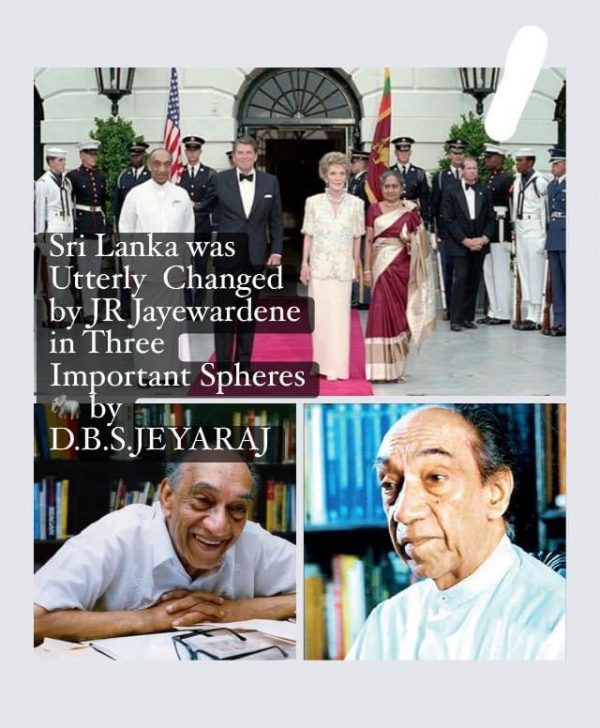
Sri Lanka was Utterly Changed by JR Jayewardene in Three Important Spheres.


D.B.S.Jeyaraj

“All changed, changed utterly” is a powerful line from “Easter, 1916”, the famous poem of William Butler Yeats. The poem by W.B .Yeats was about the Irish easter uprising in 1916 , its cruel suppression and how all changed utterly in Ireland.”A terrible beauty is born”says Yeats.

In Sri Lanka “all changed” and “changed utterly” with the ascension of Junius Richard Jayewardene to the premier seat of power in 1977. J.R.Jayewardene known popularly as “JR” ushered in political, economic and electoral changes that utterly changed Sri Lanka. Those of us who are old enough to have experienced this change, are witnesses to the transformation brought about by JR Jayewardene. As to whether this utter change has made Sri Lanka better or worse remains debatable still.
Continue reading ‘Sri Lanka was Utterly Changed by JR Jayewardene in Three Important Spheres.’ »

President Ranil Wickremesinghe and USAID Chief Samantha Power Have One on One Meeting Prior to Official Meeting but US envoy Juiie Chung Exerts Pressure and gets “permission” to sit in one what was Supposedly a one on one Conversation.


(Excerpted from the Political Column spearing in the “Sunday Morning”of September 18th 2022)

USAID Chief Power during her brief visit to Sri Lanka met with President Wickremesinghe, Opposition legislators, farmers, civil and business communities and the PTA was also a focal point in her discussions.

Wickremesinghe and Power had a one-on-one meeting as well. When Power and her delegation arrived at the President’s Office, the President’s staff had requested Power if she was first willing to meet Wickremesinghe for a one-on-one meeting prior to the official meeting. Power had expressed her willingness

. However, US Ambassador to Sri Lanka Julie Chung had not been too pleased and asked if the official meeting was to take place. Upon being informed that the official meeting would be after the meeting between the President and Power, the USAID Chief had met the President.

Continue reading ‘President Ranil Wickremesinghe and USAID Chief Samantha Power Have One on One Meeting Prior to Official Meeting but US envoy Juiie Chung Exerts Pressure and gets “permission” to sit in one what was Supposedly a one on one Conversation.’ »

President Wickremesinghe Issues Directive to set up an accelerated national multi-sector combined programme to ensure that no citizens should starve due to lack of food and children should not be victims of malnutrition;president’s Office sends out Circular to ministries, provincial council chief secretaries, district and divisional secretaries for Implementation

The President’s Office has directed state institutions to ensure that no citizens should starve due to lack of food and children should not be victims of malnutrition.

A circular has been sent out to ministries, provincial council chief secretaries, district and divisional secretaries to implement a series of decisions and an accelerated national multi-sector combined programme to ensure food security and protect children from malnutrition.

Continue reading ‘President Wickremesinghe Issues Directive to set up an accelerated national multi-sector combined programme to ensure that no citizens should starve due to lack of food and children should not be victims of malnutrition;president’s Office sends out Circular to ministries, provincial council chief secretaries, district and divisional secretaries for Implementation’ »

State agents are acting with impunity against public figures with no fear of popular reprisal. That signifies a change in the methods of the Deep State. Evidently, all pretences have been dropped. What we are up against now is a fully fledged police state and these words are not used lightly either.


By

Kishali Pinto-Jayawardene

Hawks may cry till the cows come home (to horribly malign that popular idiom) but as another ‘Geneva session’ takes place with the customary trumpeting, a few home truths must be recognised, as unpalatable as those may be.

Geneva promises defeated by action at home

Sri Lanka’s Foreign Affairs Minister who also doubled up as the personal lawyer of former President Gotabhaya Rajapaksa not so long ago, has bleated his ‘reassurances’ of preserving democracy before the 31st session of the United Nations Human Rights Council a few days earlier. But he must surely understand how hollow his words sound, even to himself. There is no point in mouthing the promise that, ‘notwithstanding severe constraints and challenges, Sri Lanka remains firmly committed to pursuing tangible progress in the protection of human rights and reconciliation through independent domestic institutions.’

What do those words even mean, pray? Are politicians so immune to common sense if not a basic sense of reality that they fail to comprehend the absurdities of their own lies? This is a rhetorical question, let me be clear. It is very obvious that they are, in fact, so immune. But even as a nod to our own sanity, we must ask the question as to how and in what manner can Sri Lanka promise to secure ‘human rights’ and ’reconciliation’ when the State has directed its formidable guns under the Prevention of Terrorism Act (PTA) on citizens exercising the right to peaceful protest in the heart of Colombo?

Continue reading ‘State agents are acting with impunity against public figures with no fear of popular reprisal. That signifies a change in the methods of the Deep State. Evidently, all pretences have been dropped. What we are up against now is a fully fledged police state and these words are not used lightly either.’ »

Sri Lanka having a president of the calibre of Ranil instead of Gotabaya can be considered an accidental outcome of the Aragalaya, which is beneficial for the country

By

Victor Ivan

After Ranil Wickremesinghe became the President, the dominance the Aragalaya had gained over the Government was suppressed by the police and the security forces without causing loss of lives or major injuries to the protestors. If it was not done, the authority of the Government would have collapsed completely, and the country would have plunged into a terrible state of anarchy; and the balance of payments crisis also would have plummeted into an uncontrollable point.

By that time, the official opposition of the country too, had become an active participant of the Aragalaya. So much so, breaking the dominance of the Aragalaya came under strong opposition not only of the protestors themselves, but also of the movement of the official opposition as well. By the time the new president ended the dominance gained by the Aragalaya, the belief of the protestors as well as the official opposition was that by taking the struggle one step further would enable them to topple the Government and capture the ruling power of the country.

Although there is no room for such a change of power within the existing political system, not only the young protesters but also the educated elderly professionals and even the experienced leaders of trade unions who supported the Aragalaya, quite uncritically, were unable to realise the simple fact that under the present constitution of Sri Lanka it would not be possible to change the Government during the period within two elections.

Continue reading ‘Sri Lanka having a president of the calibre of Ranil instead of Gotabaya can be considered an accidental outcome of the Aragalaya, which is beneficial for the country’ »

Inebriated State Minister from Political Family pulls out Personal Pistol and Shoots in air Bringing Part of the Ceiling down Injring one at Party hosted for new State Ministers by President Ranil Wickremesinghe’s Brother Channa Wickremesinghe

(Excerpted from the “Ceylon Politics”Column in “Ceylon Today” by Gagani Weerakoon)

Channa Wickremesinghe, younger brother of President Ranil Wickremesinghe, hosted a party for State Ministers who recently assumed duties. A majority of the invitees were in attendance.
As the night grew many State Ministers who attended the wine and dine session appeared overly inebriated. A State Minister who hailed from a political family was quite ‘high’ and was seen being very vocal and animated.

Continue reading ‘Inebriated State Minister from Political Family pulls out Personal Pistol and Shoots in air Bringing Part of the Ceiling down Injring one at Party hosted for new State Ministers by President Ranil Wickremesinghe’s Brother Channa Wickremesinghe’ »

Former Sri Lankan President Maithripala Sirisena named as a suspect by Colombo Magistrate Courts in a case pertaining to the 2019 Easter terror bombings; Mr. Sirisena asked to appear in Colombo court in October


By

Meera Srinivasan

A Sri Lankan court on Friday named former President Maithripala Sirisena a suspect in a case pertaining to the 2019 Easter terror bombings and directed him to appear in court this October.

The Magistrate Court in Colombo’s Fort area gave the orders in response to a private plaint filed by Fr. Cyril Gamini Fernando, a member of the National Catholic Committee for Justice to Easter Sunday Attack Victims, local media reported.
For more than three years now, Sri Lanka’s Catholic Church, and families of the victims of the gruesome serial blasts — that killed about 280 people and left hundreds injured — have been demanding justice.

Continue reading ‘Former Sri Lankan President Maithripala Sirisena named as a suspect by Colombo Magistrate Courts in a case pertaining to the 2019 Easter terror bombings; Mr. Sirisena asked to appear in Colombo court in October’ »

Tamils Detained Under Prevention of Terrorism Act to be Released soon, President Ranil Wickremesinghe tells Samantha Power, Administrator, US Agency for International Development (USAID);“We have agreed on a formula that will set off the period in detention against the judgement, and since they have all had more than ten years, no judgement will be more than ten years”says Ranil

By

Gagani Weerakoon

President Ranil Wickremesinghe said if Parliament fails to reach an agreement on electoral reforms, he will hold a referendum and ask the country which system they prefer.

He said he will convene Parliament to state unequivocally that they must agree on electoral reform, despite the fact that the parties are arguing among themselves.

He made these remarks during a meeting with Samantha Power, Administrator of the United States Agency for International Development (USAID), who was in Sri Lanka on a two-day official visit.

The President also said they would bring anti-terrorist legislation.

Continue reading ‘Tamils Detained Under Prevention of Terrorism Act to be Released soon, President Ranil Wickremesinghe tells Samantha Power, Administrator, US Agency for International Development (USAID);“We have agreed on a formula that will set off the period in detention against the judgement, and since they have all had more than ten years, no judgement will be more than ten years”says Ranil’ »

‘We will revive and upgrade the Free Trade Agreement with India into a comprehensive economic and technological partnership’ states Sri Lankan President Ranil Wickremesinghe


By

Meera Srinivasan

Sri Lanka will revive its Free Trade Agreement with India and upgrade it to a “a comprehensive economic and technological partnership”, President Ranil Wickremesinghe has said, signalling Colombo’s willingness to revisit a stalled pact.

Addressing the Sri Lanka India Society on Thursday, Mr. Wickremesinghe said his government would take steps for better trade integration with India.

“We will revive and upgrade the Free Trade Agreement into a comprehensive economic and technological partnership. We started that in 2018 and 2019,” he said referring to the Comprehensive Economic Partnership Agreement (CEPA) that was later known as the Economic and Technical Cooperation Agreement (ETCA). Both versions of the proposed agreement sparked stiff resistance within Sri Lanka, as critics feared it would impact Sri Lankans’ job prospects with more competition from Indians.

Continue reading ‘‘We will revive and upgrade the Free Trade Agreement with India into a comprehensive economic and technological partnership’ states Sri Lankan President Ranil Wickremesinghe’ »

Geopolitics of the Indian Ocean has turned Sri Lanka into the regional ‘punching bag said President Ranil Wickremesinghe while addressing the irst ever graduation ceremony of the National Defence College in Colombo

By

Gagani Weerakoon

Addressing the first ever graduation ceremony of the National Defence College in Colombo, President Wickremesinghe said the geopolitics of the Indian Ocean has turnedSri Lanka into the regional ‘punching bag’.

He pointed out that there are around 17 ports operated by the Chinese in the Indian Ocean and they are all commercial ports, adding that, Hambantota is also a commercial port and not a military port.

Speaking further he said the Indian Ocean region should be open to all to ensure freedom of navigation for commercial viability. He noted that Sri Lanka will not participate in military alliances and does not want the problems of the Pacific coming into the Indian Ocean. In this scenario, he urged regional nations to come together to look at how best to maintain stability.

Continue reading ‘Geopolitics of the Indian Ocean has turned Sri Lanka into the regional ‘punching bag said President Ranil Wickremesinghe while addressing the irst ever graduation ceremony of the National Defence College in Colombo’ »

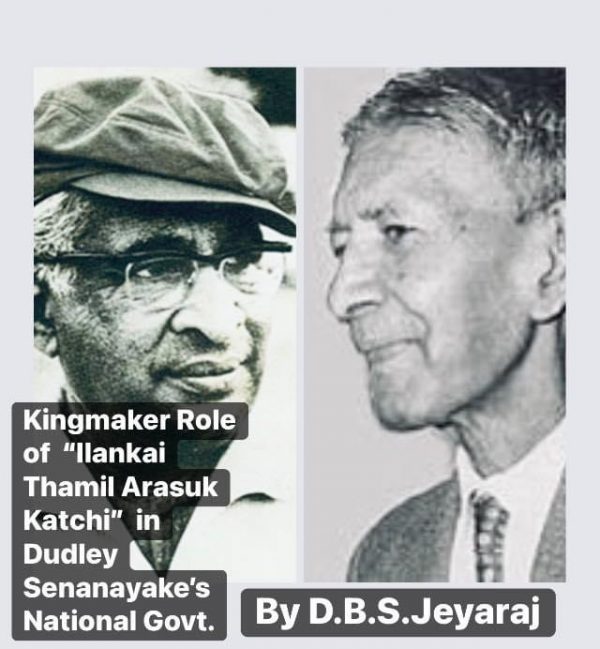
Kingmaker Role of “lankai Thamil Arasuk Katchi” in Dudley Senanayake’s National Govt.

By
D.B.S. Jeyaraj

Part One – The Tamil Factor in Sri Lanka’s First UNP- led “National” Govt of Premier Dudley Senanayake

When the March 22nd 1965 election results were announced no single party had obtained a simple majority on its own. It was a hung parliament. As stated in the first part of this article last week,The UNP had obtained 66 seats. The SLFP came next with 41 seats. The Ilankai Thamil Arasuk Katchi(TAK) was third with 14 seats.The prevailing Parliamentary arithmetic after the elections indicated that the ITAK with its 14 seats held the balance of power . . What happened thereafter will be related in detail in this article’s second and final part.

When the Ilankai Thamil Arasuk Katchi (ITAK) known in English as the Federal Party became the determining factor in government formation after the 1965 general election, the party was faced with a historic opportunity. It could be a “Kingmaker” by supporting the United National Party(UNP)led by Dudley Senanayake or be a “Queenmaker”by throwing in its lot with the Sri Lanka Freedom Party(SLFP) led by Sirimavo Bandaranaike. In such a situation the ITAK/FP leader Samuel James Veluppillai Chelvanayagam was ardently wooed by both sides. His arrival from Jaffna to Colombo was anxiously awaited by both sections.

Continue reading ‘Kingmaker Role of “lankai Thamil Arasuk Katchi” in Dudley Senanayake’s National Govt.’ »

“Emperor of Tamil Pop Music” AE Manoharan’s Futile Attempt to be a Film Star in Tamil Nadu.

By
D.B.S. Jeyaraj

Blessed are those Sri Lankans who have lived in different parts of the country, travelled widely within its borders and interacted with all people cutting across ethnic and religious barriers during times of peace and tranquillity in the past. Those who have had such broad experiences unsullied by narrow sectarianism know that the Island is truly “God’s own country” populated by a friendly, good-natured people.

Anthonyppillai Emmanuel Manoharan known to the world at large as A. E. Manoharan was one such person. Manoharan was a multi-faceted personality possessing many talents. He was a singer, musician, broadcaster and stage and screen actor but it was his singing that brought him great success and honour.

What was most commendable and praiseworthy in many of his songs was his discernible love and affection for Sri Lanka and her people. This was vividly reflected in his songs. He sang of Lanka and its beauty, of its landscapes, mountains, rivers, people, arts, heritage, places of worship and above all the unity amidst diversity of her people.

Continue reading ‘“Emperor of Tamil Pop Music” AE Manoharan’s Futile Attempt to be a Film Star in Tamil Nadu.’ »

Frontline Socialist Party Education Secretary Pubudu Jayagoda tells Press Conference that “people had no option but to take to the streets to chase out the incumbent govt”; Jagoda says “Ranil Wickremesinghe says that he has no home to go. He should not go home, he should be sent to a prison for the crimes he had committed”

By Saman Indrajith

The Frontline Socialist Party, on Tuesday, said that people had no option but to take to the streets to chase out the incumbent government.

“The government has not learnt that people engage in protests because they no longer can put up with hardships. We have no other option but to beat off this government. Ranil Wickremesinghe says that he has no home to go. He should not go home, he should be sent to a prison for the crimes he had committed,” FSP Education Secretary, Pubudu Jayagoda, told a press conference held in Colombo.

Continue reading ‘Frontline Socialist Party Education Secretary Pubudu Jayagoda tells Press Conference that “people had no option but to take to the streets to chase out the incumbent govt”; Jagoda says “Ranil Wickremesinghe says that he has no home to go. He should not go home, he should be sent to a prison for the crimes he had committed”’ »

Newly drafted resolution on Sri Lanka, co-sponsored by the Core Group of countries on Sri Lanka, Comprising the UK, Canada, Germany, Malawi, Montenegro, North Macedonia, and the US presented at the ongoing 51st United Nations Human Rights Council (UNHRC) session in Geneva

BY Mirudhula Thambiah

A fresh draft resolution on Sri Lanka, which was co-sponsored by the Core Group of countries on Sri Lanka at the ongoing 51st United Nations Human Rights Council (UNHRC) session, noted the need for power devolution, the conduct of polls, addressing the plight of missing persons, replacing the Prevention of Terrorism (Temporary Provisions) Act, and accountability for protest-related violence, whilst recognising the efforts of the Government of Sri Lanka (GoSL) to address the economic crisis, including the staff-level agreement with the International Monetary Fund (IMF).

This newly drafted resolution on Sri Lanka, co-sponsored by the Core Group of countries on Sri Lanka, namely, the UK, Canada, Germany, Malawi, Montenegro, North Macedonia, and the US, was made public yesterday (14).

Continue reading ‘Newly drafted resolution on Sri Lanka, co-sponsored by the Core Group of countries on Sri Lanka, Comprising the UK, Canada, Germany, Malawi, Montenegro, North Macedonia, and the US presented at the ongoing 51st United Nations Human Rights Council (UNHRC) session in Geneva’ »

How a 22 Year old Sri Lankan Journalist Became Famous in his Family Circle as “The boy who shook hands with the Queen of England, and the Duke of Edinburgh”.

By

Shavindra Fernando

It was on October 22 in 1981 in Colombo.

I was 22, the youngest of the Sri Lanka Press Corps of around a dozen reporters, who were afforded an audience with the Queen of England and the Duke of Edinburgh in Colombo. I was a reporter for the Ceylon Daily Mirror of the Times of Ceyon.

The Duke of Edinburgh’s tie pin at the Trenchard House reception was a green elephant. Much to the horror of the few British diplomats present, one of our reporters (from the UNP party journal, Siyarata) touched Prince Philip’s tie and said “Sir you are wearing our party colours and our green elephant”.

The Prince and the Queen were amused, laughed, and the Prince explained that it was a symbol of elephant conservation, a global organization which he headed. We had about an hour with the Royals, drinks flowed freely, we reporters were all high and spoke freely, and the accompanying British press and regular Royal staff entourage who were not a part of this tiny gathering said later, that they were taken aback, as to how freely the Royals had entertained us. Some of the British reporters had never had such a reception.

In retrospect, I believe the Royals felt that despite our relative Sri Lankan “press” disregard for propriety and decorum, we reporters warmly and genuinely reflected the public feeling of goodwill that still existed towards the British Royals in Sri Lanka. But none of us were as forward as the UNP Siyarata reporter, and we knew he was a political intruder who had been included by our government, when he had no business to be there as a reporter of a party newspaper.

Continue reading ‘How a 22 Year old Sri Lankan Journalist Became Famous in his Family Circle as “The boy who shook hands with the Queen of England, and the Duke of Edinburgh”.’ »

Sri Lanka’s Asia Cup Winning Cricket and Netball Teams Embody the Resolve of a Nation that has seen Adversity, Suffered untold Horrors and yet Overcame all Challenges, Smiling Through it all.This Self-belief is in Sri Lankan DNA


By

Krishantha Prasad Cooray

World champions they are not. In times gone by, Sri Lankan teams secured silverware on the world’s premier cricketing podiums. But not since 2014 when they won the Asia Cup. Since then, not even close. The glory days of the 1990s and the first decade of the new millennium were stuff for those so bereft of reasons to cheer that they had to make do with grainy archival footage in the almost sepia colours of years past. Sometimes even of matches played before they were even born.

Prof Arjuna Desilva with Sri Lankan cricket captain

One swallow does not a summer make, and a scintillating performance in the Asia Cup T20 final on Sunday does not make Sri Lanka world champs. Nevertheless, considering that they bested two teams highly regarded as contenders for the world title in Australia, i.e., India and Pakistan, the tag ‘world beaters’ is not altogether inappropriate.

Cricket is a game of glorious uncertainty and sometimes what marks the superior outfit is the resolve, tenacity, recalibration and execution to take the team across the line after being tripped or having stumbled. All things considered, one might even say that Sri Lanka from the get go to literally the final delivery of the tournament had set out to prove just that. And that they did.

This team, led by Dasun Shanaka, hardly warranted mention in previews of the tournament a few weeks ago. Although in Wanindu Hasaranga they had a world class bowler who could also wield the willow to good effect when needed, even he was forgotten in the rush to compare and contrast the two favourites, India and Pakistan. A first night drubbing at the hands of Afghanistan only went to justify such dismissal. Sri Lanka was there to make up the numbers. That’s it.

Continue reading ‘Sri Lanka’s Asia Cup Winning Cricket and Netball Teams Embody the Resolve of a Nation that has seen Adversity, Suffered untold Horrors and yet Overcame all Challenges, Smiling Through it all.This Self-belief is in Sri Lankan DNA’ »

WELL WON::Even in the desert sands, Dasun Shanaka’s men felt at home and during Sunday’s final at the Dubai International Cricket Stadium, Sri Lanka defied the odds to defeat Pakistan by 23 runs. -THE HINDU


Originally pencilled in as the host, it was fitting that Sri Lanka won the Asia Cup even if the championship was held in the United Arab Emirates (UAE).

The debilitating economic crisis in the island-nation meant that Sri Lanka had to shift the continental tournament’s base to the UAE but even in the desert sands, Dasun Shanaka’s men felt at home.

And during Sunday’s final at the Dubai International Cricket Stadium, Sri Lanka defied the odds to defeat Pakistan by 23 runs.

Continue reading ‘WELL WON::Even in the desert sands, Dasun Shanaka’s men felt at home and during Sunday’s final at the Dubai International Cricket Stadium, Sri Lanka defied the odds to defeat Pakistan by 23 runs. -THE HINDU’ »

Outgoing UN Human Rights High Commissioner Michele Bachelet’s Up to date Report on Sri Lanka presented to the Human Rights Council on Sri Lanka concludes that the current administration “appear[s] to reflect a continuity with the past.”


By
Sanja De Silva Jayatilleka

The Sunday papers in Colombo gave a heads-up on the new resolution (currently at the stage of the ‘Zero Draft’) on Sri Lanka reportedly being negotiated at the United Nations Human Rights Council in Geneva, revealing that “the Zero Draft resolution seeks to recommend action against political leaders and state officials responsible for economic crimes that have adversely impacted on human rights in Sri Lanka.”

The news reports indicate that “…The names of ex-President Gotabaya Rajapaksa and his brother, former Finance Minister, Basil Rajapaksa, have figured in these consultations…reference is to be made to then President Mahinda Rajapaksa…”

Evidently, two of the Rajapaksa brothers, former President Gotabaya and former Finance Minister Basil have come up in discussions in relation to economic crimes, while the third, former President Mahinda, President during the last stages of Sri Lanka’s war against the Tigers, is to be mentioned “for not fulfilling ‘assurances’ given to Ban Ki-moon, then UN Secretary General, during his visit to Sri Lanka on May 26, 2009”. This covers between them, transgressions of pretty much most of the social, economic, civil and political rights guaranteed under the Universal Declaration.

President Ranil Wickremesinghe needn’t feel left out because he will find that his own recent ‘see-if-I-care’ violations of the rights of protesters, more in-your-face than any since the war, hardly went unnoticed by the OHCHR fact-finding mission recently in Colombo, which included them in the Human Rights High Commissioner’s Report.

Together, these personalities comprise the larger part of the top rank of the ruling elite in Sri Lanka over the last decades. No one should be surprised that Sri Lanka is in unprecedentedly deep crisis.

Continue reading ‘Outgoing UN Human Rights High Commissioner Michele Bachelet’s Up to date Report on Sri Lanka presented to the Human Rights Council on Sri Lanka concludes that the current administration “appear[s] to reflect a continuity with the past.”’ »

India Voices concern at the UN Human Rights Council in Geneva over the “lack of measurable progress” in Sri Lanka’s Committed political solution to the ethnic issue “through full implementation of 13th Amendment of the Constitution, delegation of powers to Provincial Councils and holding of Provincial Council elections at the earliest”


By

Meera Srinivasan

India on Monday voiced concern over the “lack of measurable progress” in Sri Lanka’s promised political solution to the long-pending Tamil national question, while making an unusual reference to the crisis-hit island nation’s “debt-driven” economy in the context of its current crisis.

In its statement at the 51 st session of the United Nations Human Rights Council in Geneva, India said it has “always believed in the responsibility of States for promotion and protection of human rights and constructive international dialogue and cooperation” guided by the U.N. Charter.

“In this regard, the Indian delegation notes with concern the lack of measurable progress by Government of Sri Lanka on their commitments of a political solution to the ethnic issue — through full implementation of the 13th Amendment of the Constitution, delegation of powers to Provincial Councils and holding of Provincial Council elections at the earliest,” India said.

Continue reading ‘India Voices concern at the UN Human Rights Council in Geneva over the “lack of measurable progress” in Sri Lanka’s Committed political solution to the ethnic issue “through full implementation of 13th Amendment of the Constitution, delegation of powers to Provincial Councils and holding of Provincial Council elections at the earliest”’ »

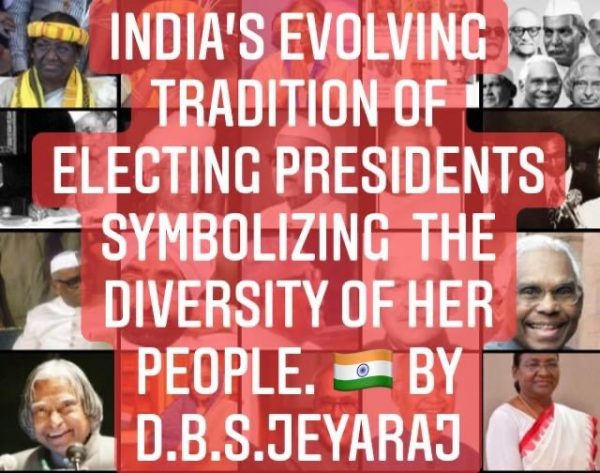
India’s Evolving Tradition of Electing Presidents Symbolizing the Diversity of Her People

By
D.B.S. Jeyaraj

Sri Lanka’s nearest neighbour and closest friend, India celebrated her 75th anniversary of gaining freedom from British rule on the 15th of this month.. “Incredible” India also made history last month by electing a woman from a tribal community as the Republic’s 15th President . 64 year old Droupadi Murmu was sworn into office after being elected India’s President last July. She is India’s first president hailing from the “AadivaasI” community or people from scheduled tribes. Droupadi Murmu is the second woman and youngest person to be elected president of India.t


President Smt Droupadi Murmu taking the National Salute from Tri Services Guard of Honour at the forecourt of Rashtrapati Bhavan.

Presidents of India

Droupadi Murmu was born as Puti Biranchi Tudu on 20 June 1958 in the Uparbeda village of India’s eastern state Orissa now known as Odisha. She hails from the Santhal ethnic group of India’s scheduled tribes. The Aadivaasis or tribal people comprise 8.6% of India’s population. Droupadi Murmu worked as a clerk and teacher before taking to politics as a member of India’s Bharatiya Janata Party(BJP). She has served as a local authority councllor. Member of the legislative assembly and state minister. Droupadi Murmu was also appointed as Governor of Jharkand State by the Narendra Modi Government from 2015 to 2021. She has suffered immense personal tragedies in having lost her husband,two sons,mother and brother within a span of 7 years from 2009 to 2015.The only living family member is her daughter.

Continue reading ‘India’s Evolving Tradition of Electing Presidents Symbolizing the Diversity of Her People’ »

Sri Lanka Muslim Expatriates’ Council will Take up issue of Prevention of Terrorism Act(PTA) related Human Rights Violations Affecting Muslims in Sri Lanka During UN Human Rights Council Sessions in Geneva


By Mirudhula Thambiah

Sri Lankan Muslim expatriates yesterday (11) voiced disappointment over the current implementation of the Prevention of Terrorism Act (PTA) against muslims in Sri Lanka, and stressed that they would take up the human rights violations in relation to this rigid law at the 51st United Nations Human Rights Council (UNHRC) sessions scheduled to commence today (12) in Geneva, Switzerland.

Sri Lanka Muslim Expatriates’ Council International Affairs Co-ordinator Aiyoob Azmin told The Morning that human rights violations relating to the PTA should be raised during the UNHRC sessions, and that their organisation would mainly focus on the implementation of this draconian law against the muslims in Sri Lanka.

“Sri Lanka’s economic crisis is yet unsolved and continues to create immense human suffering, but the PTA continues to be in force. State-level abuse of this law, illegal arrests, detentions, and repression continues,” he added.

Continue reading ‘Sri Lanka Muslim Expatriates’ Council will Take up issue of Prevention of Terrorism Act(PTA) related Human Rights Violations Affecting Muslims in Sri Lanka During UN Human Rights Council Sessions in Geneva’ »

“The United States stands ready to participate in the restructuring of Sri Lanka’s debt. It is imperative that all of Sri Lanka’s creditors, most notably the People’s Republic of China cooperate in this process openly and on comparable terms with each other.” Says Samantha Power, Administrator of the United States Agency for International Development (USAID


By

Meera Srinivasan

China must cooperate with Sri Lanka in its debt restructure process, Samantha Power, Administrator of the United States Agency for International Development (USAID) said on Sunday, while assuring Colombo of the U.S.’s support.

Sri Lanka, which opted for a preemptive sovereign default in April amid a rapid downturn, must negotiate with its diverse creditors — International Sovereign Bond holders, multilateral agencies, bilateral creditors such as China, Japan, and India — and restructure its outstanding debt to them, in order to qualify for a $2.9 billion-package from the International Monetary Fund (IMF).

Addressing a media conference at the end of her two-day visit, Ms. Power said: “The United States as a creditor, and as a member of the Paris Club, stands ready to participate in the restructuring of Sri Lanka’s debt. It is imperative that all of Sri Lanka’s creditors, most notably the People’s Republic of China cooperate in this process openly and on comparable terms with each other.”

Continue reading ‘“The United States stands ready to participate in the restructuring of Sri Lanka’s debt. It is imperative that all of Sri Lanka’s creditors, most notably the People’s Republic of China cooperate in this process openly and on comparable terms with each other.” Says Samantha Power, Administrator of the United States Agency for International Development (USAID’ »

NPP Parliamentarian Dr. Harini Amarasuriya and former MP Hirunika Premachandra accuse prison authorities of mistreating actress cum “Aragalaya” activist Damitha Abeyratne after visiting her at Welikada Jail

By Buddhika Samaraweera

National People’s Power (NPP) MP Dr. Harini Amarasuriya and former MP Hirunika Premachandra accused the prison authorities of mistreating actress Damitha Abeyratne, who was arrested and then placed in remand custody for allegedly forcibly entering the Presidential Secretariat in Colombo during the massive public protests in July.

Dr. Amarasuriya, after visiting the Welikada Prison last Saturday (10) to inquire about the well-being of Abeyratne, told the media that she had to wait outside for more than 45 minutes to enter the prison. Noting that she, as an MP, is entitled to visit prisoners, she said that it is however questionable as to why the prison authorities did not allow her to enter for a long period of time.

“I came to see Abeyratne, but the prison officials did not allow me to go in for a long time. They said that they can’t allow me to go in without permission from the Chief Jailor.

Continue reading ‘NPP Parliamentarian Dr. Harini Amarasuriya and former MP Hirunika Premachandra accuse prison authorities of mistreating actress cum “Aragalaya” activist Damitha Abeyratne after visiting her at Welikada Jail’ »

Several key “Aragalaya” activists Arrive in Geneva to voice out against what they claim is Govt repression and raise awareness about the arrest of Inter-University Students Federation (IUSF) Convenor Wasantha Mudalige. During UN Human Rights Council Sessions


By Dinitha Rathnayake

Several key activists of the “aragalaya” are in Geneva, Switzerland to participate in the 51st session of the United Nations Human Rights Council (UNHRC).

The UNHRC will hold its 51st regular session starting today (12) until 7 October at the Palais des Nations in Geneva.

Social activist Shehan Malaka, Attorney-at-Law Nuwan Bopage, and author Sunanda Deshapriya are among the “aragalaya” members who have reached Geneva, Switzerland to voice out against what they claim is Government repression and raise awareness about the arrest of Inter-University Students Federation (IUSF) Convenor Wasantha Mudalige.
Speaking to The Morning, Bopage said they will deliver their speeches to the UNHRC today.

Continue reading ‘Several key “Aragalaya” activists Arrive in Geneva to voice out against what they claim is Govt repression and raise awareness about the arrest of Inter-University Students Federation (IUSF) Convenor Wasantha Mudalige. During UN Human Rights Council Sessions’ »

Sri Lanka’s political leadership must learn that, by forsaking the lessons that the first wave of protests have taught us, they risk second and third waves of far deadlier agitations.No one can say that they were not forewarned.

By

Kishali Pinto – Jayawardene

It is entirely fitting that, President Ranil Wickremesinghe, while swearing in an obscene number of State Ministers including those who assaulted peaceful protestors at the Galle Face Green on May 9th 2022, had the profound gall to issue a directive this Friday instructing the ‘frugal’ manner in which state funds must be spent.

Insanity of the ship of State

What is ‘frugal’ about appointing all these state ministers when the economy has been destroyed by these very individuals forming part of the administration that brought Sri Lanka to its knees?

It would have been ‘frugal’ not to have appointed them in the first instance, quite apart from the fact that some of these worthies should be prosecuted for their thuggery. Veritably this is the insanity that comprises the ship of State in Sri Lanka.

Are these state-ministerships, rewards for their brutish actions perforce? This is to insult the good intelligence of the citizenry, whether the President acts on his will or at the crack of a whip elsewhere.

The directive, issued by his Secretary, calls upon secretaries of ministries ‘to make special arrangements for the management of public expenditure’ in view of severe economic difficulties.

This is farce at its highest and cruelest extent.

Continue reading ‘Sri Lanka’s political leadership must learn that, by forsaking the lessons that the first wave of protests have taught us, they risk second and third waves of far deadlier agitations.No one can say that they were not forewarned.’ »

The SLPP-led coalition is shattered and now the SLPP itself has suffered a schism. The ruling party, no longer a ruling coalition, is barely clinging to a simple majority in Parliament. In a clearly positive development, a significant centre-left space has reopened in Sri Lankan politics.

By Dr. Dayan Jayatilleka

When President Gotabaya Rajapaksa, whose political support base the Sri Lanka Podujana Peramuna (SLPP) and its allies secured a two-thirds majority in Parliament and leveraged it to pass the hyper-centralising 20th Amendment to the Constitution, Sri Lanka had its most unipolar political moment since 1977-’78, which resulted in two civil wars and an external intervention.

Though the 20th Amendment still remains on the books and is wielded by an unelected President, leaving the fundamental task of toppling a new tyranny yet to be undertaken, the unipolar moment in Sri Lankan politics is over. That horror will almost certainly never return in my lifetime.

The SLPP-led coalition is shattered and now the SLPP itself has suffered a schism. The ruling party, no longer a ruling coalition, is barely clinging to a simple majority in Parliament.

In a clearly positive development, the exits made by various tendencies of the 2020 ruling coalition has led to a significant centre-left space reopening in Sri Lankan politics. That space is not obvious because of its splintering but it has nevertheless been re-born.

Continue reading ‘The SLPP-led coalition is shattered and now the SLPP itself has suffered a schism. The ruling party, no longer a ruling coalition, is barely clinging to a simple majority in Parliament. In a clearly positive development, a significant centre-left space has reopened in Sri Lankan politics.’ »

Sparks fly in Parliament as Opposition Raised the Issue of \ The arrest of award-winning actress Damitha Abeyratne who had been at the forefront of the ‘aragalaya’ (struggle),


By Sandun Jayawardana

The arrest of a prominent ‘aragalaya’ activist and a contentious debate on malnutrition among the country’s mothers and children saw sparks fly between the government and opposition benches in Parliament this week.

The arrest of award-winning actress Damitha Abeyratne, who had been at the forefront of the ‘aragalaya’ (struggle), saw opposition MPs raise vociferous protests on Thursday (8). Opposition Leader Sajith Premadasa, who had been to see Ms Abeyratne at the Fort police station after her arrest the previous evening, raised the matter just as Parliament sessions commenced.

He told the House that the actress had not been involved in any violence. She had not taken part in any illegal activity or caused damage to state or private property. “She was simply exercising her rights and I urge the government to release her,” Mr Premadasa said.

Continue reading ‘Sparks fly in Parliament as Opposition Raised the Issue of \ The arrest of award-winning actress Damitha Abeyratne who had been at the forefront of the ‘aragalaya’ (struggle),’ »

The International Monetary Fund (IMF) may be the new divinity, saint, aacharya, sacred preacher or teacher in this fight against corruption in Sri Lanka.


By

Lucien Rajakarunanayake

The International Monetary Fund (IMF) has brought us to a crisis that seems worse than what the politicians did by bringing us to bankruptcy. It is the process of recovery – with that shaky pledge of US $ 2.9 billion in four years, to overcome the unprecedented economic turmoil.Among the IMF aims to stabilize the economy,
protect the livelihoods of the Sri Lankan people, and prepare the ground for economic recovery and promoting sustainable and Inclusive growth, is the fight against corruption.

Economists and specialists in Good Governance would have much to think and say about the IMF, its goals, plans, history and all that. We have some politicians who are hugely against the IMF and others who are in favour of it, or wholly supportive of it. But this call against corruption is a message that the Sri Lankan people have been waiting for from our political leaders, from whatever party or colour, from Ministers, Deputy Ministers, MPs, Heads of State Institutions and all others for more than two decades. All who have remained disgustingly silent other than the occasional political hurrah shouts.

The IMF may be the new divinity, saint, aacharya, sacred preacher or teacher in this fight against corruption in Sri Lanka. It certainly brings new courage to the people to launch a serious and meaningful fight against the system of governance – apart from political crookedness – that has been, and remains the biggest weight, pulling our country and people to the very bottom of the social structure.

Continue reading ‘The International Monetary Fund (IMF) may be the new divinity, saint, aacharya, sacred preacher or teacher in this fight against corruption in Sri Lanka.’ »

Island-wide signature campaign calling for the repeal of the draconian Prevention of Terrorism Act (PTA) to Commence from Kankesanthurai in the North to Hambantota in the South


(Text of Press Release Issued on Behalf of the Ilankai Thamilarasu Katchi (ITAK)Youth Front, Justice for All and the Alliance of Trade Union & Mass organisations)

An island-wide signature campaign has been launched calling for the repeal of the draconian Prevention of Terrorism Act (PTA) brought in 1979 as a temporary provisions Act for six months but continues to be in operation for over 40years.

During this period, we have witnessed its use to crush dissent against the government of the day. As it has been done consistently in the past, it continues even today. Especially, this particular act is being used to oppress the peaceful protestors of the Galle face “Aragalaya”

This country-wide mobile Signature campaign from Kankesanthurai to Hambanthota will begin tomorrow (10/09/2022) from Mavittapuram, Kanthaswami Kovil, at 9.00 am. This is to urge the government to honour its promise to repeal the PTA.

We humbly invite everyone to join us tomorrow at this launch and sign the Petition calling for the repeal of the PTA,

K. Seyon – Ilankai Thamilarasu Katchi Youth Front

M. A. Sumanthiran – Justice for All

Joseph Stalin – Alliance of Trade Union & Mass organisations

How can the Government delegation to UNHRC now refuse UNHRC mechanism to gather evidence of human rights violations in Sri Lanka having in 2019 allowed foreign agencies to investigate 21/4 Easter Sunday attacks?

By M.M.Zuhair

At a time when the country is increasingly dependent on the assistance of foreign countries to tackle the deepening economic crisis and the steeply rising cost of living, the Government must objectively address the human rights concerns alleged against Sri Lanka in the UN Human Rights Council (UN HRC) commencing sittings in Geneva.

Addressing the media in Colombo last Monday, Foreign Minister M. Ali Sabry was quoted by Associated Press (AP), that the Government cannot agree to any “external mechanism, external evidence gathering mechanism, charging citizens outside the country, getting hybrid judges to come and hear the cases, all these are against the Constitution. So we can’t agree to that”.

Continue reading ‘How can the Government delegation to UNHRC now refuse UNHRC mechanism to gather evidence of human rights violations in Sri Lanka having in 2019 allowed foreign agencies to investigate 21/4 Easter Sunday attacks?’ »

President Wickremesinghe Imposes Strictures on all 37 newly Appointed State Ministers in a bid to Utilise Public Fubds Frugally amidst Economic Crisis; separate Expenditure Head will not be Allpcared to State Ministries

President Ranil Wickremesinghe has emphasised that all authorities should make every effort to utilise public funds spent by the Government in a frugal and efficient manner, taking into account the severe economic difficulties that the Government has to face in the current economic and social climatallocated e of the country.

President’s Secretary Saman Ekanayake has instructed all the secretaries of the ministries yesterday to make special arrangements for the management of public expenditure.
The President’s Secretary has issued these instructions to all Ministry Secretaries informing that the 37 State Ministers appointed by the President with effect from Thursday should act according to those terms while carrying out their duties.

Accordingly:

1. A separate expenditure head is not allocated for State Ministries. Secretaries will not be appointed for those Government ministries and the most senior additional secretary should be employed among the additional secretaries of those ministries to facilitate the work of the State Ministers under each scope

2. The Ministry to which the relevant State Ministers have been appointed should meet the staffing requirements from the currently approved staff. Requests for creation of new posts should not be submitted to the Department of Management Services

Continue reading ‘President Wickremesinghe Imposes Strictures on all 37 newly Appointed State Ministers in a bid to Utilise Public Fubds Frugally amidst Economic Crisis; separate Expenditure Head will not be Allpcared to State Ministries’ »

Appointment of Lohan Ratwatte,Sanath Nishantha and Sivanesathurai Chandrakanthan alias Pillaiyan as State Ministers Critized by Human Rights Watch; all three are allegedly implicated in Human rights Abuses charges HRW

By

Meenakshi Ganguly
South Asia Director h-Human Rights Watch

On Thursday, Sri Lankan President Ranil Wickremesinghe appointed 37 new ministers to his government.

In the latest alarming indication that his new administration is not committed to protecting human rights, ending impunity, or upholding the rule of law, three of the appointees are implicated in serious rights abuses.

Sivanesathurai Chandrakanthan, better known as Pillayan, is a former member of the armed separatist Liberation Tigers of Tamil Eelam (LTTE), who was personally implicated in abducting children and other abuses.

Continue reading ‘Appointment of Lohan Ratwatte,Sanath Nishantha and Sivanesathurai Chandrakanthan alias Pillaiyan as State Ministers Critized by Human Rights Watch; all three are allegedly implicated in Human rights Abuses charges HRW’ »

President Ranil Wickremesinghe directs Ministry of Public Administrations & Home Affairs to declare September 19 a day of mourning for the passing of Queen Elizabeth II. Ranil Tweets “queen was a symbol of stability and endurance and will be greatly missed.”


Sri Lanka President Ranil Wickremesinghe has directed the Ministry of Public Administrations & Home Affairs to declare September 19 a day of mourning in view of the passing of Queen Elizabeth II.

A statement from the president’s office said on Friday September 09 that the national flag will be hoisted at half-mast.

Continue reading ‘President Ranil Wickremesinghe directs Ministry of Public Administrations & Home Affairs to declare September 19 a day of mourning for the passing of Queen Elizabeth II. Ranil Tweets “queen was a symbol of stability and endurance and will be greatly missed.”’ »

India announces a day of National Mourning on Sunday, September 11, to mark the passing of the Queen of United Kingdom, Elizabeth II;As per the protocol, the National Flag would be flown at half-mast on Sunday and there will be no official entertainment that day.


By

Suhasini Haidar

India announced a day of National Mourning on Sunday, September 11, to mark the passing of the Queen of United Kingdom, Elizabeth II.

The government announced the day of mourning on Friday, adding that President Droupadi Murmu, Vice-President Jagdeep Dhankar, and Prime Minister Narendra Modi sent condolence messages to the U.K. royal family and government.

“In their messages, they noted that she was a stalwart of our times; a compassionate personality and provided inspiring leadership to her nation and people,” a government statement said.

Continue reading ‘India announces a day of National Mourning on Sunday, September 11, to mark the passing of the Queen of United Kingdom, Elizabeth II;As per the protocol, the National Flag would be flown at half-mast on Sunday and there will be no official entertainment that day.’ »

“The Queen’s life spanned the entire history of modern Britain. She was born when Britain ruled a global empire of some 600 million people. She died when Britain was a medium-sized northern European country with an uncertain future”- The Guardian


(Text of Editorial in “The Guardian” headlined “The Guardian view on the death of Queen Elizabeth II: the end of an era”)

News of Queen Elizabeth’s death was not wholly unexpected. She lived to the great age of 96. After enjoying markedly good health for so long, the oldest monarch in British history had recently appeared more fragile. She had understandably become a more private woman since the death of Prince Philip last year and had been less publicly visible, undertaking lighter duties. All of us knew that this moment was approaching.

It arrives nevertheless as a national shock, but also as a shared moment of reflection, and as the start of a new and unwritten chapter for the British monarchy and the country itself. The Queen’s death brings personal loss for those close to her, and she had also been a constant presence in millions of lives. The longest monarchical reign in British history, stretching more than 70 years, is over. But the record book is less important than the widely shared sense of what has now slipped away, never to return.

The Queen’s life spanned the entire history of modern Britain. She was born when Britain ruled a global empire of some 600 million people. She died when Britain was a medium-sized northern European country with an uncertain future. She came into the world before all British adults had the vote. At 10, she witnessed the abdication of her uncle that made her heir to the throne. At 14, she lived through the existential threat to the nation that followed the fall of France. As monarch, her first prime minister was Winston Churchill, who had participated in a cavalry charge at Omdurman in 1898, yet she had already been on the throne for 23 years before the current prime minister, her 15th, was even born.

Continue reading ‘“The Queen’s life spanned the entire history of modern Britain. She was born when Britain ruled a global empire of some 600 million people. She died when Britain was a medium-sized northern European country with an uncertain future”- The Guardian’ »

Leader of the Opposition Sajith Premadasa Urges Release of Actress cum Aragalaya Activist Damitha Abeyratne and Ignites Heated Argument in Parliament with Prasanna Ranatunga,Namal Rajapaksa and KPS Kumarasiri

BY Buddhika Samaraweera

A request by Opposition and Samagi Jana Balawegaya (SJB) Leader Sajith Premadasa from Leader of the House Minister Susil Premajayantha to take necessary steps to release actress and activist Damitha Abeyratne ignited a heated debate between the Opposition and Government in Parliament yesterday (8).

Abeyratne, who was arrested by the Police on Wednesday (7) during the ‘black hour’ protest for allegedly forcibly entering the Presidential Secretariat in Colombo during the public protests in July, was placed under remand custody until September 14 when she was produced before Colombo Fort Magistrate’s Court yesterday.

Speaking in Parliament ahead of the remand order, Premadasa claimed that the Government was carrying out a witch-hunt targeting Abeyratne, who is a member of the ‘Aragalaya’ protest movement, and using State brutality and terrorism. He claimed that he was well aware that she was not involved in any act of violence, other illegal activities, or causing damage to public or private property.

“She has only exercised her human rights such as the freedom of speech, protest, and movement. That is why I request Premajayantha to intervene to release her. This arrest has been made falsely, and with no reason. I am sorry to say this, but this Government cannot stand artists, young people, and university students,” he claimed.

At this point, Chief Government Whip Minister Prasanna Ranatunga was observed interrupting Premadasa.

Continue reading ‘Leader of the Opposition Sajith Premadasa Urges Release of Actress cum Aragalaya Activist Damitha Abeyratne and Ignites Heated Argument in Parliament with Prasanna Ranatunga,Namal Rajapaksa and KPS Kumarasiri’ »

Barring a few, all newly appointed State ministers, including some tainted by allegations of corruption and violence, are from the Rajapaksas’ Sri Lanka Podujana Peramuna (SLPP) or its long-time allies.


By
Meera Srinivasan

Sri Lanka on Thursday appointed 37 State ministers, including one from the Rajapaksa family, as President Ranil Wickremesinghe expanded his government amid efforts to set the country’s battered economy on a recovery path.

Barring a few, all newly appointed ministers, including some tainted by allegations of corruption and violence, are from the Rajapaksas’ Sri Lanka Podujana Peramuna (SLPP or People’s Front) or its long-time allies.

They held similar, or in some instances, same positions, in the former Rajapaksa administration that was booted out by a historic people’s uprising.

Continue reading ‘Barring a few, all newly appointed State ministers, including some tainted by allegations of corruption and violence, are from the Rajapaksas’ Sri Lanka Podujana Peramuna (SLPP) or its long-time allies.’ »

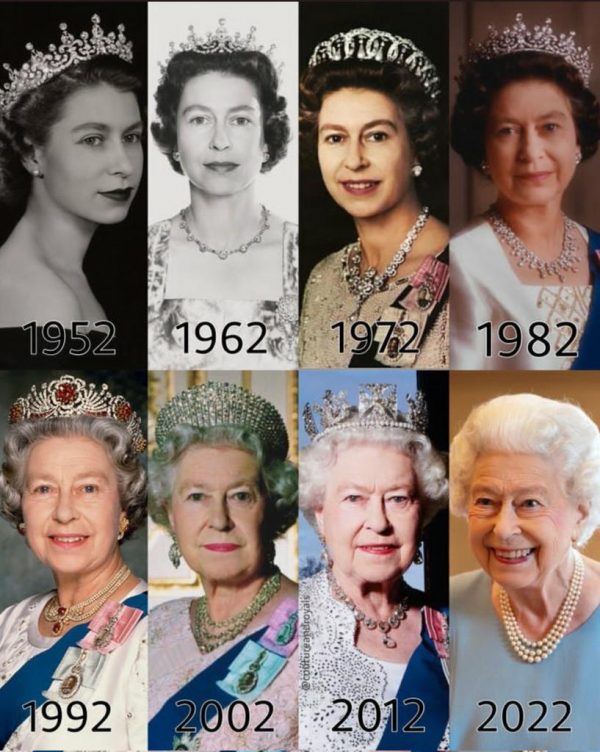
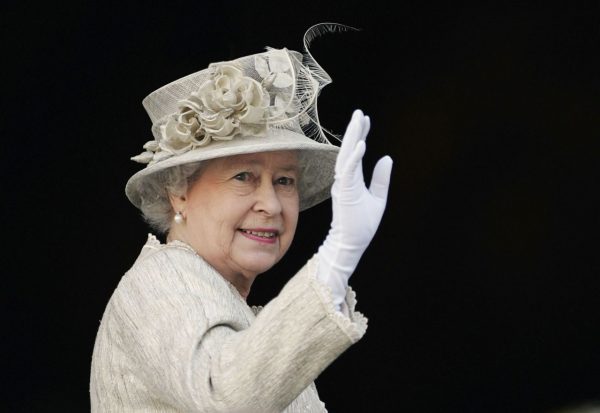
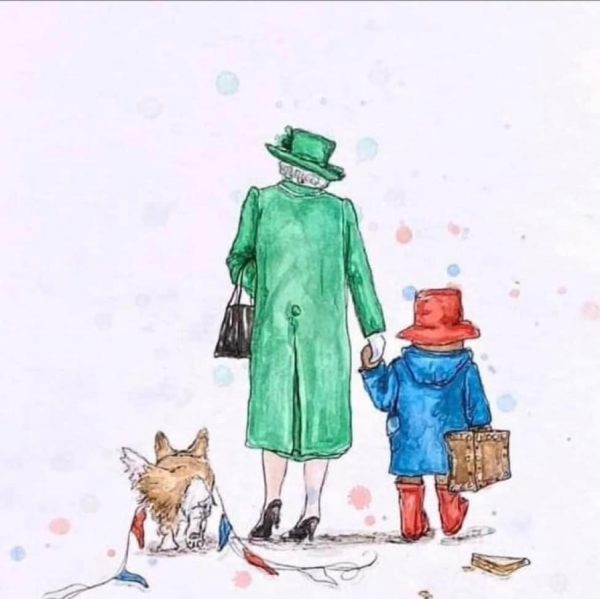
Queen Elizabeth II, the longest-reigning monarch in British history dies peacefully at Balmoral Castle at the age of 96.;Prince Charles, 73, is now King, Charles 111 and the Duchess of Cornwall is now Queen Consort.


By
Caroline Davies

Queen Elizabeth II, the longest-reigning monarch in British history, has died at the age of 96.

Prince Charles, 73, heir to the throne since the age of three, is now king, and the Duchess of Cornwall is now Queen Consort.

In a statement, Buckingham Palace said: “The Queen died peacefully at Balmoral this afternoon. The King and the Queen Consort will
remain at Balmoral this evening and will return to London tomorrow.”

The royal family’s official website carried the message: “Queen Elizabeth II 1926-2022” along with the official statement issued by Buckingham Palace.

In statement, the new king said: “The death of my beloved mother, Her Majesty The Queen, is a moment of the greatest sadness for me and all members of my family.

Continue reading ‘Queen Elizabeth II, the longest-reigning monarch in British history dies peacefully at Balmoral Castle at the age of 96.;Prince Charles, 73, is now King, Charles 111 and the Duchess of Cornwall is now Queen Consort.’ »

Court of Appeal issues notices on Sri Lanka Podujana Peramuna (SLPP) parliamentarian and Newly Appointed State Minister Sanath Nishantha to appear in court on September 13 over two contempt of court cases filed by two lawyers.

By

Lakmal Sooriyagoda

The Court of Appeal today issued notices on Sri Lanka Podujana Peramuna (SLPP) parliamentarian Sanath Nishantha to appear in court on September 13 over two contempt of court cases filed by two lawyers.

The lawyers Vijitha Kumara and Priyalal Sirisena had filed these applications against Puttlalam District Parliamentarian Sanath Nishantha for committing the offence of Contempt of Court under the provisions of constitution.

Court of Appeal two-judge-bench bench comprised Justice Nissanka Bandula Karunaratne and Justice R. Gurusinghe.

Continue reading ‘Court of Appeal issues notices on Sri Lanka Podujana Peramuna (SLPP) parliamentarian and Newly Appointed State Minister Sanath Nishantha to appear in court on September 13 over two contempt of court cases filed by two lawyers.’ »

37 State Ministers Sworn in Before President Ranil Wickremesinghe on Sep 8th; Rajapaksas Begin Return to Govt with Shasheendra Rajapaksa becoming Irrigation State Minister;Majority of ministers are from the SLPP.

37 State Ministers were sworn in before President Ranil Wickremesinghe at the Presidential Secretariat in the morning of September 8th 2022.

Sri Lanka Freedom Party Parliamentarians Jagath Pushpakumara, Ranjith Siyambalapitiya, Chamara Sampath Dasanayake and Lasantha Alagiyawanna have taken oaths as State Ministers before the President

The Sworn in State Miisters and the portfolios assigned

Jagath Pushpakumara – State Minister Foreign Employment

Ranjith Siyambalapitiya – State Minister of Finance

Lasantha Alagiyawanna – State Minister of Transport

Dilum Amunugama – State Minister of Investment Promotion

Kanaka Herath – State Minister of Technology

Janaka Wakkumbura – State Minister of Provincial Councils, and Local Government

Shehan Semasinghe – State Minister of Finance

Mohan Priyadarshana De Silva – State Minister of Agriculture

Thenuka Vidanagamage – State Minister of Urban Development and Housing

Pramitha Bandara Tennakoon – State Minister of Security

Rohana Dissanayake – State Minister of Sports and Youth Affairs

Arundhika Fernando – State Minister of Urban Development and Housing

Vijitha Berugoda – State Minister of Piriven Education

Lohan Ratwatte – State Minister of Plantation Industries

Tharaka Balasuriya – State Minister of External Affairs

Sanath Nishantha- State Minister of Water Supply

Indika Anurudhdha – State Minister of Power and Energy

Siripala Gamlath – State Minister of Highways

Shantha Bandara – State Minister of Media

Anuradha Jayaratne – State Minister of Justice and Prisons Affairs

S. Viyalendran – State Minister of Trade

Sisira Jayakody – State Minister of Indegenious Medicine

Piyal Nishantha De Silva – State Minister of Fisheries

Prasanna Ranaweera – State Minister of Small and Medium Scale Industries Development

D. V. Chanaka – State Minister of Wildlife and Forest Conservation

D. B. Herath – State Minister of Livestock Development

Shasheendra Rajapaksa – State Minister of Irrigation

Dr. Seetha Arambepola – State Minister of Health

Cader Masthan – State Minister of Rural Affairs

Ashoka Priyantha – State Minister of Home Affairs

Aravind Kumar – State Minister of Education

Geetha Kumarasinghe – State Minister of Women and Child Affairs

Sivanesathurai Santhirakanthan – State Minister of Rural Roads Development

Dr. Suren Raghavan – State Minister of Higher Education

Diana Gamage – State Minister of Tourism

Chamara Sampath Dassanayake – State Minister of Primary Industries

Anura Paquel – State Minister of Social Empowerment.

COURTESY:DAILY MIRROR
“ I am facing a different situation to what other UNP leaders had to face I have no UNP government. I have no UNP parliament team..Today, we have to all come together in governing this country and with the support of several other parties, including the SLPP”- President Ranil Wickremesinghe

(Text of Speech made by President Ranil Wickremesinghe at the 76th anniversary celebrations of the United National Party (UNP held at the Sugathadasa Indoor stadium on September 6th 2022).

“We have gathered today for the party’s anniversary celebrations, for the first time, after the Covid-19 pandemic. I would like to extend my sincere thanks to all of you. Not just for being here, today, but for having faith in the UNP, even during the difficult period. Therefore, I extend my gratitude to you all. Today we commemorate our past leaders D.S. Senanayake, Dudley Senanayake, Sir John Kotelawala, J.R. Jayewardene, R. Premadasa and D.B. Wijetunga who built this country. We have learnt from them and I am here as a result of what I have learnt from them.

I address you today as the 4th State Leader from this party. I am facing a different situation to what other UNP leaders had to face. I have no UNP government. I have no UNP parliament team. Today, we have to all come together in governing this country and with the support of several other parties, including the SLPP. Why? Because today we have to face a grave crisis. I don’t think the country had to face such a crisis in its history. The economy has collapsed and we have to find solutions. I have come in the middle of this crisis.

Today, unlike other UNP leaders, I am unable to make appointments. The people are pressurized and some can’t even afford three meals. They are unemployed. I can only give you sweat, effort and criticism. But, I boldly declare that with our sweat and effort, we will resurrect this country.Last year, we celebrated our anniversary, through zoom technology. That day, I made a special statement to those who participated. I told them that today the youth of this country despises politics. The government is hoodwinking the people and the Opposition is limited to only criticism.

Continue reading ‘“ I am facing a different situation to what other UNP leaders had to face I have no UNP government. I have no UNP parliament team..Today, we have to all come together in governing this country and with the support of several other parties, including the SLPP”- President Ranil Wickremesinghe’ »

“The Next Objective of the “Aragalaya” (Struggle)Must be to Build a new Leadership and send 100 Brand New Faces to Parliament” suggests Dr. Pathum Kerner of “Gota Go Home”Protest Fame

The next objective of the “aragalaya” (struggle) should be to build new leaders to be sent to Parliament, stated “aragalaya” leaders.

Dr. Pathum Kerner, a prominent figure amidst the “GotaGoHome” campaign, which sought to hold former President Gotabaya Rajapaksa accountable for his perceived mistakes, said that the next struggle should be to build new leaders to be sent to Parliament.
“The country is the most valuable. Let’s make 100 brand-new faces. It’s up to you. Before the next vote, prepare your leadership,” he urged the public on social media.’

Meanwhile, a satyagraha protest titled “black hour” was organised against the Government urging the latter to step down at the Diyatha Uyana yesterday (7).

Continue reading ‘“The Next Objective of the “Aragalaya” (Struggle)Must be to Build a new Leadership and send 100 Brand New Faces to Parliament” suggests Dr. Pathum Kerner of “Gota Go Home”Protest Fame’ »

President Wickremesinghe’s tax proposals constitute a commendable first step. These are probably the most progressive taxation measures proposed by a Lankan administration in decades


By Tisaranee Gunasekara

“The Basil Rajapaksa faction…were demanding positions as state ministers…with perks and privileges (including) one private secretary, one media secretary, and three coordinating secretaries. All are entitled to separate vehicles… State ministers are also entitled to five office staff members, three vehicles, and other perks and privileges enjoyed by the ministers.” – The Sunday Times (28.8.2022)

Public policy subverted for private gain; laws broken with impunity in the certain knowledge there will never be a reckoning. Unintelligent governance brought us to our knees. Lankagama-Neluwa road is a microcosm of that expressway to disaster.

In 2020, President Gotabaya ordered the army to build the road in 90 days. About 8 km sliced through Sinharaja, a world heritage primary rain forest. No Environment Impact Assessment was obtained. In 2021, Minister Johnston Fernando proclaimed that the road was built without harming the environment.

Environmentalists claimed that the real purpose of the road was to service a hotel owned by a Rajapaksa offspring. PM Mahinda’s second son Yoshitha’s name was widely mentioned. He rejected the charges and threatened legal action. A Ravindu Soyza came forward claiming the hotel as his. The story became buried under an avalanche of newer troubles: exploding gas cylinders, fertiliser ban, COVID-19.

Turns out a Rajapaksa scion did own the hotel. Not Yoshitha but Rohitha; the youngest of Mahinda Rajapaksa’s three sons; the one who told an interviewer that he’d seen the world and would travel to space next. The hotel, Sinharaja Green Ecolodge, was burned down on 10 May. The police, investigating that crime of arson, revealed the name of the true owner in an official announcement.

While apprehending the arsonists, there are some related matters the authorities should not disregard. Why did Ravindu Soyza claim ownership of the hotel? When his older brother Yoshitha was accused of being the owner, why didn’t Rohitha Rajapaksa come forward to reveal the truth? How did Rohitha Rajapaksa, who has no known locus of employment or source of income, raise funds to purchase a hotel in such a prized location? Does he pay personal income taxes? Did President Gotabaya order the construction of the Lankagama-Neluwa road sans an EIA as an uncle’s gift to a nephew?

Continue reading ‘President Wickremesinghe’s tax proposals constitute a commendable first step. These are probably the most progressive taxation measures proposed by a Lankan administration in decades’ »

Central Bank Governor States that there is no Practice of Revealing IMF programs to Parliament early; “Memorandum of Economic Policies signed between IMF and Finance Minister “has never been tabled in the parliament to my knowledge and has not even been submitted to the cabinet” says Dr.Nandalal Weerasinghe


Sri Lanka had no practice of revealing International Monetary Fund programs to parliament early and tax changes can only be revealed to the parliament at the time of implementation, Central Bank Governor Nandalal Weerasinghe said.

Sri Lanka has had 16 IMF programs in the past after balance of payments trouble was triggered by Sri Lanka’s intermediate regime central bank which prints money to suppress market interest rates leading to forex shortages.

Sri Lanka’s finance minister usually signs a memorandum of economic policies with the IMF as part of a program, Governor Weerasinghe said.

Continue reading ‘Central Bank Governor States that there is no Practice of Revealing IMF programs to Parliament early; “Memorandum of Economic Policies signed between IMF and Finance Minister “has never been tabled in the parliament to my knowledge and has not even been submitted to the cabinet” says Dr.Nandalal Weerasinghe’ »

The Tamil Factor in Sri Lanka’s First UNP- led “National” Govt of Premier Dudley Senanayake

By
D.B.S. Jeyaraj

Reaching a viable agreement with the International Monetary Fund (IMF) and forming an inclusive cabinet are currently the twin urgent priorities of the Government headed by President Ranil Wickremesinghe and Prime Minister Dinesh Gunawardena.

On the economic front both President Wickremesinghe and Central Bank Governor Dr.Nandalal Weerasinghe have been optimistic about reaching a staff level agreement with the IMF. According to a Reuters report the staff level agreement has been reached with the IMF and details would be formally announced on Sep 1st 2022. The staff level preliminary agreement will be followed by debt re-structuring talks with creditors especially China. Some observers have opined that the process could take at least 3 to 6 months before a satisfactory arrangement is arrived at.

On the political front, President Wickremesinghe has been diligently striving to form a multi-party Government comprising all political parties represented in Parliament. Forming such an inclusive Govt is very likely to strengthen the Sri Lankan side in negotiations with the IMF as well as creditor entities and nations. Despite protracted discussions this goal seems rather elusive at present. This is chiefly because the chief opposition party the Samagi Jana Balawegaya (SJB) as a party is unwilling to join what is formally referred to as an all – party Govt.

Continue reading ‘The Tamil Factor in Sri Lanka’s First UNP- led “National” Govt of Premier Dudley Senanayake’ »

“We will begin a ‘Devani Aragalaya’ (Second Struggle)to bring in vast reforms shortly. I won’t live to see the country reaping the harvest of these changes. However I intend to build a better nation for the future generations”says President Ranil Wickremesinghe

By

Yohan Perera

Highlighting that a ‘Devani Aragalaya’ (A second struggle) will be launched for a systems change shortly, President Ranil Wickremesinghe said the parties will finalise an agreement on the proposed National Council.

Speaking during a gathering held to mark the 76th anniversary of UNP, the President said Prime Minister Dinesh Gunawardena had informed him that parties will finalise an agreement on the National Council next week.

“We will begin a ‘Devani Aragalaya’ to bring in vast reforms shortly. I won’t live to see the country reaping the harvest of these changes. However I intend to build a better nation for the future generations,” he said.

Continue reading ‘“We will begin a ‘Devani Aragalaya’ (Second Struggle)to bring in vast reforms shortly. I won’t live to see the country reaping the harvest of these changes. However I intend to build a better nation for the future generations”says President Ranil Wickremesinghe’ »

United National Party’s 76th Anniversary celebrated with the theme “let us Build Together” at Sugathadasa Stadium in Colombo with Party Leader President Ranil Wickremesinghe Presiding over Ceremonies


The United National Party’s (UNP) 76th anniversary was held yesterday (6) at Sugathadasa Stadium in Colombo under the patronage of President Ranil Wickremesinghe, the first time in 28 years that the UNP celebrated its anniversary with its leader as the President of Sri Lanka.

“Let’s Build Together” was the theme of this year’s UNP anniversary, and was the first UNP anniversary following Ranil Wickremesinghe’s assumption of the Presidency.

Continue reading ‘United National Party’s 76th Anniversary celebrated with the theme “let us Build Together” at Sugathadasa Stadium in Colombo with Party Leader President Ranil Wickremesinghe Presiding over Ceremonies’ »

Undedrlying Reasons for Sri Lanka’s economic Collapse are past impunity for human rights abuses, economic crimes and Corruption ’ says UN Human Rights Commissioner Michele Bachelet in UNHRC Report


By

Meera Srinivasan

Linking Sri Lanka’s past record on human rights record to its current economic crisis, the U.N. Human Rights Chief on Tuesday said “impunity” for human rights abuses, economic crimes, and corruption was the “underlying” reason for the country’s collapse.

A report from the U.N. High Commissioner for Human Rights, released days ahead of the 51st session of the U.N. Human Rights Council in Geneva, noted that Sri Lanka is facing a “devastating” economic crisis, and urged the international community to support Sri Lanka in its recovery. “For sustainable improvement, however, it is vital to recognise and assist Sri Lanka to address the underlying factors, which have contributed to this crisis, including embedded impunity for past and present human rights abuses, economic crimes and corruption,” the top U.N. official said.

The report, prepared by the office of Michelle Bachelet, who recently completed her term, said the broad-based demands by Sri Lankans from all communities for accountability and democratic reforms presented “an important starting point for a new and common vision for the future”. It was a reference to the demands of the mighty people’s movement that ousted the Rajapaksas earlier this year, in the wake of the harrowing economic downturn.

Continue reading ‘Undedrlying Reasons for Sri Lanka’s economic Collapse are past impunity for human rights abuses, economic crimes and Corruption ’ says UN Human Rights Commissioner Michele Bachelet in UNHRC Report’ »

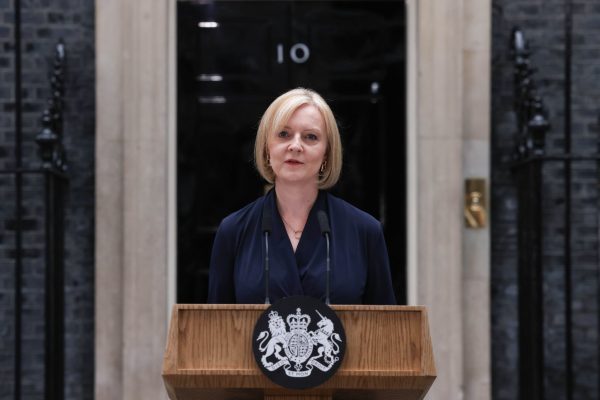
“As strong as the storm may be, I know that the British people are stronger,” says Britain’s new Prime Minister Liz Truss in a brief address to the nation as Country faces looming recession, high inflation, a historic energy price shock, and a sinking currency.


By Max Colchester and David Luhnow

Liz Truss became Britain’s third prime minister in just over three years on Tuesday, taking power in a nation that faces a toxic brew of looming recession, high inflation, a historic energy price shock, and a sinking currency.

Ms. Truss, 47, met Queen Elizabeth II in Balmoral, Scotland, to be formally appointed to form a government, taking over from Boris Johnson. Hours later, standing on a rain soaked Downing Street in London, she outlined an ambitious agenda of tax cuts and greater spending to boost sluggish growth in the world’s sixth-biggest economy.

“As strong as the storm may be, I know that the British people are stronger,” she said in a brief address to the nation.
The former foreign minister, a member of the ruling Conservative Party, faces as difficult an economic challenge as any recent British leader, troubles of the country’s own making and the result of Europe’s biggest conflict since World War II, in Ukraine. The pound this week sank to its lowest level against the U.S. dollar since 1985, and the currencies could reach parity for the first time in their more than two-century pairing.

Economists expect the British economy to fall into a mild but relatively long recession. Inflation is at a 40-year high at 10.1% and could hit 13% by year-end, according to the Bank of England. Unions are increasingly striking as real wages fall at their fastest rate in 20 years. Public school teachers and doctors are among those threatening strikes in coming months.

The ruling Conservatives, who have been in power for 12 years, trail the opposition Labour Party by roughly 10 percentage points in leading opinion polls.

Continue reading ‘“As strong as the storm may be, I know that the British people are stronger,” says Britain’s new Prime Minister Liz Truss in a brief address to the nation as Country faces looming recession, high inflation, a historic energy price shock, and a sinking currency.’ »

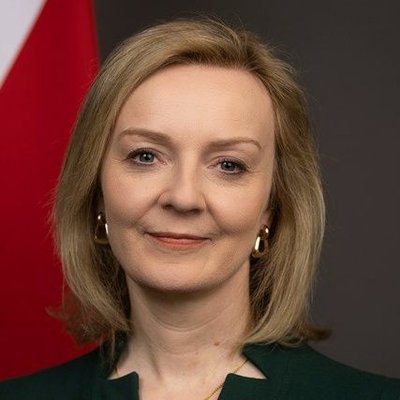
“What kind of prime minister will Liz Truss be? Britain’s new Leader is a small-state conservative in a big-state era”-The Economist

Declinism, that dull fear of Britain’s sunset, has shaped the country’s post-war politics. It propelled Harold Macmillan’s wish to enter the European Economic Community, the eu’s precursor, and fuelled Margaret Thatcher’s economic revolution. And now it has helped Liz Truss into Downing Street.

The Economist

On September 5th Ms Truss was declared the winner of the ballot of 172,000 Conservative members to replace Boris Johnson as the Tory leader; tomorrow, she will fly to Balmoral Castle, Queen Elizabeth’s remote Scottish home, where she will be invited to form a government.

Ms Truss won the contest in large part because she is cheerful, a characteristic she shares with Mr Johnson. On the campaign trail, she would dismiss the warnings of hard choices from Rishi Sunak, her rival in the protracted final stage of the contest. “I don’t agree with this declinist talk,” she’d say. “I believe our country’s best days are ahead of us.”

Such optimism struck a chord among party activists. Her colleagues think her positivity might appeal to the broader electorate, too. “It’s boosterism without Boris,” says a cabinet minister. “It’s a gamble, but it might be a very powerful cocktail.”

Whereas Mr Johnson’s government often seemed to run on optimism alone, Ms Truss promises substance as well as sunshine. She is a self-styled radical, and perhaps the keenest disciple of the Thatcherite tradition to hold the office since Thatcher’s own exit from Downing Street 31 years ago.

She has grand ambitions to transform Britain’s sluggish economy so it does not end up as a low-growth, high-tax social democracy. For her, this is a moral choice as much as an economic one: who wants to live in a society where the state takes half your income?

Yet she is triply constrained. Her free-market instincts are at odds with the need to intervene to navigate an immediate cost-of-living crisis. Household gas and electricity bills will jump by 80% in October; businesses are seeing even bigger spikes. By January 2025 she must contest a general election in which she will face the judgment of a deeply dissatisfied public.

She inherits a country in dismal spirits: 69% of Britons, including 60% of Conservative voters, agree that the country is “in decline”, according to polling by Ipsos for The Economist. And the party she now leads has grown insurrectionary: it has deposed her two immediate predecessors and is unenthused by her. She will bash at the walls like a wasp in a bell jar.

Continue reading ‘“What kind of prime minister will Liz Truss be? Britain’s new Leader is a small-state conservative in a big-state era”-The Economist’ »

Central Bank Governor Dr.Nandalal Weerasinghe Tells Sri Lankan Parliamentarians that Rich people must bear hardships caused by the Economic Crisis and not Poor People alone ;low-income groups should be protected and money should be allocated for social security networks.


Central Bank Governor Dr. Nandalal Weerasinghe recently told a forum of Members of Parliament that the crisis-led hardships must be faced by the rich as well, not just by the poor.

“If the economic difficulties faced by low-income groups increase, such groups may take to the streets and because of this, riots may occur in the country.

Therefore, by dividing the economic burden between the high-income and low-income groups, the economy should be stabilised by controlling the discomfort caused to the low-income groups,” Weerasinghe had said.

He also said that in the event of an economic crisis, the low-income groups should be protected first and therefore money should be allocated for social security networks to protect them.

Continue reading ‘Central Bank Governor Dr.Nandalal Weerasinghe Tells Sri Lankan Parliamentarians that Rich people must bear hardships caused by the Economic Crisis and not Poor People alone ;low-income groups should be protected and money should be allocated for social security networks.’ »

Appapillai Amirthalingam: From Enfant Terrible of ITAK to TULF Elder Statesman

By
D.B.S.Jeyaraj

Friday August 26th was the 95th birth anniversary of well-known Sri Lankan Tamil political leader and one-time leader of the opposition Appapillai Amirthalingam. The ‘enfant terrible ‘of the “Ilankai Thamil Arasuk Katchi”(ITAK) who later metamorphosed into the elder statesman of the Tamil United Liberation Front(TULF), strode across the Tamil political stage for nearly four decades. A lifetime of toil and service to his community was cut short on 13 July 1989 when he fell victim to bullets fired by LTTE operatives in Colombo.This column focuses this week on Amirthalingam who was referred to affectionately by his followers as Amir, Amir Annan and Amuthar.

Amirthalingam contested the Vaddukkoddai seat as an ITAK/FP candid unsucessfully in 1952. In 1956 he won Vaddukkoddai and held the same seat continuously through the March 1960 July 1960, and March 1965 elections. In May 1970 be was toppled by former school principal A. Thiyagarajah of the Tamil Congress. After seven years Amirthalingam returned triumphantly to parliament with a thumping majority in 1977. Only this time he contested the Kankesanthurai constituency which had been represented earlier by his leader SJV Chelvanayagam.

Continue reading ‘Appapillai Amirthalingam: From Enfant Terrible of ITAK to TULF Elder Statesman’ »

Sri Lankan govt reiterates that it would not accept any external mechanism on war-time accountability; “But external mechanism, we are not agreeable… because our Constitution does not allow that,” Says Foreign Minister Ali Sabry, without elaborating on the constitutional provisions that prohibit it.


By

Meera Srinivasan

Ahead of the UN Human Rights Chief’s latest report on Sri Lanka, and a likely resolution at the coming session of the Human Rights Council in Geneva, the Sri Lankan government reiterated that it would not accept any external mechanism on war-time accountability.

Addressing a media conference in Colombo on Monday, Minister of Foreign Affairs Ali Sabry said Sri Lanka “needs all partners” for its economic recovery, days after the government formalised an IMF staff-level agreement for a provisional $ 2.9 billion programme.

Continue reading ‘Sri Lankan govt reiterates that it would not accept any external mechanism on war-time accountability; “But external mechanism, we are not agreeable… because our Constitution does not allow that,” Says Foreign Minister Ali Sabry, without elaborating on the constitutional provisions that prohibit it.’ »

Mikhail Gorbachev was a tender-minded tragic figure who by his inexplicable confusion and conversion assisted the suicide of the Soviet Union as a superpower.


By

Dr.Dayan Jayatilleka

Watching Mikhail Gorbachev at the World Festival of Youth and Students in the Summer of 1985, I had a thought which I later recorded in an article in the Sri Lankan newspapers. I felt, and wrote, that “at last we have a Soviet leader we do not have to be embarrassed about”.

Pic via: @NobelPrize

I was born in the year of the 20th Congress of the Communist Party of the Soviet Union (CPSU), 1956. For my generation of the global community represented at the World Festival of Youth and Students, the only Soviet leader of our lifetime who could be admired was Yuri Andropov, and his tenure at the top was a tragically short episode.

Two years after the 1985 World Festival, at the commemoration of the 70th anniversary of the October Revolution, Fidel Castro was prophetically warning in Moscow that “one day we may awake and find that the Soviet Union has disappeared”. He added that he wouldn’t be surprised. Something had begun to go very wrong. By 1991, Fidel’s prophecy had come true.

Continue reading ‘Mikhail Gorbachev was a tender-minded tragic figure who by his inexplicable confusion and conversion assisted the suicide of the Soviet Union as a superpower.’ »

Ranjan Ramanayake’s release and the cases against him on Contempt of Court certainly raises many issues about how our legal system covers or addresses the subject of Contempt.


By

Lucien Rajakarunanayake

Ranjan Ramanayake’s refusal to accept any official position shows a commitment to independent action after gaining limited freedom from imprisonment.

The limited freedom that Ranjan has received with no civic rights is in fact a huge insult to one who has been an active politician elected to parliament by the people with a huge mandate.

The whole principle of release from prison is giving the person the ability to carry on what has been one’s system of living. The absence of civic rights to Ranjan is a denial of his system of life – politics, representation of and service to the people – that prevailed before he was sentenced to prison by the Supreme Court.

Ranjan’s present release and the cases against him on Contempt of Court certainly raises many issues about how our legal system covers or addresses the subject of Contempt.
The reality is that we do not have a Contempt of Court legislation passed by our Parliament, through 74 years of independence. Such legal delays are not confined to Contempt of Court, but several other important areas of action – social, economics, and human rights too.

Continue reading ‘Ranjan Ramanayake’s release and the cases against him on Contempt of Court certainly raises many issues about how our legal system covers or addresses the subject of Contempt.’ »

Sri Lankans from different Walks of Live Gather in Large Numbers in an Expression of Gratitude to Thank India for all of the support extended to Sri Lanka towards overcoming the economic obstacles the country has been facing in Recent Times

In what could be called a spontaneous outpouring of gratitude, huge number of Sri Lankans from all walks of life came together and filled the Grand Marquee to thank India for all of the support extended to Sri Lanka towards overcoming the economic obstacles the country has been facing.

In attendance was The High Commissioner for India in Sri Lanka H.E Gopal Baglay and Hon. Minister of External Affairs Mr Ali Sabry.
The event was organized by Sri Lankans with the thought of extending appreciation for the lifeline India threw to Sri Lanka at a time when the country was facing unprecedented challenges as a nation since independence.

Several distinguished Sri Lankans expressed their sentiments of goodwill towards their neighbour India, stressing on the common cultural and social values the two countries share. A citizens’ outpouring of gratitude towards India for reaching out to Sri Lanka in her time of acute need, was not only timely but also appropriate given the consistent level of co-operation between the two countries.

Continue reading ‘Sri Lankans from different Walks of Live Gather in Large Numbers in an Expression of Gratitude to Thank India for all of the support extended to Sri Lanka towards overcoming the economic obstacles the country has been facing in Recent Times’ »

Life may have resumed as normal for many. But the poor are squeezed just that little bit more and worse is anticipated, all in the name of economic reforms to return Sri Lanka from bankruptcy. On its part, the State has regrouped, predictably using all the formidable weapons in its arsenal.


By

Kishali Pinto Jayawardene

For a President once feted as a war hero, to creep back stealthily to a country that he fled from in panic as the angry public roared outside his gates less than two months ago, is classic filmfare.


Losing the dignity of citizenship

But this is not the stuff of celluloid. Rather, it is the grim and ugly reality of the Sri Lankan State reasserting itself in full measure. This time around, the ire of the State is aimed at the citizenry in full rather than selected targets in the majority or minorities as is its wont.

Households implacably slipping below the poverty line and unable to afford basic nutrition according to estimates by the World Bank, realise that truth to their painful cost. Once human beings disappeared in Sri Lanka, Sinhala, Tamil and Muslim.

Now, the thread of social existence, the dignity of earning one’s daily bread through humble but honest toil, indeed, the fundamental pride in citizenship itself has disappeared. How can there be any earning of daily bread when the price of a loaf of bread itself has quadrupled in the last six months?

Eggs have disappeared from public view much like the middle class itself has disappeared and basic utilities have risen to unaffordable levels for a quarter of the population.

This link between public suffering in daily nightmares of existence from the North to the South and stupendously corrupt politics which brought the nation to its bankrupt knees, had been shouted out by enraged protestors over the past several months.

It was this which propelled mass protests, bringing ordinary people in their thousands to Colombo to surround houses of the politicians who had ruined them.

Continue reading ‘Life may have resumed as normal for many. But the poor are squeezed just that little bit more and worse is anticipated, all in the name of economic reforms to return Sri Lanka from bankruptcy. On its part, the State has regrouped, predictably using all the formidable weapons in its arsenal.’ »

President and Finance Minister Ranil Wickremesinghe Succeeds in Getting interim budget passed with 115 Majority; 120 MPs from Different Parties Vote for while 5 from JVP and ACTC vote against.Most MPs Abstain or are Absent


By Sandun Jayawardana

President and Finance Minister Ranil Wickremesinghe’s interim budget, with ambitious goals of significantly increasing government revenue and reducing public debt by 2025, was passed by Parliament on Friday (2) in a vote where many in the opposition chose to abstain.

National Peoples’ Power (NPP) Leader Anura Kumara Dissanayake asked for a division on the second reading of the interim budget, known as the Appropriation (Amendment) Bill at the end of a three-day debate on Friday evening. The bill was passed by a majority of 115 votes, with 120 MPs voting for and just five against.

The three NPP MPs were joined by the two MPs from the All Ceylon Tamil Congress in voting against the bill. There were 43 abstentions. The main opposition Samagi Jana Balawegaya (SJB) chose to abstain, as did 13 Sri Lanka Podujana Peramuna (SLPP) MPs led by former minister Dullas Alahapperuma who had crossed the floor on August 31 to sit with the opposition. MPs representing the group led by former Minister Wimal Weerawansa also chose to abstain. MPs from the Tamil National Alliance (TNA) were not present when the vote was taken.

Sri Lanka Freedom Party (SLFP) Chairman and former President Maithripala Sirisena, General Secretary Dayasiri Jayasekara and Shan Wijeyalal De Silva were not present at the time of voting.

Continue reading ‘President and Finance Minister Ranil Wickremesinghe Succeeds in Getting interim budget passed with 115 Majority; 120 MPs from Different Parties Vote for while 5 from JVP and ACTC vote against.Most MPs Abstain or are Absent’ »

“We have to adopt multiple approaches to get more efficient State-Owned Enterprises (SOEs),” says LIRNEasia Chairman Prof. Rohan Samarajiva; outlines ways in which SOE reforms could be carried out to enable Sri Lanka’s economic recovery.

By Marianne David

“We have to adopt multiple approaches to get more efficient State-Owned Enterprises (SOEs),” said LIRNEasia Chairman Prof. Rohan Samarajiva, in an interview with The Sunday Morning, outlining ways in which SOE reforms could be carried out to enable Sri Lanka’s recovery.

While welcoming the move to establish an SOE Restructuring Unit as proposed in the interim Budget, Prof. Samarajiva however noted that more needed to be done. He also asserted that everyone had a role to play in Sri Lanka’s recovery, pointing out that “we have to straighten out this country together”.

Following are excerpts of the interview:

Speaking at the #ReformNow conference recently, you said ‘the State has no capacity to privatise anything today’. Where do we go from here?

Apparently the President has also understood this fact and Rs. 200 million has been set aside to establish an SOE Restructuring Unit. That is a good start, but it is not enough. When you work within government, you have to first understand the constraints in setting up such a unit.

In 2003, when we were setting up the Information and Communication Technology Agency (ICTA), we figured that if we were going to have people who were capable of managing the best in the ICT sector, we had to pay them decent salaries. But from the day ICTA was created, there was an ongoing battle with the Administrative Service, which wanted salaries to be brought down and all these conventional government rules applied. That will repeat itself here as well.

Let’s assume we can get over that. Even then, this will require a significant mobilisation of external consultants. We have to understand that people may have knee-jerk reactions to this, but you have to spend significant amounts of money to get the right kind of experience. On the local side, you need people who are knowledgeable and self-confident, who can manage the consultants.

I think we have a good start. We need to quickly get over the problem of how this is to be structured, how we recruit the right kind of people, and how the technical assistance is to be funded.

Continue reading ‘“We have to adopt multiple approaches to get more efficient State-Owned Enterprises (SOEs),” says LIRNEasia Chairman Prof. Rohan Samarajiva; outlines ways in which SOE reforms could be carried out to enable Sri Lanka’s economic recovery.’ »

Gotabaya Rajapaksa will be given a security detail from the Police and the Army in accordance with the privileges of an Executive President says Public Security Minister Tiran Alles


By Asiri Fernando

Former President Gotabaya Rajapaksa (GR) will be given a security detail in accordance with the Constitution following a threat assessment, Minister of Public Security Tiran Alles said yesterday (3).

“He will be offered a security detail from the Police and the Army in accordance with the privileges of an Executive President. Sri Lanka has done so with several former presidents and their families,” Minister Alles told The Sunday Morning.
He pointed out that former First Lady Hema Premadasa and former Presidents Chandrika Bandaranaike Kumaratunga and Mahinda Rajapaksa remained under the protection of the State in accordance with the Constitution.

According to Alles, a protection group for the seventh Executive President will be formed, similar to the units formed for the previous presidents. This will be made up of Police and Army personnel, depending on the threat assessment that will be carried out.

Continue reading ‘Gotabaya Rajapaksa will be given a security detail from the Police and the Army in accordance with the privileges of an Executive President says Public Security Minister Tiran Alles’ »

Former Sri Lankan President Gotabaya Rajapaksa arrives in Colombo’s Bandaranaike International airport under cover of darkness and is whisked away in a heavily guarded convoy of vehicles after Sri Lankan Ministers garland and welcome him back,


By

R.K.Radhakrishnan

Former Sri Lankan President Gotabaya Rajapaksa arrived in Colombo’s Bandaranaike International airport exactly the same way he left the country seven weeks ago—under cover of darkness and shrouded in secrecy—aided by Sinhalese politicians who closed ranks.

Just past midnight on September 3, a Singapore Airlines flight brought the former President back to his country. He was whisked away in a heavily guarded convoy of vehicles while media persons scrambled to confirm if indeed Gotabaya had arrived.

Sri Lankan media reported that he was met at the airport by Sri Lankan Ministers. They garlanded him and welcomed him back, an act which was unthinkable just a few weeks ago.

The same Ministers had distanced themselves from him as a restive crowd demanded the resignation of the government and forced the resignation of key Ministers and bureaucrats.

Continue reading ‘Former Sri Lankan President Gotabaya Rajapaksa arrives in Colombo’s Bandaranaike International airport under cover of darkness and is whisked away in a heavily guarded convoy of vehicles after Sri Lankan Ministers garland and welcome him back,’ »

Ex-president Gotabaya Rajapaksa Returns to Sri Lanka From Thailand by Singapore Airlines Flight; ariives at Katunayake Airport amidst tight security ;welcomed by SLPP MPs ,ministers and ex-ministers who take him to Colombo in a motorcade


Former Sri Lankan president Gotabaya Rajapaksa on Friday returned to the country from Thailand, nearly two months after he fled the country following a massive uprising against his government over the island nation’s worst-ever economic crisis.

Mr. Rajapaksa, 73, fled the country on July 13 after months-long mass public demonstrations demanding his immediate resignation on July 9 gained momentum after protesters stormed the President’s House in Colombo and several other state buildings in the capital.

Mr. Rajapaksa arrived at the Bandaranaike International Airport amidst a heavy security presence. After being received at the airport by several ministers and Parliamentarians of the ruling Sri Lanka Podujana Peramuna (SLPP) party, Mr. Rajapaksa left the airport in a heavily-guarded motorcade.

Continue reading ‘Ex-president Gotabaya Rajapaksa Returns to Sri Lanka From Thailand by Singapore Airlines Flight; ariives at Katunayake Airport amidst tight security ;welcomed by SLPP MPs ,ministers and ex-ministers who take him to Colombo in a motorcade’ »

Envisaged sea cucumber farm project with Chinese Investment in Pungudutivu off Jaffna Peninsula Causes local fishermen to raise concerns over its potential impact on their livelihoods, marine ecosystem, and land.


By

Meera Srinivasan

Citing media reports of a Chinese firm investing in a sea cucumber farm in Pungudutivu, off Jaffna Peninsula in northern Sri Lanka, local fishermen have raised concern over its potential impact on their livelihoods, marine ecosystem, and land.

“We recognise the need for investment in our war-affected region, but the sea cucumber farms are mainly for exports. They will only bring more harm than benefit for those of us living here,” said Annalingam Annarasa, President of the Jaffna Fisheries Federation. The commercial ventures, they fear, could adversely affect the local marine ecology on which their livelihoods rely.

Small-scale artisanal fishermen like him see the government’s recent push on aquaculture as the latest blow to their livelihoods, already precarious due to the relentless bottom-trawling by Indian fishermen in their seas for years, and the drastic, nearly four-fold increase in kerosene price last month.

In 2021, Sri Lanka exported about 336 tonnes of sea cucumber to China, Singapore, and Hong Kong, according to local media reports.

Continue reading ‘Envisaged sea cucumber farm project with Chinese Investment in Pungudutivu off Jaffna Peninsula Causes local fishermen to raise concerns over its potential impact on their livelihoods, marine ecosystem, and land.’ »

“Why has President Wickremesinghe signed the three Detention orders under the PTA in Sinhala instead of Signing in English as he normally does? Is there a change in personality? Is he appealing to some sections in the country by signing in Sinhala and that too on detention orders? -MA Sumanthiran

(Text of speech made in Parliament by TNA Jaffna District Parliamentarian M.A.Sumanthiran on 01st September 2022 during the interim budget debate)

நன்றி பிரதித் தவிசாளர் அவர்களே, எனக்கு முன்னதாக பேசிய அமைச்சர் யாழ்ப்பாண பிரதேசத்திலே வெங்காய உற்பத்தியைப் பற்றிச் சொன்னார், மண்ணெண்ணெய் அவர்களுக்கு கொடுக்க வேண்டும் என்று பேசினார், ஆனால் இன்றைக்கு இரண்டு மாதங்களுக்கு மேலாக மண்ணெண்ணெய் இல்லாமல் அவஸ்தை படுகிறார்கள். விவசாயிகள் நீர் இறைக்கிற இயந்திரத்திற்கு மண்ணெண்ணெய் இல்லாமல் அவஸ்தை படுகிறார்கள், மீனவர்கள் கடலுக்கு செல்வதற்கு தமது படகு இயந்திரங்களுக்கு மண்ணெண்ணெய் இல்லாமல் அவஸ்தை படுகிறார்கள். இந்த விடயத்தை எவ்வளவு தடவைகள் எடுத்துக் கூறியும் அதற்கு எந்தவிதமான பதிலும் கிடைக்கவில்லை, கிடைத்த ஒரேயொரு பதில், 87 ரூபாவாக இருந்த மண்ணெண்ணெய் 340 ரூபாவாக 253 ரூபாவினாலே அதிகரிக்கப்பட்டதாக வந்த அறிவிப்பு. அறிவிப்பு மட்டும் தான், மண்ணெண்ணெய் வரவில்லை. மண்ணெண்ணெய் விலை அதிகரிப்பு அறிவிப்பு தான் வருகிறது அனால் மண்ணெண்ணெய் வரவில்லை.

முன்பதாக மீன்பிடி அமைச்சர் பேசினார், பானையில் இருக்கின்ற நண்டுகள் பற்றியெல்லாம் பேசினார், அவர் ஏதோ ஒரு உலகத்திலே இருக்கிறார், கொதிக்கிற பானையில் நண்டு விழுந்து சாகுதாம், வெளியால் பாய்ந்து சாகுதாம் என்று தன்னுடைய நிலையைப்பற்றி உருக்கமாக பேசிவிட்டு சென்றிருக்கிறார். ஆனால் கஷ்டப்படுகிற விவசாயிக்கும் கடற்றொழிலாளிக்கும் எந்த நிவாரணமும் கொடுக்கப்படவில்லை. இந்த வரவு செலவு திட்டத்தில் கூட, இந்த இடைக்கால வரவு செலவு திட்டத்தில் கூட ஒரு முன்மொழிவு இருக்கின்றது, மண்ணெண்ணெய் பாவிப்பவர்களுக்கு நிவாரணம் கொடுப்பதாக ஒரு முன்மொழிவு இருக்கின்றது. ஆனால் ஒதுக்கீட்டைப் பார்த்தால் ஒரு சதம் கூட அதற்கு ஒதுக்கப்படவில்லை.

There’s a subsidy that has been promised for kerosene, but no funds have been allocated, zero rupees have been allocated for that. This is in contrast to 46,000 billion that has been allocated for social safety net. We welcome that, in contrast I can site the health allocation, 248 billion a 3 % increase for health allocation, so what is in words as promised in the budget proposals you can also see it in rupees.

I am just contrasting that, with the promise to grant relief to kerosene users, yet no allocation is made. Now this is significant because the whole approach of this government is to silence the middle class and upper – middle class. So you are making petrol available now, you are making super diesel available now, but diesel is in short supply, and there is no kerosene.

Your priority must be the other way around- you must address the needs of those who need it most. Not the upper middle class. But you are doing that because you think, if you silence the upper middle class, then you can get by with blue murder- blue murder is what is happening around the country all round, every day we here of shooting; people being shot dead here, there, everywhere. Police are not investigating any of those crimes.

Continue reading ‘“Why has President Wickremesinghe signed the three Detention orders under the PTA in Sinhala instead of Signing in English as he normally does? Is there a change in personality? Is he appealing to some sections in the country by signing in Sinhala and that too on detention orders? -MA Sumanthiran’ »

Sri Lanka Reaches Staff Level Agreement with the International Monetary Fund subject to the approval by IMF management and the Executive Board in the period ahead:IMF will Provide a new 48-month Extended Fund Facility (EFF) amounting to US$2.9 billion

An IMF mission led by Peter Breuer and Masahiro Nozaki visited Colombo from August 24 to September 1, 2022 to continue discussions on IMF support for Sri Lanka and the authorities’ comprehensive economic reform program.

At the end of the mission, Messrs. Breuer and Nozaki issued the following statement:

“The Sri Lankan authorities and the IMF team have reached a staff-level agreement to support the authorities’ economic adjustment and reform policies with a new 48-month Extended Fund Facility (EFF) with a requested access of about SDR 2.2 billion (equivalent to US$2.9 billion)”

“The new EFF arrangement will support Sri Lanka’s program to restore macroeconomic stability and debt sustainability, while safeguarding financial stability, reducing corruption vulnerabilities and unlocking Sri Lanka’s growth potential,” the IMF said in a statement.

“The agreement is subject to the approval by IMF management and the Executive Board in the period ahead, contingent on the implementation by the authorities of prior actions, and on receiving financing assurances from Sri Lanka’s official creditors and making a good faith effort to reach a collaborative agreement with private creditors. Debt relief from Sri Lanka’s creditors and additional financing from multilateral partners will be required to help ensure debt sustainability and close financing gaps.”

Continue reading ‘Sri Lanka Reaches Staff Level Agreement with the International Monetary Fund subject to the approval by IMF management and the Executive Board in the period ahead:IMF will Provide a new 48-month Extended Fund Facility (EFF) amounting to US$2.9 billion’ »

Sri Lanka has reached only a preliminary agreement with the International Monetary Fund (IMF) prior to a staff-level agreement for an Extended Fund Facility (EFF) and Rapid Financing Instrument (RFI) states former Central Bank of Sri Lanka (CBSL) Deputy Governor Dr. W.A. Wijewardena


By Imesh Ranasinghe

Sri Lanka has only reached a preliminary agreement with the International Monetary Fund (IMF) prior to a staff-level agreement for an Extended Fund Facility (EFF) and Rapid Financing Instrument (RFI), stated former Central Bank of Sri Lanka (CBSL) Deputy Governor Dr. W.A. Wijewardena, clarifying a report by Reuters published yesterday (31 August).

“The IMF has neither confirmed nor denied the Reuters report. We don’t know whether it’s true or not. But preliminary means we need to have further consultations. This is not the final agreement,” he stated.

Reuters reported yesterday, quoting four sources, that Sri Lanka and the IMF have reached a preliminary agreement on an emergency loan, while a formal announcement in this regard will be made today (1).

Following the report, IMF Senior Mission Chief for Sri Lanka Peter Breuer and IMF Mission Chief for Sri Lanka Masahiro Nozaki said in a statement that the IMF Mission in Colombo has extended its stay by one day, as discussions are still underway with the authorities. They had stated that they planned to conclude the mission and issue a press release today.

Continue reading ‘Sri Lanka has reached only a preliminary agreement with the International Monetary Fund (IMF) prior to a staff-level agreement for an Extended Fund Facility (EFF) and Rapid Financing Instrument (RFI) states former Central Bank of Sri Lanka (CBSL) Deputy Governor Dr. W.A. Wijewardena’ »

Sri Lanka Reaches Preliminary Agreement with the International Monetary Fund(IMF); Formal Announcement likely to be made on Thursday Sep 1st


by Uditha Jayasinghe

Sri Lanka and the International Monetary Fund (IMF) have reached a preliminary agreement on an emergency loan to the crisis-hit country and a formal announcement will be made on Thursday, four sources with direct knowledge of the matter said.

The debt-laden island nation had sought up to $3 billion from the global lender as it struggles with its worst economic crisis in more than seven decades. Sri Lankans have faced acute shortages of basic goods and sky-high prices for months.

Spokespersons for the IMF and the Sri Lankan government did not immediately respond to requests for comment.

Continue reading ‘Sri Lanka Reaches Preliminary Agreement with the International Monetary Fund(IMF); Formal Announcement likely to be made on Thursday Sep 1st’ »

“Sri Lanka will be a critical test of Chinese willingness to co-ordinate with other lenders. The hope now for Sri Lanka is that Zambia’s deal has set a precedent for China to co-ordinate with other creditors”- The Economist


Few moments better encapsulate the hope and hubris of China’s Belt and Road Initiative, a global infrastructure binge, than the inauguration of Sri Lanka’s Colombo Port City in 2014. Xi Jinping, China’s president, attended in person, nodding approvingly as a project manager introduced the $15bn plan to build a high-tech offshore financial centre with a marina, hotels and luxury homes on 665 acres (269 hectares) of land reclaimed from the sea off Sri Lanka’s capital. Local officials likened the project to Dubai and Singapore.

Mr Xi called it a “major hub” of the 21st Century Maritime Silk Road—the part of Belt and Road that aimed to reshape ocean trade by financing ports and related infrastructure without the pesky conditions that Western and multilateral lenders demand.

Flash forward to August 2022 and the future of Sri Lanka—let alone Colombo Port City—hangs in the balance. Crippled by fuel and food shortages, the country is seeking a bail-out from the International Monetary Fund after defaulting on its debt in May. Pakistan, another big borrower, is also in the midst of an imf bail-out and dozens more Belt and Road countries are facing debt distress.

The extent to which China, the world’s biggest official creditor, bears responsibility is hotly debated. But what matters now is how it responds. Sri Lanka will be a critical test of Chinese willingness to co-ordinate with other lenders, potentially at the expense of Mr Xi’s original geostrategic goals.

Continue reading ‘“Sri Lanka will be a critical test of Chinese willingness to co-ordinate with other lenders. The hope now for Sri Lanka is that Zambia’s deal has set a precedent for China to co-ordinate with other creditors”- The Economist’ »

Jaffna University Students’ Union Lashes out Against Chinese Ambassador Qi Zhenhong at Media briefing;signing of agreement between Jaffna Agriculture faculty and Chinese Agricultural institute indefinitely postponed;Chinese envoy’s visit to Jaffna cancelled.

By P.K.Balachandran

The Jaffna University Students’ Union has lashed out at the Chinese envoy in Sri Lanka, Qi Zhenhong, for extending support to the Sri Lankan government’s stand on the war crimes issue that is to come up for discussion at the UN Human Rights Council’s session in September.

In an article sent to the Sri Lankan media recently, the envoy had indicated that China would support Sri Lanka in contrast to some countries which had either ruled or invaded Sri Lanka in the past. The allusion was to the Western powers and India.

Continue reading ‘Jaffna University Students’ Union Lashes out Against Chinese Ambassador Qi Zhenhong at Media briefing;signing of agreement between Jaffna Agriculture faculty and Chinese Agricultural institute indefinitely postponed;Chinese envoy’s visit to Jaffna cancelled.’ »

Mikhail Gorbachev who ended the cold war was the last leader of the Soviet Union and the architect of its dissolution

The two great heroes in Mikhail Gorbachev’s pantheon were 19th-century socialist thinkers, Alexander Herzen and Vissarion Belinsky, whose main concerns were the dignity of the individual, and whose books he knew almost by heart. When they appeared on the Russian stage, in Tom Stoppard’s trilogy “The Coast of Utopia”, he went to see them. At the end of the performance he was called on stage and given a standing ovation by an audience that, for the most part, had scarcely been born when, in 1985, he became the last general secretary of the Soviet Union.

The perestroika (“restructuring” or “reformation”) which he started never reached the destination he wanted, a democratic, humane socialism—perhaps because that destination was Utopia, rather than a real place. To the elite of modern Russia, he seems an oddity if not a traitor: a fool who brought about the collapse of the Soviet Union and made no money out of it. He had power, a comfortable life and the fate of hundreds of millions of people in his hands—and he let it all go when, on December 25th 1991, he resigned as president of the Soviet Union.

He had spent eight hours in a meeting with Boris Yeltsin, Russia’s president and his bitter rival, discussing the transfer of power. Afterwards, he went to lie down in his office—for the last time. When Alexander Yakovlev, his closest comrade, walked in, he saw tears in Mr Gorbachev’s eyes. “You see, Sasha,” said the president, “this is how it goes.”

Continue reading ‘Mikhail Gorbachev who ended the cold war was the last leader of the Soviet Union and the architect of its dissolution’ »

“I would say that the 225 MPs are hanging on by force. They do not have the people’s mandate anymore……… I fully agree that all 225 MPs must go and a new government with new faces and the right kind of vision must come to power.”- Former President Chandrika Kumaratunga in Interview with “The Hindu”


By

Meera Srinivasan

Sri Lanka’s economic crisis is a consequence of the corruption over two Rajapaksa regimes, said former President Chandrika Bandaranaike Kumaratunga, admitting she is “thrilled” by the aragalaya or people’s movement that overthrew them recently.

“When our systems have crashed and been destroyed consciously, how do you change things…the only way to change is through a socio-political upheaval, a revolution,” she told The Hindu, in an interview on the dramatic changes that Sri Lanka witnessed in recent months, amid a crippling economic crisis.

In her view, the island nation had reached the stage where, with two Rajapaksa regimes, “everything that was bad and hateful was stabilised in power…today we are bankrupt only because of the corruption of the [Rajapaksa] family and their acolytes,” said the two-term President and survivor of an attempted assassination by the LTTE.

Observing that she would “wait and watch” how President Ranil Wickremesinghe, who relies on the Rajapaksas’ party in parliament, fares, Ms. Kumaratunga contended that his government must opt for an economic model that combines a social welfarist model with a liberal economic logic.

While Colombo might have challenging foreign policy choices ahead, especially while negotiating external assistance, the government must opt for a “dynamic non-alignment” policy, she noted, accusing the Rajapaksa administrations of “veering too much towards one country”.

“I am personally very thankful that India has come in, giving us all this aid when they could have stood back and waited because they were not very happy with the Rajapaksa government’s policies,” she said.

For over 15 years now, former two-term President of Sri Lanka Chandrika Bandaranaike Kumaratunga has stayed out of active politics. She re-emerged as a key player in the formation of the Yahapalanaya [good governance] coalition — of Maithripala Sirisena and Ranil Wickremesinghe — in 2015, only to witness the Sri Lanka Freedom Party of the Bandaranaike clan collapse after the Rajapaksas carved out their own party from it. Speaking to The Hindu at her Colombo residence recently, Ms. Kumaratunga reflects on the staggering developments in Sri Lanka over the last few months, and the way forward for the country’s political and economic progress.

Excerpts…

Continue reading ‘“I would say that the 225 MPs are hanging on by force. They do not have the people’s mandate anymore……… I fully agree that all 225 MPs must go and a new government with new faces and the right kind of vision must come to power.”- Former President Chandrika Kumaratunga in Interview with “The Hindu”’ »

The political class as a whole is not going to let people’s power decide as to how they should act. Even though the opposition parties speak in support of the ‘Aragalaya’ movement, they still support the govt’s current repressive measures in their heart of hearts.


By

V.Thanabalasingham

Mahinda Rajapaksa resigned from the post of Prime Minister on May 9. On June 9, former Finance Minister Basil Rajapaksa resigned as a Member of Parliament. Following a mass uprising on July 9, President Gotabaya Rajapaksa left the Presidential Palace, flew abroad, and resigned from there. These three “9ths” have secured a permanent place in Sri Lankan political history.

This seems to have given some opposition parties a delusion that they can topple the government if they protest on the 9th. Therefore they declared August 9 as a day of mass protest and called upon the people to gather in Colombo.

The purpose of the call was to send President Ranil Wickremesinghe-led government home. Even though the Janata Vimukti Peramuna (JVP) and Frontline Socialist Party were behind the call, the Samagi Jana Balawegaya’s Member of Parliament, former army chief Field Marshal Sarath Fonseka, was in the frontline calling upon people to participate in the “‘final battle”. On July 9, the day of the historic popular uprising in the capital, the protestors were seen chasing away other politicians but a section of them was seen happily welcoming Fonseka. That reception seems to have given him a delusion that he has huge support in the protest movement. Fonseka behaved as if he was the main spokesman of the ‘Aragalaya’ movement both inside and outside Parliament.

He termed the orders issued by the government to suppress the popular protest as ‘illegal’ and appealed to the army not to follow those orders. Although 13 years have passed since he retired from the post of the army chief, he appeared confident that the soldiers will heed his request. Samagi Jana Balawegaya did not fail to declare that they had nothing to do with his call.

As expected, people were not interested in participating in the final battle on August 9. Those who called for that protest could not mobilize people in large numbers. Some trade union movements and supporters of the respective parties took out protest marches in some places. No one claimed to have seen the Field Marshal at any of those demonstrations.

Continue reading ‘The political class as a whole is not going to let people’s power decide as to how they should act. Even though the opposition parties speak in support of the ‘Aragalaya’ movement, they still support the govt’s current repressive measures in their heart of hearts.’ »

President Wickremesinghe rolls out sweeping reforms and relief via mini-Budget to appease crisis-hit vulnerable groups;“I am well aware of the difficulties faced by many due to the ongoing crisis.That’s why I decided to cut some of the capital expenditure and find room to provide enhanced support for vulnerable communities,” Ranil Tells Parliament.


President Ranil Wickremesinghe yesterday rolled out sweeping reforms and relief via the mini-Budget to appease crisis-hit vulnerable groups as well as kick-start recovery in the economy.

The interim Budget was replete with reforms, especially in the public sector and included mandatory exit by December by all Government and semi-Government employees who are over 60 years old, from 65 reducing the retirement age to 60; restructuring of State-Owned Enterprises and consolidation of identified Local Government Authorities.

It also included provisions to accommodate the policy package introduced in January 2022, provisions for strengthening social safety net programs (Rs. 163 billion inclusive of Rs. 133 billion loan from the World Bank), additional cost (Rs. 263 billion) due to increased interest payments in 2022, provisions (Rs. 250 billion) for financing obtained through the Indian Line of Credit and increased cost of fertiliser subsidy (Rs. 63 billion), among others.

The Government has also directed around Rs. 300 billion out of capital expenditure and less priority spending allocated in the original budget 2022 for these purposes, including the provision of relief to those who are affected by the economic crisis.

“I am well aware of the difficulties faced by many due to the ongoing crisis. That’s why I decided to cut some of the capital expenditure and find room to provide enhanced support for vulnerable communities,” President told Parliament.

Continue reading ‘President Wickremesinghe rolls out sweeping reforms and relief via mini-Budget to appease crisis-hit vulnerable groups;“I am well aware of the difficulties faced by many due to the ongoing crisis.That’s why I decided to cut some of the capital expenditure and find room to provide enhanced support for vulnerable communities,” Ranil Tells Parliament.’ »

President cum Finance Minister Ranil Wickremesinghe Presents Sri Lanka’s interim budget which is intended to lay the foundation for a progressive economy even as it provides a buffer to the poor who are bearing the brunt of the current unprecedented economic crisis.

By P.K.Balachandran

Sri Lanka’s interim budget presented by President cum Finance Minister Ranil Wickremesinghe in parliament here on Tuesday, is intended to lay the foundation for a progressive economy even as it provides a buffer to the poor who are bearing the brunt of the current unprecedented economic crisis.

“The Interim Budget is basic to the formulation of a national economic policy in accordance with the new world order. Based on this foundation, the Budget for the year 2023, will initiate the process of creating a new economy,” Wickremesinghe said.

First and foremost, he called for an attitudinal change towards the political economy and appealed for the rejection of old ideas which have pushed the country downhill.

“From the time the Government nationalized businesses, most of the tax revenue of our country has been spent to cover their losses. Funds which have to be utilized for the necessities of the community, are being wasted on keeping these companies afloat. Government should be formulating policies and implementing them. However, presently the Government does everything and the people also expect such from the country’s administration,” he said.

“We have not been following appropriate policies, not only in relation to state enterprises, but also in attracting foreign investments. Continuously, there has been no proper use of the nation’s resources, that too in the guise of seeking to protect state assets,” he said.

“If we can nourish our minds with creative thoughts, according to the current trends of the modern world, then we can solve the economic crisis,” he added.

Continue reading ‘President cum Finance Minister Ranil Wickremesinghe Presents Sri Lanka’s interim budget which is intended to lay the foundation for a progressive economy even as it provides a buffer to the poor who are bearing the brunt of the current unprecedented economic crisis.’ »

The ongoing crackdown on the protest movement needs to cease. Its excessive nature is discrediting the government in the eyes of the international community as well as within the country. The blame for this is falling squarely on the president


By Jehan Perera

The ruling party has requested President Ranil Wickremesinghe to facilitate the return of former president Gotabaya Rajapaksa to the country and his appointment as prime minister. The former president left the country when large numbers of protestors who had been actively protesting against the economic collapse and corruption in the country took over his presidential residence.

Few would wish to see a former president going from country to country seeking asylum. Even those who have supported the protest movement are unlikely to oppose his return to the country. However, any attempt to promote his active participation in political affairs is likely to be controversial and would also go against the “GotaGoHome” struggle’s main objective and can undermine the government.

The primary target of the protest movement was the former president who was held responsible, as the political leader holding the most power, for the economic crisis in the country. There were other reasons as well, such as his ill-advised decision to ban chemical fertilisers and convert Sri Lankan agriculture to organic status overnight. This policy brought visible disaster to farmers within a few months.

Further, appointing the former president as prime minister will necessarily displace the sitting prime minister, Dinesh Gunawardena, who is a leader of an influential faction within the government and is also personally close to President Ranil Wickremesinghe in a way that makes a partnership possible. The fact that the prime minister is the person who will succeed the president if anything should happen to the president is also likely to play a role in the final decision on this matter.

Continue reading ‘The ongoing crackdown on the protest movement needs to cease. Its excessive nature is discrediting the government in the eyes of the international community as well as within the country. The blame for this is falling squarely on the president’ »

Sri Lankan Airlines Group to be restructured by inviting foreign operators to take up 49% equity stake and management;Govt Unable to fund Loss making National Carrier any longer


By Nisthar Cassim

Saddled with nearly half a trillion rupee accumulated losses and $ 1 billion in debt and dues, SriLankan Airlines Group is to be restructured inviting foreign operators to take up 49% equity stake and management to ensure the national carrier no longer becomes a burden on the public.

Ports, Shipping and Aviation Minister Nimal Siripala de Silva yesterday revealed the way forward for Sri Lanka’s flag carrier which he will propose to the Cabinet of Ministers for final approval. The rationale for critical restructuring and the process were shared with trade unions, industry stakeholders and media.

Minister de Silva said given the country’s financial, forex and economic crisis, the Government can no longer fund the national carrier which for the past 10 years had made a collective loss of Rs. 435 billion. Latest FY22 saw the worst performance with Rs. 165 billion loss, largely due to 40% depreciation of the rupee whilst in the past 2019 Easter Sunday and COVID pandemic impacted its performance.

Continue reading ‘Sri Lankan Airlines Group to be restructured by inviting foreign operators to take up 49% equity stake and management;Govt Unable to fund Loss making National Carrier any longer’ »

Power and Energy Minister Kanchana Wijesekera defends decision to increase electricity tariffs, citing spendthrift generation plans and unsuitable policies adopted by successive governments pushed for the inevitable upward adjustments.

Power and Energy Minister Kanchana Wijesekera yesterday in Parliament defended the decision to increase electricity tariffs, citing spendthrift generation plans and unsuitable policies adopted by successive governments pushed for the inevitable upward adjustments.

Speaking during an adjournment debate on electricity tariff hike, he pointed out that electricity users would not have been shocked if timely revisions were implemented from time to time, whilst diversifying the power generation mix with cost-effective and renewable sources.

Continue reading ‘Power and Energy Minister Kanchana Wijesekera defends decision to increase electricity tariffs, citing spendthrift generation plans and unsuitable policies adopted by successive governments pushed for the inevitable upward adjustments.’ »

Indian Media had analyses of how Yuan Wang-5 berthing in Hambantota would compromise the security of India’s naval bases and satellite and missile launch sites The plain truth is Yuan Wang-5 is capable of carrying out all these actions even without docking in Hambantota port.

By

Col R.Hariharan


(The writer is a retired military intelligence specialist on South Asia associated with the Chennai Centre for China Studies)

The controversial visit of China’s “spy ship” Yuan Wang-5 to Sri Lanka’s Hambantota port from August 16 to 22 is perhaps Sri Lanka’s most commented news story, next only to President Gotabaya Rajapaksa’s escape in stealth from the island-nation a few weeks earlier. The reason is not far to seek; the research ship belongs to the PLA’s 5th branch – the Strategic Support Force (PLASSF) created in December 2015 to carry out space, cyber and electronic warfare. The ship is equipped with advanced electronic equipment, sensors and antennae to assist PLA’s land-based stations in tracking satellite, rocket and ICBM launches within a range of 750 km.

Sri Lanka’s foreign affairs ministry originally allowed the vessel to dock in Hambantota from August 11 to 17. India expressed its security concerns over berthing the ship in Hambantota as soon as reports indicated that the ship was heading to the Sri Lankan port. The US also had expressed its security concerns. Perhaps in deference to India’s concerns, the ministry in a message to the Chinese embassy asked the visit be delayed until further consultations.

The Chinese embassy clarified that the maritime research vessel’s visit was for replenishment and refuelling and did not pose a threat to any security or economic interests. It eventually succeeded in pressuring Sri Lanka’s defence ministry to allow the research vessel to berth in Hambantota port from August 16 to 22, after laying down conditions that it would switch off its tracking equipment.

The media pundits in India went to town with analyses of how the ship’s berthing in Hambantota would compromise the security of our naval bases and satellite launch sites and missile launches. The plain truth is Yuan Wang-5 is capable of carrying out all these actions even without docking in Hambantota port. Many analyses across global media had been cautioning the US of China overtaking it as a strategic power. These analyses were basically revisiting the bogey of China’s growing military prowess in the Indo-Pacific.

Social media castigated Sri Lanka for its “ungratefulness” to India, which had gone all out to lend a helping hand in times of Sri Lanka’s economic distress, unlike China. Some critics called it a violation of the India-Sri Lanka Accord 1987, though the Accord has no specific clause forbidding the berthing of warships of other countries in Sri Lanka ports in peacetime. Moreover, Sri Lanka had been repeatedly reassuring India at various levels that it would not allow the use of its soil to pose a security threat to India.
The controversy over Yuan Wang-5’s visit is timed to draw attention away from growing India-Sri Lanka relations, which are on the apogee. Probably it is also aimed at reminding Sri Lanka that it cannot afford to ignore China’s interests, now embedded in the body politic of the island-nation. Moreover, for some time now, Sri Lanka is in talks with India at multiple levels to upgrade its transactional relations into a strategic relationship.

These efforts have encouraged India to extend all out support to the people of Sri Lanka to meet their essential economic and energy requirements after the country went bankrupt. India’s support has continued, in spite of political uncertainties in the country after the unceremonious exit of President Gotabaya Rajapaksa and the ascent of Ranil Wickremesinghe as president.
It is worthwhile to examine the Yuan Wang-5 issue in the larger context of the strategic dynamics of the Indo-Pacific. Alfred North Whitehead, mathematician and process philosopher considers “symbolism as no mere idle fantasy or corrupt degeneration. It is inherent in the very texture of human life.” His words: “there is urgency in coming to see the world as a web of interrelated processes of which we are integral parts, so that all of our choices and actions have consequences for the world around us” have great relevance in understanding the substance behind China’s acts of symbolism.

India celebrated Azadi Ka Amrit Mahotsav—75 years of India’s independence—on August 15. On that day, the Xinjiang command conducted live-fire drills near the LAC with a “new type of surface-to-air missile” at an altitude of more than 4,500 metres (14,760 feet). A report in the South China Morning Post quoted military observers to say the weapons appeared to be HQ-17A air defence missiles, part of an integrated system that can fit in a single vehicle. Yuan Wang-5 steaming into Hambantota a day after India’s Independence Day is also symbolic of China enforcing its writ in Sri Lanka despite India’s security concerns.
More than all this, Yuan Wang-5 is a demonstration of PLASSF capability as part of China’s power projection in space and cyberspace. The SSF is also designed to coordinate intelligence sharing and operations in the informatized battlefields in real time. Informatization has been the mantra of Chinese Communist Party (CCP) ever since PLA thinkers drew many lessons from their observations of the US Gulf War (1991) and Iraq War (2003). In their assessment, the US used effective coordinated employment of global media, international law, and other psychological warfare techniques. The use of these techniques collectively referred to as “three warfares” could enhance results as military operations became more and more dependent on information technology tools.
The concept of “three warfares” was incorporated in the PLA Political Work Regulations for future conflicts in 2003. This has resulted in increased coordination of civil and military organs of state since then to get the best results of “three warfares”.
The timing of the Yuan Wang-5 controversy is uncanny. On June 6, India successfully carried out the training launch of the intermediate range ballistic missile Agni-4 from APJ Abdul Kalam Island off Orissa under the aegis of the Strategic Forces Command. The visit of Yuan Wang-5 is perhaps China’s way of flaunting its capability to track India’s ICBM launches. A month later, PLA tested an advanced PHL Multiple Lau¬nch Rocket System (MLRS) at an altitude of more than 5,300 metres in the Xinjiang Region.
India’s Foreign Minister S Jaishankar has been on a mission for some time to lay bare China’s double speak on matters related to India in many international forums. Only a month earlier, the 16th round of border talks between Corps Commanders of India and China ended in yet another stalemate. Last week in Bangkok, Jaishankar said the relationship between India and China is going through an “extremely difficult phase” after the Galwan incident in the Ladakh border in 2020. He emphasised that the Asian Century will not happen if the two neighbours could not join hands. “We very much hope that wisdom dawns on the Chinese side,” he said while replying to a question in Bangkok.
Now on a six-day tour of South America, Jaishankar said China has cast a shadow on bilateral ties by disregarding border pacts with India. He said the relationship cannot be a one-way street. “They are our neighbour and everybody wants to get along with their neighbour…But everybody wants to get along with their neighbour on reasonable terms. I must respect you and you must respect me,” he added. The EAM said “from our point of view, we’ve been very clear that if you have to build a relationship, then there has to be mutual respect. Each one will have their interests and we need to be sensitive to what the concerns are, of the other party.”
Sri Lanka is caught not only in the midst of muscle flexing between India and China in the Indian Ocean region, but it is also facing the flak of the strategic maelstrom blowing across the Indo-Pacific, after the visit of the US House Speaker Nancy Pelosi to Taiwan on August 2. President Xi Jinping had spoken to POTUS Joe Biden, a month earlier to prevent the visit.

According to media reports, President Biden not only told Xi that he “could not oblige” as the US Congress was an independent body, but also warned the Chinese president against taking any “provocative and coercive” actions if the visit took place. Pelosi’s visit may be considered a big loss of face for Xi, particularly when he is poised to be re-elected as the CCP General Secretary in the next few months. The invectives China has used to condemn the US and its allies on this issue show that the stand-off over Taiwan is likely to continue for some time. We can expect the spill over of the continuing US-China confrontation in the Indian Ocean region in the coming months. It is imperative that China’s symbolic acts are studied to gauge the substance behind them to understand its intentions.

**************************

“We want the 13th Amendment to be fully implemented. We want Sri Lanka to be constitutionally recognised as multi-ethnic, multi-lingual, and multi-religious in nature. My view, which is now picking up support, is that Sri Lanka should be a secular state.”- TPA Leader Mano Ganesan

By Asiri Fernando

Sri Lankan politicians need to come together to form a credible government that can regain international confidence to lead the country to recovery, Tamil Progressive Alliance (TPA) Leader and Opposition Member of Parliament Mano Ganesan told The Sunday Morning.

Mano Ganesan

The trilingual member from Colombo stressed that the silver lining during the current crisis Sri Lanka was facing was a “God-given opportunity to change our country’s direction” and urged all parties to collectively support the interim government in its efforts to move towards economic recovery.

Ganesan also warned that Sri Lanka Podujana Peramuna (SLPP) involvement in the interim government could undermine efforts to rebuild trust and credibility with the international communities at a time when Sri Lanka desperately needed help. While acknowledging that the President and Parliament did not have the mandate of the people, Ganesan called for early General Elections to seek a new mandate from the public. He also said that Sri Lanka needed solid policies on constitutional reforms and reconciliation, not words and slogans.

In an interview with The Sunday Morning, the Opposition MP and award-winning rights activist called for the removal of the much-criticised Prevention of Terrorism Act (PTA), clarity on law enforcement practices, and the full implication of the 13th Amendment to the Constitution.

Following are excerpts of the interview:

Q;What are your thoughts on the current political climate and the ongoing crisis?

A; We are at a crossroads politically, economically, and culturally. I always look for the light in a dark situation. Even though the tunnel may be long, I can see some light at the end of it. Despite the crisis, I believe we have a God-given opportunity to change our country’s direction.

While the crisis is hard, we must use this opportunity to find answers for long-term issues that we have been facing. You need a crisis to trigger change. This is what history teaches us. Yes, there is a price to pay for it. However, we should not waste this opportunity to make Sri Lanka a better place.

Continue reading ‘“We want the 13th Amendment to be fully implemented. We want Sri Lanka to be constitutionally recognised as multi-ethnic, multi-lingual, and multi-religious in nature. My view, which is now picking up support, is that Sri Lanka should be a secular state.”- TPA Leader Mano Ganesan’ »

Sri Lanka is in an economic crisis, there’s no reason to deny it. And yet, Sri Lanka stands firm, unbowed and continues to smile despite trade imbalance, shortage of fuel, gas and fertiliser, and other hardships.


By

Krishantha Prasad Cooray

Crisis and turmoil are probably the opposite of sun and sand. The very whiff of these words associated with a country in the news deters most travellers from visiting even the most beguiling of destinations. The discerning traveller, however, spots opportunity, for not all crises are equal.

Some can, in fact, lead to a six-star vacation at a three-star price. Put another way, a European for example, could consider the option of a four-month tropical holiday as opposed to footing a gas bill four times the cost of such a vacation. Consequently, today, if we were to mark the countries in crisis on a map, the country that immediately fits this criterion would be Sri Lanka.

Among the many heart-warming stories of how humanity rose above all the trauma and enforced deprivation produced by the Covid-19 pandemic is one that didn’t really go viral worldwide. Some 40 tourists, mostly young backpackers on shoestring budgets, were stranded in Ella, 200 km east of the Sri Lankan capital, Colombo. Darshana Ratnayake, a cafe owner, knew that the small bed-and-breakfast lodges would soon run out of food due to severed supply chains and be forced to shut down. He offered free food and shelter for the tourists.

For Ratnayake the decision was easy: ‘Our livelihood depends on tourism. We must help tourists when they are in trouble. Money isn’t everything. We must help and share at difficult times like this.’

The Sri Lanka and Sri Lankan ways of this story are timeless. They have survived all manner of calamities, human-made and natural, from floods, droughts, cyclones and a debilitating tsunami in recent years and, in the longue durée, half a millennia of colonial rule, over seventy years of gross mismanagement after Independence, two bloody insurrections and three decades of war.

Continue reading ‘Sri Lanka is in an economic crisis, there’s no reason to deny it. And yet, Sri Lanka stands firm, unbowed and continues to smile despite trade imbalance, shortage of fuel, gas and fertiliser, and other hardships.’ »

President Ranil Wickremesinghe must be categorically told that the 1970s-1980’s Prevention of Terrorism (PTA) playbook wielded by his uncle JR Jayewardene , will not work in modern-day Sri Lanka.


By

Kishali Pinto Jayawardene

The 1970s-1980’s Prevention of Terrorism (PTA) playbook wielded with consummate skill by his uncle Junius Richard will not work in modern-day Sri Lanka, President Ranil Wickremesinghe must be categorically told.

Absurd actions of the State

In fact, the comedy of errors where well-known sports champions to well-meaning citizens who provided food and water to young protestors are being hauled up by the Criminal Investigation Department (CID) would be funny if it was not so deadly serious.

There had always been a touch of farce about the way that Sri Lanka’s Deep State operates. I remember appearing in a case where a Tamil engineer had been arrested under the PTA by a famously wayward police and army checkpoint off Stanley Wijesundera Mawatha purely because he stuttered.

That was the only reason that the police could present hesitatingly before the Supreme Court when the arrest was challenged, the police officers themselves conscious of the absurdity thereof. That was not only the only thing absurd about that case.

This unfortunate professional had been arrested on grounds of ‘suspiciously stammering’ when all he had was a natural stutter, taken to the Colpetty police station and left to his own devices outside unguarded while the police officers who had him in their charge, went inside to have a cup of tea.

Continue reading ‘President Ranil Wickremesinghe must be categorically told that the 1970s-1980’s Prevention of Terrorism (PTA) playbook wielded by his uncle JR Jayewardene , will not work in modern-day Sri Lanka.’ »

Indian High Commission in Colombo Responds Strongly to Chinese Envoy’s Article in Sri Lankan Media Saying “His violation of basic diplomatic etiquette may be a personal trait or reflecting a larger national attitude”


By
Meera Srinivasan

Sharply reacting to recent remarks of the Chinese Ambassador to Sri Lanka, on the controversial visit of a Chinese military vessel from August 16 to 22, the Indian mission in Colombo said they “violated basic diplomatic etiquette” and “gave away” the purpose of the vessel’s visit.

In a strongly worded Twitter thread late on Saturday, the Indian High Commission said it had noted the remarks of the Chinese Ambassador. “His violation of basic diplomatic etiquette may be a personal trait or reflecting a larger national attitude,” the Indian mission said.

Continue reading ‘Indian High Commission in Colombo Responds Strongly to Chinese Envoy’s Article in Sri Lankan Media Saying “His violation of basic diplomatic etiquette may be a personal trait or reflecting a larger national attitude”’ »

“I can’t speak like I used to on certain issues as there is a risk of the suspended prison sentence against me being reactivated and me being sent back to prison for a further five years,” says Ranjan Ramanayake


After serving one year and seven months of a four-year prison sentence, popular actor and former Samagi Jana Balawegaya (SJB) MP Ranjan Ramanayake walked out of the Welikada Prison and into the arms of an adoring crowd on Friday (26
).

Mr Ramanayake walked out a free man after President Ranil Wickremesinghe granted a conditional presidential pardon. He was escorted out through the gates of the prison by Opposition Leader Sajith Premadasa and other SJB MPs.

Also present was Minister of Labour and Foreign Employment Manusha Nanayakkara. Mr Nanayakkara and Tourism and Lands Minister Harin Fernando, who had defected from the opposition to assume ministerial positions in the government several months ago, had insisted on granting a presidential pardon to Mr Ramanayake as one of the conditions for joining the government.

The popular film star was mobbed and garlanded by fans, well-wishers and SJB supporters who had showed up outside the prison in large numbers. They were far less charitable towards Minister Nanayakkara who had to make a hasty exit after being booed by the crowd.

Continue reading ‘“I can’t speak like I used to on certain issues as there is a risk of the suspended prison sentence against me being reactivated and me being sent back to prison for a further five years,” says Ranjan Ramanayake’ »

Japanese Embassy Asks Jaffna Municipal Council to Refund Rs 14,329,446 Given in 2019 to Purchase four reconditioned waste-collection trucks ;”greatly regrettable that the project has already been three years late over the schedule and you were unable to implement the project,” the embassy informs Mayor V. Manivannan on the cancellation of the project.

The Japanese embassy has requested the Jaffna Municipal Council (JMC) to refund the money spent for the import of four reconditioned waste-collection trucks after the project was delayed for more than three years.

The embassy has written to the council to refund Rs 14.3 million (USD 83,432) which was given for the import of the four trucks.

“It is greatly regrettable that the project has already been three years late over the schedule and you were unable to implement the project,” the embassy informed Mayor V. Manivannan on the cancellation of the project.

Continue reading ‘Japanese Embassy Asks Jaffna Municipal Council to Refund Rs 14,329,446 Given in 2019 to Purchase four reconditioned waste-collection trucks ;”greatly regrettable that the project has already been three years late over the schedule and you were unable to implement the project,” the embassy informs Mayor V. Manivannan on the cancellation of the project.’ »

Police explainin the reasons for arresting Wasantha Mudalige, Hashan Jeewantha Gunathilaka and Galwewa Siridamma Thera under the Prevention of Terrorism Act (PTA) No. 48 of 1979)

(Text of Statement issued by the Police explaining the reasons for arresting Wasantha Mudalige, Hashan Jeewantha Gunathilaka and Galwewa Siridamma Thera under provisions of the Prevention of Terrorism (Temporary Provisions) Act No. 48 of 1979)

On 18.08.2022, Mudalige Wasantha Kumara of Ulpatha Niwasa, Dambana, Mahiyanganaya and Gunathilaka Siriwardanalage Hashan Jeewantha Gunathilaka of Mathupola, Pallama were arrested at New Chetty Street, Colombo by the Divisional Crimes Detective Bureau of Kelaniya Police Division, on the grounds that these On the arrest of Wasantha Mudalige, Hashan Jeewantha Gunathilaka and Galwewa Siridamma Thera in terms of the Prevention of Terrorism (Temporary Provisions) Act No. 48 of 1979, the Police explain the following:

On 18.08.2022, Mudalige Wasantha Kumara of Ulpatha Niwasa, Dambana, Mahiyanganaya and Gunathilaka Siriwardanalage Hashan Jeewantha Gunathilaka of Mathupola, Pallama were arrested at New Chetty Street, Colombo by the Divisional Crimes Detective Bureau of Kelaniya Police Division, on the grounds that these suspects who while being the members of an unlawful assembly committing offences into which the investigations may be conducted under the provisions of the Prevention of Terrorism (Temporary Provisions) Act No. 48 of 1979, who were escaping by a motor bicycle.

On 18.08.2022 Ven. Galwewa Siridamma Thera of Kodikanda Aranya Senasanaya, Thunmodara, Hanwella, was arrested at Narahenpita by the Borella Police for being the suspect of a case bearing the number of Fort Magistrate’s courts B 22362/22 (being a member of the unlawful assembly formed on 09.06.2022 in front of the Police Headquarters) and of a case bearing the number of Fort Magistrate’s Court’s B 22236/22 (being a member of an unlawful assembly formed on 28.05.2022) and kept under custody of the Fort Police Station on the same day. Thereafter, this suspect was transferred to the custody of the Thalangama Police Station in connection with a case bearing number B 50948 in the Kaduwela Magistrate’s Court.

Continue reading ‘Police explainin the reasons for arresting Wasantha Mudalige, Hashan Jeewantha Gunathilaka and Galwewa Siridamma Thera under the Prevention of Terrorism Act (PTA) No. 48 of 1979)’ »

Former MP and State Minister Ranjan Ramanayake walks out a free man after being released from a 4 year rigorous imprisonment sentence; President Wickremesinghe grants conditional pardon stipulating that Ramanayake should not make any statement critical or derogatory of the entire judiciary in future.

Former MP and State Minister Ranjan Ramanayake was freed yesterday from prison after a conditional pardon by President Ranil Wickremesinghe.

Opposition Leader Sajith Premadasa, Labour and Foreign Employment Minister Manusha Nanayakkara, MPs Nalin Bandara and Harshana Rajakaruna were present outside the Welikada prison along with supporters to welcome him.

Ramanayake who was serving a four-year rigorous imprisonment since January 2021 for contempt of court.

Continue reading ‘Former MP and State Minister Ranjan Ramanayake walks out a free man after being released from a 4 year rigorous imprisonment sentence; President Wickremesinghe grants conditional pardon stipulating that Ramanayake should not make any statement critical or derogatory of the entire judiciary in future.’ »

China always supports Sri Lanka’s sovereignty, independence, and territorial integritywhile some countries,far or near, always make various groundless excuses to bully Sri Lanka and trample on Sri Lanka’s sovereignty and independence repeatedly.


by Qi Zhenhong

(This article written by Mr. Qi Zhenhong the Chinese Ambassador to Sri Lanka was first published in the “Sri Lanka Guardian”)

In recent days, two pieces of news related to China have widely caught the eyes in Sri Lanka. Early this month, after U.S. House Speaker Nancy Pelosi’s sneaky visit to China’s Taiwan region, the Chinese side responded with firm countermeasures immediately. Over 170 countries around the world have all expressed their firm support for the One-China Principle and strong objection against the US provocation. I’m grateful to see that H.E. President Ranil Wickremesinghe, many Sri Lanka’s political parties and social groups have also openly spoken up for justice in support of China.

Continue reading ‘China always supports Sri Lanka’s sovereignty, independence, and territorial integritywhile some countries,far or near, always make various groundless excuses to bully Sri Lanka and trample on Sri Lanka’s sovereignty and independence repeatedly.’ »

Colombo Fort Magistrate Thilina Gamage issues order directing the CID to conduct an investigation into a contemptuous statement allegedly made at a press conference by Puttalam District Parliamentarian Sanath Nishantha Following Submissions made by President’s Counsel Upul Jayasuriya

BY
Lakmal Sooriyagoda

The Colombo Fort Magistrate today issued an order directing the CID to conduct an investigation into a contemptuous statement alleged to have been made by Puttalam District Parliamentarian Sanath Nishantha.

Colombo Fort Magistrate Thilina Gamage ordered the CID to examine the video footage of a press conference attended by Sanath Nishantha in order to determine whether remarks made by the parliamentarian are detrimental to the judiciary.

Continue reading ‘Colombo Fort Magistrate Thilina Gamage issues order directing the CID to conduct an investigation into a contemptuous statement allegedly made at a press conference by Puttalam District Parliamentarian Sanath Nishantha Following Submissions made by President’s Counsel Upul Jayasuriya’ »

Four Suspects Arrested by Police for burning down on May 10 the ‘Green Eco Lodge’ Hotel in Kolonna that was Owned by Mahinda Rajapaksa’s Youngest son Rohitha who is unemployed and whose sources of income Remain a mystery

Four suspects have been arrested by the Kolonna police over setting ablaze a luxury hotel owned by former President Mahinda Rajapaksa’s youngest son Rohitha Rajapaksa on May 10.

Police said the suspects were arrested on Monday and Tuesday for stealing items and setting on fire to the ‘Green Eco Lodge’ Hotel on May 10 situated at Gongalakanda in Kolonna, Embilipitiya, close to Sinharajah.

The suspects aged 25 and 50 years were identified as residents of Kolonna.

Continue reading ‘Four Suspects Arrested by Police for burning down on May 10 the ‘Green Eco Lodge’ Hotel in Kolonna that was Owned by Mahinda Rajapaksa’s Youngest son Rohitha who is unemployed and whose sources of income Remain a mystery’ »

Police Storm Into Press Conference Held at CSR in Maradana to Protest Against Detention of Three IUSF Activists Stating they Want to Arrest Eranga Gunasekara the National Organiser of the Socialist Youth Union without possessing a Valid Arrest Warrant

BY Aloka Kasturiarachchi

The Police raided a press conference called by the Inter University Student Federation at the CSR in Maradana yesterday (23).

The press conference was called to mark the united opposition of political parties, trade unions, public organisations and social activists against the detention of the three student leaders, Wasantha Mudalige, Galwewa Siridhamma Thera and Hashan Jeevantha, using the Prevention of Terrorism Act.

Continue reading ‘Police Storm Into Press Conference Held at CSR in Maradana to Protest Against Detention of Three IUSF Activists Stating they Want to Arrest Eranga Gunasekara the National Organiser of the Socialist Youth Union without possessing a Valid Arrest Warrant’ »

The 9 July Uprising may not have ended in the victory progressives anticipated. But efforts to draw out its lessons and to shift the battle onto a higher plane are not over

By Devaka Gunawardena

During periods of great upheaval, dividing lines between allies and enemies are redrawn. The reaction to the 9 July uprising in Sri Lanka is an example. The polarisation between progressive and reactionary forces has become clearer. But to develop its implications, it helps to insert it into the narrative of universal history, to identify its deeper potential. In this sense, the cunning of reason, to use Hegel’s famous phrase, continues. The spirit of the uprising lives.

What does this mean in practice? It helps to start by comparing with a well-established example. The Concert of Europe, created in 1815 in the aftermath of the French Revolution and the Napoleonic Empire, represented perhaps the most famous modern attempt to try and corral forces of change within the boundaries of national territories. Chief among them were the Holy Alliance including Russia, Austria, and Prussia.

Although they could not ultimately contain the outburst of nationalisms leading, for example, to Italian unification, their efforts were felt in the immediate suppression of popular revolutions in 1848 that built on the legacy of the French Revolution. These rebellions aspired to greater democracy and failed. But they paved the way for the thinking and preparation that ultimately contributed to the rise of the working-class movement that would have a tremendous impact on Europe from the late 19th century onwards.

Continue reading ‘The 9 July Uprising may not have ended in the victory progressives anticipated. But efforts to draw out its lessons and to shift the battle onto a higher plane are not over’ »

“It’s not worth dragging this out.Take a deep cut, but ensure that you can get recovery going. So…when you make changes, make it deep, make all the changes you have to make and then allow it to come up…”- President Ranil Wickremesinghe in Interview with “The Economist”

We (The Economist) interviewed the president of Sri Lanka in Colombo on August 14th 2022. This transcript has been edited for length and clarity.

The Economist:

The Economist

Thank you very much for taking the time to see us, Mr Wickremesinghe. The last time we were here was three weeks ago, when it was obvious that this was a country in crisis. We got in last night and the vibe has changed tremendously. It’s visible on the street, on the way in from the airport. What has happened since July 21st to have caused that change?

Ranil Wickremesinghe:

Firstly, I think people wanted law and order. A lot of people are losing out…employed people couldn’t go to work. They had complaints about the government, but when President Gotabaya [Rajapaksa, Mr Wickremesinghe’s predecessor] left, they were willing to give us another chance. The election of the president went constitutionally, parliament voted, and has taken on the existing cabinet so that we can call for an all-party government, with people from outside within the committee system. We will devise some new mechanisms for that. People know that we are going in for a tough time. And they want to get out of it as soon as possible. Even those that supported the aragalaya [the protest movement], from about the end of May, they were getting tired of [the chaos]. And they didn’t expect the violence that took place on the 9th and the 13th.

TE:

Concretely though, there’s obviously more fuel in the country, the qr code system seems to be a big success, the fuel queues have vanished. There are more cars and auto rickshaws on the street. What steps have been taken in the past three weeks to have changed the mood of the country?

RW:

Well, first, we had to tackle the fuel issue. Second was the fact that we were reaching out to everyone. Even peaceful protesters in the aragalaya were welcomed. We are willing to establish people’s assemblies to look at all the changes to be made. The new standing order for oversight committees makes room for four youth representatives. And they can ask questions, with the permission of the chairman. And while they can’t subscribe to the report, they can have their views recorded in it. And the parliament itself is grappling with ensuring that all the parties in the all-party administration can work together.

TE:

You’ve said it’s very important to you to form that kind of government. What’s so important about it? And what makes it problematic?

RW:

Well there’s a big crisis here. So how do we even get parties to work together? I’ve taken the lead in pushing the 22nd Amendment [to reduce the powers of the executive presidency], which is what they all wanted. So we will bring that in. And then you can set a new study for a new constitution, if they want. I brought that together with the select committee, the oversight committee system, plus a new National Council, modelled on something like the European Council. Also, we will try to get behind a common minimum programme so that the government knows that we have party support. Other issues can be discussed regularly, once a month. That’s to get the party leaders in. I said that I’m willing to have some of the chairmen of the oversight committees invited to cabinet as and when necessary.

TE:
What have been the obstacles in setting up this all-party government?

RW:

We’re only in discussions and every party is now in different groups. It’s not merely a question of parties, but groups and their point of view. The responsibility for the country coming out of the crisis lies with parliament. I refer even the IMF proposals to parliament. If anyone has better proposals, certainly we look at them. Otherwise we have to go ahead with what we have.

TE:

You’ve been very honest in recent weeks about how difficult it’s going to be, and what needs to happen to reduce the deficit and get back to a primary surplus, to reduce government debt. In terms of concrete steps, legislative priorities on economic policy, what are some of the things you need to tackle first?

RW:

We need a public-finance bill on the new taxes, then on state-owned enterprises [soes]. My idea is to do a deep cut and make a legislative framework for a highly competitive export-oriented economy, and then ensure the recovery takes off by 2024. It’s not worth dragging this out. Take a deep cut, but ensure that you can get recovery going so…………………….

Continue reading ‘“It’s not worth dragging this out.Take a deep cut, but ensure that you can get recovery going. So…when you make changes, make it deep, make all the changes you have to make and then allow it to come up…”- President Ranil Wickremesinghe in Interview with “The Economist”’ »

Sri Lanka President Ranil Wickremesinghe has discussions with visiting International Monetary Fund team to reach a staff level agreement with a credible economic program to negotiate with creditors to re-structure their debt.

Sri Lanka President Ranil Wickremesinghe met visiting International Monetary Fund team for a round of discussions as the country tries to strike a staff level agreement with a credible economic program to negotiate with creditors to re-structure their debt.

Senior Mission chief Peter Breuer, who is an expert in debt re-structuring, Sri Lanka mission chief Masahiro Nozaki, Resident Representative Tubagus Feridhanusetyawan met President Wickremesinghe, who is also Finance Minister on August 25.

The cabinet of ministers on Monday has approved a budgetary framework which where 9.9 percent of Gross Domestic Product budget deficit in 2022 will be brought down to 6.9 percent by 2023.

Continue reading ‘Sri Lanka President Ranil Wickremesinghe has discussions with visiting International Monetary Fund team to reach a staff level agreement with a credible economic program to negotiate with creditors to re-structure their debt.’ »

President Wickremesinghe granted his consent to a 90-day Detention Order (DO) for interrogation under the PTA, against IUSF Convener Wasantha Mudalige, based on submissions made to him by the Security Forces Reveals Justice Minister Dr.Wijeyadasa Rajapakshe

Minister of Justice, Prison Affairs, and Constitutional Reforms, Dr. Wijeyadasa Rajapakshe said the President had granted his consent to a 90-day Detention Order (DO) for interrogation as per the PTA, against IUSF Convener Wasantha Mudalige, based on submissions made to him by the Security Forces. He said according to the Police, there has been a possible attempt to overthrow the Government, while impeding national security on the part of the IUSF Convener.

He said it was highly unjust to claim the country’s security apparatus was using the PTA to unnecessarily hound anti-Government elements and blatantly crush such sentiments.

The Minister emphasised the PTA could be utilised to protect the State if there are genuine or tangible threats to its existence and the maintenance of national security.

Continue reading ‘President Wickremesinghe granted his consent to a 90-day Detention Order (DO) for interrogation under the PTA, against IUSF Convener Wasantha Mudalige, based on submissions made to him by the Security Forces Reveals Justice Minister Dr.Wijeyadasa Rajapakshe’ »

Government Brings temporary ban with effect from Aug 23 on the import of products from over 360 categories in a bid to save foreign exchange and support local manufacturers.


The Government has slapped a temporary ban on the import of products from over 360 categories in a bid to save foreign exchange and support local manufacturers.

The move was announced via special regulations yesterday under the Imports and Exports Control Act by President Ranil Wickremesinghe in his capacity as the Minister of Finance, Economic Stabilisation and National Policies.

As per these regulations (“Imports and Exports (Control) Regulations No. 13 of 2022”) importation of specified goods will be temporarily suspended effective from 23 August until further notice. However, the goods specified which have been shipped on board with the date of Bill of Lading/Airway Bill on or before 23 August and arrived at any seaports or airports in Sri Lanka on or before 14 September, will be allowed for Customs clearance.

Continue reading ‘Government Brings temporary ban with effect from Aug 23 on the import of products from over 360 categories in a bid to save foreign exchange and support local manufacturers.’ »

The 2000 Day “Poaraattam” (Struggle) by Tamil Women for Their “Disappeared” Loved Ones.

By
D.B.S. Jeyaraj

The people’s protest mass movement known as the “Aragalaya” or struggle has concluded after 124 days.The “Gota Go Home”protest launched at Galle Face Green on 9 April 2022 came to an end on 11 August 2022. The Aragalaya that captured huge media attention during its peak did succeed in its original objective of compelling President Gotabaya Rajapaksa to quit. Gota who resigned as president , has been shuttling from country to country after fleeing Sri Lanka – first to the Maldives,then Singapore and currently Thailand.

Pic via: @theICMP

The well-known struggle in the south may have ended for the time being but another less known struggle in the north continues. This struggle known as “Poaraattam” in Tamil is waged by the kith and kin of persons who have been made to “disappear” over the past years. The lengthy secessionist war between the Liberation Tigers of Tamil Eelam(LTTE) and the Sri Lankan armed forces as well as the brutal suppression of the Janatha Vimukthi Peramuna(JVP)uprisings have created the “enforced disappearances” pfenomenon in Sri Lanka. So much so that at one time Sri Lanka enjoyed the dubious distinction of being second only to Iraq in the case of disappearances.

Continue reading ‘The 2000 Day “Poaraattam” (Struggle) by Tamil Women for Their “Disappeared” Loved Ones.’ »

The use of the PTA after the government committed itself to discontinuing its use is a betrayal of trust that will not gain it the trust of the people but their antipathy.

by Jehan Perera

Early this year the government under President Gotabaya Rajapaksa amended the Prevention of Terrorism law. It accepted the position that the law was in violation of international standards and wanted to show it was committed to improving its human rights record. The ground was set to mitigate the pressures from the UN Human Rights Council and other international bodies.

However, the government’s plans now appear to be veering of course. This is reflected in the appeal of UN Special Rapporteur on Human Rights Defenders to President Ranil Wickremesinghe not to sign the detention orders of Inter-University Students Federation convenor Wasantha Mudilage and two others. She said “I call on President Ranil not to sign their detention order, doing so would be a dark day for Sri Lanka.” The significance of the detention orders is that they were issued under the Prevention of Terrorism Act.

Former foreign minister Prof G. L. Peiris who is no longer a member of the government has expressed his concern about this misuse of the PTA, which as the name suggests is for dealing with terrorists. He pointed out that If legitimate democratic activity is suppressed under the guise of terrorism, the consequences would be incalculable. “When I presented urgent amendments to the PTA and had them enacted by Parliament, the clear understanding was that the PTA would not be used pending a comprehensive review and introduction of fresh legislation.” He also warned that it was contradictory and cynical to allow the state of emergency to lapse and to use the provisions of the PTA instead. The use of the PTA after the government committed itself to discontinuing its use is a betrayal of trust that will not gain it the trust of the people but their antipathy.

Continue reading ‘The use of the PTA after the government committed itself to discontinuing its use is a betrayal of trust that will not gain it the trust of the people but their antipathy.’ »

People’s Alliance on Right to Land (PARL) demands the immediate and unconditional release of Activist Chinthaka Rajapakse and all others arrested with him at the peaceful protests on 18th August.


(Text of statement issued by the People’s Alliance on Right to Land (PARL) on 24th August, 2022)

Chinthaka Rajapakse, a convenor of the Movement for Land and Agricultural Rights and Reform (MONLAR), was arrested on the 18th of August 2022 for participating in a peaceful protest organized by the Inter University Students Federation. He was arrested with 19 others. Three of these protesters have since been subjected to 90-day Detention Orders under the Prevention of Terrorism Act, which itself is a gross misuse of repressive legislation against protestors.

Chinthaka and the others were produced at Colombo Magistrate Court on 19th August, where the others were granted bail, and the police requested that Chinthaka be further remanded and the Magistrate ordered that he remain in custody until the 26th of August 2022. We strongly believe that the request to prolong his custody in remand by the police was motivated as a means of punishment for Chinthaka’s long standing activism and effective mobilization of citizens to protest injustice.

Continue reading ‘People’s Alliance on Right to Land (PARL) demands the immediate and unconditional release of Activist Chinthaka Rajapakse and all others arrested with him at the peaceful protests on 18th August.’ »

“How could a public protest campaign, dubbed as peaceful, destroy 70 houses and 600 other properties belonging to as many as 72 MPs, within a matter of 24 hours? Asks SLPP Gen Secy Sagara Kariyawasam


By Shamindra Ferdinando

General Secretary of the ruling Sri Lanka Podujana Peramuna (SLPP) Sagara Kariyawasam, MP, yesterday (23) said that there should be no holds barred investigation into violence in the run-up to the May 09 incidents, at Galle Face, and outside Temple Trees, and after the resignation of the then Premier Mahinda Rajapaksa.

SLPP National List MP and Attorney-at-Law Kariyawasam strongly defended the utilization of the Prevention of Terrorism Act (PTA) to deal with some of those who had been arrested, in connection with incidents, related to the so-called public protest movement.
Kariyawasam said so in response to Opposition political parties, a section of the diplomatic community, as well as some local and foreign NGOs, condemning the issuance of detention orders in terms of the PTA.

Referring to detention orders issued in respect of three persons, including Wasantha Mudalige, convenor, Inter-University Students’ Federation (IUSF), affiliated to the Frontline Socialist Party (FSP), lawmaker Kariyasawam said that interested parties had quite conveniently forgotten the destruction of houses, and other properties, belonging to one-third of lawmakers, killing of Polonnaruwa district SLPP MP Amarakeerthi Atukorale, and causing grievous injuries to Kalutara District MP Kumara Welgama.

Continue reading ‘“How could a public protest campaign, dubbed as peaceful, destroy 70 houses and 600 other properties belonging to as many as 72 MPs, within a matter of 24 hours? Asks SLPP Gen Secy Sagara Kariyawasam’ »

Arrest and Detention of Three University Student Union Activists under the Draconian Prevention of Terrorism Act(PTA) Results in Widespread Critism of Wickremesinghe Govt


By

Meera Srinivasan

The Sri Lankan police on Monday confirmed the detention of three student activists under a dreaded anti-terrorism law, four days after arresting them at a protest held in capital Colombo.

Local and international rights advocates have slammed the move, accusing the government of construing dissent as terrorism, even as Sri Lanka’s controversial Prevention of Terrorism Act comes under sharp focus yet again.


Sri Lankan civic activists concerned over ‘witch-hunt’ by state

On August 18, the police arrested nearly 20 protesters at a march held in Colombo, organised by the Inter University Students’ Federation, where participants highlighted many issues, including “state repression” and the spiralling cost of living.

While a majority of those arrested were soon granted bail, Federation convener Wasantha Mudalige, student activists Hashan Jeewantha and Galwewa Siridhamma — who leads the universities’ monk federation — were in police custody for over 72 hours, amid reports of their detention under the PTA. As lawyers struggled to obtain information on the students’ whereabouts, rights activists, members of the political opposition, and international human rights watchdogs were quick to condemn the move.

Continue reading ‘Arrest and Detention of Three University Student Union Activists under the Draconian Prevention of Terrorism Act(PTA) Results in Widespread Critism of Wickremesinghe Govt’ »

The SLPP will not gain a majority in the next election. But it won’t be wiped out either. The Rajapaksa family party is likely to command a significant minority with around 20% of the vote, especially if Mahinda Rajapaksa leads the campaign.

By Tisaranee Gunasekara

“What are we supposed to do when the system consistently yields terrible candidates?” Nanjala Nyabola (The Kenyan Kakistocracy, The Nation, 12.8.2022)

Most politicians have a questionable relationship with reality. The Rajapaksas operate in a reality that is all their own. Asked why brother Gotabaya fled the country, Mahinda Rajapaksa replied, “Who accuses him of fleeing? He went for a medical check-up.”

So the SLPP, that quintessential Rajapaksa party, acts as if the recent popular uprising happened in a parallel universe. As poverty engulfs new swathes of population and malnutrition ravages the young, the SLPP is planning to present a cabinet paper authorising the payment of Rs. 117 million to favoured ex-officials (civilian and military) on the spurious grounds of political victimisation. This in a land where the main children’s hospital is making urgent appeals for orthopaedic surgical supplies.

Gotabaya Rajapaksa might be fleeing from country to country; his family has learnt nothing from his fate. Sons and nephews remain as clueless as fathers and uncles. Namal Rajapaksa sent a letter to the Minister of Environment recommending two names as CEO of a subsidiary of the Geological Survey and Mines Bureau, one a Pradesheeya Sabha member and former secretary to acolyte politician D.V. Chanaka. (Ranil Wickremesinghe set up a committee to review and approve appointments and transfers in the upper bureaucracy probably in response.) When outrage ensued, the Rajapaksa scion clarified matters by explaining he gives such letters of recommendation frequently!

The SLPP has submitted a should be ministers list to the president. This roll call of favourites sounds (in most part) like the broader populace’s index of undesirables. Whether President Wickremesinghe accedes to that request will say much about his ability to chart a path that bypasses some of the worst Rajapaksa excesses. Unfortunately, if an election is held today, SLPP faithful will ensure that many on that list are back in parliament.

Continue reading ‘The SLPP will not gain a majority in the next election. But it won’t be wiped out either. The Rajapaksa family party is likely to command a significant minority with around 20% of the vote, especially if Mahinda Rajapaksa leads the campaign.’ »

Wickremesinghe does not seem to have learnt a lesson from a basic mental aberration that the UNP suffers from: Crushing legitimate dissent by force using UNP thugs or security services has been one of the main reasons for the nemesis of the party,


By

Gamini Weerakoon

(The writer is a former editor of The Sunday Island, The Island, and consultant editor of the Sunday Leader)

President Ranil Wickremesinghe has taken on the role of an alchemist of sorts.

Ancient alchemists attempted to transform various metals called, base metals, as lead and copper by subjecting them to various treatment as melting to produce pure gold, which was the most sought after metals in those times, as it is today. They failed in their attempts which were said to be impossible to achieve on scientific principles.

A different kind of alchemist also attempted to produce an elixir that could make humans immortal or produce a panacea — sure cure — for all diseases. These attempts have so far not been successful although the attempts still continue, viz, ‘Vadakaha Sudiya’ and ‘Covid Paniya’ which we Lankans are familiar with.

Wickremesinghe’s chosen specialty appears to be Political Alchemy: Mixing up ‘base politicians’ together with other ingredients to produce pure gold recognised worldwide in the 21st Century — the All American Mighty Dollar which could save Sri Lanka from the financial and political crisis it is sinking in.

The Wickremesinghe strategy appears to be centered on the APG (All-Party Government) under his presidency. The opposition parties, the SJB of Premadasa, the TNA of the North and East, and allied parties of the JVP have declined invitations to join the APG under Wickremesinghe, and he is left with those of the Rajapaksa government left destitute after Mahinda Rajapaksa and his ministers resigned and Gotabaya Rajapaksa took off to foreign climes with almost the whole country at his heels.

Continue reading ‘Wickremesinghe does not seem to have learnt a lesson from a basic mental aberration that the UNP suffers from: Crushing legitimate dissent by force using UNP thugs or security services has been one of the main reasons for the nemesis of the party,’ »

Ranil Wickremesinghe, Dulles Alahapperuma and the Historic 2022 Presidential Election

By
D.B.S.Jeyaraj

Leon Trotsky famously observed , “Politics is more like algebra than like elementary arithmetic, and still more like higher rather than elementary mathematics”. The recent election of President Ranil Wickremesinghe by Sri Lankan members of Parliament appears to be an illustrative example of Trotsky’s statement about Politics being more like Algebra than Arithmetic.

Prior to actual voting by the 225 MP’s, it was Sri Lanka Podujana Party(SLPP) dissident MP, Dulles Alahapperuma who was perceived as the would be winner. The pledges of support by many different political parties and groups of so called “independent” MP’s indicated in terms of arithmetic that Alahapperuma would easily gain the minimum number of 113 votes.

On the other hand, the sole MP from the United National Party(UNP) Ranil Wickremesinghe had the support of the SLPP – as announced by its General Secretary Sagara Kariyawasam – which was the single largest party in Parliament However this was challenged by SLPP chairman Prof.G.L. Peiris who went to the extent of formally seconding Alahapperuma’s candidacy. Moreover the chief opposition party Samagi Jana Balavegaya(SJB) leader Sajith Premadasa withdrew as a candidate and supported the candidacy of Dulles by proposing his name.

Continue reading ‘Ranil Wickremesinghe, Dulles Alahapperuma and the Historic 2022 Presidential Election’ »

SLPP Dissident MP Alahapperuma writes to Prime Minister Gunewardena Complaing of Discrimatory Treatment being meted out against MPs who supported him at the July 20 Presidential Election.


In a letter to Prime Minister Dinesh Gunawardena, Sri Lanka Podujana Peramuna (SLPP) MP Dullas Alahpperuma says the Government is treating him and the Parliamentarians who supported him at the Presidential election in Parliament in a hostile manner.

Alahapperuma noted in his letter that the Government has ensured it does not re-appoint MPs who supported him at the recent election to positions in Parliamentary committees. He expressed his disgust and protest in this regard.

According to him, when appointing members for committees in Parliament after the commencement of a new Parliamentary term, many who worked unconditionally to expose the fraudulent and illegal activities of the Government have been politically victimised.

Continue reading ‘SLPP Dissident MP Alahapperuma writes to Prime Minister Gunewardena Complaing of Discrimatory Treatment being meted out against MPs who supported him at the July 20 Presidential Election.’ »

SLPP Delegation led by National Organizer Basil Rajapaksa Meets President Wickremesinghe and Requests him to Facilitate Former President Gotabaya Rajapaksa’s safe Return to Sri Lanka :assures party’s fullest support to Ranil’s endeavours to ensure the recovery of Sri Lanka’s economy.

The Sri Lanka Podujana Peramuna says it has requested President Ranil Wickremesinghe to facilitate the safe return of former President Gotabaya Rajapaksa back to Sri Lanka.

The SLPP said the request was made during a meeting between representatives of the SLPP and the President held on Thursday at the Presidential Secretariat.

According to the SLPP, the party’s national organiser former Minister Basil Rajapaksa had assured the President of their fullest support in his endeavours to ensure the recovery of Sri Lanka’s economy. In a release, the SLPP said Rajapaksa had stressed to the President that this was the party’s main request.

Continue reading ‘SLPP Delegation led by National Organizer Basil Rajapaksa Meets President Wickremesinghe and Requests him to Facilitate Former President Gotabaya Rajapaksa’s safe Return to Sri Lanka :assures party’s fullest support to Ranil’s endeavours to ensure the recovery of Sri Lanka’s economy.’ »

From Lone MP to PM and President: Resilient Ranil’s Three Stage Return and Rise to the Top.

By

D.B.S.Jeyaraj

‘There is a tide in the affairs of men.
Which, taken at the flood, leads on to fortune;
Omitted, all the voyage of their life
Is bound in shallows and in miseries.”
– William Shakespeare – “Julius Caesar” (Act 4 Scene 3)

There were many in Sri Lanka and abroad who thought the political life of Ranil Wickremesinghe had been laid to rest after the August 2020 parliamentary elections. The United National Party(UNP) that had Wickremesinghe at the helm for more than 25 years was routed at the polls. For the first time since its inception, the UNP failed to get even one MP elected. The UNP was able to garner only 249, 435 (2.15%) votes throughout the Island.

In Colombo district where Ranil Wickremesinghe contested the UNP got only 30,875 (2.61%). Ranil’s share of the preference votes was reported to be 19, 241. It was a terrible downfall for the UNP leader and five times prime minister whose personal tally at the previous 2015 parliamentary election had been a record breaking 500,566. Also Ranil had never suffered defeat in an election from the time he first entered Parliament as an MP in July 1977.

Continue reading ‘From Lone MP to PM and President: Resilient Ranil’s Three Stage Return and Rise to the Top.’ »

“The arrival of a Chinese ship in Sri Lanka raises hackles in India; flip-flopping by Sri Lanka over Yuan Wang 5 irritates both China and India. ‘- The Economist

On august 15th Ranil Wickremesinghe, Sri Lanka’s president, travelled to the Katunayake air base near Colombo, the capital, to take delivery of a Dornier 228 maritime surveillance aircraft, a gift from India. The very next day, Yuan Wang 5, a Chinese surveillance ship, docked in the port of Hambantota, in the south, despite objections from India and America. Meanwhile, pns Taimur, a Chinese-built Pakistani frigate, called at the port of Colombo on August 12th.

For Sri Lanka, it has been a tricky few days. Responding to allegations in the Indian press, its navy denied that it was conducting “war games” with the Pakistani boat. But the Chinese ship captured the imaginations of both Sri Lankans and Indians. Originally due to dock on August 11th, its arrival was “deferred” at the request of Sri Lanka under pressure from India, which fears the vessel can track its missile launches.

All of which would be delicate enough under normal circumstances. But Sri Lanka, which defaulted on its debt in May, is dependent on the goodwill of its creditors and its neighbours. China alone accounts for 10% of the country’s $32bn in foreign borrowing, and is usually reluctant to offer write-downs.

Continue reading ‘“The arrival of a Chinese ship in Sri Lanka raises hackles in India; flip-flopping by Sri Lanka over Yuan Wang 5 irritates both China and India. ‘- The Economist’ »

Gotabaya Rajapaksa Likely to Return to Sri Lanka on Aug 25th From Thailand; will be Provided House and Security by State as a former President is entitled to; wants to go back to California after obtaining US Green Card


By

Jamila Husain

Former President Gotabaya Rajapaksa who fled the country last month amidst public protests calling for his resignation, is awaiting to obtain a US Green Card to return back to the United States and settle there with his wife and son, the Daily Mirror learns.

Highly placed sources said that Rajapaksa’s lawyers in the United States had already begun the procedure last month for his application to obtain the Green Card as he was eligible to apply due to his wife Ioma Rajapaksa being a US citizen.

The procedure will also now involve his lawyers in Colombo submitting the additional documents here in order to go ahead with the procedure.

Continue reading ‘Gotabaya Rajapaksa Likely to Return to Sri Lanka on Aug 25th From Thailand; will be Provided House and Security by State as a former President is entitled to; wants to go back to California after obtaining US Green Card’ »

Rebuilding Sri Lanka and countering China go hand in hand.And as home to the largest Sri Lankan diaspora in the world, Canada also carries a moral responsibility for Sri Lanka’s well-being.

By Shuvaloy Majumda and Vijay Sappani

Sri Lanka is in deep turmoil; understanding this crisis is crucial for Canada’s wider interests in the Indo-Pacific.

Prior to the upheaval, Sri Lanka had a thriving economy, among the best human development index scores in South Asia, and wide-ranging trade and preferential market agreements throughout the region and world. With access to global markets, many sectors — notably tea, agriculture, apparel, manufacturing, shipping, and tourism — had expanded. Its economy was strong, growing, and supporting development and prosperity for all.

But these brighter days gave way to troubling warning signs. Sri Lankan politicians were warned as early as 2015 about the risks of an evolving economic crisis.

Continue reading ‘Rebuilding Sri Lanka and countering China go hand in hand.And as home to the largest Sri Lankan diaspora in the world, Canada also carries a moral responsibility for Sri Lanka’s well-being.’ »

Rebuilding Sri Lanka and countering China go hand in hand.And as home to the largest Sri Lankan diaspora in the world, Canada also carries a moral responsibility for Sri Lanka’s well-being.

By Shuvaloy Majumdar and Vijay Sappani

Sri Lanka is in deep turmoil; understanding this crisis is crucial for Canada’s wider interests in the Indo-Pacific.

Prior to the upheaval, Sri Lanka had a thriving economy, among the best human development index scores in South Asia, and wide-ranging trade and preferential market agreements throughout the region and world. With access to global markets, many sechttps://dbsjeyaraj.com/dbsj/wp-admin/post.php?post=79034&action=edit#edit_timestamptors — notably tea, agriculture, apparel, manufacturing, shipping, and tourism — had expanded. Its economy was strong, growing, and supporting development and prosperity for all.

But these brighter days gave way to troubling warning signs. Sri Lankan politicians were warned as early as 2015 about the risks of an evolving economic crisis.

Continue reading ‘Rebuilding Sri Lanka and countering China go hand in hand.And as home to the largest Sri Lankan diaspora in the world, Canada also carries a moral responsibility for Sri Lanka’s well-being.’ »

Police use Tear Gas and Water Cannon to Disperse Protest Demonstration Organized by the Inter-University Student Federation;Six persons including Wasantha Mudalige taken into custody

Sri Lanka Police fired tear gas and water cannon on a small protest yesterday to break up the first demonstration since the crisis-hit island nation lifted a state of emergency.

This year, an unprecedented economic collapse has often sparked massive anti-Government rallies after months of hardship caused by shortages of essential goods, rolling blackouts and spiralling inflation. The Government has curbed dissent by imposing a State of Emergency giving security forces sweeping detention powers, but the ordinance lapsed overnight. Several hundred students attempted to march to the city centre in Colombo for a rally outside the railway station before they were blocked and dispersed by officers armed with batons and riot shields.

A Police official told AFP that Wasantha Mudalige, leader of the Inter-University Student Federation, was among six people in custody. He further stated that they used minimum force and only arrested those who attacked officers or damaged state property.

Continue reading ‘Police use Tear Gas and Water Cannon to Disperse Protest Demonstration Organized by the Inter-University Student Federation;Six persons including Wasantha Mudalige taken into custody’ »