How did Sri Lanka get so distant from global realities, so soon?
Why is a protest near an embassy of the United States a matter for such concern for the Police to even obtain a court order against, when the whole democratic world is carrying on such protests?
In the first few days, as America burned, the world looked on amazed and bewildered, wondering what this would mean for the immediate and long-term future.
As the protests settled down and drew larger crowds with an overwhelming number of young people, one began to think of other movements in Hong Kong, in India, with regard to climate change, the Me Too movement where young people battled police and began to insist on a world based on principles.
President Gotabaya Rajapaksa appointed a Task Force of the heavy mob, which will press its collective knee into the neck of the new, socially legitimate Parliament that will arise thanks to the Supreme Court judgment which cleared the way for the Election Commission to name a date for voting.
Lankans live at the overlap of two hinge-points of contemporary history.
The Lankan hinge is stamped by the two gazettes issued on President Gotabaya Rajapaksa’s instructions on the night of 2 June 2020 setting up the Task Forces, the first comprised exclusively of serving or ex-military and Police brass, the second overwhelmingly so.
Election Commission member Prof. Ratnajeevan Hoole said yesterday that sensible people would be satisfied with his explanation as regards his recent interview with Jaffna-based Dan TV. Asked whether he believed the matter was closed now after EC Chairman Mahinda Deshapriya on Monday said that the explanation given by you in respect of the Dan TV interview was acceptable to him, Prof. Hoole has sent us the following response:
“For reasonable people my explanation should settle the matter — that 1) I did not say do not vote for the SLPP but rather that I said to not vote for people who trick and mislead you with untruths, and 2) I did not call the Sinhalese language a garbage language but rather that I said I do not know Sinhalese and therefore cannot read the garbage they write in Sinhalese.
This week, the Sri Lankan government stopped planned air flights to bring Sri Lankan migrant workers back home from the Middle East. The decision was made after it was discovered that many were infected with the coronavirus.
On May 26, President Gotabhaya Rajapakse’s media division announced that a “new mechanism is to be formulated to repatriate Sri Lankans.” Information about the “new mechanism” has not yet been released.
On Wednesday, Army Commander Shavendra Silva, head of the National Operation Centre for the Prevention of COVID-19, told the media that 157 coronavirus cases had resulted from workers returning from abroad. “If more Sri Lankans were repatriated from Middle Eastern (ME) countries,” he said, “there’s the possibility of more infected patients.”
The distinguishing feature of Gotabaya Rajapaksa and indeed, at the same time the cause for concern with regard to him, is that he was never elected to any office until he won the presidency. He was a military man first and then the all-powerful bureaucrat as Secretary to the Ministry of Defence – a soldier as opposed to a politician, elected in November 2019 to do a politicians job. What this means is the ability to accommodate, to reach consensus, to compromise when necessary and to unite the diverse groups that make up the country. To be able to design and shape policy, not just implement it, as a politician in a position of authority would expect of a soldier.
Gotabaya Rajapaksa does not really have a solid and undisputed constituency, which he can call entirely his own and rely upon to back him through thick and thin other than his former colleagues and current officers of the tri –forces and perhaps the Police. His Viyath Magaand Eliya in contrast to the Sri Lanka Podujana Party or SLPP of his very politically savvy and matured brothers, is not, -early days of his administration notwithstanding – proving to be that rich resource pool of talent and competence the people who elected Gotabaya to the presidency, expect.
Beyond the obvious fact of his training and the trust he has in the forces, his gut reactionwhen in doubt or without a perceivable option, of giving it to the forces or ex-service personnel to do, has not yielded great results. On the face of it, their management of the Covid 19 pandemic appears to have contained the spread and virulence of the virus to an extent. However, there is more information to be had on this and time yet for the post-mortem on policy.
As the United States erupts in outrage at the killing of George Floyd, the question posed by multi-racial protestors on the streets is simple. Why are there two Americas, one for the whites who do not fear death, deprivation or insults when stopped by the police and another for ‘communities of colour’ whose lived realities are entirely different?
The beam in our own eyes
That same question is very relevant in the rest of the world. In Australia for example, demonstrators in Canberra, Sydney, Brisbane and Melbourne raise their hands not only against Floyd’s death but also in regard to discrimination directed against aboriginal communities and people of colour.
In France, rampant racism targeted at migrant black communities is the target of Parisian angst even as they protest the ills of the American justice system.
A covid-19 traumatised world has metamorphised into an extraordinarily spectacular global eruption of anger against injustice. There is a connection there which perhaps philosophers or psychologists may point to.
In Sri Lanka however, most have latched on to the ‘trending topic’ of ‘Black Lives Matter’ while cosily ignoring evils at home. Regardless, those waxing eloquent on the fate of the African American are advised to look to the beam in their own eyes, not the mote (if that may be referred to as such) in others. For there are two Sri Lankas, at different overlapping levels. One Sri Lanka is for the Sinhalese with special elevation for Sinhala Buddhists and another for Tamils and Muslims who face far more brutal treatment at the hands of state agents.
After ten days of hearings, the Supreme Court, in a unanimous decision, has dismissed eight Fundamental Rights (FR) petitions that had challenged the validity of the March 2 Presidential proclamation dissolving Parliament and refused the petitioners leave to proceed.
Incidentally, the judgement day, Tuesday, coincided with the end of the three-month period during which a new parliament had to be convened in terms of the March 2 presidential proclamation.
The five-judge Bench, in a majority decision, also overruled all preliminary objections submitted against the petitions.
The Bench comprised Chief Justice Jayantha Jayasuriya and Justices Buwanaka Aluvihare, Sisira de Abrew, Priyantha Jayawardena, and Vijith Malalgoda. The hearings were held in the spacious ceremonial court room in keeping with the health guidelines related to the Covid pandemic.
Minutes after Chief Justice Jayantha Jayasuriya dismissed the petitions, the news was welcome by the sound of firecrackers in several towns and in places not far from the court complex.
Three police officers connected with the alleged assault of a teenaged autistic boy in Dharga Town have been interdicted, according to a statement from Police Headquarters released at 7.45 p.m on June 5th.
The interdiction follows an investigation into the incident, where dereliction of duties on the part of the three officers has been determined, says the statement.
The three involved in the incident are a Sub Inspector of Police and a Sergeant, both attached to the Police College at Kalutara, who were on secondment to the Aluthgama Police on special official duties and a Constable of the Aluthgama police.
The Centre for Policy Alternatives (CPA) in a statement yesterday expressed its deep concern with the appointment of two Presidential Task Forces by President Gotabaya Rajapaksa.
Following is the CPA’s full statement.
These appointments came soon after the Supreme Court refused leave to proceed to all petitioners on the subject of the dissolution of Parliament for more than three months and the holding of free and fair elections.
At present, Parliament has been dissolved for longer than the constitutionally mandated three months.
Thus, there is no legislative oversight over executive action. In such a context, the appointment of the two task forces demonstrates troubling trends of authoritarian rule and militarisation with serious implications to constitutional democracy and reconciliation in Sri Lanka.
President Gotabaya Rajapaksa has authorised Rs. 1,043 billion for expenditure from the Consolidated Fund from 1 June up to 31 August in terms of provisions of Paragraph (3) of Article 150 of the Constitution.
The relevant circular was issued by the Secretary to the Ministry of Finance S. R. Attygalle this week to all secretaries to ministries, chief secretaries of provincial councils, and heads of departments.
Of the authorised amount, Rs. 644.1 billion will be for recurrent expenditure while Rs. 398.8 b will be for capital expenditure.
The money will be utilised for uninterrupted government services, COVID-19 eradication activities and other essential services.
The Presidential Task Force for Archaeological Heritage Management in the Eastern Province, which was gazetted on June 2, has no Tamils or Muslims even though Tamils and Muslims together constitute two-thirds of the population of the province.
Secondly, the Task Force has a number of Sinhala-Buddhist monks but no representative of Hinduism or Islam. Thirdly it has been placed under the Secretary of Defense, who is a retired Major General – Kamal Gunaratne.
President Gotabaya Rajapaksa has appointed a 11-member Presidential Task Force to conduct a comprehensive survey of archaeological sites in the Eastern Province and recommend measures to preserve them.
The Task Force will be chaired by Secretary to the Ministry of Defence Major General (Rtd.) Kamal Gunaratne.
This is one of two Task Forces the President appointed on Tuesday, making a total of six that he has set up since taking office last November.
The members of the Presidential Task Force for Archaeological Heritage Management in the Eastern Province included two members of the Buddhist clergy, namely Ven. Ellawala Medhananda Thera and the Chief Prelate for the Northern and Eastern Provinces, Chief Senanayake of Thamankaduwa Direction, and Chief Incumbent of Arisimalai Aranya Ven. Panamure Thilakawansha Thera.
Watching on TV Prime Minister MR’s empathy at the funeral of Arumugam Thondaman, I remembered the two of us walking back from the funeral of S. Thondaman in 1999, discussing politics (the upcoming Dec ’99 Presidential Election).
It was fitting indeed that the 50th anniversary of the entry to Parliament of Prime Minister Mahinda Rajapaksa was celebrated so close to the 11th anniversary of Sri Lanka’s victory over separatist terrorism. The latter anniversary marks the indelible historic achievement of Mahinda Rajapaksa, liberating his country as his presidential predecessors from President Jayewardene onwards could not, from the hellfire of terrorism. He won the war, brought peace.
Mahinda’s war
Since the instrumentality that won the war was the same military albeit with a reshuffled command, that had failed to beat the Tigers since it was first sent north in 1979 by President Jayewardene with orders to “eradicate terrorism in all its forms”, the most crucial variable becomes clear to the analyst, namely that of political will. Mahinda Rajapaksa had the confidence that Prabhakaran could be defeated, the political will to see it through to the end, and the determination not to be pressured or fooled as others had been, into stopping half-way.
It was Mahinda’s War, in quite the same sense as the American Civil War of Reunification was Lincoln’s war and the Allied fightback against the fascist Axis was Churchill’s, Stalin’s, Roosevelt’s and de Gaulle’s war. The wickedest thing that can be done to MR is to take that away from him or dilute, deflect and divert that unprecedented historical achievement. That historical revisionism came (in 2012) and still comes from within his camp.
Despite familiar wiles of lawyers sacrificing the national interest in favour of (political) clients in cases currently being heard at the Supreme Court leading to sensational headlines that Sri Lanka’s topmost health officials had waved the green flag for the holding of the country’s 2020 Presidential Elections, the truth was not so simple, it so appears.
Sri Lanka facing multiple dilemmas
As the somewhat pugnacious interview given to state run television last Sunday by the Director General of Health Services Frank Jasinghe disclosed, the nation had to first implement a raft of safety measures, as noted in his response to the Secretary to the President upon a query being made to him.
These measures included implementing regulations under the quaintly colonial Quarantine and Prevention of Diseases Ordinance (1897) bringing covid-19 control measures within a regulatory framework. As he warned, ‘if these measures are not implemented, then in another three weeks, let alone an election, Sri Lanka will not be able to do anything at all.’
There is something that must be added to this salutary concern. While regulations under this antique Ordinance are crucial as the Director General points out, what is even more urgent is a wholesale revamping of that statute. This is in order to fashion the legislative environment needed to meet the unprecedented threat posed by the global pandemic which has left death and destruction in its wake across the world. But for that, Sri Lanka’s Parliament must sit.
President Gotabaya Rajapaksa completed six months in office on May 18. He came after the Sinhala majority voted him to power after they were disillusioned by the Sirisena-Wickremesinghe government’s failure to deliver on their promises. The last straw was the failure of the government in taking decisive action to stop the Easter Sunday massacre by Jihadi terrorists in spite to getting advance notice.
The first-time president, an army veteran, has lived up to his image as guardian of Sinhala Buddhist heritage and champion of the armed forces. He minced no words in his refusal to take action on accountability for alleged war crimes as promised by Sri Lanka at the UN Human Rights Council. He did not bother about the political hierarchy of his own party in making appointments, drawing from a pool of civil service and military talent. In his vocabulary, devolution has become a bad word; Sinhala being majority their writ will prevail he declared. It has left Tamil polity stranded as they are encountering a president, who has said a loud NO to their core interest – devolution. Muslims are equally unhappy as the aftermath of Easter Sunday attack has left them cowering from hostile Sinhala backlash in society. Muslim politicians accustomed to cosy up to the majority party in power are spending time to protect themselves from the long arm of law looking into their wheeling and dealing. Memories of earlier Rajapaksa rule are haunting human rights activists as the victims of enforced disappearances due to the war continue languish.
The Supreme Court yesterday unanimously dismissed all the Fundamental Rights (FR) petitions filed challenging the Gazette issued by President Gotabaya Rajapaksa dissolving Parliament, as well as that of the Election Commission setting the date of the General Election,
The Court also dismissed all preliminary objections raised during the ten days of hearings.
In the brief statement, Chief Justice Jayantha Jayasuriya PC announced the decision of the five-member bench to the ceremonial courtroom, which had been converted to a makeshift courtroom to facilitate adherence to COVID-19 health regulations such as social distancing, during the hearing of these petitions.
The bench comprised Chief Justice Jayantha Jayasuriya and Justices Buwaneka Aluvihare, Sisira de Abrew, Priyantha Jayawardena, and Vijith Malalgoda. No reasons were given for the Court’s decision, but are likely to be made public in a few days.
Soon after the ruling become public, the sound of crackers were heard from the surrounding areas. Jubilant members of the ruling party who spoke to reporters outside the SC welcomed the decision.
The Supreme Court five-judge-bench headed by Chief Justice Jayantha Jayasuriya yesterday unanimously refused to grant Leave to Proceed with eight Fundamental Rights petitions filed challenging the dissolution of Parliament and holding the General Election on June 20, 2020.
Accordingly, the Court decided to dismiss all petitions in limine.
However, Preliminary Objections raised by respondent parties including Attorney General were overruled by majority decision of the five judges.
The Supreme Court Five Judge Bench comprised Chief Justice Jayantha Jayasuriya, Justice Buwaneka Aluwihare, Justice Sisira de Abrew, Justice Priyantha Jayawardena and Justice Vijith Malalgoda.
The United National Party (UNP) working committee today approved the suspension of the party membership of its deputy leader Sajith Premadasa and 98 other former ministers, MPs, provincial councillors and organizers.
Former MP Ruwan Wijewardene told journalists that the membership of 99 UNPers will be suspended pending their explanation letters on their decision to contest from another party.
Among the seniors, who were suspended are: Sujeewa Senasinghe, Ranjan Ramanayake, Lakshman Kiriella, Ajith P Perera, Ranjith Aluvihare, Hirunika Premachnadra, Harsha de Silva, Ranjith Madduma Bandara, Field Marshal Sarath Fonseka, Eran Wickramaratne, Gayantha Karunatilleke, Mangala Samaraweera, Kabir Hashim, Harin Fernando, Talatha Athukorala and Mayantha Dissanayake
“These members have been suspended on the basis that they defied the party’s decision to contest the general election under the elephant symbol,” Mr. Wijewardene said adding that the doors were still open for these members to rejoin the UNP.
“Some former MPs and others who joined the Samagi Jana Balawegaya (SJB) are talking to party Leader Ranil Wickremesinghe, myself and to the Assistant Leader Ravi Karunanayake and expressed their willingness to rejoin. They can re-join any time,” Mr. Wijewardene said.
Sri Lanka is now going through the last stage of the disastrous, multi-phased journey into the rock bottom of a great abyss, which had begun 72 years ago and gradually progressed in several phases. The time cohorts from 1948 to 1956, 1956 to 1978, 1978 to 2009 and 2009 to 2020 can be considered its main phases. In each phase the volume of the crisis remained much greater than it was in the immediately preceding phase and it can be considered a salient feature of this journey.
Another significant highlight of this journey has been that the navigators who steered the craft of Sri Lanka at each stage and the passengers on-board were not aware that it was heading towards a great abyss. In the last Presidential Election, which can be considered the stage at which it had reached the end of the abyss, both the candidates who contested the election and the public who voted for them were not aware that they had reached the penultimate halt before the final destination. They all aspired to go to heaven whereas at the end they had reached hell.
‘Traitorisation,’ the monster created over the years by Tamil nationalist politics, is running amok again. The current target is former Jaffna District Parliamentarian and Tamil National Alliance (TNA) spokesperson Mathiaparanan Abraham Sumanthiran.
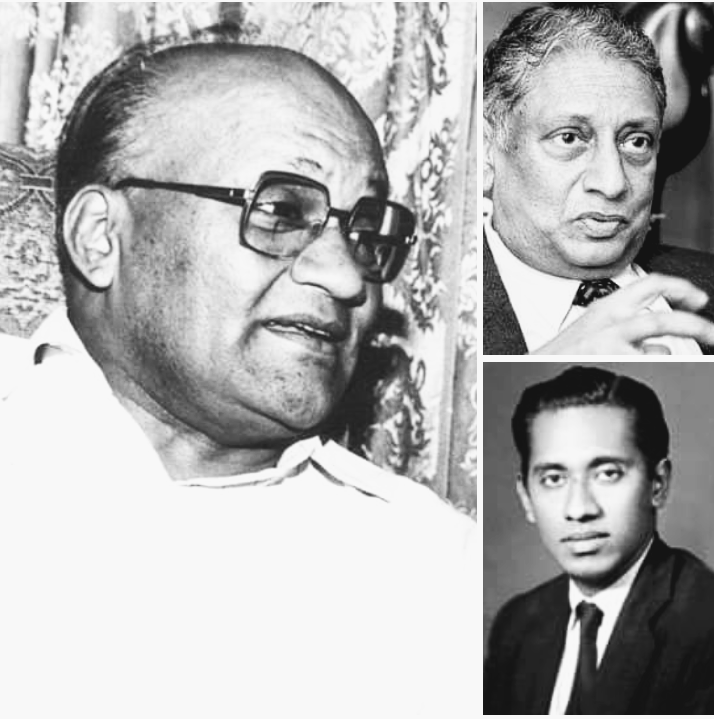
A.Amirthalingam, Lakshman Kadirgamar & Alfred Durayappah
The lawyer-politician is being attacked as a ‘Tamil traitor’ for some of the comments he reportedly made in a Sinhala language interview conducted by journalist Chamuditha Samarawickrama for his ‘Truth with Chamuditha’ You Tube channel.
A few of the answers in Sinhala were picked up by a Tamil TV aligned to a pro-Government politician and publicised in Tamil. The TV allegedly mistranslated the words of Sumanthiran into Tamil with a mischievous anti-LTTE twist in a bid to irritate and provoke Tigerish and pro-Tiger elements in the Tamil community. It seems to have worked!
MA Sumanthiran
The past week or more saw Sumanthiran being attacked viciously by many in a heated exhibition of ‘manufactured rage’ over the mainstream Tamil media and social media within and outside Sri Lanka. A number of media statements were issued by Tamil politicians condemning Sumanthiran.
The Tamil National Alliance (TNA) is the premier political configuration representing the Sri Lankan Tamils of Northern and Eastern Sri Lanka. The booming question that has been looming large on the Tamil political horizon during the past week or more is whether the TNA was created by the Liberation Tigers of Tamil Eelam(LTTE) in 2001. This revival of interest in the antecedents of the TNA was sparked off by a You Tube interview of TNA spokesperson and former Jaffna district MP M. A. Sumanthiran by senior journalist Chamuditha Samatawickrama on his “Truth wih Chamuditha” show. The interview has resulted in a lot of critism being levelled against Sumanthiran.Much of the “manufactured rage”targeting Sumanthiran was due to he lawyer -politician re-iterating that he had not been supportive of the LTTE in the past.
One of the interesting aspects thaon hist was highlighted in this anti-Sumanthiran political storm was the origin of the TNA itself. Chamuditha Samarawickrama in his interrogative style harped on the TNA being the creation of the LTTE through a barrage of “hostile” questions. He even charged that LTTE leader Veluppillai Prabhakaran had chaired the inaugural TNA meeting. Sumanthiran denied the charges with unflappable dignity. He emphasized the fact that the TNA was not formed by the LTTE in 2001. Continue reading ‘Was The Tamil National Alliance Formed By The “Tigers” In 2001?’ »
Former Jaffna District Parliamentarian and Spokesperson of the Tamil National Alliance(TNA) and Ilankai Thamil Arasuk Katchi(ITAK), Mathiaparanan Abraham Sumanthiran is currently in the eye of a political storm. The you tube interview given by the 56 year old Presidents counsel cum politician to the “Truth With Chamuditha” show conducted by senior journalist Chamuditha Samatawickrama is the reported cause of the controversy.
A few of the questions and answers in Sinhala were picked up by sections of the Tamil media who seem to have deliberately mistranslated the words of Sumanthiran with duplicitous twists and mischievous slants. Many Tamils opposed to Sumanthiran either believed or pretended o believe this and indulged themselves in an orgy of “manufactured rage”. This in turn led to a cacophony of angry voices , over the mainstream Tamil media and social media – within and outside Sri Lanka – berating Sumanthira n for what he had “purportedly”stated. He was – and is being – attacked viciously. Continue reading ‘TNA Spokesperson Sumanthiran In The Eye Of a Political Storm’ »
The political prospects of the Tamil people, or if you prefer, the Tamil ethnonational community or Tamil minority are at the dimmest, lowest and most challenging that I can remember, and my memory goes back to 1972, the hoisting of black flags (occasioning a sensitive Daily News editorial by my father) and the boyhood of Tamil militancy.
The problem the Tamils face today goes beyond the historic folly of Tamil nationalism not settling for a stalemate with structural reform as in Northern Ireland, instead of supporting to the bitter end a war for a separate state which was utterly lost. The problem they face is similar to that which the Palestinians do, in that there is an ultra-hawkish administration which has decidedly turned its back on the earlier consensus on the nature of the problem and the contours of a solution, and is moving swiftly and unilaterally to shape a final geopolitical outcome of a zero-sum character.
The challenge the Tamil community faces today is the drastic discontinuity in Sri Lankan politics and political history: for the first time since Independence, the ultranationalist Sinhala Hard Right is in office and wields State power.
This is the ultimate polarised outcome that Prabhakaran sought and thought he obtained in 2005. He was wrong, and that mistake killed him. His wish has now been realised, but the grimness of the political prospect facing the Tamil community is testimony to his folly.
50 years ago, on May 27, 1970, the journey of a political legend began. Entering Parliament as the youngest MP to join, Hon. Mahinda Rajapaksa, entered the political sphere back then with only one aim, one vision – to serve the country, to sacrifice himself for his people, and bring the country up to its true potential.
Mahinda Rajapaksa, today, completes his 50th year serving the nation, in dedication and true spirit. While his journey has been an emotional and memorable ride for him and us, as his children, my mother always says, it has all been worth it. To see mother Sri Lanka risen, to see her develop, to see her children strive and to free her from terrorism, are somethings he can now reflect back and be happy with, a feat no other political leader could achieve.
Responding to the report ‘Sri Lanka will not tolerate targeting of war heroes: Gotabaya Rajapaksa’ published on May 20 in The Hindu, the office of the President of Sri Lanka, Gotabaya Rajapaksa, has said the article did not reflect “the real situation”.
The President’s Media Division, in a written response, pointed to its reference to several Sri Lankan soldiers, especially top officers, being accused of human rights violations during and soon after the war, and said: “In any armed conflict, maintaining human rights of an individual is akin to preventing muddy puddles during rain.” Due to the “volatile” nature of warfare, International Humanitarian Laws are “not a set of clear-cut rules in black and white that one may tick off against.” “Instead, it must take into consideration the principles of distinction and legitimate targeting, military necessity and proportionality to judge a military operation for its action,” the statement said, adding that no official documentation had “proven allegations” of war crimes.
.
Ceylon Workers’ Congress [CWC] leader and Sri Lanka Cabinet Minister Arumugan Thondaman passed away on Tuesday night, after a sudden illness. He was 55.
Earlier on Tuesday, Minister Thondaman met Indian High Commissioner Gopal Baglay and held discussions on development partnership in Sri Lanka’s hill country, where Malayaha Tamils, or Tamils of recent Indian origin, reside.
President Gotabaya Rajapaksa has brought six institutions including the Api Wenuwen Api Fund and the National Police Academy (NPA) under the Ministry of Defence.
The relevant Gazette notification was issued by the President on Saturday.
The Api Wenuwen Api Fund was set up as a collaboration between the Defence Ministry and the Central Bank to build 50,000 houses for the serving armed forces personnel in 2009 while the NPA used to function under the Police Department.The other institutions brought under the Defence Ministry are the MILODA Institute (Academy of Financial Studies) which is the training arm of the Ministry of Finance, the National Authority for the Implementation of Chemical Weapons Convention which was under the Ministry of Industry and Commerce during the last Government and the Sri Lanka Institute of National Defence Studies, and the Department of Multi-Purpose Development Task Force.
Sri Lankan President Gotabaya Rajapaksa’s decision to entrust the survey and preservation of archaeological sites in the ethnically-mixed Eastern Province to a Presidential Task Force headed by the Defense Secretary, appears to have a political objective.
Ostensibly taken at the instance of the Buddhist Advisory Council (including the Mahanayakes) the decision taken at a meeting on May 22, seems to be aimed at ensuring the hold of the ruling Sri Lanka Podujana Peramuna (SLPP) on the Sinhala-Buddhist constituency in the Lankan parliamentary elections to be held in a couple of months.
Giving the task to the Defense Secretary, who is a former Major General, conveys the political message that any decisions taken by the Task Force will be enforced in military style. This gives the Sinhala-Buddhist nationalist lobby confidence that the Gotabaya government means business. This lobby believes that a manifest show of toughness is called for because Tamil nationalists (not just the pro-LTTE Eelamists) consider the North and East as their “Traditional Homeland” which had been encroached upon by the Sinhala-Buddhists in the post-independence period through systematic “colonization”.
Tamil militants had fought, albeit unsuccessfully, a 30-year war for a Homeland free of other ethnic groups. The Sinhala-Buddhist majority is apprehensive about a resurgence of the Tamil separatist movement and are anxious to reclaim what they consider to be their historical habitat which, in their view, was taken by force by Tamil speaking invaders from South India.
And it is on the Eastern Province that their eyes are set because it is here that the Sinhala-Buddhists have a foothold, forming as they do, a third of the total population.
As part of its efforts to revive the economy and reduce the COVID-19 impact, the Government yesterday eased import restrictions on several product categories linked to exports and production of import substitution goods but retained the ban on vehicles.
The interim trade and custom based tax policy framework, which is part of the COVID-19 Economic Revival Plan of the Government was released yesterday and will see imports of motor vehicles, including motor cars and three wheelers continue to be banned along with imports of ethanol, furniture, and aluminium products among others.
The interim guidelines aimed at revising Sri Lanka’s external trade and customs-based tariff policy was sent to Customs Director General Major Gen. (Retd.) Vijitha Ravipriya by President’s Secretary Dr. P.B. Jayasundera on Thursday.
In the covering letter, Dr. Jayasundera said the guidelines provide a framework based on which the Customs can make decisions while adhering to the policy thrusts and guiding principles prioritised by the Government.
A heaty dialogue appears to have been generated on social media over two letters that I had addressed to the Ravaya staff recently, suggesting to them the desirability of liquidating Ravaya in the present context of the coronavirus pandemic Sri Lanka is facing rather than continuing the publication and avoid disastrous financial consequences that might arise if we were to continue under trying conditions.
Ravaya being a unique experiment made by me in the field of journalism providing a radical platform to discuss controversial and sensational issues, I felt it is appropriate, at this juncture, to publish a brief account of my observations which I had communicated to the Ravaya staff and highlight major experiments I have made with Ravaya over the last 33 years for the benefit of journalists as well as the Ravaya readers.
The State of Sri Lanka and its institutional system and the political system of Sri Lanka and its social system have been the major focus of my interest and investigation for a very long time. One major observation I have made after the internal civil war was over was that the State and the sociopolitical system of Sri Lanka would inevitably suffer a serious decline, plunging the country into anarchy unless immediate measures were taken to introduce structural reforms leading to a formal recreation of the State and the socio-political system. I reached this horrific conclusion taking the following reasons into consideration.
Unsurprisingly but nonetheless worryingly, a seismic shift in positing the military front and centre of Sri Lanka’s governance framework was pronounced in Prime Minister Mahinda Rajapaksa’s statement this week, issued on the eleventh anniversary of the military defeat of the Liberation Tigers of Tamil Eelam (LTTE).
Powerful imagery and symbolic thrust
Lost in the general storm of covid-19 updates which still crowds out virtually every other happening, this Prime Ministerial statement, given its powerful imagery and symbolic thrust, must not be lost sight of. And for those seeking illusionary comfort in imaginary divisions among the Rajapaksas, that statement should put such frivolities to rest.
Indeed, the Prime Minister’s statement went so far as to rework the historic five force influence in Sri Lanka into a political narrative of militarisation which has significant impact on the democratic process. It is not so much the words used per se as the justification behind them which has concerning undertones.
Those familiar with Sri Lanka’s history would know that the ‘Pancha Maha Balavegaya,’ namely the ‘Sangha’ (priesthood), ‘Weda’ (medicinal men), ‘Govi’ (farming community) and ‘Kamkaru’ (workers) was the cannily manipulative banner with which the ‘Sinhalisation’ movement of the late Premier SWRD Bandaranaike rode into battle against the scorned colonised Westernized liberal elite of the day, not long after the country attained independence.
It did not take much time before Bandaranaike was assassinated by a fanatical adherent of one (the ‘Sangha’) of those same five groups but thats ancient history to be sure.
S’
At a time when big and mighty countries struggle to cope with soaring numbers of coronavirus cases and consequent deaths, the official figures from 21-million strong Sri Lanka stand out — 1,070 cases, 660 recoveries and nine deaths as of Saturday evening.
Behind those promising numbers are early thinking and swift action, according to Dr. Anil Jasinghe, Director General of Health Services in Sri Lanka. The senior public health official, helming Sri Lanka’s pandemic response, along with the Army Commander who heads a task force on COVID-19, says it is “targeted and tough” control measures, rather than a generic template “based on literature”, that helped the island nation arrest the pandemic’s spread.
Data published by the World Health Organization shows that Sri Lanka remains among the least affected countries in South Asia, along with Nepal, Bhutan and Myanmar that have recorded under 1,000 positive cases so far. “We have managed this because we planned in advance,” Dr. Jasinghe notes, in an interview to The Hindu at the Ministry of Health.
Minister Bandula Gunawardena is out. He thought it was a sixer he hit, with the ball rising up in the sky and racing to pass the boundary. But it suddenly moved down, and was caught by none other than the Vice Captain – the Prime Minister himself.
Which means the Homagama, Diyagama Test Cricket Field is out, at least now, being suspended. There is always a chance of a rebirth of a Cricket Ground that is named after none other than Mahinda Rajapaksa. But let that take its own time. We now have to cheer the Rajapaksa fielding at the boundary that sent Bandula Gunawardena to the pavilion; to think of another headline hitter that will stand out amidst the Covid scares.
Sri Lankan health authorities announced on Friday that the total number COVID-19 infections had risen to 1,068 but that the official death toll remained at nine.
The government is using these relatively low numbers to claim that the coronavirus is “under control” and that the existing, but limited, national curfews can be lifted.
The low number of infections, however, is because of the small number of COVID-19 tests being conducted—an average of less than 600 per day between February 18 and May 20.
On May 11, President Gotabhaya Rajapakse declared a “reopening of the economy.” About one third of employees from the state-owned and private sector returned to work in Colombo and Gampaha, the country’s main working-class centres.
Since then the government, with corporate media backing, has conducted a “living with corona” or “new normal” campaign, promoting the illusion that the pandemic danger is receding.
Existential perils to the democratic, constitutional model on which the Sri Lankan Republic was constructed now quickening apace, does not even have the excitement of novelty to spark the imagination.
Familiar patterns of militaristic governance
There is nothing very special in the creeping militarisation of governance that we are witnessing. From increasing numbers of miltary men who are elbowing public servants out of positions of high state responsibility sans national protest to a President who commands the remainder in the public service to ‘obey or else…’ and a global health pandemic being unquestioningly conflated with fighting an enemy with our brave troops, this is a familiar pattern. So too is the phenomenon of militaristic monks who openly announce that covid-19 has made elections irrelevant and that the country should just be ruled by the President and his men.
Alas, there are no redeeming romantics here, no flourishing figures of mettle roaring against popular historical injustices who may have at least enlivened the singular boredom of this common or garden path transition from a flawed democracy to a militaristic model in all but name. This is the same reasoning on which it seems that a nation has accepted the arrest of an attorney by state agents citing no other reason at the time of arrest, than being ‘directly in touch’ with suspected terrorists, apart from other grounds now being advanced to justify the same.
Addressing a victory celebration on Tuesday, Sri Lankan President Gotabhaya Rajapakse eulogised the military for its part in Colombo’s 30-year communal war and declared that he would continue to oppose all war crime indictments against the armed forces. The event was held at Battaramulla, in the Colombo suburbs, near a memorial to mark the 11th anniversary of the defeat of the separatist Liberation Tigers of Tamil Eelam (LTTE).
The war ended on May 19, 2009 in a bloody assault that lasted several weeks. The United Nations estimates that about 40,000 Tamil civilians were killed during the final weeks of the conflict. Hundreds of those who surrendered, including LTTE fighters, simply disappeared and some 300,000 civilians were incarcerated in military-controlled camps. About 11,000 young men and women were herded into so-called rehabilitation centres.
Others participating in Tuesday’s event included the president’s brother, Prime Minister Mahinda Rajapakse, and the commanders of Sri Lanka’s army, navy and air force. The Rajapakse’s directly oversaw the bloodbath, with Mahinda serving as president and Gotabhaya as his defence secretary. Along with the military leadership, they are implicated in the war crimes committed.
This year’s “celebration” was held amid the deepening COVID-19 crisis and rising class tensions in Sri Lanka and internationally. While Rajapakse has “reopened the economy” and is demanding people return to work, his government and big business backers are nervous about the growing working-class opposition to unsafe working conditions, massive job and wage cuts and attacks on other rights.
Speaking at the National War Heroes Commemoration Ceremony on 19 May 2020, President Gotabaya Rajapaksa declared that he will not hesitate to withdraw Sri Lanka from any international body or organisation that continuously targets the country and war heroes.
The President was probably referring to the UN Office of the High Commissioner for Human Rights and the Human Rights Council, given that they are the only international entities that Sri Lanka belongs to, which have systematically targeted the country and its armed forces.
The statement has received wide publicity in the international media and can boomerang back on Sri Lanka at a time it desperately needs international support, precisely to protect its war heroes.
The United Nations is an obstacle to US hegemony, but Sri Lanka cannot survive without it.
The intention of this author is not to echo the detractors of Sri Lanka, whose object it is to undermine the country’s sovereignty. On the contrary, it seeks to highlight the dangers of a policy of withdrawal from an international organisation that, under the existing international order, is the ultimate guarantor of that sovereignty.
The footage on TV news was straight out of my favourite Netflix series. A long convoy of glossy black four-wheel drives coming down a dusty road with a heat haze shimmering in the background. Elite guards in red berets and body-armour, sunshades and carrying Heckler-and-Koch MP6s dismount, escorting the Bosses, also in shades, one in civvies and tie, the others in uniform. Marking it a South Asian rather than Latin American setting is a puff of pink saree in a bustle. Cut to a sitting room in which the heavy-hitters are in conversation with venerable members of the Buddhist clergy.
The Secretary/Defence General Kamal Gunaratne and the Army and Navy Chiefs took time off from spearheading the anti-corona campaign to visit the Muhudu Maha Vihara and Digavapi in the Eastern Province.
LankaCNews headlined the story thus: “On the orders of the President, the Secretary of Defence arrives at Muhudu Maha Vihara with the Tri-Services…erects military encampment to save the heritage.”
A TV station friendly towards the administration gave more detail.
Below are my Initial comments on the statement made by President Gotabaya Rajapaksa yesterday when addressing the war hero’s ceremony at the war memorial, that he will not hesitate to pull Sri Lanka out of any international organisation that unfairly targets the country’s war heroes.
My Comments
The President is most likely referring here to the UN Human Rights Council and the UN Office of the High Commissioner for Human Rights. The statement indicates he is either wrongly advised about the UN or plain politics, which could go against Sri Lanka at a time it desperately needs international support precisely to protect its war heroes. The statement has been widely picked up by Western media agencies, which have a global influence.
Why is there a problem with the statement?
SL is not a Member of the UN Human Rights Council (HRC) it is only an Observer State, so the question of ‘pulling out’ does not arise. Besides, HRC is an integral part of the United Nations, a subsidiary body of the UN under the General Assembly, which elects HRC members from among UN member States. The only way to completely withdraw from HRC is to leave the United Nations.
As for ‘pulling out’ of OHCRC, the only way to do so would also be by leaving the UN altogether, OHCHR being a body of the United Nations, not a Specialised Agency.
The Election Commission (EC) yesterday informed the Supreme Court that the general election could not be held on June 20.
President’s Counsel Saliya Peries, appearing for the EC submitted to the court that as of now it felt that the general election could not be held on June 20.
The submission was made when the fundamental rights petitions challenging the date of the election were taken up by the court.
The five- judge bench consisting of Chief Justice Jayantha Jayasuriya and Justices Buwaneka Aluvihare, Sisira de Abrew, Priyantha Jayawardena, and Vijith Malalgoda continued hearing the relevant petitions for the third consecutive day, yesterday (20).
After de-colonization, many countries in South and South East Asia have been subjected to military rule. But military rule has been both direct and indirect. The affected countries have also gone through “de-militarization” and “re-militarization” depending upon a variety of domestic and external development impinging on the ruling elites’ notion of “national security.”
The reasons for a country’s military seizing political power or its continuance as a ruler have been diverse. The most common reasons are external and external threats to national security and a manifest failure of civilian regimes to ensure stability, democracy and functional efficiency in governance. The development of a vested interest in having a hand on the levers of power is another important reason.
Pakistan, Bangladesh, Thailand, Myanmar, Indonesia and the Philippines have seen military governments; attempted military coups; and the military’s playing a role in civilian politics by supporting or denying support to political groups.
In Pakistan and Bangladesh the failure of early civilian governments to provide stability, democracy and economic growth brought the military to the political sphere. Though the Pakistani military is back in the barracks for sometime now, it does exercise control over civilian governments. It has also developed a vested interest in political power having to safeguard it economic interest as a major corporate investor.
Brigadier Priyanka Fernando was Promoted to the rank of Major General of Sri Lanka Army on the 11 th Anniversary of liberation of Sri Lanka from the LTTE.
The President promoted over a 14000 officers in the military to mark the 11th anniversary of the national war heroes day.
President Gotabaya Rajapaksa yesterday declared that he wouldn’t hesitate to withdraw from the international bodies relentlessly attacking Sri Lanka over unsubstantiated war crimes allegations.
He said so at the 11th annual commemoration of the defeat of the LTTE. The ceremony was held at War Heroes’ memorial in Battaramulla.
The President said: “Even leaders of powerful countries have emphatically stated that they would not allow any action against their war heroes. As such, in a small country like ours where our war heroes have sacrificed so much, I will not allow anyone, or organization, to exert undue pressure on them and harass them.
“If any international body or organization continuously targets our country and our war heroes, using baseless allegations, I will also not hesitate to withdraw Sri Lanka from such bodies or organizations.”
(20th May, 2020 Statement Issued by the Peoples Alliance for Right to Land (PARL) on recent developments in Pottuvil Muhudu Maha Viharaya inclusive of Misuse of land acquisition laws and the military)
The People’s Alliance for Right to Land (PARL) is deeply disturbed by the military intervention in civilian land administration in the Pottuvil Muhudu Maha Viharaya area in Ampara, and the reported moves to attempt legal acquisition of these lands as an archaeological site without adhering to transparent procedures, providing scientific justification of archaeological claims, and consulting with affected communities.
Any developments must also take account of the fact that land issues in this area have a complex history, and its people have long standing grievances that require sensitive and meaningful solutions.
The second day of hearing of Fundamental Rights (FR) petitions that have been filed challenging the Gazette issued by President Gotabaya Rajapaksa dissolving Parliament as well as the Gazette issued by the Election Commission that has set 20 June as the date for the General Election were taken up before a five-member Bench of the Supreme Court yesterday.
The Bench comprises Chief Justice Jayantha Jayasuriya as well as Justices Buwaneka Aluvihare, Sisira de Abrew, Priyantha Jayawardena, and Vijith Malalgoda.
Counsel for five of the Petitioners made submissions yesterday arguing that the Gazette notification issued by the President dissolving Parliament is no longer valid as the Constitution stipulates the new Parliament must meet within three months of such a dissolution.
The Supreme Court yesterday began hearings into several Fundamental Rights petitions that have been filed challenging the Gazette issued by President Gotabaya Rajapaksa dissolving Parliament as well as the Gazette issued by the Election Commission that set 20 June as the date for the poll.
The case is being heard before a five-member Bench consisting of Chief Justice Jayantha Jayasuriya as well as Justices Buwaneka Aluvihare, Sisira de Abrew, Priyantha Jayawardena, and Vijith Malalgoda.
Prime Minister Mahinda Rajapaksa yesterday issuing a statement to mark the 11th year anniversary to commemorate the victory against the Liberation Tigers of Tamil Eelam (LTTE) reiterated it was not a war against the Tamil people, but against an organisation designated by the FBI as the deadliest terrorists in the world.
Following is the full statement issued by the Prime Minister:
“On 19 May we mark the 11th anniversary of the victory against the LTTE. That was not a war against the Tamil people but against an organisation designated by the FBI as the deadliest terrorists in the world. Due to the defeat of the LTTE, Tamil people are now free to live as they wish. Tamil children are no longer forcibly recruited by the LTTE. Tamil politicians no longer live in fear of LTTE assassins. Furthermore, due to the absence of the LTTE, elections can be held in the Northern and Eastern Provinces and that has safeguarded the sovereign rights of the people of those provinces.
A five-judge bench of the Supreme Court, will tomorrow, May 18, examine at least six Fundamental Rights petitions challenging the holding of the Parliamentary General Elections on June 20 and the President’s refusal to reconvene the recently dissolved Parliament.
At these hearings, the Court will decide whether they are to accept the petitions and grant “leave to proceed” with the cases.
Some of the petitions are seeking the reconvening of the recently dissolved Eighth Parliament as a solution for a looming Constitutional Crisis and an invalidation of the date of the election now fixed for June 20.
Monday and Tuesday have been set aside for the hearings.
Chief Justice Jayantha Jayasuriya has appointed Supreme Court Justices Buwaneka Aluwihare, Sisira de Abrew, Priyantha Jayawardena and Vijith K Malalgoda to the bench that will decide whether leave to proceed will be granted. Chief Justice Jayasuriya will preside.
The CJ may appoint a full seven-judge bench for the hearings, if leave to proceed is granted.
When Seven major opposition parties made an offer of responsible cooperation in return for restoration of Parliament to President Gotabaya Rajapaksa they were rudely rebuffed. When his brother Prime Minister Mahinda Rajapaksa invited all former MP’s of the dissolved Parliament for a political conference, he was rebuffed (but not rudely) by all opposition parties. All parties except one. Of the seven opposition parties who jointly made the responsible cooperation offer, only the Tamil National Alliance(TNA) accepted the premier’s invitation albeit with reservations. By responding positively to PM Mahinda Rajapaksa’s invitation positively, the TNA seems to have scored politically.
What had happened earlier was that in a related development several of Sri Lanka’s opposition parties came together for a common purpose in the national interest. Seven political parties, namely, the United National Party (UNP), Samagi Jana Balawegaya (SJB), Tamil National Alliance (TNA), Sri Lanka Muslim Congress (SLMC), All Ceylon Makkal Congress (ACMC), Tamil Progressive Alliance (TPA) and Jathika Hela Urumaya (JHU) issued a ten – point joint statement on April 27 pledging ‘Responsible cooperation’ to the President and Government if Parliament is restored in the best interests of the country and all her people. Continue reading ‘TNA Scores Politically By Responding To PM Mahinda’s Invitation Positively’ »
BEFORE THE presidential election he won last November, Gotabaya Rajapaksa laid out for Banyan his vision for Sri Lanka. It was a sunlit upland of peaceful, inclusive “knowledge-based” development. All the political bickering of recent years, “Gota” promised, would be swept aside by his programme of brisk, technocratic proficiency. His years as an army officer would ensure that.
A military timbre to the former lieutenant-colonel’s rule was always on the cards. Mr Rajapaksa’s campaign dwelt on the need for a “disciplined society”. Viyathmaga, a social movement with political ambitions that backed him, counted many former officers among its leaders. The president’s personal network is rooted not just in his family (his elder brother, Mahinda, now prime minister, was himself president from 2005 to 2015). Go
ta commands the loyalty of past and present soldiers, a band of brothers from his time fighting a horrific, long-running civil war against Tamil insurgents, first as an officer and latterly as the powerful secretary of defence under Mahinda.
(Text of Statement Issued by R Sampanthan Leader of the Tamil National Alliance and former Member of Parliament)
My attention has been drawn to the interview said to have been given to the media by Mr. M. A. Sumanthiran, President’s Counsel, former Member of Parliament Jaffna District, and Spokesman for the Tamil National Alliance.
Mr. Sumanthiran has been frank and forthright in his answers to questions that have been asked with the deliberate purpose of promoting mischief and disunity amongst the people of this country particularly amongst the Tamil people with the ulterior purpose of sabotaging efforts to find a resolution to the National Question within the framework of a single united undivided and indivisible Sri Lanka.
On 11 and 12 May, several newspaper and websites quoted the Attorney General as stating in Court that day that he could not represent the Election Commission in the ongoing FR petitions on the Parliamentary Elections.
The Attorney General represented by ASG Indika Devamuni de Silva said that the AG would represent only State institutions named as Respondents. The EC was not considered a public institution; it was an independent commission. Therefore the AG Department would not represent the Elections Commission or its Chairman, the ASG added.
Nonsense. Pure spin. The EC has been an Independent Commission from late 2014 and has been represented by the AG in dozens of cases. When did the AG discover that he cannot represent Independent Commissions?
Sri Lanka’s Tamil National Alliance (TNA) has sought the release of “political prisoners” who were arrested — some convicted — for their alleged association with or role in the rebel LTTE during the civil war.
On Tuesday night, TNA spokesman and former Jaffna parliamentarian M.A. Sumanthiran handed over a list of the detainees under Sri Lanka’s controversial Prevention of Terrorism (PTA) Act to Prime Minister Mahinda Rajapaksa.
“There are 96 political prisoners in all and 47 of them were convicted. Only a presidential pardon can release them,” he said, referring to the Sri Lankan President’s discretionary power to grant amnesty. In March this year, President Gotabaya Rajapaksa pardoned a soldier who was on death row for killing eight Tamil civilians, including a five-year-old, during the civil war.
There is a standoff between the New President and the Old Parliament. The Old Parliament wants the New President to recall it. And the New President wants to bring in a New Parliament that supports him. But both are stuck. The Old Parliament does not have the power to recall itself. It depends on the President. And the President does not have the power to hold elections. He depends on the Election Commission. And the Election Commission does not have the power to hold an election whenever it wishes. Its decision depends on the state of the coronavirus.
If the corona pandemic dissipates or even remains at the same level after the lockdown is eased on May 11, elections can be held on June 20. But if the coronavirus continues to spread or there is a spike in the numbers of those infected, the elections will have to be pushed back further.
The President blames the Old Parliament, arguing it cannot be trusted to deliver the funds, the legislation or the political support to deal with the corona crisis despite the risk to Sri Lankan lives. Meanwhile, the Old Parliament blames the New President, saying he is in an unseemly rush to hold elections so he can have a majority in parliament, despite the risk to Sri Lankan lives due to the coronavirus.
Both should understand that however much they would like to blame each other, the culprit is corona. And the real decision maker of how to deal with elections in the context of corona is not Gotabaya Rajapaksa, Mahinda Rajapaksha or Sajith Premadasa. It is Mahinda Deshapriya, Jeevan Hoole and Nalin Abeysekara. It is the latter three who will call the shots, as long as the former cannot agree.
The Election Commission, which met yesterday, decided to postpone the issuing of the Gazette notification bearing the names and preferential number of candidates contesting the upcoming General Election until the Supreme Court rules on the Fundamental Rights petitions filed challenging the date of the election.
EC sources said the Commission decided to await the Court ruling, as issuing of preferential numbers would result in the candidates beginning their campaigns when there was uncertainty over the election date.
The Supreme Court on Monday fixed 18 and 19 May to consider the seven Fundamental Rights petitions that have been filed challenging the Gazette Notification setting 20 June as the date of the Parliamentary Election.
June 20th 2020 is the D-day for Sri Lankan Parliamentary Elections. The Election Commission has fixed June 20 as the new date for the postponed election of April 25. However a question mark looms large over the holding of polls on the said date as scheduled. At least eight fundamental rights petitions have been filed in the Supreme Court challenging the holding of elections on June 20.
Among the petitioners are a civil society group of Prominent Sri Lankans led by Journalist Victor Ivan, the Centre for Policy Alternatives and its Executive Director Dr.Paikiyasothy Saravanamuttu, Samagi Jana Balavegaya General Secretary Ranjith Madduma Bandara, Jathika Hela Urumaya leader Patali Champika Ranawaka, Former Kalutara district MP Kumar Welgama and Attorney – at – law Charitha Gunaratne.
Three separate benches comprising three judges each are expected to begin hearing them next week from May 11th onwards. The first of the cases will be taken up for support by the Supreme Court on Monday May 11th . This will be the FR petition filed by Charitha Gunaratne.The bench will comprise Chief Justice Jayantha Jayasuriya, Justice Murdu Fernando and Justice Sithamparapillai Thurairajah. In an unexpected turn of events Presidents Counsel M. A. Sumanthiran is expected to appear on behalf of petitioner Gunaratne. Ex-Jaffna district MP Sumanthiran will also be appearing for the Group led by Victor Ivan when that petition is taken up by courts.
‘Responsive cooperation’ was at one time a popular phrase in the political lexicon of Ceylon as Sri Lanka was known in the past. It came into vogue through G.G. Ponnambalam, the mercurial leader of the All Ceylon Tamil Congress (ACTC), founded in 1944.
The G.G. Ponnambalam-led Tamil Congress demanded a political system based on the principle of balanced representation known popularly as ‘fifty-fifty’ to safeguard the minority communities under majority rule after the then Ceylon gained independence from Britain.
What G.G. Ponnambalam wanted was for one-half of the seats in the Legislature to be allocated to the majority community (Sinhalese) and the other half to be divided among the minority communities (Sri Lankan and Indian Tamils, Muslims, Burghers, Malays). The Soulbury Commission rejected the balanced representation proposal.
The pragmatic Ponnambalam accepted the inevitable with the impending dawn of Independence and adjusted his policies accordingly. He abandoned the politics of confrontation and proposed a new approach of accommodation and cooperation with the majority. The Tamil Congress changed its stance from balanced representation to responsive cooperation.
“We are for responsive cooperation with fair -minded Sinhalese,” said Ponnambalam. The responsive cooperation proposed by Ponnambalam culminated in his joining the Government of Prime Minister D.S. Senanayake and becoming Minister of Industries, Industrial Research and Fisheries in the UNP Cabinet.
‘Responsible Cooperation’
More than seven decades later the concept of responsive cooperation has re-emerged within the political discourse of the Island nation albeit with a variation. The old ‘Responsive cooperation’ has been replaced with the new ‘Responsible cooperation’.
The world including Sri Lanka is undergoing a pandemic crisis of colossal proportions. The Island nation however is in double jeopardy as it is in the grip of two crises siumultaneously. One of course is the Covid-19 Health crisis inflicted globally by nature. The other experienced by Sri Lanka is the Constitutional crisis which is essentially man made. Complicating matters further is the fact that both the corona crisis and the Constitutional crisis are to some extent inter-twined in the Sri Lankan context.
via: facebook.com/PresidentRajapaksa
Karu Jayasuriya who was the previous Parliament’s Speaker (technically he remains Speaker until the new Parliament convenes) has observed very correctly that Sri Lanka is the only country facing the Coronavirus without a legislature. The parliament elected in 2015 has been dissolved. Envisaged elections to elect a new Parliament in 2020 are yet to take place because of postponement due to Covid -19 pandemic. The deadline for the vote on account passed by the previous Parliament is on April 30.
Even though the country is faced with a pandemic, Parliament has not been re-convened to cope with the emergency. There is also no indication by the president that he would rescind his gazette procalamation dissolving parliament. The chances of the postponed election – earlier scheduled for April 25 – being held soon seem remote at present. If so the possibility of a new Parliament meeting before June 2 as stipulated by the constitution is highly unlikely.The country is heading for a crisis of great magnitude. Continue reading ‘Politics of Postponing Parliamentary Elections Amidst a Pandemic’ »
By (Dr) Jayampathy Wickramaratne, President’s Counsel
My article, ‘Necessity: Doctrine That Destroyed Pakistani Democracy’ published in The Island on 08 May has evoked interest in the subject and I have been asked for my views on its implications for Sri Lanka, including on whether it can be invoked in the present circumstances.
For the benefit of readers who have not read my earlier article, let me say that according to the doctrine of necessity, first expounded as a criminal law principle, ‘that which is otherwise not lawful is made lawful by necessity’. We have seen the doctrine of necessity being used to destroy democracy in our neighbourhood, in Pakistan. Chief Justice Munir who first invoked the doctrine in 1954 has been described as the ‘destroyer of Pakistan’. A senior Pakistani lawyer who read my article wrote to me to say that years later, Munir clarified in a lecture at the Lahore High Court that holding against the Governor General would have entailed enforceability issues and caused bloodshed.
In his book ‘From Jinnah to Zia’ published in 1979, Munir does not utter a word about his infamous judgements or about the doctrine, probably out of remorse. After several decades, and military coups which were validated using the doctrine, the Supreme Court, in Syed Yusuf Raza Gilani, Prime Minister’s case, refused to resurrect ‘the malignant doctrine of necessity which has already been buried, because of the valiant struggle of the people of Pakistan.’ I wish to correct a mistake in my earlier article; the date of the Gilani judgement is 19 June 2012, not 19 June 2019.
The doctrine has come up for discussion in Sri Lanka due to the postponement of Parliamentary elections due to the Covid-19 pandemic.
By Harindra Dunuwille (The Writer a former Mayor of Kandy is an Attorney-at-Law and an ex-State Minister of Constitutional Affairs)
Dissolution of Parliament
President Gotabaya Rajapaksa exercising his constitutional powers and prerogatives under the 19th Amendment to the Constitution, dissolved Parliament immediately upon it completing four and a half years by a Proclamation on the 2nd of March 2020. Under normal circumstances Parliament stands dissolved upon the expiry of five years. Clearly the intention was to go before the electorate hot on the heels of his own impressive victory and cashing in on the split in the UNP.
In both instances of the dissolution of Parliament, it is incumbent upon the President to fix the date of the poll for the ensuing General Election and to summon the new Parliament to meet on a date not later than three months after the date of such dissolution/proclamation. Accordingly he fixed 25th April for the poll and 14th May for the new Parliament to sit, complying with the three month time frame stipulated in the Constitution.
Covid-19 Crisis
Unfortunately, the aforementioned legitimate time-frame for the election and summoning of Parliament has been upset by the Covid-19 pandemic. Today, on the 8th of May, we have 724 reported cases and nine deaths. The government appears to be doing its best to overcome the crisis and protect the people.
The growing pandemic has threated the upcoming parliamentary election in several ways. First, it made it practically impossible for the Election Commission to organise the election in the usual way on the date fixed by the President. It has caused the Commission to delay the election until 20th June with no guarantee that the election machinery can be made to function normally even on that date.
Governance in Sri Lanka, is once again, on familiar ground; a constitutional crisis, or at the very least, a constitutional conundrum. In the main, we are presented with two alternatives. Neither of these alternatives seem attractive at first brush; reviving a Parliament that had a mixed record in which we had a minority government since November 2019 or conducting a general election during a pandemic to elect a new parliament. The legality of the curfew and approvals for public spending beyond what has already been approved are two other serious issues that have arisen. As it is often the case in Sri Lanka, public debate on these matters is polarized. The COVID 19 pandemic has led to a crisis in public health. It has also caused a crisis in governance.
Sri Lanka’s response to the pandemic is led by the President, with the active leadership of the military. A COVID-19 Health Care and Social Security fund has been established with donations of more than LKR 800 million. The President has appointed one of his brothers to manage this fund. The entire Sri Lankan population has been confined to their homes for several weeks without a clear legal basis for the curfew. The exercise of public power is being centralised beyond the high level of centralization that the Constitution already provides for. As citizens, how should we evaluate these developments?
What lies beyond a first response?
Undoubtedly, this is a global crisis with an indefinite lifespan. The government’s first response, even if slightly delayed, is to be commended. Others who stepped in to ensure delivery of provisions are also to be commended for adapting very quickly to this crisis. The restriction of movement might be an immediate response to slow the spread of the virus, but it cannot be the only response to this complex and dynamic pandemic. Questions about capacity for testing, criteria for testing, capacity for intensive care, personal protective equipment for healthcare professionals and policies on border control must be resolved. Policy decisions and programmes must be revised as ground conditions evolve. Economic policies and decisions must be devised including for debt servicing, regulation of imports and exports and measures for supporting the different sectors that have been affected. Provision of welfare and education are two other equally affected sectors that require immediate policy, planning and programmatic interventions. Now, more than ever before, the state must deliver efficiently, responsively and in a sustained manner.
(Text of a Press Release Issued by Prime Minister Mahinda Rajapaksa Under the Heading “Controlling the Coronavirus pandemic and gradual restoration of normal life”)
Covid-19 came to the attention of the world as a new disease around the beginning of this year. From the very outset, the World Health Organisation (WHO) stated very candidly that this was a completely new disease and that they too were still in the process of learning more about it.
Even as late as 29 February 2020, the WHO was advising against the imposition of international travel bans. It was only on 6 April that the WHO recommended the use of face masks if it was not possible to maintain social distancing. Every country in the world had to learn more about this disease through experience.
Sri Lanka began preparations for this pandemic quite early. The President set up a task force to combat the Cronavirus as early as 26 January 2020. Even though there were no Coronavirus patients in Sri Lanka at that time, the first quarantine center was declared in Hendala on 4 March. The first Coronavirus patient was discovered on the night of 10 March. From 11 March all passengers coming into Sri Lanka from Coronavirus affected countries, were sent for quarantine.
As the armed forces and police carried out an effective contact tracing programme to identify those who had come into contact with patients, this disease has now been brought under control to a satisfactory degree.
Rishad Bathiudeen, Leader of the All Ceylon Makkal Congress (ACMC) and a former Minister of Industry and Commerce, has written to President Gotabaya Rajapaksa to say that the cremation of Muslims who had died of coronavirus, violates an authentic “Hadeeth” which is attributed to Prophet Mohammad and one of is companions.
”Breaking A Muslim’s Bones When He Is Dead Is Tantamount To Breaking Them When He Is Alive” says a Hadeeth which is authentic and has been ascribed both to the Prophet (PBUH) and to one of the Companions. As such there is no permission to burn the corpse of a dead Muslim,” Bathiudeen points out in his letter, which was also released to the media on Saturday.
“Your Excellency, it is incumbent upon the living Muslims to dispose the body of a dead Muslim as per our religious rites. Among them, burial is the only option prescribed in Islam.It is forbidden for us to cremate our dead. We are expected to take utmost care and sensitivity in even bathing the dead.”
This is not the first time that their livelihoods are being disrupted or destroyed. From the nearly three decade-long civil war until 2009, to the invasive Indian trawlers that reigned their seas soon after, to conflicts with locals operating powerful mechanised boats, to migrant fisherfolk competing for their catch — Sri Lanka’s northern fisherfolk have seen it all. After struggling through the post-war decade, to cope with the aftermath of the devastating war, and against the Indian trawlers’ destructive fishing in Sri Lanka’s waters — which prompted Sri Lanka to introduce tougher laws — things were just beginning to look up. And then the coronavirus (COVID-19) pandemic hit them.
On March 10, Sri Lanka reported its first local case of COVID-19, when a tour guide tested positive. Ten days later the government imposed a nationwide curfew, forbidding travel from one district to another. As of Saturday evening, Sri Lanka had reported 824 cases, 240 recoveries and nine deaths.
The United States Federal Registry run by the National Archive and Records Administration has published President Gotabaya Rajapaksa’s name on its quarterly published expatriate list of individuals renouncing United States citizenship.
The list (document number 2020-09814) published yesterday, prepared by the Internal Revenue Service (IRS) of the US Treasury, lists details of those renouncing US citizenship.
The doctrine of necessity was first expounded in the 13th century by English jurist Bracton, who stated ‘that which is otherwise not lawful is made lawful by necessity’. Glanville Williams described the defence of necessity as involving ‘a choice of the lesser evil. ‘
The doctrine is recognized in criminal law. For example, section 74 of our Penal Code gives the following illustration: ‘A in a great fire pulls down houses in order to prevent the conflagration from spreading. He does this with the intention, in good faith, of saving human life or property. Here, if it be found that the harm to be prevented was of such a nature and so imminent as to excuse A’s act, A is not guilty of an offence.’
Because of its express recognition, with such illustrations, chances of the doctrine being abused in matters of criminal law are less, also because there is at least one appeal available to a higher court. The danger is with its application in constitutional law when a matter is decided almost always in the highest court of a land, as happened in Pakistan.
In Re the Reference by the Governor General (PLD 1955 FC 435), the Pakistani Federal Court quoted Cromwell as saying ‘[i]f nothing should be done but what is according to law, the throat of the nation might be cut while we send for someone to make the law.’ But Cromwell was aware of the danger of abuse of the doctrine. He stated in Parliament on 12 September 1654: “Necessity hath no law. Feigned necessities, imaginary necessities…are the greatest cozenage men can put upon the providence of God . . ..”
S. A. De Smith, having seen the doctrine being prostituted in Pakistan, stated in his Constitutional and Administrative Law (3d ed. 1977, p. 502) that the necessity must be proportionate to the evil that is to be averted and acceptance of the principle does not normally imply total abdication from judicial review or acquiescence in the supersession of the legal order.
This paper is about how the doctrine paved the way for the destruction of democracy in Pakistan, from whose experience Sri Lanka has much to learn. The immediate reason for writing this is the call from pro-government lawyers to emulate what happened in Pakistan. What is worse is the attempt at eulogizing Chief Justice Munir, who introduced the doctrine to Pakistan and who has rightly been labelled ‘the destroyer of democracy in Pakistan’.
Sri Lanka and India can be considered as the only two South Asian countries that have chosen and followed the democratic path since independence.
The Indian National Congress which led India’s freedom struggle had a very clear democratic vision from its very beginning. It can be said that the democratic outlook of the Congress had advanced further after Gandhi took over the leadership of the Congress. The Congress appeared strongly for democratic values and played an important role in socialising them. It had a Charter of Human Rights of its own as far back as 1936 when there was no organisation of the United Nations.
In a democratic sense, Sri Lanka’s independent movement did not reach such an advanced stage. Though some leaders of the independent movement of Sri Lanka had been educated in the West, they however, did not have an advanced liberal outlook. All the leaders of the independent movement except A.E. Gunasinha were so backward in their outlook that they opposed the proposal to grant universal suffrage.
From an ideological point of view, despite the leaders of Sri Lanka being so backward compared to their Indian counterparts, the country still chose the path of democracy notwithstanding these limitations and shortcomings.
Sri Lanka faced two military coups d’état and three armed insurrections in the interim, and none of them were able to change the democratic path that Sri Lanka had been pursuing. Both President J.R. Jayewardene and President Mahinda Rajapaksa, who can be considered the two most powerful leaders that emerged in Sri Lanka since independence, attempted to establish a long-term one-party rule, but, in the final analysis, they failed to achieve their dream.
President Gotabaya Rajapaksa pardoned Sunil Rathnayake in March. Rathnayake is a convicted war criminal who was on death row. He was convicted of killing eight Tamil civilians, including a five-year-old. Releasing him from prison is outrageous and should be condemned in the strongest possible terms.
AFP notes that the murdered “were killed as they returned to their bombed homes to salvage what was left of their belongings and their bodies were found buried in a cesspit near an army camp at Mirusuvil on the Jaffna peninsula.”
The depressing reality is that the Rathnayake pardon isn’t anomalous. It’s not particularly unexpected and there had been rumours this pardon was in the works. What was truly surprising is that Rathnayake actually got convicted in the first place.
A Fundamental Rights Violation Petition was filed on Tuesday 5 May on behalf of lawyer Hejaaz Hizbullah, who is purportedly under custody on detention order.
The Petition was filed by senior Attorney-at-Law Gowry Shangary Thavarajah citing Acting IGP C.D. Wickramaratne, Director of CID SSP W. Thilakaratne, Chief Inspector Karunatilaka of the CID, OIC of the SIU Unit 3 Deepani Menike, OIC of the CID Mihindu Abeysinghe, as well as the Attorney General Dappula de Livera as Respondents.
Petitioner Gowry Shangary Thavarajah filed the petition upon her personal knowledge, from documents and information made available to her and from instructions.
She received instructions from the Hizbullah family, namely his Egyptian wife Mariam M. Khalifa and his father Neina Mohamed Hizbullah.
She states on instruction that the following transpired on or about 14 April 2020:
The JVP yesterday questioned how a Vote on Account for March-May 2020 has been included in the Pre-election Budgetary Position Report 2020, issued by the Finance Ministry under the Fiscal Management (Responsibility) Act, without Parliamentary approval
Former JVP Sunil Handunnetti said that the Report states that a Vote on Account for three months commencing from 6 March 2020 has been prepared, and questioned how this could have been done when Parliament was dissolved on 2 March, and there was no functioning Legislature to approve such a VoA..
“No one can prepare such a VoA and authorise the use of money from the Treasury without Parliamentary approval. This is illegal,” Handunnetti said at a press conference .
General Secretary of the Samagi Jana Balawegaya (SJB) Ranjith Madduma Bandara filed a Fundamental Rights Petition challenging the purported 20 June Parliamentary Election.
The petition was filed through Dinesh Vidanapathirana citing Attorney General Dappula de Livera, Election Commission Chairman Mahinda Deshapriya, and Election Commission members N. J. Abeysekera and Ratnajeevan Hoole as Respondents.
Senior journalist Victor Ivan and seven others yesterday filed rights petition challenging the 20 June Parliamentary Election.
Petitioners Victor Ivan, T.M. Premawardana, Prof. Anton Meemana, A.M Jiffry, S. Sivagurunathan, Mahinda Hattaka, M.S. Jayakodi and Dr. H.D.S.F.D Herath cited Attorney General Dappula de Livera, Election Commission Chairman Mahinda Deshapriya, and Election Commission members N. J. Abeysekera and Ratnajeevan Hoole as Respondents.
The Petitioners state that the 8th Parliament was dissolved and/or purportedly dissolved on or about 2 March 2020, 25 April 2020 was nominated and/or purportedly nominated as the date for elections; and the new Parliament was summoned and/or purportedly summoned to meet on 14 May 2020 in terms of Gazette Extraordinary No. 2165/08 of 2 March 2020. They state that thereafter the Election Commission gave inter alia notice of poll on or about 20 March 2020 that the election would be held on 25 April 2020.
On 16 April, I heard that my former classmate Hejaaz Hisbullah had been arrested by the CID. As I learnt more about the questionable circumstances of his arrest, I have been struck by how little these questions seem to matter in various media and social-media circles. It appears that by virtue of his arrest and identity alone, Hejaaz is being pre-judged.
Hejaaz and I first met as five-year-olds. As the saying goes, we know each other ‘warts and all’. Small in stature, Hejaaz is a natural leader who cares deeply about people, community and principle. He was a fantastic sportsman, an articulate and sharp debater, a hard-working and diligent student, the co-editor of the college magazine and a much-respected school prefect. He had an impish smile and a healthy disregard for overbearing authority. He spoke his mind fearlessly, even to prefects and teachers.
Looking back at our childhood together, I recall many moments where Hejaaz displayed effortless courage, humour, solidarity and brilliance. Whether it was jumping into the fray as a classmate was about to be beaten up, carrying out an elaborate prank against an unsuspecting friend or having a quiet word with another for bullying younger students, Hejaaz was an influential and integral part of my childhood. We didn’t have the vocabulary for it then, but Hejaaz from a very young age, showed signs of growing up to be a man of principle, conviction and integrity.
The Centre for Policy Alternatives (CPA) and its Executive Director Dr. Paikiasothy Saravanamuttu filed a Fundamental Rights application challenging the decision of the President to dissolve Parliament on 2 March 2020 and the decision of the Elections Commission to reschedule elections on 20 June 2020.
Petition states the Articles 70 and 33(2)(c) of the Constitution permit the President to dissolve Parliament prior to the completion of its five-year term, after the passage of four and a half years from its first sitting.
The President used this power to dissolve the Eighth Parliament on 2 March 2020 by Gazette Extraordinary no. 2165/8 and fix 25 April 2020 as the date for election of the Ninth Parliament, it states.
It points out that this was despite the fact that COVID-19 was spreading across the world, and Sri Lanka too was taking steps to combat it.
The declaration of COVID-19 as a pandemic, and its rapid spread resulted in the Election Commission making a decision to postpone the election. Thereafter, on 20 April 2020, the Commission issued Gazette Extraordinary no. 2172/3 fixing the election for 20 June 2020, it adds.
The Gazette by which the Eighth Parliament was dissolved fixed the date for the first meeting of the Ninth Parliament for 14 May 2020, it states.
It contends that while the said Gazette remains in place, a new date for the election of the Ninth Parliament cannot be fixed beyond 2 June 2020.
It maintains it is impossible to hold a free and fair election in the context of the COVID-19 crisis and that it would be difficult for election officers and voters to maintain social distancing during the election and the preparation for the same, which would increase the risk of the spread of the virus. As such there is a likelihood that elections could be further postponed beyond 20 June.
The lack of a functioning Parliament for more than three months undermines the sovereignty of the people and undermines the rule of law, it underlines.
It seeks the Supreme Court to declare that fundamental rights have been violated.
(Text of a letter sent by former Finance minister Mangala Samaraweera to the Secretary to the President, Dr.PB Jayasundara)
05.05.2020
Dr. P.B. Jayasundara
Secretary to H.E. the President
Presidential Secretariat
Colombo 01
Dear Dr. Jayasundara,
Regarding your reply to my letter to HE the President on 28 April 2020.
It is regrettable to note that your reply to my letter addressed to H.E. the President on April 28, 2020, requesting that Parliament be re-convened conditionally to resolve the crises constitutionally and to approve public expenditure does not address the pertinent issues mentioned in the letter but instead, refers to some other external matters of no consequence. It is, in fact, unbecoming of a senior public official of your stature to send a political reply with no basis with the objective and intention of defaming the past government to conceal facts from the people and mislead the public.
The Constitution is the supreme law of the country. Elected leaders of the country and public officials publicly pledge to uphold and defend the Constitution, based on the admirable concept that there can be no democratic governance in a lawless country. It is the Constitution that is supreme and not an individual or political party. In fact, Governments come into being as stipulated by the Constitution.
At present, Sri Lanka faces a crisis that exceeds the Constitution. Although the President issued an extraordinary gazette notification declaring the dissolution of Parliament, it has not been possible to hold parliamentary elections on the date specified therein. Also, it is not possible to convene the new Parliament within three months of dissolution i.e., by June 02, 2020, as stated in the same gazette notification.
In this context, as stated in your letter and as per the opinion of Constitutional experts, the President shall be authorized to issue and spend money from the Consolidated Fund only for three months from the date on which the new Parliament is summoned to meet.
Over 250,000 people have succumbed to Covid-19 as I write these words. If every death diminishes each one of us left alive, then we have indeed been reduced to minuscule dimensions. Yet our fears and sorrows are monumental. Before Covid-19, few of us had truly comprehended that death, indeed, is a great leveller.
When Portuguese billionaire and President of the Santander Bank Antonio Piera died on the 21st of April, his daughter observed, ‘we are a wealthy family, but my father passed away alone, suffocating, looking for something free, which is air … The money stayed at home.’ He was one among the 973 who died out of 24,505 infected in Portugal. The other 972 did not take anything with them either. They may not have had wealth, but like Piera they had to leave behind family, property, plans, joys of one kind or another and hopes. Material acquisition and the processes of acquisition have started to seem meaningless.
The virus has infected royalty and mendicant, doctor and patient, jailor and prisoner, capitalist and worker. Even if we do not directly attribute it to god, the natural order or some other supernatural frame, there is a lesson here about discrimination. What this means is that we are in a rare state in which the possibility of imminent death is shared by one and all.
Attorney General (AG) Dappula de Livera yesterday gave the go ahead to the Election Commission (EC) to conduct the Parliamentary Election according to the procedure established by law.
The AG’s response was sent in response to a letter sent by the AG yesterday seeking advice on whether a legal issue arises due to acceptance of nomination on 17, 18 and 19 March which were within the nomination period but were declared as special public holidays by two Gazette notifications due to the outbreak of the coronavirus.
Monday’s meeting convened, at Temple Trees, to discuss the future course of action as regards the country’s fight against COVID0-19, had badly exposed those who boycotted it, Prime Minister Mahinda Rajapaksa said, yesterday.
Rajapaksa thanked the TNA for having attended the meeting to express its views on the difficulties faced by the Tamil people and made a meaningful contribution to the discussion on the anti-Covid-19 campaign.
“The TNA could attend the meeting, but the JVP and others in the Opposition did not want to come because they are not interested in making a contribution to the battle against coronaviurs. They do not want to find a solution. They are demanding the reconvening of Parliament not to find any solution but to seek political expediency.
A study by the Economist magazine has shown that Sri Lanka is one of the countries least able to deal with the economic fallout of the coronavirus induced world economic crisis. Out of 66 countries assessed, Sri Lanka came 61st in terms of its ability to handle the crisis without being economically debilitated and fared much worse than its South Asian neighbours. Bangladesh at 9th place, India at 18th and Pakistan at 43rd place all fared better than Sri Lanka. The human cost of the crisis is visible in media images of thousands of angry young workers from around the country stranded in the vicinity of the Katunayake free trade zone, many of them abandoned by their factory employers, unable to get back to their home villages due to the coronavirus travel restrictions.
The pathetic situation of the free trade zone workers is only one aspect of the crisis that has had an unimaginable impact on large numbers of other Sri Lankan whose livelihoods have become insecure just as in many other parts of the world. However, the governments of the more economically advanced countries have been able to provide substantial cash grants and other unemployment benefits to those whose livelihoods have been negatively impacted. Lockdowns to halt the spread of the coronavirus are prevalent in almost all countries of the world and in many of them have governments been able to find the resources to sustain the living standards of their citizens. With its access to foreign assistance from the Asian Development Bank and China, Sri Lanka could give more to sustain the affected population.
Unfortunately, Sri Lanka is not among those countries whose governments have been prepared to adequately buffer their citizens against the economic devastation that the coronavirus has brought in its wake. The country seemed to be having success in containing the spread of the coronavirus, but this too has been thrown into doubt by the sudden spiking of coronavirus infections despite the long term lockdown and curfew. The low rates of infection reported in mid-March at the time parliament was prematurely dissolved gave rise to the possibility of general elections taking place as scheduled. The initial low infection rates that were reported may have been due to the low rate of testing taking place in the country, which led to underestimates of the numbers actually infected.
The Election Commission has announced that it shall conduct the General Election on 20 June. Over the media, politicians, journalists, and lawyer-politicians have defended that decision by providing inaccurate interpretations of certain constitutional provisions.
I do not claim infallibility, but the relevant provisions of the Constitution have been stated in such clear terms that their meaning should be obvious to all except those who view it through politically-tainted lenses.
The Constitution is the supreme law
The Constitution is our supreme law. It means that every other law should be read subject to the provisions of the Constitution. No legislative, executive or administrative act can override the Constitution. No power vested in any person or body by the Constitution can be exercised by any other person or body.
Ratnajeevan Hoole, a member of the Election Commission of Sri Lanka (EC), stirred many a discussion of the behaviour of a public servant in recent times due to the unprecedented nature of his published writings and interviews given to the newspapers. The President said that EC is not independent citing the behaviour of Hoole and many others are of the same view.
Hoole is from Nallur, Jaffna. His father was an Anglican priest and the mother was a lecturer of the Kopay Teacher Training College. His wife is a fellow academic, and they have three daughters and one son. His brothers Rajan and Paul are PhD holders. Rajan was a co-author of ‘Broken Palmyra,’ which equally criticised the atrocities of both LTTE and the State. His brother Noel is the Head of the Technical College, Vaddukoddai. His sister is in New Zealand and he lost two of his brothers.
He graduated from University of Moratuwa with a BSc in electrical engineering. He holds a PhD in electromagnetic field computation from Carnegie Mellon University, USA and a DSc in computational electromagnetics from the University of London (N.M. Perera also had a PhD and a DSc). He was working in Singapore, Canada and USA and came back to Sri Lanka in 1999.
He was appointed Vice Chancellor of University of Jaffna By President Mahinda Rajapaksa in 2006. However, he could not take up the position due to death threats of the LTTE. He went back to USA and came back in 2010 after the defeat of LTTE.
(Text of a Media Statement Issued by the Tamil National Alliance(TNA)
3rd May 2020
R. SAMPANTHAN
LEADER TAMIL NATIONAL ALLIANCE (TNA)
STATEMENT – TAMIL NATIONAL ALLIANCE
1. An appeal was made by the Tamil National Alliance and other political parties to His Excellency the President for the dissolved Parliament to be reconvened. The response to this request thus far has been negative.
2. In this background the Hon. Prime Minister has invited all Members of the dissolved Parliament to a meeting at Temple Trees on Monday the 4th.
Media reports have confirmed that the Sri Lankan defence ministry has stationed thousands of soldiers in up to 16 schools in Colombo and in other areas, including the North and Central provinces. The soldiers were dispatched to Colombo on Monday, during the all-island curfew.
This week M. M. Ratnayake, an additional secretary to the education ministry secretary, revealed that the schools would “serve as lodging for the Armed Force personnel who are deployed for duty from distant areas.” The comments were in response to a Facebook post by Akila Viraj Kariyawasam, the education minister in the previous United National Party (UNP)-led government, who said the schools are to be used as quarantine centres.
Yesterday, retired Major General Kamal Gunaratne, the current defence ministry secretary, also denied schools were being used as quarantine centres. There was a huge influx of soldiers, he said, because they had been recalled from leave and the armed forces needed additional camps to accommodate them. Gunaratne did not explain why most of the soldiers were dispatched back to Colombo.
Last week the army deployed its Quick Action Battalion to bolster existing security force operations at Colombo’s main entry points. The battalion was reportedly needed to prevent coronavirus victims entering the capital.
Despite Sri Lankan President Gotabhaya Rajapakse’s claims that the pandemic is under control and conditions are emerging to “reopen the economy,” Sri Lanka is experiencing a surge in COVID-19 infections.
The government is deliberately carrying out a small number of tests so as to produce lower infection rates and downplay the risk posed by the pandemic. Sri Lankan medical experts, citing the World Health Organisation’s (WHO) call for mass testing, have insisted the government should increase the number of daily tests to 5,000 at least. Only on Monday the Director of Health, Dr. Anil Jasinghe, boasted of having carried out 1,500 tests that day.
In the war-torn Northern Province, as in other parts of Sri Lanka, tests are carried out inadequately while quarantine centers are being maintained in dangerous conditions. As a result of the utterly insufficient number of tests, currently only 18 people have been identified to have COVID-19; more than 300 are being observed in quarantine centers.
During the 30 year bloody communal war waged in the north and east against the separatist Liberation Tigers of Tamil Eelam (LTTE) by successive Sri Lankan governments, these region’s rudimentary health infrastructure was almost destroyed. Since the end of war in May 2009, some hospitals have been improvised, including the Jaffna Teaching Hospital, the premier hospital in Jaffna district.
(Text of a MEDIA RELEASE Issued by Prime Minister Mahinda Rajapaksa Under the Heading “Politicking in the midst of the Coronavirus crisis”)
The President, the government and the state apparatus have focused their entire attention on combating Covid-19. The way in which the people have benefited from this, is clearly apparent. Even in the midst of this national crisis and global disaster we see the unpleasant sight of the political opposition in this country vociferously demanding that the dissolved Parliament be reconvened and asserting that after the 30th of April, the President has no legal right to allocate funds for the maintenance of government services without the approval of the old parliament. They have even issued a threat to the effect that unless Parliament is reconvened, the President and all of us in the government run the risk of the loss of our civic rights and the confiscation of our property.
Parliament was dissolved at the beginning of March when there were no Coronavirus patients in the country. After the first Corona virus patient was found one and a half weeks later, the Elections Commission postponed the election till the 20th of June. The Elections Commission has already announced that the election could be postponed further depending on the advice of the medical authorities. The Elections Commission will hold the election at a suitable time in accordance with the powers vested in them. The opposition’s concern obviously is that if the election is held in a situation where the anti-Coronavirus campaign in Sri Lanka has shown much better results than in most other countries, they would be placed at a serious disadvantage. Hence we see that the opposition’s present efforts are aimed at getting the old Parliament reconvened and using their majority in Parliament to block government finances, thereby sabotaging the anti-Coronavirus campign in order to bring the government into disrepute before the election.
(Text of a Letter Written By Ex-Parliamentarian M.A.Sumanthiran PC to the Chairperson and Other Membes of the Human Rights Commission of Sri Lanka)
3rd May 2020
The Chairperson and other members of The Human Rights Commission of Sri Lanka,
Colombo 4.
To: Madam Chairperson and other members,
Imposition of “curfew”
I write this in the public interest.
However, at the outset I must declare my “interest” in a related matter. I appear as Counsel in the Nugegoda Magistrate’s Court in Case No: B/1454/20 for Mr Ranjan Ramanayake, former Member of Parliament. In the course of my submissions made to court on 20th April 2020, I took up the position that no curfew has been declared in the country in terms of any applicable law. Having recorded my submission in this regard and while granting bail to my client, the learned Magistrate very specifically held that he was not making a determination as to the legality of the curfew at this point in time. It is pertinent to note that my client has not been accused of violating any curfew.
An island-wide “curfew” was declared from 6pm on 20th March 2020 and announced to the country by the President’s Media Division (PMD), which has virtually been in force up to now with variations in certain districts and “curfew” being “lifted” and “re-imposed” at different times in different places.
Some members of the SLPP have expressed the fear that if the Parliament is reconvened as demanded by the opposition, the latter which has the majority in Parliament could present an impeachment motion against the President. Going by the behavior of the opposition, such fears may not be unfounded and it could be that the opposition does harbor hopes of being able to present an impeachment motion against the President if Parliament is reconvened. The requirements to carry through to a successful conclusion an impeachment motion against a President are heavy. So much so that there is absolutely no chance of such an attempt succeeding. However, there may be some in the opposition who think that by presenting an impeachment motion against the President, the dissolution of the reconvened Parliament can be blocked at least for a while.
Before the 19th Amendment, our Constitution had Article 70(1)(c) which stated that the President shall not dissolve Parliament after the Speaker has entertained a resolution to impeach the President. However, Article 70(1)(c) no longer exists in the Constitution after the 19th Amendment. Hence the President can dissolve Parliament even after an impeachment motion has been entertained by the Speaker in the reconvened Parliament – if such a reconvening takes palce.
Identification of more than two hundred navymen attached to the Welisara navy camp as superspreaders of the coronavirus after being allowed to go to their villages on leave without first being tested, shows the fragility of that vicious ‘us vs them’ dichotomy in no uncertain terms.
From heroes to pariahs
Abruptly, the dynamic of social interaction changed overnight. Instead of paens of praise with which the South fetes the tri-services, they began to be treated like untouchables. So much so that Sri Lanka’s Department of Government Information and the Ministry of Defence had to issue pleas not to discriminate service personnel as carriers of the virus. Regardless, navymen turned from heroes to pariahs in a twinkling of an eye as it were. In some areas, their family members were attacked by villagers fearing that they were harbouring the virus. In Anuradhapura and Kurunegala, residents imposed their own lockdowns with traders refusing to open up their shutters and lawyers refusing to go to court.
Indeed, the sheer absurdity of this begs the imagination. Is this behaviour a hallmark of less developed mindsets, despite gleeful cackling about Sri Lanka’s two thousand five hundred years of unbroken recorded history? In what scientific or commonsensical context is infection of the virus equalised to shameful, stigmatizing behaviour? Certainly some anchors on private electronic media stations appear to be infected with this inferior mindset as they stigmatized Muslims as virus carriers. This was while their stations carried out highly publicised ‘charity’ campaigns, disregarding the fact that racism weighed far heavier to the bad in the scales than a few bags of rice or grains.
The Human Rights Commission of Sri Lanka (HRCSL) has raised alarm about a spate of recent arrests of persons for statements they had made on social media, particularly about the spread of COVID-19.
There are at least eight recorded cases, all before the Magistrate’s Court of Colombo, the HRCSL told the Sunday Times. The alleged offences include speculating about a COVID-19 affected childbirth at a private hospital; claims that Muslims are being subjected to an “ideological warfare”; the spreading of “false” information that the virus has killed ten people; and claims that the Kotelawala University Hospital is reserved for VIPs.
One person was detained for posting a video on Facebook saying police actions to curb the spread of COVID-19 must be stopped and that religious observances should be permitted to overcome the virus. Another was taken in for, in a Facebook comment, insulting the founders and followers of a particular religion and publishing disfigured pictures of those founders.
The Election Commission has sought an opinion from the Attorney General on the implications of the Government declaring special public holidays during the Parliamentary elections nomination period which ended on March 19.
Chairman Mahinda Deshapriya told a meeting of political party representatives yesterday that the EC was awaiting a response from the AG’s Department.
In the world’s four-month battle against the coronavirus (COVID-19) pandemic, one reality remains unchanged. It has been an unequal fight with a tiny, but significantly stronger and resilient opponent.
On the frontline are health workers, with the military aiding them in Sri Lanka’s case, toiling day and night in stifling full body suits, just so someone can breathe a little more and live. Given that no country was prepared for this, their best efforts are proving inadequate. Like everywhere else, Sri Lanka too is dealing with many gaps — some new and others owing to the many fractures in society that the pre-COVID-19 world was largely indifferent to. Identifying a few immediate needs, Sri Lanka’s business sector has been pitching in.
(Text of a Media Statement Issued by Speaker of Dissolved Parliamemt Karu Jayasuriya)
Recently, a majority of Opposition MPs of the dissolved Parliament requested from H.E. President to reconvene the Parliament to avert a constitutional crisis, in doing so, they pledged to fully support the government to overcome the pandemic, , in the event of it being reconvened.
In a recent twitter message I expressed my view that the said development was a timely democratic step that involved all stakeholders to reach a consensus in the current situation.
This is May Day, when many years ago there were thousands on the streets in Mai Dina Pelapaali, loudly singing “Saadukin Pelanavun – Dan ithin negitiyav” – the LSSP’s revolutionary theme song, with focus on the hunger of the people.
There are no May Day processions or rallies, today (01 May), with the spread of Covid-19 bringing a ban on all public movements, which are not possible with the physical distancing, emerging as a new social order, at least till a vaccine is available to fight the coronavirus.
But ‘Saadukin Pelanavun’ – those who are suffering and distressed by hunger, are a rising reality today, bringing a new May Day message to the Corvid-19 affected people. The distribution of rice and vegetables as well as the Rs. 5,000 state give-away has all become a political bonus. Hunger is certainly increasing with the lack of employment, absence of earnings, and with a more bleak future for those who will lose employment in the coming months.
President Gotabaya Rajapaksa on Thursday replied to a letter sent to him by former Finance Minister Mangala Samaraweera in which the latter had made a request for the resummoning of Parliament to conditionally resolve crises and to approve public expenditure.
In the reply to Samaraweera sent through his Secretary P.B. Jayasundera, the President said the letter contained many factual inaccuracies and gave a detailed answer to the questions raised by the former Minister.
The President also said that from 2015 to 2019, both Samaraweera and the Finance Minister before him had presented a number of supplementary estimates each year whilst failing to ensure the legality of relevant legislation related to budget proposals in Parliament.
Responding to open statement from Opposition parties,
Dr. Jayasundara writes to former Opposition leader reiterating Parliament will not be reconvened
Secretary to the President Dr. P.B. Jayasundara yesterday said President Gotabaya Rajapaksa would not reconvene Parliament, despite the request of Opposition political parties.
Amid a profound economic and political crisis, Sri Lanka’s minority government has taken a series of sinister, authoritarian steps in conjunction with the military that indicate a coup d’état could be in preparation.
At the very least, the government is using the COVID-19 pandemic as the pretext to mount a power grab, insert the military even more fully into the running of the state, and run roughshod over working people’s democratic rights—all in flagrant violation of democratic-constitutional norms.
In so doing, President Gotabhaya Rajapakse and his prime minister and brother, the former President Mahinda Rajapakse, are not simply accruing more power at the expense of their bourgeois opponents. Their real and principal target is the working class.
The “lockdown”, as the principal way to contain the coronavirus pandemic, appears to be fraying at the edges now. Even as governments are extending the lockdown, driven by the advice of doctors and public health professionals, they cannot but take into account the growing opposition to it, at least in its present form.
The top leadership in some countries like Sri Lanka know the need of the people to get on with their lives for their own survival and for the survival of their country. The Sri Lankan government is therefore cautiously and selectively relaxing the lockdown regimen. This appears to be working.
There are those who openly say that the lockdown will do more harm than good, given its grave economic implications right across any country’s sectoral and social spectrum. Agitations against the lockdown have taken place in about 25 States in the United States. In the UK, some conservative politicians have come out against it. In India, there have been violent resistance to being tested for COVID 19 as nobody wants to be quarantined and deprived of a livelihood. The practice of sealing off whole areas is causing inconvenience to people, the majority of whom are perfectly healthy.
Under pressure from President Gotabhaya Rajapakse and his caretaker cabinet, the Election Commissioner (EC) announced last week that Sri Lanka’s postponed general election would be held on June 20. Rajapakse’s agitation for a quick election takes place amid surging coronavirus infections in Sri Lanka and internationally.
Anyone aware of Rajapakse’s authoritarian actions—past and present—knows that his early election had nothing to do with defending democratic rights.
On March 2, Rajapakse used his executive powers to dissolve parliament, six months before its official term ended, and announced a general election for April 25 with the deadline for candidate nominations on March 19.
In the face of mounting concerns over the coronavirus pandemic, the Election Commission decided to postpone the election date indefinitely. Rajapakse, however, did not implement a nationwide coronavirus lockdown until a day after candidate nominations had been submitted.
Rajapakse’s demand that the election be held as early as possible is bound with his authoritarian agenda. Since his election as president last November he has repeatedly declared that he wants a two-thirds parliamentary majority in order to scrap the 19th constitutional amendment and other legal restrictions to his presidential executive powers.
For Irrfan, who died in Mumbai on Wednesday at the age of 53, life had only just begun.
After years of slaving away in television shows and a string of critically acclaimed but little seen films in the 1990s, the actor had entered the Bollywood big league in the early 2000s. He was one of India’s most well-known exports to Hollywood. Films such as Haasil, Maqbool, Talvar, Paan Singh Tomar, The Lunchbox, Piku and The Warrior owe as much to this late-bloomer as to their makers.
Irrfan had many more emotions and experiences to share with his fans. Had he not been cut down by poor health, his would have been one of the richest careers in Hindi cinema.
Irrfan had been diagnosed in March 2018 with a neuroendocrine tumour, and had spent several months being treated in the United Kingdom. He had returned to India in 2020, and was admitted to a hospital in Mumbai for a colon infection earlier this week. He is survived by his wife, television writer and producer Sutapa Sikdar, and sons Babil and Ayan. His mother, Saeeda Begum, had died in Jaipur on April 25 at the age of 86.
According to a note shared by his publicist on behalf of the family, “It’s saddening that this day, we have to bring forward the news of him passing away. Irrfan was a strong soul, someone who fought till the very end and always inspired everyone who came close to him. After having been struck by lightning in 2018 with the news of a rare cancer, he took life soon after as it came and he fought the many battles that came with it. Surrounded by his love, his family for whom he most cared about, he left for heaven abode, leaving behind truly a legacy of his own. We all pray and hope that he is at peace.”
In March 2018, Irrfan made his medical condition public with a bolt-from-the-blue tweet. Two productions that had been previously filmed followed the announcement, Blackmail and Karwaan. Irrfan managed to headline another movie in 2020, Angrezi Medium. It was the last Bollywood release before India went into a lockdown in March because of the coronavirus pandemic.
There should be a normalcy in the country with the novel coronavirus COVID-19 eliminated to a substantial level by at least 15 May, if the General Election is to be held on 20 June, Election Commission Chairman Mahinda Deshapriya said yesterday.
“A minimum period of five weeks is required for candidates to campaign for the election, which would mean that the country should be free of COVID-19 by at least 15 May, so that a free, fair, transparent and credible election can be held,” Deshapriya told the Daily FT.
(Text of a Joint Statement signed by Opposition Party Leaders of the UNP, SJB,TNA,SLMC, ACMC, TPA and JHU pledging “Responsible Cooperation ” to the President and Government if Parliament Dissolution is Revoked and Parliament Re-convened in the best interests of the Country and all her people)
We, the undersigned political parties and formations, representing the majority Members of Parliament, who were members of the Opposition in Parliament when it was dissolved on 2nd March 2020 wish to state as follows:
1. Against the backdrop of a public health crisis caused by the COVID-19 pandemic and the steps taken by governments to control it, a range of new challenges have emerged in Sri Lanka as well. Regrettably, the optimism that prevailed in our country until a few days ago that the spread of the virus could be managed is now receding.If further spreading of the pandemic is not decisively halted in the coming few weeks, the country will face the risk of the prevailing public health crisis being compounded by crisis situations in the economic, social, and political spheres too.
2. We are concerned that several hundreds have been infected; several thousands have lost their livelihood. Frontline health workers are putting their best efforts to protect us all risking their own safety. Their efforts should not go in vain because of our political decisions.
June 20th 2020 is the new D-day for Sri Lanka’s postponed parliamentary elections. The three – member election commission that met in Colombo on April 20 has decided that fresh elections to the now dissolved parliament could be held on June 20. A notification to this effect has been duly gazetted. The parliamentary poll earlier scheduled for April 25 this year was put off indefinitely by the Election commission(EC) due to the spread of the Covid -19 pandemic in the Island . Sri Lanka is yet to come out of the coronavirus woods but the Election commission in its wisdom has now scheduled polls for June 20.
The EC comprising former Commissioner of Elections Mahinda Deshapriya, retired Legal Draftsman Nalin Abeyesekera PC and Ex-Jaffna University vice-chancellor Dr.Ratnajeevan Hoole met in Colombo on Monday April 20th. Earlier it was doubtful whether Dr. Hoole residing in Jaffna would be able to make it to Colombo on time. There were also media reports suggesting that the Election Commission itself was hopelessly divided on the issue of holding an early election. It is learnt that there was much discussion and debate among EC members on the matter. Many dates were proposed and rejected. Finally the EC arrived a decision by consensus and announced the June 20 date.
Prior to the Intra- EC confabulations, the election commission chaired by Mahinda Deshapriya met top officials of the health sector, police, army, postal services, government printer and other stakeholders to review the covid-19 situation and decide when polls could be held.Another meeting was held with all district secretaries who would be acting as the district returning officers in the election.
On April 21st the Election Commission met representatives from all registered political parties . Political parties were asked to send only two representatives each due to Covid -19 threat. Since Ratnajeevan Hoole had returned to Jaffna only Mahinda Deshapriya and Nalin Abeyesekera represented the EC at the discussions with political parties. The discussions were in two segments with one group of parties in the morning and another in the afternoon. The political parties protested strongly at not being consulted prior to the announcement being made. They also raised objections to an election being held at a time when the corona pandemic had still not been brought under control. They pointed out that campaigning for elections would aggravate the risk and emphasised the safety of the people. EC chairman Deshapriya said that he too was concerned about public health and safety. The EC Chairman said that the June 20 date was by no means final. He said that the situation would be reviewed on May 4th. If the health situation in the country was taking a turn for the worse the June 20th date would be postponed he assured.
President Nandasena Gotabaya Rajapaksa
In what appears to be a very, very curious coincidence the new election date of June 20 also happens to be the birthday of President Nandasena Gotabaya Rajapaksa. Gota would be celebrating his 71st birthday on June 20. Some have commented in lighter vein that June 20 being fixed by the EC was a birthday present to the president. They point out that the presidential election held last year was on Nov 16 and that after winning the poll, Gota was sworn in as President on Nov 18. This was the birthday of Mahinda Rajapaksa. Interestingly enough this point was raised by ACMC Leader Rishad Bathiudeen at the EC Meeting. When the former minister accused the EC of favouring Gota by fixing the date on June 20, EC chairman responded sternly and dismissed Rishad’s charges vehemently. He explained that the new date was finalised to provide eight weeks time from the old date of April 25. Some have pointed out that Contrary to the accusation of the June 20 date being favourable to the Govt , the reality was that the new date in mid-june may actually causes fresh problems. This writer however suspects a mischievous whim at play on the part of the EC in picking June 20. At least two of the EC Members have displayed an impish streak at times.
Obviously it is too early to predict whether the elections would take place wholly or in parts because of the fickle fluctuations of the Covid-19 spread. There are many who doubt whether the health situation would be conducive for an election even on June 20.Even though a free and fair poll to elect a new parliament would be most welcome, it is the health and safety of the people that is of paramount importance. Hence the Election date has to be predicated on that basic premise and could be subject to a change if circumstances warrant it. The EC Chairman himself has confirmed that the situation would be reviewed on May 4th and if health circumstances necessitate it the June 20 date could be postponed again.
Given what we know about the new cases detected in the past two weeks, it was no longer justifiable to relax COVID control measures on Monday (April 27), including lifting the curfew in Colombo. This is a monumental and totally avoidable policy failure and an unmitigated fiasco. If accountability meant anything in this country, there would have been consequences for those involved in setting the health response. And to be absolutely clear, I do not mean the President, who has so far only acted in good faith on the advice he has been given.
When the government imposed an island-wide curfew on the evening of March 20, we only had 72 cases. Until that point, almost all were people who had acquired the infection overseas and returned before we stopped all incoming flights on March 19. There were just a dozen other cases of local transmission, involving people in the community who had been infected directly or indirectly by a local arrival or foreign tourist.
The curfew should have had three clear objectives:
Last year, suffering and death struck with the arrival of Easter, to plunge us back into Good Friday. Thousands who lost loved ones and limbs were shattered by this senseless violence. Many of them still continue in search of Easter life, submerged in the agony and questions of Good Friday.
This year we kept Easter, in the inescapable atmosphere of Good Friday. As deaths caused by the virus pile up world-wide, bodies of loved ones are disposed of clinically, governments enforce unprecedented measures to segregate individuals and communities and struggle to keep their economies afloat at the same time, public health systems and medical personnel reach breaking point, and our own nation faces up to grim health, economic and political uncertainties, the lesson is clear.
It is no coincidence that the increasingly not-so-insidious growth of Sri Lanka’s anti-democracy virus, first reflected on in these column spaces last month, has kept apace with the exponential rise of coronavirus infected individuals in the last ten days.
As transparency diminishes, so does accountability. This is so in relation to pandemic controls of testing, isolating and containing as much as in making sure that state officers act in accordance with the law in arresting people or in addressing the hunger of the poor.
Acts of dubious legality
That column (Covid 19 and Sri Lanka’s anti-democracy virus, March 15th 2020) was in the last printed edition of this newspaper before an island-wide curfew, of dubious legality but endured due to the extraordinary threat facing the nation, compelled the presses to still their roar. Along with that silencing, other aspects of our repressed but still defiant resistance movement also lapsed into silence.
To employ a useful oxymoron, that silence was so deafening that law enforcement officers felt emboldened enough, as I remarked last week, to arrest an attorney-at-law in circumstances that even a full week later, give rise to grave concerns.
The Highways Ministry and the Road Development Authority (RDA) are rushing moves to award a multibillion rupee contract for the fourth section of the Central Expressway Project (CEP IV) from Kurunegala to Dambulla.
Talks between the Government and an identified contractor–the British consultancy firm Roughton–have been going on amidst the protracted curfew and growing COVID-19 pandemic, authoritative sources said. They did not wish to be named.
The Cabinet has granted approval to start talks on the unsolicited proposal which will be financed by a loan. The project was not advertised for bids.
Therefore, there is no open tender for what has been termed an engineering, procurement and construction (EPC) contract.
Roughton is expected to partner with two local building contractors, who are yet to be announced. The project was once valued at Rs 161.61bn, excluding tax.
Highways Ministry Secretary R.W.R. Pemasiri confirmed that Roughton was the named party. The company was the consultant for a section of the Southern Expressway that was financed by the Asian Development Bank.
The coronavirus pandemic has had significant consequences on almost every socio-political and economical aspects of mankind, and naturally, people’s health and security came to the forefront and the impact on the entertainment industry, of course, has been an area of least concern and has not been figured at the forefront of national or international levels of concern.
Vulnerable industry
In this context, due to the pandemic, no industry perhaps, has been damaged as quickly as well as widely as the entertainment business, particularly, the cinema industry. Proving this fact, in Sri Lanka, the first industry to shutdown in the wake of the coronavirus outbreak was the film theatre industry and the cultural events which had been organised by then. Although, in Sri Lanka film theatres were not one of the thriving industries even in the pre-corona world, the global situation is quite the contrary. Analysts estimate that the virus has already cost the global box office as much as $5 billion, mainly due to theatre closures in China (the world’s second biggest film market, behind only the US), but also in Japan, South Korea, Italy, and France.
The film industry is particularly vulnerable to the pandemic because of its 100 per cent people driven process and from the beginning to the end it requires that large numbers of people huddle together in small spaces. Also, it is a truly global industry, where most of the production companies and studios have offices and film sets in several countries and they often require employees to travel between them frequently.
(The writer is attached to the Department of Community and Family Medicine, University of Jaffna, and is a member of the Public Health Writers’ Collective)
In responding to epidemics, states are compelled to resort to restrictive measures to contain the spread of infection, including quarantine and isolation procedures, travel bans, lockdowns, and curfews. With such restrictions on movement, draconian measures are often swiftly implemented as a subdued citizenry remains compliant, in support of national efforts to combat an unknown ‘enemy.’
In Sri Lanka, we are seeing strict censorship alongside the fast and furious implementation of policies and measures that would otherwise have faced widespread protest and dissension.
Restrictions on free speech are detrimental to public health efforts. Dr. Li Wenliang, the whistleblower who succumbed to coronavirus in February, is now deemed a martyr in China for having alerted colleagues about the novel coronavirus through social media. Instead of responding appropriately to contain the spread of the virus, Chinese authorities interrogated the doctor on the grounds of spreading fake news and silenced him, in effect, delaying its response to the epidemic.
Similarly, a number of healthcare workers in the United States have been fired after speaking out about their risky work conditions.
In Sri Lanka, there seems to be substantial self-censorship within the Ministry of Health’s COVID-19 control program. Apart from the numbers reported by the Epidemiology Unit, we do not know on what basis decisions are being made to quarantine communities, or to extend (and lift) curfews. We do not know who is involved in making these decisions. There are concerns that the military is overriding the Ministry of Health’s authority in such matters.
The College of Community Physicians of Sri Lanka (CCPSL) on Friday submitted a scientific exit strategy to President Gotabaya Rajapaksa for the COVID-19 affected Colombo Municipality area, which the most densely populated and economically important area in the island nation.
Colombo City Profile:
Colombo city is the economic hub of the country. It is the most populous city in Sri Lanka, with 650,000 –750,000 people living within the city limits. This is also added with a 500,000 daily floating population. People of Colombo City are from a multi-religious, multi-ethnic and multi-cultural background, representing a mix of several ethnic groups, mainly Sinhalese, Sri Lankan Tamils and Sri Lankan Moor.The City covers an area of 37 sq. km divided into six Districts. The Districts are further divided into 47 Colombo Municipal Council (CMC) Wards for its administrative purpose.
District 1 Colombo North; 2. District 2A Colombo Central; 3. District 2B Colombo Central; 4. District 3 Borella; 5. District 4 Colombo East; 6. District 5 Colombo West.
The latest coronavirus disease 2019 (COVID-19) data as per 24th April 2020 indicate that 91 out of 334 confirmed cases are from the Municipality area. Considering the uniqueness of Colombo as the commercial capital of Sri Lanka and the urgency in establishing normalcy, an exit strategy unique to Colombo Municipality area is indispensable.
However, at the same time, the fact that Colombo Municipality area is the worst-hit geographical area due to COVID-19 epidemic should be taken into consideration.
Key objectives
The key objectives are; 1. Maintaining a low case load; 2. Returning to near normal public life; 3. Economic recovery.
June 20 is the new date for the general election. But, the election actually begins four or five weeks before that. Are we ready for an election from, say May 23? That is the corona puzzle our Health and Medical authorities will have to solve. Elections in Sri Lanka are not confined to voting on the polling day. It is a trajectory of political activity, often corrupt, divisive and with little importance to the truth. Knowing what elections are, do we in fact need any election of our prevailing type on June 20 or any other day?
We are caught in a political virus of the type that threatens Democracy. Covid-19, if allowed to spread, as some of our political leaders wish to, we could lose many more Sri Lankan lives, mainly among the elderly, bringing sorrow and hardship to families. The bigger danger is that the manipulation of Covid-19 by the political forces in and out of power could really wipe out the Democracy we have.
Are we ready for the wiping out of the Electoral Democracy we have? It is a Democracy, so known because of regular elections, which are hugely corrupt, take strides in dividing the people on religion, ethnicity and caste too, offer no serious solutions to the economic problems of the country and society, and ensure enormous benefits to the elected to enjoy their parliamentary privileges, financial, service and luxury vehicle entitlements, and political birthrights to their children?